
Is My Cat a Ragdoll? How to Tell
Looks can rule a Ragdoll out. Only the family tree can rule one in.
Last reviewed
Is my cat a Ragdoll? Start with two tests that take ten seconds. A Ragdoll is always pointed, darker on the face, ears, legs and tail than on the body, and always blue eyed. A cat that fails either test is not a Ragdoll, however fluffy, floppy or enormous. A cat that passes both is a pointed longhair, which a Ragdoll is, and so are a Birman, a colourpoint Siberian and a great many handsome moggies. Looks narrow it down. Only knowing the parents settles it.
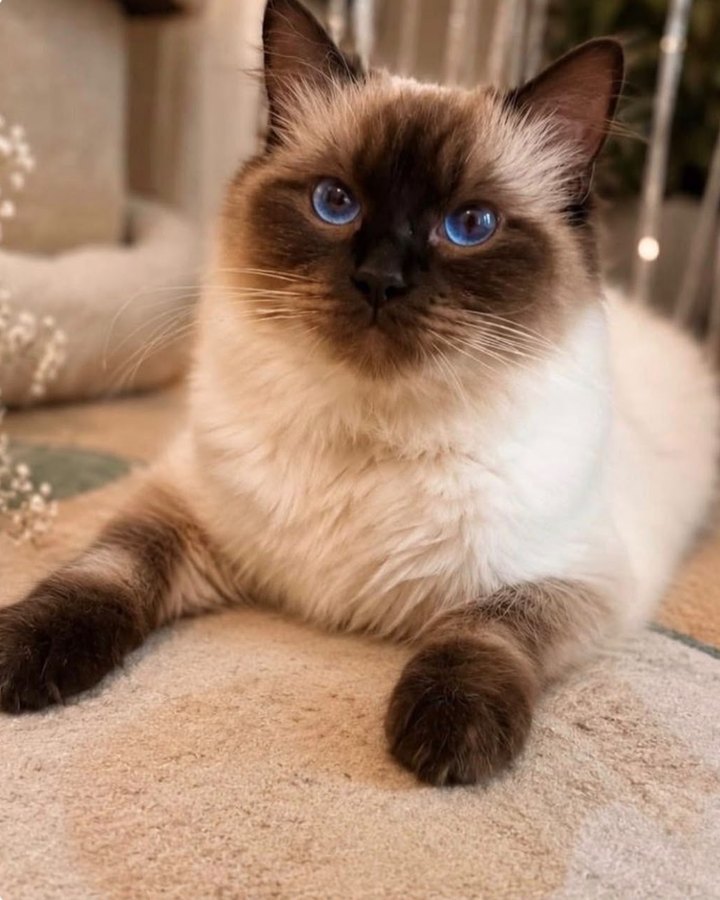
Dorothy, our seal point queen: dark points, a pale body and blue eyes, the first three things to look for.
Can you tell a Ragdoll just by looking?
You can rule one out by looking. You cannot rule one in. The breed has two fixed features, points and blue eyes, and a cat without both is something else: a solid black cat, a tabby with green eyes or a white cat with gold ones is not a Ragdoll, whatever the advert said. Unusual Ragdoll colours goes through the names that cause the confusion.
The trouble starts with the cats that pass. The gene behind points and blue eyes is not owned by any one breed. It turns up in Siamese, Birmans, Himalayans and colourpoint Siberians, and in ordinary cats with no pedigree at all, so a blue eyed, pointed, long coated cat from a rescue or a farm litter can look very like a Ragdoll and share none of its ancestry. A Ragdoll is a family, not a look: every one descends from the same few cats in 1960s California, as the breed's history tells.
So treat what follows as evidence, not a verdict. The more boxes a cat ticks, the more likely a Ragdoll is somewhere in the story. The section on proof says what settles it.
Seven things to look at
1. Points
Colour on the face, ears, legs and tail, with a clearly paler body. On a mitted or bicolour cat white covers some of it, so look at the ears and tail, which always carry colour.
2. Blue eyes
Every Ragdoll, in every pattern, for life. Not green, not gold, not one of each. Kittens of every kind start out blue eyed, so this test only counts from about twelve weeks. Do all Ragdolls have blue eyes? explains how the eyes and the points are linked.
3. Coat
Semi long and silky, lying close to the body, with a ruff at the neck, longer fur on the back legs and a full plume of a tail. It has much less woolly undercoat than a Persian or a Siberian, which is why it mats less. A short coat rules a Ragdoll out: the breed has no shorthaired version.
4. Size and build
A big, long, heavy boned cat with a broad chest, slow to mature and often not full size until three or four years old. Females are noticeably smaller than males. Our size and weight guide has the figures by age.
5. Head
Broad between the ears with a gently rounded muzzle, medium ears set wide apart, and large oval eyes. Not the long narrow wedge of a Siamese and not the flat face of a Persian.
6. Pattern
One of three. Colourpoint has no white. Mitted has white mittens in front, white boots behind, a white chin and a white stripe down the belly. Bicolour has an inverted white V on the face with white legs, chest and belly. Markings do not always follow the textbook, and a mismarked kitten can still be a Ragdoll, so pattern is weaker evidence than points and eyes.
7. Temperament
Relaxed, people loving, likely to follow you from room to room and often happy to be carried. The reputation is real, but it is the least reliable test of the seven: not every Ragdoll flops, and plenty of cats of no breed at all go limp in the arms of someone they trust. Why Ragdolls go limp covers the famous flop.
Cats that are mistaken for Ragdolls
Most cats taken for Ragdolls turn out to be one of these.
- Birman. The closest double: pointed, blue eyed and silky. A Birman has four neat white gloves and always a coloured chin, and is a smaller, lighter cat. Our seal mitted queen Tennessee is the cat here most often mistaken for one. Ragdoll vs Birman has the side by side.
- Siamese and Balinese. Pointed and blue eyed, but slim, fine boned and long in the face, and far more talkative. Ragdoll vs Siamese sets them apart.
- Himalayan, or colourpoint Persian. Pointed and blue eyed with a flat face, a short cobby body and a much thicker coat. Ragdoll vs Persian compares them.
- Colourpoint Siberian. Pointed, blue eyed and large, with a dense triple coat and a rounder outline. Ragdoll vs Siberian covers the differences.
- Ragamuffin. A cousin breed with a similar build and temperament, in nearly every colour and with any eye colour, so most are not pointed at all. Ragdoll vs Ragamuffin explains the split.
- The pointed moggy. The commonest of all: a long coated cat of no particular breed that happens to have inherited the pointed gene from both parents. Often a lovely cat, and often smaller and lighter in the bone than a Ragdoll.
Then there are the crosses. A kitten with one Ragdoll parent gets a share of the size and often the temperament, but points and blue eyes only appear if the other parent carried the pointed gene too, which is why a half Ragdoll rarely has blue eyes. Ragdoll cross cats covers what to expect.
What proves a cat is a Ragdoll
One thing: the family tree. A Ragdoll is a Ragdoll because both its parents were, and theirs before them.
- Papers from the breeder. Where a breeder registers with the GCCF or TICA, the papers record the parents and the generations behind them. Where a breeder does not, you are relying on their own records, so ask to see the family tree and, above all, the parents. We are in the second group and say so: our lines are Ragdoll bred to Ragdoll across five generations, recorded by us, and why we do not register is set out in full.
- The parents themselves. Two pointed, blue eyed parents can only have pointed, blue eyed kittens. Meeting the mother with her litter, and seeing the father or his photographs and records, tells you a great deal.
- A vet's opinion. A vet can tell you a cat looks like a Ragdoll. No vet can certify a breed from an examination, and the breed on a microchip record is simply what the keeper typed in.
- A DNA test. Home kits compare a cat's DNA with reference groups and report how similar it is. They do not verify a breed, and one of the best known makers says so in its own help pages: it is not a breed verification test and does not determine pedigree status. A test can show that a cat carries the pointed gene, but every Birman and Siamese carries it too.
No papers and no known parents means no proof, and that is fine. Call the cat what it is, a Ragdoll type or a pointed longhair, and enjoy it.
When the answer matters and when it does not
For the cat on your sofa it changes nothing. The care is the same: a comb through the coat twice a week, play, company and a good diet. Grooming and feeding apply to any big, silky, people loving cat.
It matters in three places.
- Buying. A Ragdoll price needs Ragdoll evidence. If a seller cannot show you the parents and the records, pay a moggy price or walk away. Choosing a breeder has the questions to ask.
- Insurance. Insurers ask for the breed, and a wrong answer can cause trouble at claim time. Tell them what you know. If you do not know, say so, and ask how they want the cat described.
- Health. The heart condition HCM runs in some Ragdoll lines, and there is a DNA test for the known Ragdoll variant. If your cat may be part Ragdoll, mention it to your vet. HCM in Ragdolls explains the test and its limits.
And never breed from a cat on the strength of its looks. Should you breed from your cat? explains why.
Quick questions, answered
How can I tell if my kitten is a Ragdoll?
Under twelve weeks you mostly cannot, because every kitten has blue eyes and pointed kittens are still colouring up. Look at the parents instead: two pointed, blue eyed Ragdoll parents and a breeder who shows you the family tree are the evidence. From twelve weeks expect clear points, blue eyes and a silky coat that is getting longer.
Can a Ragdoll have green or yellow eyes?
No. Every Ragdoll has blue eyes for life, because the gene that makes the points also keeps the eyes blue. A cat with green or gold eyes is a cross, or one of the mink, sepia or solid variants bred from Ragdoll lines, which the GCCF does not recognise as Ragdolls.
Will a DNA test tell me if my cat is a Ragdoll?
Not reliably. Home tests compare a cat with reference groups and report similarity, and the makers themselves say this does not verify a breed or a pedigree. A test can confirm the pointed gene and can check for the Ragdoll HCM variant, but neither proves ancestry. Only the family tree does.
My cat goes limp when I pick it up. Is it a Ragdoll?
Not on that evidence. The flop gave the breed its name, but it is temperament and trust, not a test. Many Ragdolls do it, some never do, and plenty of relaxed cats of no breed at all go limp in the arms of someone they like.
What is a Ragdoll type cat?
A fair name for a cat that looks like a Ragdoll but has no known family tree: pointed, blue eyed, long coated and usually large. It promises nothing about ancestry, and it is a more accurate label than Ragdoll for a cat whose parents nobody knows.
Sources and further reading
- Basepaws: Will this test confirm that my cat is pedigree?: A DNA test maker explaining that its test reports similarity and does not verify a breed.
Thinking about a Ragdoll kitten?
Our Ragdoll kittens grow up in our home in Ryde, Isle of Wight, with health tested parents and our support for life. See who is available now, or join the waiting list for the next litter.