
From our colony to your sofa
Ragdoll vs Birman: The Lookalikes, Compared
Two blue eyed, colour pointed, white footed cats, and the differences that matter once you get close.
Last reviewed
Two blue eyed, colour pointed, white footed cats, and the differences that matter once you get close.
Last reviewed
If a visitor to our house ever mistakes one of our cats for a Birman, it is always the same cat: a seal mitted Ragdoll, white feet, dark mask, blue eyes, sitting still. From across the room the two breeds are near twins. This guide is about what changes when you get close, and about the honest differences in size, temperament and health that should decide the choice.
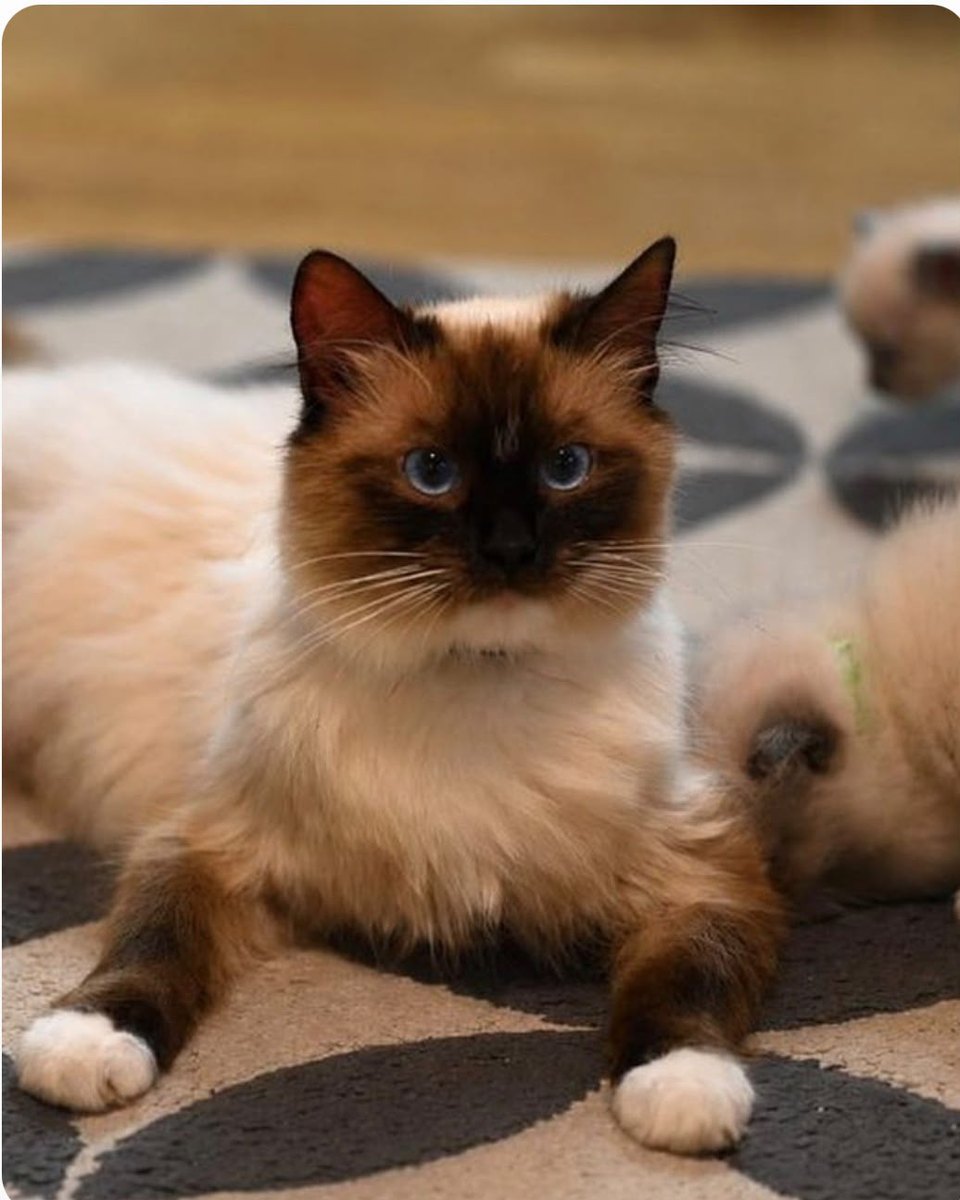
The Birman is the older story by a long way. A cat called Poupée de Madalpour, born in Nice in 1920, is the founding mother the records agree on; the breed was registered in France as the Sacré de Birmanie in 1925, wrapped from the start in a temple legend about priests, a golden goddess and paws turned white at the moment of devotion. The legend is lovely and unproveable. What is documented is harder edged: the breed was nearly lost in the Second World War, rebuilt from a single surviving pair, Orloff and Xenia de Kaabaa, with careful outcrossing, and reached Britain in 1965, with GCCF recognition the following year.
The Ragdoll is a Californian invention of the 1960s. Ann Baker of Riverside built the breed around a white cat called Josephine and her unusually relaxed kittens, set up her own registry in 1971 and trademarked the name. One of the founding males, Daddy Warbucks, looked strikingly like a Birman, white socks, white chin, a white stripe down the belly, and that resemblance is where the enduring “Ragdolls came from Birmans” story comes from. The Ragdoll clubs are clear that the mitted Ragdoll is genetically its own thing, and the genetics lab at UC Davis has found the Birman gloving variant only at low frequency in Ragdolls, where it is not what produces the mitts. Distant cousins by look, then, rather than by pedigree.
Size is the first honest difference and the one you notice from across the room. The Ragdoll is a genuinely big cat, slow to finish, heavy through the chest and hindquarters, with a broad, flat topped head and a long tail that seems to arrive a moment after the rest of the cat. Adult males routinely end up among the heaviest domestic cats you will meet. The Birman is medium to large, described in the GCCF standard as long and substantial, with a broad rounded skull, a Roman nose and full cheeks, but it sits a clear size class below the Ragdoll: a big Ragdoll male can be close to twice the weight of a Birman female.
Head shape is what breeders use when the coats are similar. The Birman face is rounder and softer, the nose with a distinct curve and a slight flat spot on the forehead; the Ragdoll head is a broad modified wedge, flatter between the ears, with the ears set wider. Neither is better; they are simply different faces wearing similar colours.
Both breeds are colour pointed, both have deep blue eyes, both can have white feet. That is the whole reason this guide exists. Here is what actually separates them, in the order it is easiest to check.
The chin. A mitted Ragdoll must have a white chin. A Birman has a coloured chin, always: the standards on both sides of the Atlantic treat any white outside the gloves as a serious fault, and white on the face is simply not Birman. If the chin is white, you are not looking at a Birman.
The belly. A mitted Ragdoll carries a white stripe from the chin, down the chest and belly, all the way to the tail. A Birman does not; its body colour is the pale wash of the points with no white band.
The feet. Birman gloves are the defining feature of the breed and they are exact: pure white gloves on the front paws ending in an even line, and on the back legs white socks that taper up the back of the hock into “gauntlets” or “laces”, ideally symmetrical. Ragdoll mitts are white feet too, but the standard does not demand the laced gauntlet and the white commonly runs higher up the back legs like boots. In other words, a Birman’s feet are a signature; a Ragdoll’s are a description.
Size and head. If the cat is very large and flat headed, it is a Ragdoll. If it is medium sized with a rounder face and a curved nose, it is a Birman.
The genetics underneath. Birman gloving comes from a specific variant in the KIT gene, inherited as a recessive: every Birman carries two copies, which is why the pattern is so consistent from cat to cat. The GCCF is explicit that this is a different mechanism from the white spotting that makes bicolour cats. Ragdoll patterns work the other way: colourpoint, mitted and bicolour are three separate patterns within one breed, and a Ragdoll litter can contain all three. A Birman comes in exactly one.
Both are semi longhaired cats with little undercoat, which is the good news: neither mats the way a Persian does, and neither needs daily combing to stay presentable. The Birman coat is famously silky and lies close, medium to long, with a full ruff and a bushy tail; the Ragdoll coat is plusher and a touch heavier, the texture people reach for when they say a cat feels like rabbit fur. Ragdolls tend to shed more in the spring and autumn changes; Birman owners generally report a quieter moult.
The care routine is the same for both. A proper brush once or twice a week, with real attention to the stations that mat on every silky cat, the armpits, the trousers and behind the ears, and a check of the ruff after a wet day. Both breeds are born white, with colour arriving over the first weeks and the full coat not settled until around three years, so a kitten photograph tells you very little about the adult.
The palette overlaps almost completely. Both breeds come in seal, blue, chocolate and lilac, with red, cream, tortie and tabby points also recognised. The difference is entirely in pattern. A Birman is only ever a pointed cat with white gloves: no colourpoint without gloves, no bicolour, no high white. A Ragdoll is a colourpoint, a mitted or a bicolour, and within a litter you can see all three side by side. If you want the inverted white V on the face, the blaze, the white legs and white chest, you are shopping for a bicolour Ragdoll, because the Birman standard simply does not go there.
This is where the two breeds are closest and where the small differences still matter to the right household. The Birman breed advisory committee describes it as laid back, affectionate and a dependable family pet, and that is a fair summary: gentle, people focused, playful into adulthood, and generally happy to be near you rather than on you. Birmans keep a little more independence than Ragdolls; they will follow you into a room and then find their own spot in it.
The Ragdoll is the more physically dependent of the two, the cat that goes soft in your arms, wants to be on the lap rather than beside it, and treats your presence as the main event of the day. Both are quiet cats with soft voices, both are patient with children and other animals, and both are indoor cats by temperament, trusting and not built for roads. If you want a cat that is affectionate with an off switch, the Birman edges it; if you want the cat that melts, it is the Ragdoll.
Both breeds are generally robust, mature slowly and live into their mid teens with ordinary luck, but their inherited risks are different and a good breeder of either should be able to talk about them without prompting.
For the Ragdoll the headline is the heart. Hypertrophic cardiomyopathy runs in Ragdoll lines, there is a breed specific DNA test for the MYBPC3 mutation, and the well run catteries screen parents by DNA and by echocardiogram. Polycystic kidney disease testing is the other routine question. Our own health testing guide covers what the certificates mean.
For the Birman the list is longer and less well known outside the breed. There is an inherited syndrome, congenital hypotrichosis with thymic aplasia, in which kittens are born hairless with a missing thymus and rarely survive; it is recessive, caused by a deletion in the FOXN1 gene, and a DNA test now lets breeders keep two carriers apart. Birmans also carry a documented predisposition to feline infectious peritonitis, which is one of the reasons cleanliness and low stress in a multi cat cattery matter so much for the breed. Corneal sequestrum, a painful dark plaque on the surface of the eye, is seen more often than in the general cat population. And Birmans have a high frequency of type B blood, in the region of a quarter to a half of the breed in published surveys, so a breeder must blood type queens and studs or risk neonatal isoerythrolysis, where a type B mother’s milk destroys the red cells of type A kittens in their first days. Birmans also tend to run higher creatinine values than other cats, which a vet needs to know before reading a blood panel.
Heart disease occurs in Birmans too, but there is no breed specific mutation to test for as there is in the Ragdoll, so screening there is by ultrasound. The practical upshot for a buyer is that the paperwork you ask for is different: HCM DNA and PKD results from a Ragdoll breeder; FOXN1 status, blood typing and an honest conversation about FIP history from a Birman breeder.
The questionnaire is short. Do you want a cat that is very large or one that is comfortably medium? On the lap or beside you? A single, precise pattern you can recognise at fifty paces, or a litter that can throw three patterns and a white face? A breed with one well known heart test, or one with a wider, quieter list that the right breeder handles for you?
Then apply the filter that matters more than the breed: health tested parents with the certificates to show for it, kittens raised underfoot in a home, and a breeder who asks you questions back. A well bred example of either breed will outlast and outshine a badly bred example of the one you thought you wanted.
Ragdoll and Birman are the cat fancy’s great lookalikes: blue eyes, pointed colour, white feet, silky coats and gentle temperaments in both. Get close and they separate. The Ragdoll is much bigger, flatter headed, comes in three patterns and must have a white chin and belly stripe when mitted. The Birman is medium sized, rounder faced, comes in one pattern with exact white gloves and laces, and never has white on its face. The Ragdoll wants your lap; the Birman wants your room. And their health questions are different enough that you should know which breed you are buying before you ask them.
No. They look alike, but a mitted Ragdoll has a white chin and a white stripe down the belly, both of which a Birman never has. Ragdolls are also a size class larger and have a flatter, broader head. Breeders tell them apart at a glance by chin colour, head shape and boning.
The Ragdoll, clearly. Ragdoll males are among the heaviest domestic cats and a big male can be close to twice the weight of a Birman female. The Birman is a medium to large cat, substantial but not a giant.
Not in any documented pedigree. One of the Ragdoll’s founding males looked very like a Birman, which started the story, but the Ragdoll clubs consider the mitted Ragdoll genetically separate, and the Birman gloving gene is not what makes a Ragdoll mitted. Think of them as distant cousins by appearance rather than by descent.
They are close. Both have little undercoat and neither mats like a Persian. Birman owners generally report a lighter seasonal moult; Ragdolls shed more noticeably in spring and autumn. Either way, a proper brush once or twice a week with attention to the armpits, trousers and ruff keeps them right.
Both are, in different registers. The Ragdoll is the more physically dependent, the lap cat that goes limp when picked up. The Birman is affectionate with a little more independence, happy near you rather than on you. Neither is aloof.
No, and this is worth knowing before you ask a breeder for paperwork. Ragdolls carry a breed specific heart mutation with a DNA test, plus PKD screening. Birmans have a recessive hairless syndrome with a DNA test of its own, a predisposition to FIP, a high rate of type B blood that makes blood typing essential before breeding, and a tendency to higher creatinine readings. Different lists, both manageable by a careful breeder.
No. The Birman standard allows exactly one pattern: pointed colour with white gloves, and any other white is a serious fault. If you want the inverted white V, the white chest and the white legs, that is a bicolour Ragdoll.
Both are large, slow maturing breeds, with Maine Coons generally the bigger of the two and famously the longest domestic cats on record. The Coon wears a shaggier, more rugged coat with ear tufts, a lion ruff and a magnificent brush of a tail, in almost any colour, with eyes of gold, green or copper. The Ragdoll wears the silkier semi longhaired coat, always pointed, always blue eyed, as our colours guide explains. Side by side, the Coon looks like a wild forest cat and the Ragdoll like a cloud that learned to purr.
Both are gentle giants, brilliant with families, and neither is a lap avoider. The differences are flavour: Ragdolls are the floppier, more devoted lap seekers, people orientated to their bones, while Maine Coons are sociable in a more independent, busier way, famous for chirping conversations, supervising household jobs from a respectful distance, and a curious fascination with water. If you want a cat on you, lean Ragdoll. If you want a cat with you, lean Coon. Either way you get a companion, not an ornament.
Grooming needs are similar, with the Coon’s denser coat asking slightly more of the comb; the routine in our grooming guide serves both. Both breeds share HCM as their headline heart condition, which makes tested parents the non negotiable question for either breed, exactly as our health guide and breeder guide set out. Feeding, indoor life and enrichment advice is identical for both.
If you find yourself genuinely torn, there is a third answer living in our house: the Ragcoon, the Ragdoll cross Maine Coon, blending the flop with the bounce. Whichever way you lean, choose the individual kitten in front of you over the breed brochure, because inside every breed the personalities still range, and a visit tells you more than any comparison guide can.
For impartial breed profiles of both giants, International Cat Care keeps measured comparisons free of marketing.