
How Big Do Ragdolls Get? Ragdoll Size and Weight
Typical weights, lengths and the long slow road to full size, from a house with sixteen of them.
Last reviewed
Ragdolls are one of the largest domestic cat breeds: an adult male typically weighs 5.5 to 9 kg and a female 3.5 to 6.5 kg, and a big male can measure close to a metre from nose to tail tip. They are slow to get there. Most of the height and length arrives in the first year, but the bulk and coat keep filling out until three or even four years old, so a two year old is not the finished cat. Here is the detail on ragdoll size, what ragdolls weigh, when ragdolls stop growing and when the kitten energy calms down.
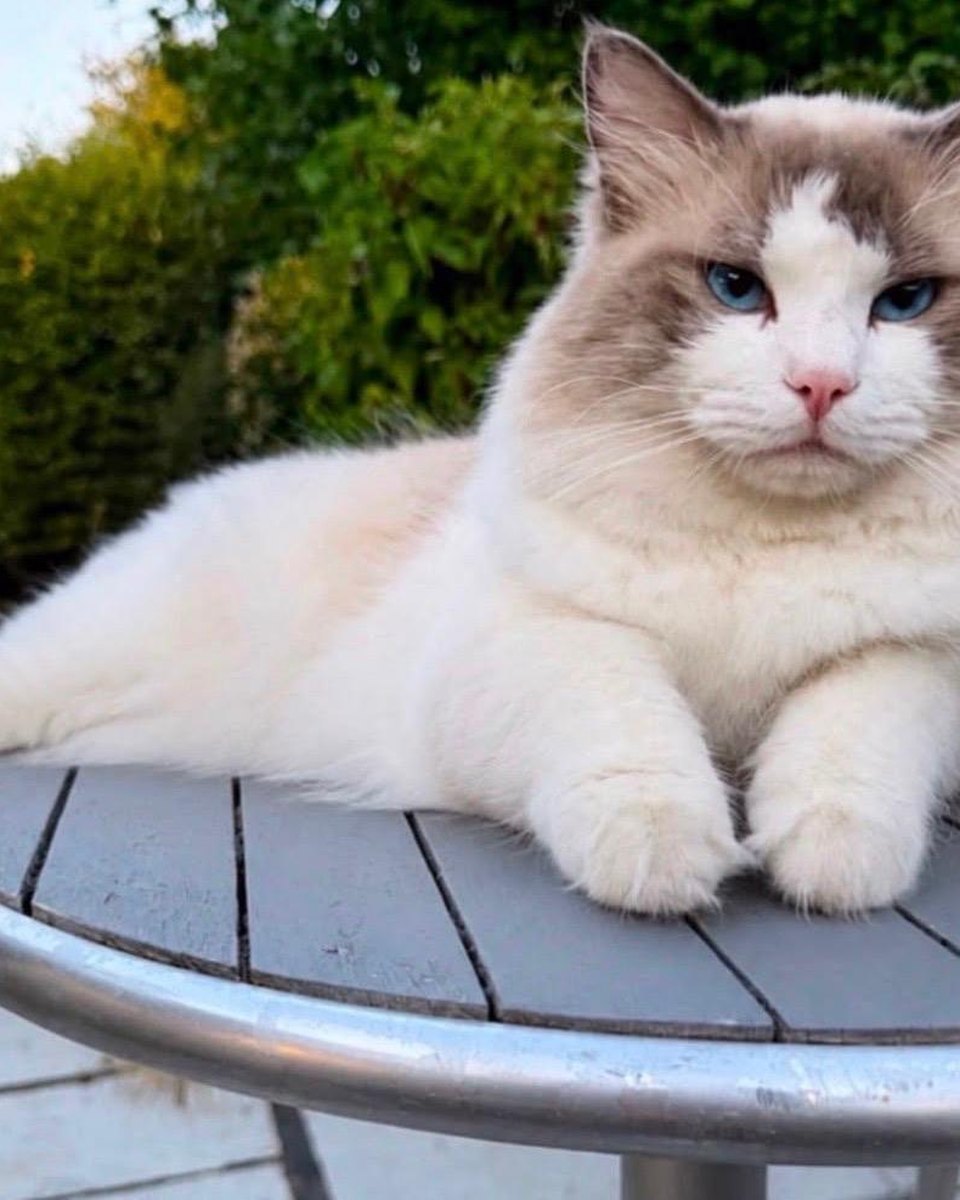
Aqua, our blue bicolour stud. A full grown Ragdoll male is a great deal of cat to pick up.
How big do Ragdolls get?
Ragdolls are one of the largest domestic breeds. The mainstream figures are 5.5 to 9 kg for an adult male and 3.5 to 6.5 kg for an adult female. An average moggy sits around 4 to 5 kg, so a big Ragdoll male is comfortably double the cat most people grew up with.
Length is where they surprise visitors. A large male stretched out can be close to a metre from nose to tail tip, and the tail itself is long and plumed. Shoulder height is roughly 23 to 28 cm, which does not sound much until the cat is standing on your chest at six in the morning.
Neutered cats of both sexes often settle at the heavier end of their range: partly metabolism, partly a quieter life.
Treat all of these as ranges, not promises. Growth varies by litter, by sex and by the individual, and a healthy 4 kg female is every bit as much a Ragdoll as her 6 kg sister.
How big do Ragdoll males and females get?
Sex is the biggest single predictor of adult size, far more than colour or pattern. A Ragdoll male is heavier boned, broader across the chest and head, and carries a thicker ruff. Our studs, Aqua and Dunston, are built to a different scale from the queens.
So how big do Ragdoll males get? Most land between 5.5 and 7.5 kg, with the real heavyweights reaching 8 or 9 kg on a large frame. Much above that on a cat that is not also enormous in length is more likely fat than big.
How big do Ragdoll females get? Typically 3.5 to 6.5 kg. A Ragdoll female is still a substantial cat, bigger than most domestic shorthairs, on a lighter frame. Some queens stay petite all their lives; some fill out to rival a small male once neutered.
If size is part of your decision, read male vs female: the temperament differences are small and the weight difference lasts.
When do Ragdolls stop growing?
Later than almost any other breed. Ragdolls are slow maturing: most of the height and length arrives in the first year, but the bulk, the chest, the ruff and the full coat keep filling out until three or even four years old. A two year old Ragdoll is not a finished cat.
It starts small. Kittens are born at around 90 to 120 g and the breed's growth is steady rather than explosive. Our kittens leave at nine to ten weeks with big paws and a lot of tail; the leggy stage comes between four and twelve months, and the heavy adult outline comes last.
Growth varies by litter and by sex: two kittens from one litter can be a few hundred grams apart at twelve weeks and both be normal. For the week by week picture see kitten development. For what to feed a cat still growing at two, see feeding: many breeders keep slow maturing breeds on a growth diet past twelve months, and your vet can say when to switch.
Weight is not the same as condition
A 9 kg Ragdoll can be a magnificent, lean, long cat or a 7 kg cat carrying 2 kg of fat. The scales cannot tell the difference and neither can the breed standard. Only your hands can, by feeling for ribs and a waist under all that coat, and the method is set out in weight and body condition.
This matters more for Ragdolls than for most breeds. The coat hides a lot, the calm temperament burns less than a busy moggy does, and a neutered adult still fed like a growing kitten will quietly turn muscle into padding. Obesity shortens lives and loads the joints of a cat that is already heavy by design.
So feed to condition, not to the number on the bag, and weigh your cat monthly if you can: a creep of 100 g a month is invisible to the eye and obvious on paper. Feeding and feeding multiple cats cover the practicalities.
How big do Ragdoll cross cats get?
Bigger, potentially. The cross people ask about most is the Ragcoon, a Ragdoll crossed with a Maine Coon, the cross our queen Dorothy produces. Maine Coon males commonly reach 8 to 10 kg and the breed holds most of the records for domestic cat length, so a Ragcoon has the genetics to outgrow a Ragdoll.
Whether it does depends on which parent it takes after. First crosses are variable: one kitten can lean Ragdoll in build and coat while a sibling gets the Maine Coon frame, longer legs and shaggier coat. Expect a Ragcoon to land somewhere between the two breeds and to keep growing for the same three to four years, because both parents are slow maturing.
Other Ragdoll crosses, with a British Shorthair or a moggy, usually come out smaller than a Ragdoll, because in most pairings the Ragdoll is the big one.
See the Ragcoon for the full guide and Ragdoll vs Maine Coon for the side by side.
When do Ragdolls calm down?
Around two to three years, give or take, and it tracks the growth. The kitten energy fades as the body finishes, and the slow maturing that keeps a Ragdoll growing until three keeps him kittenish for longer than you might expect from a breed with a reputation for lying about.
In our house the difference is plain. The adults spend the day in heaps on the sofa and the cat tree; the rising girls, the youngest in the house, do laps of the landing at midnight. A Ragdoll in its first two years is still a cat: it climbs curtains, ambushes ankles and has the same evening madness as any kitten. The famous calm is an adult trait, and it is earned.
If the night racing is wearing you down, night zoomies covers how to move it earlier, and kitten development what is normal at each age. It does pass.
Quick questions, answered
What do Ragdolls weigh as adults?
An adult male typically weighs 5.5 to 9 kg and an adult female 3.5 to 6.5 kg, with neutered cats of both sexes tending towards the heavier end. These are ranges rather than targets: a lean 4 kg female and a lean 8 kg male are both normal Ragdolls, and condition matters more than the number.
When do Ragdolls stop growing?
Most of the height and length is in place by about a year, but Ragdolls keep filling out in bulk, chest and coat until three or even four. A two year old is not finished. Growth is steady and varies by litter and sex, so compare your cat with its own last weight rather than with a chart.
Is my Ragdoll too small?
Probably not. Females, kittens from smaller lines and cats under three are often lighter than the headline figures, and some healthy Ragdolls never reach 5 kg. What matters is steady growth, good condition and a cat that eats, plays and grooms normally. If a kitten stops gaining weight or loses it, see your vet.
When do Ragdolls calm down?
Usually between two and three years old, as the body finishes growing and the kitten energy fades. Until then expect curtain climbing, ankle ambushes and evening zoomies like any young cat. Neutering, plenty of play and a settled routine all help bring the quieter stage forward a little.
What should a Ragdoll weigh at 3, 6, 12 and 24 months?
Typical ranges, not targets: about 1.2 to 2 kg at 3 months, 2.5 to 4 kg at 6 months and 3.5 to 6 kg at 12 months, with males at the top of each range. By 24 months most females are near their adult 3.5 to 6.5 kg and males are still filling out towards 5.5 to 9 kg, which they reach at 3 to 4 years. A kitten growing steadily, with ribs you can feel under a little cover, matters more than any number.
Sources and further reading
- The International Cat Association (TICA): Registry breed profile describing the Ragdoll as a large, slow maturing breed.
- Wikipedia: Ragdoll: Overview of the breed, its size range and its history.
Thinking about a Ragdoll kitten?
Our Ragdoll and Ragcoon kittens grow up in our home in Ryde, Isle of Wight, with health tested parents and our support for life. See who is available now, or join the waiting list for the next litter.