
Why Do Ragdolls Go Limp and Flop When Held?
The relaxation response that named the breed, the myth that came with it, and how to pick up 7 kg of cat.
Last reviewed
Ragdolls go limp when held because a relaxed, trusting, people oriented cat lets its muscles go when it feels safe, and this breed was selected for exactly that temperament: the name comes from the way many of them hang in your arms like a rag doll. It is a relaxation response, not a reflex every Ragdoll has, and not a sign that they cannot feel pain. Not every Ragdoll flops, and the ones that do will stop if they are held badly. This guide explains why Ragdolls flop, whether they like to be held, what the floor flop in front of you means, and how to carry one properly.
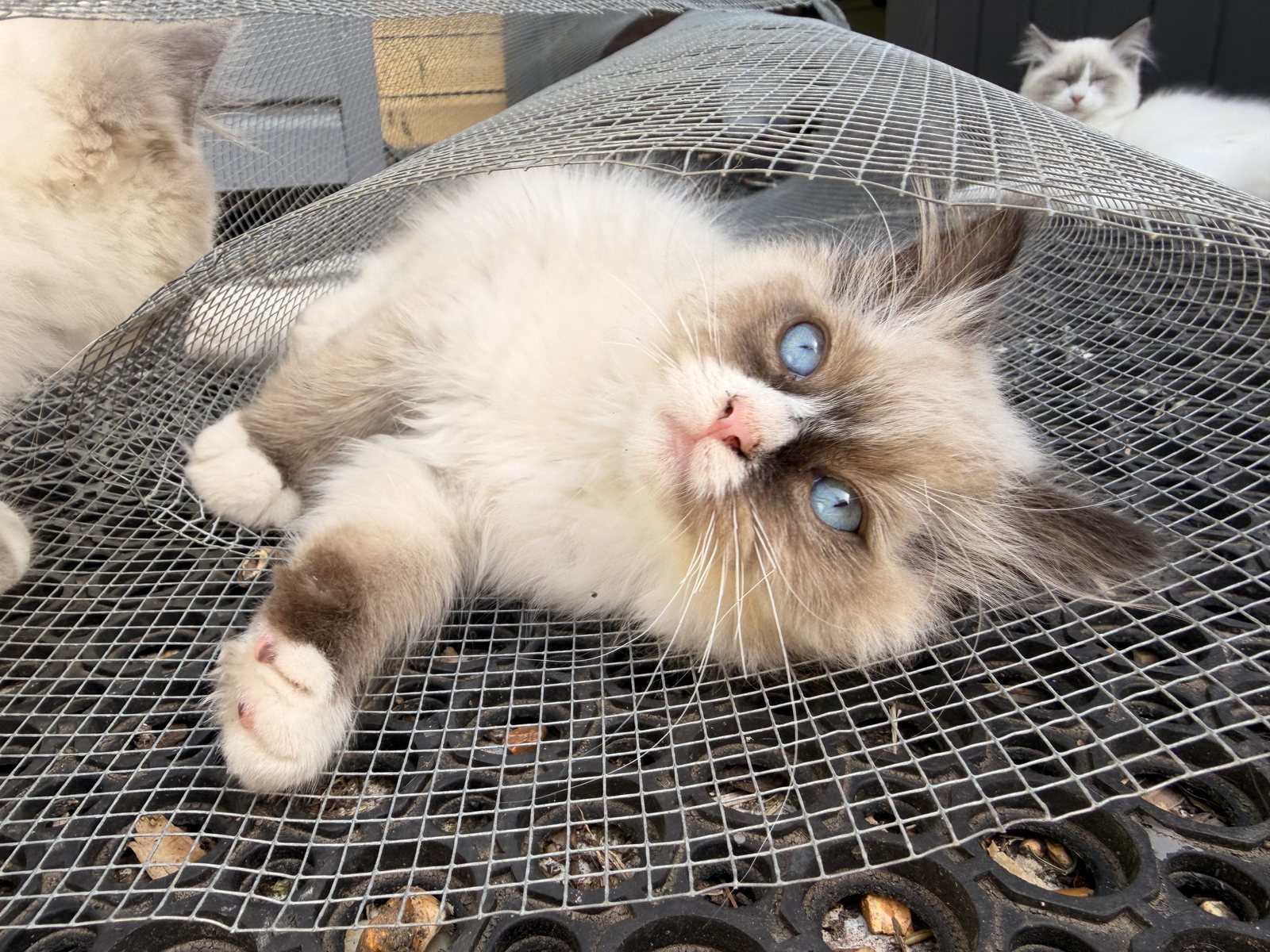
A colony kitten upside down on the catio hammock. Belly up sleeping is what a cat that feels safe looks like.
Why do Ragdolls go limp when held?
Because they are relaxed, and the breed was built from cats that relax easily. The Ragdoll was developed in the 1960s from unusually placid, people oriented cats, and the trait that gave the breed its name is the way many of them let their whole body go when picked up, hanging in your arms like a rag doll. Ragdoll history tells that story.
What is going on is a relaxation response. A cat that does not expect to be dropped, squeezed or carried somewhere unpleasant has no reason to brace, so it does not. Muscle tone drops, the legs dangle, the head lolls against your shoulder. It is the same thing you see in a cat asleep belly up in the sun, just vertical.
It is not a reflex and it is not universal. Plenty of excellent Ragdolls never flop in your arms, and a nervous or badly held Ragdoll will stiffen like any other cat. Treat the flop as something a trusting cat may offer you, not a feature that comes with the pedigree.
The pain myth, and why it matters
The breed's founder made some strange claims in the early days, among them that Ragdolls go limp because they cannot feel pain. That was never true. Ragdolls have the same nervous system as every other cat and feel pain just as sharply; they are simply quieter about it, which is a very different thing.
The myth is harmful because it gives owners a reason not to look. A Ragdoll that goes limp when you pick it up might be relaxed, or it might be unwell and too flat to object. A cat that stops jumping on the bed, grooms less, sits hunched or goes limp in a new way is telling you something, and recognising pain explains what to look for. If in doubt, see your vet.
We keep the other things people get wrong about the breed in Ragdoll myths. The pain one is the only myth on that list that can cost a cat its comfort.
Do Ragdolls like to be held?
Many do, some tolerate it, a few would rather not, and pedigree has less to do with it than three other things.
Individual temperament. Within one litter you will get a kitten who climbs into every lap and a kitten who prefers to sit beside you with one paw on your leg. Both are normal Ragdolls.
Early handling. Kittens learn that hands are safe by being handled gently and often from the first days of life, which is why ours are picked up and fussed every day from birth and grow up underfoot among the adults. A kitten that saw few hands in its first weeks takes much longer to trust them.
How they are held. A cat whose back end is dangling is not relaxed, it is waiting to fall. Hold a Ragdoll properly and the flop often appears; hold it badly and it will leave, politely at first.
Respect the ones that prefer the floor. A Ragdoll that follows you from room to room and sleeps on your feet loves you as much as the one draped over your shoulder. Ragdoll temperament covers the rest.
How to hold a Ragdoll properly
Most of the Ragdoll flop is good handling. The rules are the same for a 1 kg kitten and a 7 kg stud, but the stud will make you regret ignoring them.
- Support the chest. One hand or forearm under the chest, behind the front legs, so the weight rests on your arm rather than hanging from the armpits.
- Support the back legs. The other hand under the bottom and back legs. A dangling back end is the commonest reason a Ragdoll stiffens or wriggles.
- Hold against your body. Bring the cat in so your chest takes some of the weight. A big male held at arm's length is heavy for you and alarming for him.
- Never scruff an adult. Scruffing is for kittens and their mothers, not for carrying 7 kg.
- Put them down when they ask. A tail swish, a look at the floor, a shift of weight: honour the first request, because the second one involves claws.
Children should learn the two hand hold before they lift a kitten at all, sitting down, over a soft surface. We go through it in children and kittens.
Why do Ragdolls flop over and roll in front of you?
The floor flop is a different thing from the arm flop, and easier to misread. A Ragdoll that trots up, drops onto its side at your feet and rolls to show you its belly is greeting you and telling you it feels safe. It is one of the clearest trust signals a cat gives. It is not, as a rule, a request for a belly rub.
So why do Ragdolls like belly rubs when other cats bite? Many tolerate a brief one, and some seem to enjoy it, because the same easygoing temperament that produces the arm flop raises their threshold for being touched somewhere vulnerable. Some do not, and even the tolerant ones have a limit. Read the ears and the tail, keep it short, and stop before the paws come up. Cat body language has the full vocabulary.
Belly up sleeping is the same signal with no greeting attached: a cat that sleeps on its back in the open, throat and stomach exposed, feels entirely safe where it lives. In our house the catio hammock and the middle of the landing are the usual spots. The upside down kitten in the photo above is not asking for anything. It is simply at home.
Quick questions, answered
Do all Ragdolls go limp when picked up?
No. The flop is common in the breed but not universal, and it depends more on the individual cat, how it was handled as a kitten and how you hold it than on pedigree. A Ragdoll that never flops in your arms is still a Ragdoll. Hold it properly, let it choose, and you will see how relaxed it can be in its own way.
Can Ragdolls feel pain?
Yes, exactly as much as any other cat. The old claim that Ragdolls go limp because they are insensitive to pain was never true and is harmful, because it tempts owners to overlook a cat that is unwell. Ragdolls tend to suffer quietly, so a change in how your cat moves, eats, grooms or sits is worth a call to your vet.
Why do Ragdolls like belly rubs?
Many tolerate a brief belly rub because the breed's easygoing temperament raises the threshold for being touched somewhere vulnerable, and some clearly enjoy it. Not all do. A Ragdoll rolling over at your feet is greeting you and showing trust, not necessarily asking for a rub, so keep it short and stop when the ears go back or the paws come up.
How should a child hold a Ragdoll?
Sitting down, over a soft surface, with two hands: one under the chest and one under the back legs, cat held against the body. An adult lifts the cat into the child's lap at first. Teach children to put the cat down the moment it wriggles, and to leave sleeping and eating cats alone. A big adult is too heavy for a small child to carry.
Sources and further reading
- International Cat Care: Advice on handling cats and reading feline body language.
- Wikipedia: Ragdoll: History of the breed and the origin of its name.
Thinking about a Ragdoll kitten?
Our Ragdoll and Ragcoon kittens grow up in our home in Ryde, Isle of Wight, with health tested parents and our support for life. See who is available now, or join the waiting list for the next litter.