
Can Ragdolls Be Black, Orange, Tabby or Calico?
A Ragdoll is always pointed with blue eyes. Everything else is a nickname, a variant or a cross.
Last reviewed
Can Ragdolls be black? No. A Ragdoll is always a pointed cat, darker on the ears, face, legs and tail than on the body, with blue eyes, and a solid black cat fails both tests. Orange, tabby and tortie Ragdolls do exist, under names the adverts rarely use: red or flame point, lynx point and tortie point. Grey is what people call a blue point, white is usually a kitten that has not coloured up yet, and a short haired Ragdoll is not a Ragdoll at all. This guide sorts the real colours from the nicknames and the crosses.
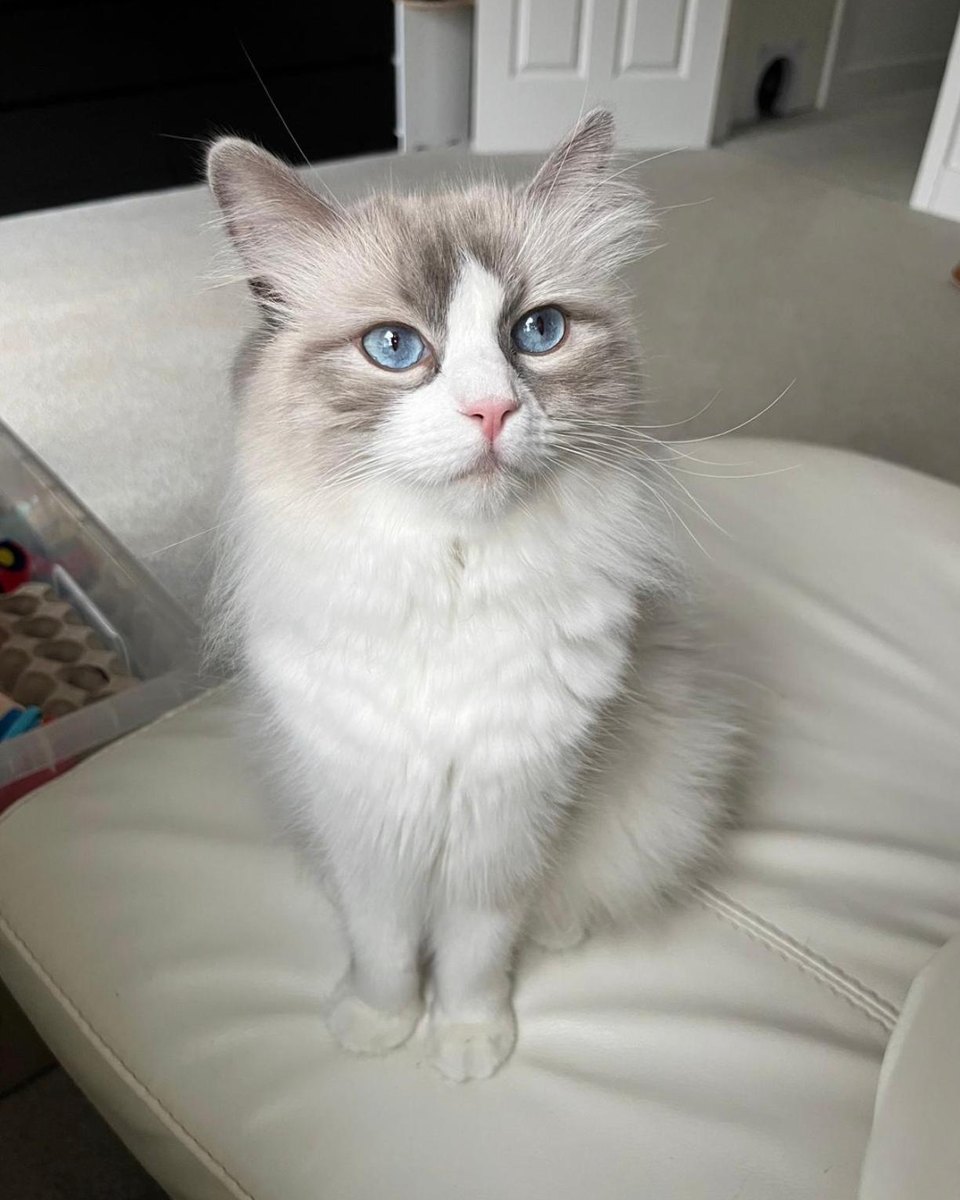
Marshmallow, one of our bicolour queens. The white blaze is pattern, not a white Ragdoll.
What colours can a Ragdoll be?
A Ragdoll is always pointed and always blue eyed, in every registry that recognises the breed. Pointed means the colour sits on the ears, face, legs and tail and the body stays paler, because the gene behind it only makes pigment in the cooler parts of the cat. On top of that rule sit six colours, three patterns and two overlays:
- Colours: seal, blue, chocolate, lilac, red (called flame in some registries) and cream. A few registries also list cinnamon and fawn, which you will almost never meet.
- Patterns: colourpoint, mitted and bicolour, which decide how much white the cat wears.
- Overlays: lynx, which adds tabby stripes to the points, and tortie, which mixes red or cream into a seal, blue, chocolate or lilac cat.
Translated into the words people search:
- Orange or ginger Ragdoll: a red or flame point. Real.
- Tabby Ragdoll: a lynx point. Real.
- Calico Ragdoll: a tortie bicolour, the nearest thing. Partly real.
- Grey Ragdoll: a blue point. Real, and the commonest colour of all.
- White Ragdoll: usually a kitten, sometimes a nickname. Real but misleading.
- Black Ragdoll, black and white Ragdoll, short haired Ragdoll: not a Ragdoll.
Our main colours guide walks through the standard ones. This page is for everything else.
Orange, ginger and flame point Ragdolls
An orange Ragdoll is a red point, and in some registries, the American CFA among them, the same cat is a flame point. The points run from warm apricot to deep orange against a cream white body, the nose leather and paw pads are pink, and the eyes are blue like every other Ragdoll. Cream is the dilute version, a paler buff that can look almost white on a young cat. Both come in all three patterns and both can carry lynx markings, giving a red lynx point or a cream lynx point.
Red is sex linked, carried on the X chromosome. A male needs one copy to be red; a female needs two, one from each parent. So most red Ragdolls are male, most tortie Ragdolls are female, and a tortie male is rare enough to be a curiosity, and usually infertile. A breeder who wants reds has to run a red or tortie queen as well as a red stud, which is part of why they are scarcer than seals and blues.
Red points are also slow to show. A red kitten can look like a white kitten for weeks, with the faintest blush on the ears, which is where a good many white Ragdoll adverts come from. Why Ragdolls change colour explains the timetable.
Tabby Ragdolls, lynx points and the calico question
A tabby Ragdoll is a lynx point: a pointed cat whose points carry tabby markings. Look for an M on the forehead, barred legs, a ringed tail and pale rims to the ears, all laid over the usual pale body and blue eyes. The tabby gene is dominant and has been in the breed from the start, so a lynx point is as much a Ragdoll as a seal point. What a lynx point is not is a tabby all over. A cat with stripes on its body, green or gold eyes and no pale middle is a tabby cross.
Tortie points mix a red series colour into a black series one on the points: a seal tortie point is seal splashed with red, a blue tortie point, often called blue cream, is blue splashed with cream, and chocolate and lilac have their own versions. Add lynx and you get a tortie lynx, which some people call a torbie. Nearly all are female.
Which brings us to the big one: can Ragdolls be calico? Almost. A tortie bicolour Ragdoll, with its white chest, legs and blaze under patches of seal and red on the face and tail, is the nearest the breed gets, and some people do call it a calico point. But a calico in the usual sense, solid patches of black, orange and white across the whole body, cannot be a pointed cat. A calico Ragdoll advert is a cross, or a very loose use of the word.
Black Ragdoll cats, grey Ragdolls and white Ragdolls
Black. A solid black cat cannot be a pointed cat, so a black Ragdoll in the breed's own terms does not exist. What does exist is the solid, or non pointed, Ragdoll: some breeders have worked from Ragdoll lines to produce cats in solid, mink and sepia coats with green, gold or aqua eyes, and sell them under the Ragdoll name. A black smoke Ragdoll is one of these solid variants carrying the silver inhibitor gene, which leaves the base of each hair white under a black topcoat, so the coat looks solid at rest and shimmers pale as the cat moves. The GCCF does not recognise them, and a black Ragdoll or black and white Ragdoll advert is either one of these variants or a Ragdoll cross with a black cat. They can be lovely pets. They are just not the breed as the standard defines it.
Grey. A grey Ragdoll is a blue point, the standard name for slate grey points on a bluish white body, and it is the most common colour of all. Our own colony is largely blue: Snowflake, Fifi, Aqua, Dunston and most of the rising girls are blue in one pattern or another.
White. Three cats hide behind this one. A kitten of a few weeks old, because every Ragdoll is born white and colours up over months. A high white bicolour, where the white has spread so far that only the ears, tail and a cap on the head carry colour. And a cream or lilac point whose points are so pale that at a glance the whole cat looks white. None is a white cat in the ordinary sense. Look at the ears, and look again in six months.
Can Ragdolls have short hair? And what to ask a seller
No. The Ragdoll is a semi longhaired breed in every registry, with no shorthaired division. The longhair gene is recessive, so a Ragdoll carries two copies and cannot throw a short coat however it is bred. A short coated cat sold as a Ragdoll is a cross, where a shorthaired parent supplied the dominant short gene, or a plain mislabelling. Young kittens are short coated for a few months, so judge texture and parents, not length. Ragdoll cross cats covers what a half Ragdoll inherits.
When a colour sounds unusual, ask for photos of both parents. Two pointed, blue eyed parents can only produce pointed, blue eyed kittens; if one parent is solid, tabby or a mystery, the kitten is a cross. Expect blue eyes and points on any kitten over twelve weeks, translate the names (flame is red, lynx is tabby, grey is blue, black is not on the list) and do not pay rare prices for an ordinary cat. Why Ragdolls have blue eyes explains the eye test.
Our colony keeps it simple. We breed seal, blue and chocolate points in all three patterns: Daisy is our chocolate point; Snowflake, Pulaski, Marshmallow, Aqua, Kitty and Boo are bicolours; Milkyway, Tennessee, Fifi, Lola, Dunston, Skye and Clover are mitted; Dorothy, Dotty and Daisy are the colourpoints. We have no reds, lynx or torties, and would rather say so than rename a cat. Each real colour has its own page with photos: seal, blue, chocolate and lilac, and the colourpoint, mitted and bicolour patterns.
Quick questions, answered
Can a Ragdoll be black?
No. A Ragdoll is a pointed breed with blue eyes, and a solid black cat is neither. Cats sold as black Ragdolls are either a solid variant bred from Ragdoll lines, which has green or gold eyes and is not recognised by the GCCF, or a Ragdoll cross. The same goes for a black smoke Ragdoll, a solid variant with a silver undercoat. They can be fine pets, but they are not the breed.
Are orange Ragdolls rare?
Less common than seals and blues, but real. An orange or ginger Ragdoll is a red point, called a flame point in some registries, with apricot to orange points and blue eyes. Red is sex linked, so most reds are male and most torties female, and a breeder needs red or tortie on both sides to produce them, which keeps numbers down.
What is a lynx point Ragdoll?
A Ragdoll whose points carry tabby markings: an M on the forehead, barred legs, a ringed tail and pale ear rims over the usual pale body and blue eyes. The tabby gene is dominant and has always been in the breed. A cat with stripes all over its body and green or gold eyes is a tabby cross, not a lynx point.
Do short haired Ragdolls exist?
No. The Ragdoll is semi longhaired in every registry and carries two copies of the recessive longhair gene, so it cannot produce a short coat. A short coated cat sold as a Ragdoll is a cross or mislabelled. Young kittens have short plush coats for a few months, so judge an older kitten by texture and by its parents.
Sources and further reading
- GCCF: The UK registry; recognised Ragdoll colours and patterns, all pointed with blue eyes.
- TICA: International registry; Ragdoll standard requiring the pointed pattern and blue eyes.
- Wikipedia: Ragdoll: Breed overview including colours, patterns and the unrecognised solid lines.
Thinking about a Ragdoll kitten?
Our Ragdoll and Ragcoon kittens grow up in our home in Ryde, Isle of Wight, with health tested parents and our support for life. See who is available now, or join the waiting list for the next litter.