
From our colony to your sofa
Grooming a Ragdoll Coat
The weekly rhythm, the tools that matter, and beating mats early.
Last reviewed
The weekly rhythm, the tools that matter, and beating mats early.
Last reviewed
Ragdolls wear a semi longhaired coat with a soft, silky texture and less dense undercoat than many longhaired breeds, which is why they mat less than you might fear. Less is not never though, and ten minutes of the right routine each week is the difference between a cloud and a headache. Here is exactly how we do it across our own colony.
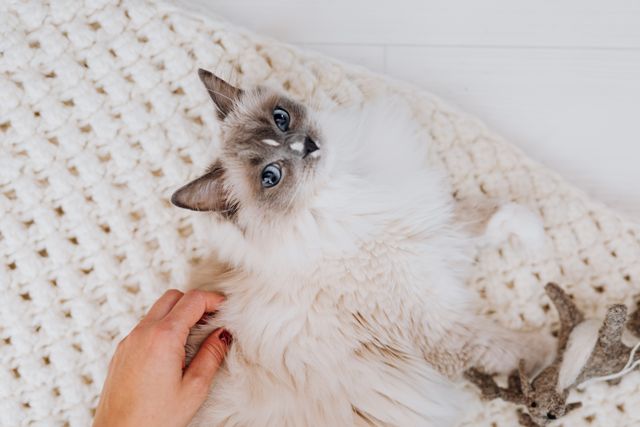
A Ragdoll coat is silky and surprisingly forgiving, with less dense undercoat than many longhairs, which is why day to day it mats less than its glamour suggests. The catch arrives with the seasonal moults of spring and autumn, when the coat changes shift and the loose harvest multiplies; those are the weeks when the daily few minutes stops being optional.
Know the mat map too: behind the ears, the armpits, the trousers and the tummy, everywhere friction and warmth meet. Those stations get checked by fingertip every session even when the topcoat looks immaculate, because mats are born underneath, in private.
The working kit is short: a slicker brush for lifting loose coat and finishing, a metal comb whose job is the truth, and for established tangles a dematting tool used sparingly. The comb is the honest instrument: if it glides to the skin everywhere, the coat is genuinely clear; if it snags, you have found tomorrow’s mat today.
Technique beats force everywhere: work with the coat’s direction, hold the base of the fur so tugs never reach skin, and keep sessions short and rewarded. A cat that experiences grooming as gentle wins the next thousand sessions in advance.
A found mat gets the escalation ladder, and the ladder has a forbidden rung: scissors. Cat skin is loose, thin and moves with the mat, and every groomer and vet carries stories of home scissor work gone wrong. Start with fingers teasing the mat apart from the edges, graduate to the comb’s end teeth, then the dematting tool in short strokes.
Anything felted to the skin, close to eyes or delicate areas, or distressing the cat belongs with the professionals, whose clippers lift safely where blades cannot. It is a cheap appointment against an expensive accident, and the regrowth is a fresh start for the brushing habit.
Ragdolls seldom need baths, their silky coat sheds dirt remarkably, but occasions arise: something sticky, something oily, a senior who has stopped reaching the back half. When a bath is genuinely due, warm water, a cat specific shampoo, a non slip mat and an unhurried schedule turn drama into mere indignity.
Rinse beyond thorough, towel hard, and finish with combing as the coat dries so it lays silk again rather than felting. And if the coat problem is grease that keeps returning, that is a health observation wearing a grooming costume, worth a vet mention.
A grooming routine earns its keep at the edges: claws tipped every few weeks, especially indoor claws that meet no pavement, ears glanced into for colour and quantity of wax, eyes wiped of sleep with a damp pad, and the chin checked for the blackhead speckle of feline acne on plastic bowl users.
Each extra takes seconds on a cat trained young to tolerate handling, and each is an early warning post: the ear that suddenly produces dark crumbs, the claw that thickens oddly, the chin that stays bumpy. Grooming is inspection with a brush in hand.
Twice a year the Ragdoll changes wardrobe: the spring drop of winter undercoat is the heavy one, autumn’s change subtler, and indoor heating blurs both into a longer, gentler shed. During moults, the twice weekly comb becomes daily, and the difference shows in your lint roller budget within a week.
Daily moult combing is hairball prevention as much as housekeeping: every tuft in the comb is fur the cat will not swallow. Pair it with the grooming mitt for the fingers between combing days, and the moult passes as a season rather than a plague.
Petplan’s vet Brian demonstrates how to groom a cat correctly, with the emphasis on long coats that need the routine most. It is the weekly comb through this guide describes, done on a real cat rather than a diagram.
Watch on YouTube Petplan, presented by vet Brian
We film the colony most days and put the clips out as Ragdoll Drama. Real cats, no script, no idea what they will do next.
The Ragdoll coat is semi longhaired silk with a lighter undercoat than most longhaired breeds, which is why it mats less than it looks like it should. The routine is short sessions a few times a week with a wide toothed comb, tightened during the spring and autumn moults. Handle mats early with fingers and patience, never scissors. Baths are rare and done properly when needed, claws and ears join the rotation, and a coat that stops being maintained is often a cat telling you something.
Rarely: the coat is designed for home care, and most never see a groomer. Exceptions are severe matting, seniors who cannot self groom, and owners who simply prefer outsourcing the moults.
Not for temperature, the coat insulates against heat as well as cold, and not cosmetically. Shaving is for veterinary need and unsalvageable matting, done professionally.
Aggressive deshedding tools can cut the silky Ragdoll topcoat and are built for denser double coats. The comb and slicker do the job here without collateral damage.
No: shrink the sessions to strokes counted on one hand, pay in treats, and grow from there. Weeks of tiny wins rebuild tolerance at any age; wrestling never does.
Tails are opinion rich: comb with the growth in short passes during a sleepy moment, never against the grain, and quit while ahead. A plumed tail needs less help than it looks.
Genuinely useful for dust, pollen on paws, and the senior’s back half between proper sessions. They supplement the comb; nothing replaces it.
Two or three short sessions a week beats one long battle. We groom after a meal when cats are relaxed and sleepy, starting where they enjoy it, along the back and cheeks, before working towards the areas that matter most: behind the ears, under the front legs, the trousers on the back legs, and the tummy if your cat permits. Those friction points are where every mat begins.
A slicker or soft brush is for the pleasant daily once over, but the tool that actually maintains a semi longhaired coat is a dematting comb or undercoat rake, drawn gently through to lift loose undercoat before it tangles into the top coat. A few strokes per area is plenty. A detangling spray misted on first makes the comb glide and turns grooming into a treat rather than a tug of war. We stock the exact comb and spray we use on the Cat Shop page, because they are the ones that survived colony testing.
Never pull, and never reach for scissors, because cat skin tents upwards inside a mat and is terrifyingly easy to cut. Hold the mat at its base against the skin, work the detangler in, and tease it apart from the edges with the comb a little at a time, over more than one session if needed. A mat that has become tight, close to the skin, or sore is a groomer or vet job, and there is no shame in that.
Ragdolls rarely need bathing, but kittens do have adventures, so use a gentle pH balanced cat shampoo, warm water, no product near the eyes or ears, and towels ready before you start. Claws want a fortnightly look: clip only the clear tip, staying well away from the pink quick, with clippers that have a safety guard if you are new to it. Eyes on a light coated cat can collect tear staining, which a daily wipe with a soft pad keeps on top of. Everything mentioned here lives on our shop shelves for collection.
Every kitten that leaves us has already met the brush, and the single best thing you can do is keep that going in the first weeks, little and often, with treats. An adult Ragdoll who adores being groomed was made in kittenhood.
Questions about your own cat’s coat? Message us on WhatsApp, we love this stuff.
For illustrated grooming technique, International Cat Care keeps an excellent coat care library covering longhaired breeds.