
Looking after your Ragdoll
Health & Veterinary Care
Who we trust with our own cats, how to keep routine costs down, how to check your cat over at home, and the numbers to save before collection day.
Who we trust with our own cats, how to keep routine costs down, how to check your cat over at home, and the numbers to save before collection day.
Book a veterinary health check within 48 hours of collection and take the health records from your kitten pack with you. That first appointment matters more than any recommendation on this page.
Every one of our cats is registered at Wootton, and it is where our kittens have their health checks before they come home to you.
If your kitten is staying on the Isle of Wight, we would point you straight there. Not because we have to, but because we trust them with our own colony, and because there is something rather lovely about your kitten carrying on with the same team who checked them over as a baby. They would be glad to meet you, and we suspect they will enjoy watching your kitten grow up as much as we will.
Wootton holds ISFM Cat Friendly Clinic accreditation at silver level, which means the practice is set up around how cats actually cope with a vet visit. If you have ever had a stressful trip to the vet with a cat, you will understand why that matters.
A small animal practice on the Island since 1998, RCVS accredited, with an on site advanced practitioner in small animal surgery. They are also an approved training centre for veterinary nurses. On site parking and disabled access.
Vaccinations, microchipping, neutering, parasite control, nurse consultations, six month health checks and nail clipping, plus diagnostics and surgery if they are ever needed. The Healthy Pet Club runs there too.
Wootton Veterinary Centre, 01983 883 955, if you decide to register with them. Whoever you choose, save your practice number and their out of hours line before collection day, then add the helplines further down.
Preventative care is the least glamorous part of owning a cat, and the easiest to put off when it arrives as a lump sum. A health plan turns it into a monthly payment instead, which is why we mention this one.
Most UK vet groups run a scheme of some kind. The one we point families towards is The Healthy Pet Club, run by CVS across their small animal practices. It has been going since 2008 and covers well over half a million pets, so it is long established rather than something new.
Vaccinations and the clinical exam that goes with them, vet prescribed parasite treatment for fleas, worms, ticks, lice and mites, a microchip, nail clipping, and a six month health check with a veterinary nurse.
10% off vet fees and products, 20% off neutering, 20% off selected long term medications, plus a fixed price for dental work. New members also get a bag of kitten food when they register.
Monthly by direct debit, or annually if you prefer. There are two tiers: Core for the essentials, or Advanced, which adds unlimited consultations under a fair use policy.
We have no arrangement with CVS and receive nothing for mentioning them. We recommend it because we use it ourselves, for every single one of our cats, and because of what lands in that first year: the initial vaccination course, then neutering by six months, which is part of your agreement with us anyway. The plan includes the vaccination course and takes 20% off the neutering, so for most families it has paid for a good part of itself before the kitten is even fully grown. Do check whether your own vet is a CVS practice, since the plan only works at theirs, and compare it against whatever your local surgery offers. A plan is also not the same thing as insurance: it covers routine, expected care, not accidents or illness. Most families want both.
Before breeding, our cats are health tested for HCM, PKD, FeLV and FIV, blood typed, and DNA screened for over 50 inherited genetic conditions. What those words actually mean is explained in plain English in our health testing guide and our Ragdoll health guide, and every certificate is shown gladly at visits.
The results table for every breeding cat loads here. Certificates are shown gladly at visits and on request.
Weight on its own tells you very little. A big framed Ragdoll boy at 7kg can be lean while a small framed cat at the same weight is carrying too much. What vets use instead is body condition, and it is something you can learn in about thirty seconds during a cuddle.
The standard is the nine point scale, where 5 out of 9 is ideal for most adult cats, alongside a four point muscle score. We have put both onto one chart you can keep. The method is look, feel, look:
Rest both hands either side of the ribcage, just behind the front legs, thumbs light on the spine. Glide your fingertips across without pressing. At an ideal score the ribs feel like the back of your hand: there, but under a thin even layer. If they feel like your knuckles, that is too thin. If they feel like your palm, that is too much.
There should be a slight upward tuck behind the ribcage rather than a straight or sagging line. Do bear in mind the primordial pouch, that loose swinging flap of skin along the belly. It is completely normal in cats, not fat, and it does not count against the score.
Standing over your cat while they are on their feet, you want to see a gentle inward curve behind the ribs. No waist at all points one way. A very sharp hourglass points the other. On a semi longhaired cat the coat hides a lot, so trust your hands over your eyes.
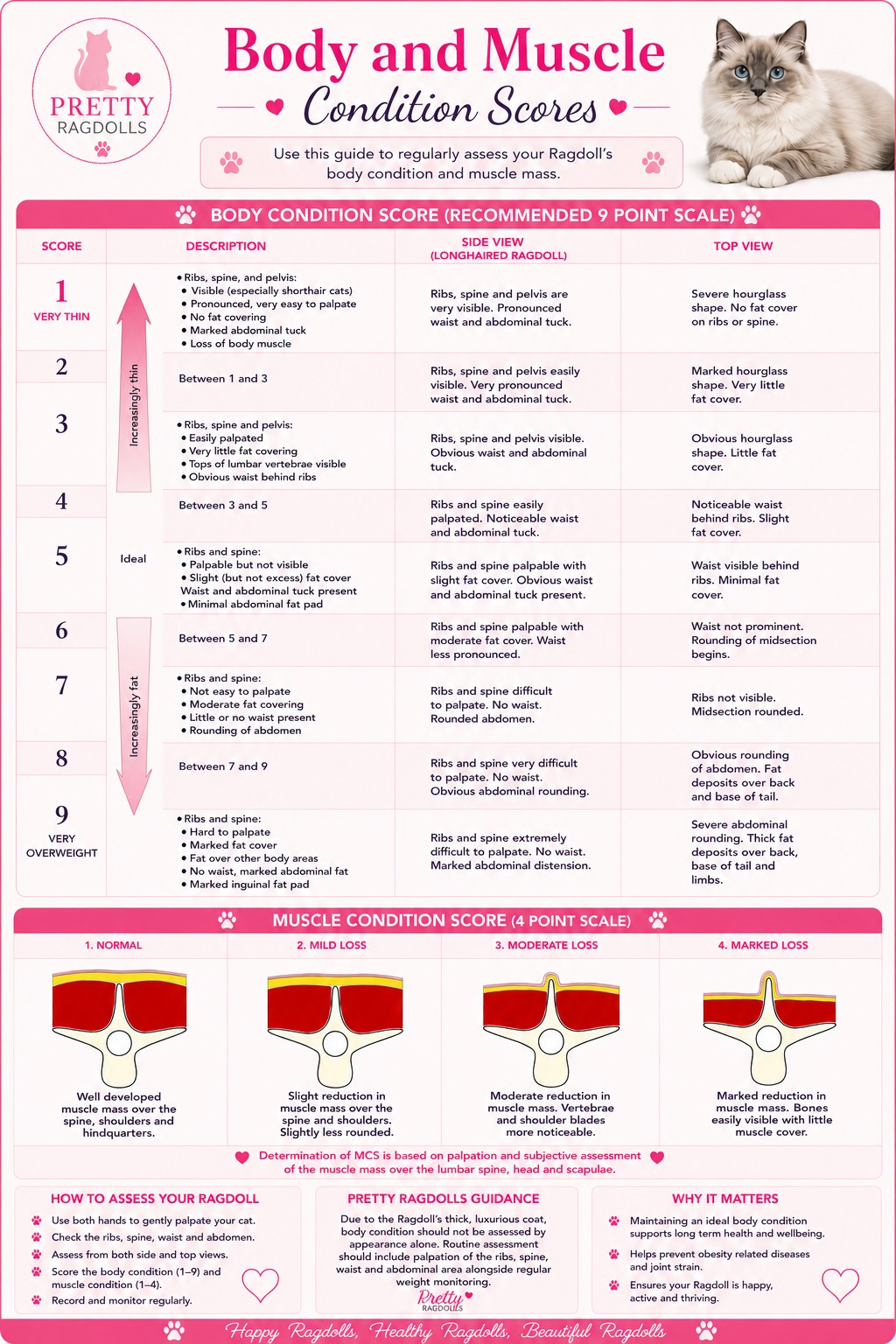
The nine point scale is written for adult cats, so do not judge a growing kitten too harshly against it. Ragdolls also mature unusually slowly, taking up to four years to fill out, so a leggy, lean looking cat of eighteen months is often exactly on track. What matters more is the direction of travel: steady gain through the first year, then a stable, settled weight afterwards. Weigh monthly while they are growing, then every few months for life, and write it down. A cat quietly losing weight over months is one of the earliest signs of illness there is, and it is almost impossible to notice by eye when you see them every day.
Your kitten leaves us with their treatment records up to date, and what those records show is where you pick up. Parasite control is not a single job to tick off. It is a routine.
The schedule most UK vets work to starts kittens at three weeks old, repeating every two weeks through weaning, then monthly up to six months where there is ongoing risk. From there it moves to an adult routine. Below is the action guide we work to ourselves, showing what we do the moment anything is spotted. It works just as well at home.
ESCCAP puts the baseline at four treatments a year for a cat whose risk cannot be clearly judged, noting that one to three times annually is not enough to keep infection at bay. A hunter needs more. Your vet can either set a schedule or test faecal samples and treat on findings.
A common assumption is that an indoor cat is safe. They are not: roundworm eggs travel indoors on shoes, and a single swallowed flea can carry tapeworm. Lower risk, certainly. Not no risk. If you have other pets, treat everyone together or you simply pass it around.
Central heating means fleas no longer take a winter off. Most of an infestation lives in your carpets and soft furnishings rather than on the cat, so treating the animal alone rarely clears it. Treat every pet in the house at once, and the house too if you find them.
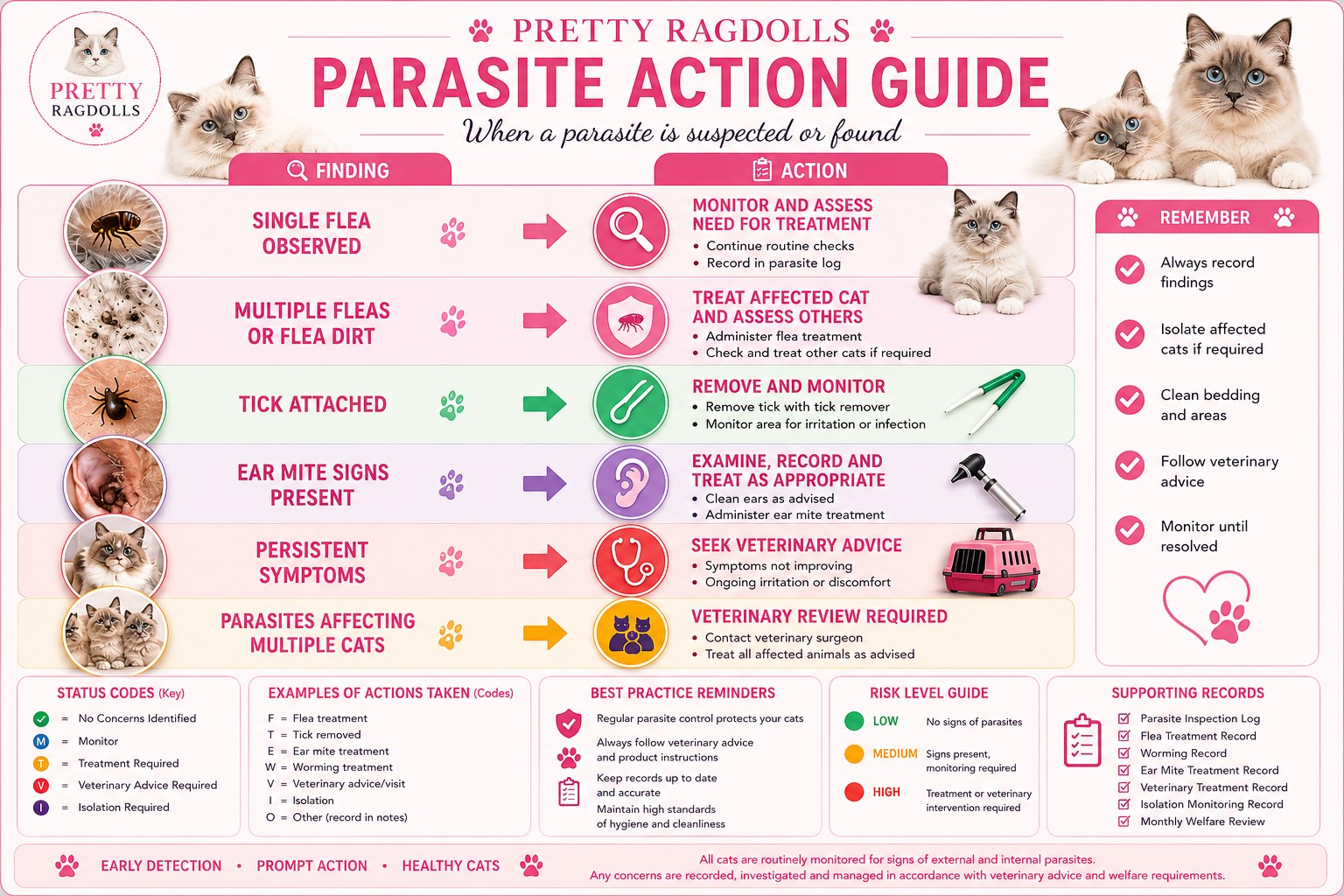
Never put a dog flea treatment on a cat. Many contain permethrin, which is safe for dogs but seriously toxic to cats, causing tremors and seizures that can be fatal. Cats have also been poisoned simply by grooming or sleeping against a freshly treated dog. If it happens, ring your vet straight away and say permethrin, because it is treatable when caught quickly. More generally, buy your parasite treatments through your vet rather than a supermarket shelf. They are prescribed by weight and lifestyle, the cheap ones are frequently the ones that do not work, and a treatment that does not work is worse than none because you stop looking.
One more thing worth knowing: some cat worms, roundworm in particular, can pass to people, which is why the advice is to wash hands after litter tray duty and keep children away from cat faeces. It is a small risk, easily managed, and staying on top of worming is most of the answer.
Helplines and emergency lines, none of which depend on which vet you end up with. Put them in your phone now, while nothing is wrong. Searching for a number one handed at two in the morning with a poorly cat in the other arm is nobody’s idea of a good time.
01202 509 000, around the clock. Run by the Veterinary Poisons Information Service, it is the only service of its kind in the UK for owners. More on how it works below.
Lost and found runs 24/7 on 01296 737 600. General enquiries and changing your details, 01296 336 579. Your kitten’s chip is registered to you at handover.
0300 1234 999, 24 hours, for an animal you believe is being neglected or mistreated, or one you have found injured. Charged at a normal landline rate.
0800 096 6606, 8.30am to 8.30pm every day, free and confidential. For when a cat is very ill, facing the end, or already gone. We hope you never need it. Some of you will.
Isle of Wight Emergency Vet, 2 Bishops Way, Newport, PO30 5WT, 01983 550 135. They cover the Island once practices close for the night.
Message us on WhatsApp, or WhatsApp. Not an emergency line, and never a substitute for your vet, but for anything you want a second opinion on we would rather you asked than wondered.
Your own practice, and whoever covers their nights and weekends. Those matter more than anything on this list, because they are the ones you will actually ring. Plenty of surgeries hand their out of hours over to a separate emergency provider some distance away, so it is worth asking who covers them, and where you would be driving to, before you ever need the answer. Get both saved in your phone the week your kitten arrives.
It is a triage service rather than a treatment line. You tell them what your cat has been near, whether that is a houseplant, a spilled tablet, antifreeze, a cleaning product or a bite, and their vets and toxicologists tell you whether you need a vet and how fast. Roughly three in four callers turn out not to need the trip. There is a charge, taken by card when you ring, and if you are sent to your vet and that practice then calls the professional line about your case, the call is refunded to you. Two things to remember: they only handle poisoning, so it is no good for anything else, and if your cat is already collapsed, fitting or struggling to breathe, ring your vet or the out of hours service first. If you can, keep the packaging or a sample of whatever it was. It helps enormously.
One last thing while you have your phone out. Microchipping has been a legal requirement for cats in England since June 2024, and so is keeping the registered details current. Your kitten leaves us chipped and registered in your name, so there is nothing to do on day one, but if you move house or change your mobile number, update Petlog. A chip with an old number on it is just a chip.
If you are weighing up vets, plans or insurance and would like a second opinion from people who have been through it a few times, just ask. We would rather talk it through than have you guess.