
Do All Ragdolls Have Blue Eyes? Ragdoll Eye Colour
The gene behind the colour, the range of shades, and what green or gold eyes tell you about a cat.
Last reviewed
Every Ragdoll has blue eyes, because the breed is colourpointed: the gene that puts dark colour on a Ragdoll's ears, face, paws and tail also limits pigment in the iris, so the eyes stay blue for life instead of turning green or gold as most kittens' eyes do. That is the whole answer to why do Ragdolls have blue eyes. Ragdoll eye colour is also a useful check when you are looking at kittens, because blue is part of what makes a Ragdoll a Ragdoll. Below: the genetics, the shades, the exceptions, and the eye problems that have nothing to do with colour.
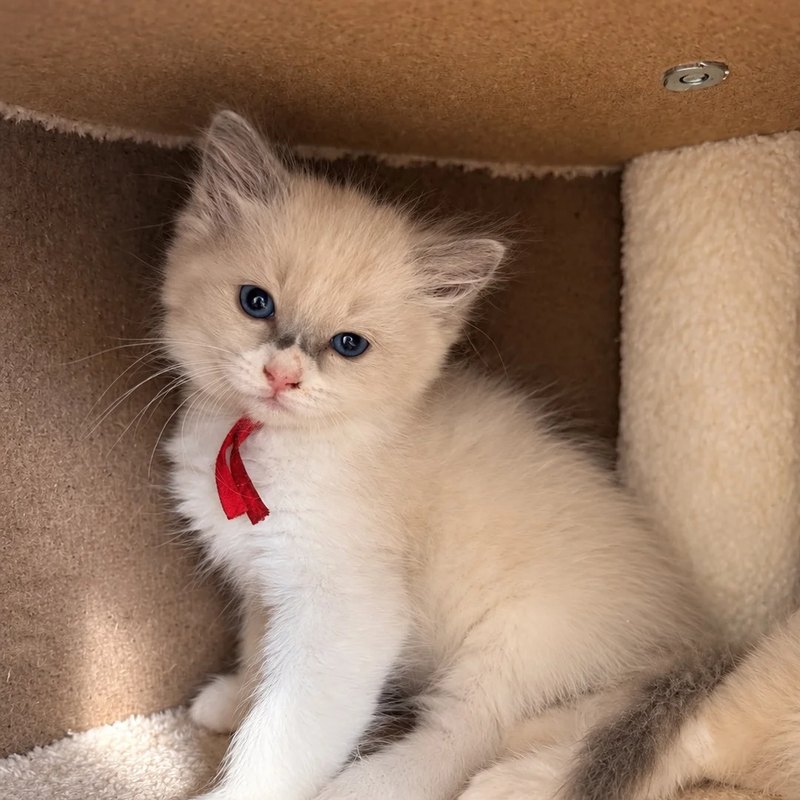
Ariel from our Fairytale litter. The blue she was born with is the blue she keeps.
Why do Ragdolls have blue eyes?
Ragdolls are a pointed breed. Every one carries two copies of the pointed version of the tyrosinase gene, the cs allele, the same one that gives a Siamese its mask. Tyrosinase is the enzyme that makes pigment, and the pointed version works poorly in warmth, which is why a Ragdoll's colour sits on the cooler extremities, as Ragdoll colours and patterns explains.
The same allele restricts pigment in the iris. Eye colour in cats comes from melanin in the front layer of the iris: plenty gives copper or gold, less gives green, and very little leaves the eye looking blue, the way a clear sky looks blue, from scattered light rather than blue pigment. A pointed cat never builds up enough iris melanin to get past blue, so blue is where it stays, from the day the eyes open to old age.
There is no separate blue eye gene in a Ragdoll, and no way to breed a Ragdoll without blue eyes: take the pointed gene away and the points go with it.
Ragdoll eye colour, from sky to sapphire
Blue covers a wide range. Some Ragdolls have pale, almost silvery sky blue eyes; others carry a deep, saturated sapphire. Both are correct. The GCCF and TICA breed standards ask for blue and prefer it as deep and vivid as possible, but the shade has no bearing on health, eyesight or temperament. A pale eyed Ragdoll sees exactly as well as a dark eyed one.
Shade is partly inherited and partly down to light. The same cat can look ice blue by a window and midnight blue under a lamp, and camera flash turns everything a flat, glassy blue, so judge a kitten's eyes in daylight if the shade matters to you. The depth usually settles over the first year, so a nine week old kitten's colour is a fair guide rather than the finished article.
In a house of sixteen Ragdolls the whole range is on one sofa, and none of it tells you anything except which cat is looking at you.
Do all kittens have blue eyes?
Yes, every kitten of every breed is born with blue eyes, because the iris has not yet laid down its pigment. The eyes open at around seven to ten days, the true colour starts to show from about six weeks, and most kittens have settled into green, gold, copper or hazel by six to eight weeks. Kitten development has the full timeline.
In a pointed kitten that change never happens. The pigment never arrives, so the baby blue stays. It is the same reason a Ragdoll kitten is born white and darkens at the ears and nose over the first fortnight: both are the pointed gene doing what it does.
So if you are told a kitten's blue eyes might change, it depends on the kitten: a moggy's probably will, a Ragdoll's will not beyond a shift in depth, and if they go green it was not a Ragdoll.
Can Ragdolls have green eyes?
Not if it is a Ragdoll as the GCCF and TICA define one. Both standards require blue eyes in every colour and pattern, so a cat with green, gold, copper or odd eyes is either a Ragdoll cross or one of the non pointed lines some breeders have developed and sell as solid, mink or sepia Ragdolls. Solids carry no pointed gene and have full coat colour with green or gold eyes; minks and sepias carry the Burmese version in place of one or both pointed copies, with a darker, more even coat and aqua or green eyes. The GCCF does not recognise them, and a buyer who asks for a Ragdoll should expect blue eyes and pointed colour.
A green eyed cat is not a worse pet, but the description on the advert is wrong, which matters at a pedigree price. If a seller cannot explain why their Ragdoll kitten has green eyes, walk away. Choosing a breeder lists the other questions worth asking, and Ragdoll myths covers a few more claims that do not survive a breed standard.
Are blue eyed cats deaf?
Not Ragdolls. The link between blue eyes and deafness is real, but it belongs to a different gene. Cats that are white because they carry the dominant white gene are at a raised risk of being born deaf, and the risk is higher again when that gene also gives them one or two blue eyes. That gene interferes with pigment cells in the inner ear, which are needed for hearing.
A Ragdoll's blue comes from the pointed gene instead, which does nothing of the sort. A blue point kitten with pale eyes is no more likely to be deaf than a tabby with gold ones. Sixteen blue eyed Ragdolls live in our house, and the state of their hearing is obvious the moment anyone opens the fridge.
Deafness does occur in cats for other reasons, and living with a blind or deaf cat covers what to do if it does. But do not let anyone sell you worry about a Ragdoll's eyes.
Caring for a Ragdoll's eyes
Blue eyes are no more delicate than any other colour, but they are easier to read, because a cloudy patch, a red rim or a watery corner shows up at once against the pale iris. Ragdolls get the same eye problems as every other cat, and none of them is caused by the colour.
- Weeping or sticky eyes. Usually conjunctivitis, which needs a vet to find the cause.
- Constant tear staining. Often a blocked tear duct.
- Squinting, ulcers and flare ups that keep coming back. Feline herpesvirus is the usual suspect, and eye damage from cat flu explains why acting early matters.
Day to day, wipe any crust away with a damp cotton pad, a fresh one for each eye, and leave the rest alone. Anything that lasts more than a day, hurts, or changes the look of the eye itself is a vet visit, not a wait and see.
Quick questions, answered
Do all Ragdolls have blue eyes?
Yes. Every Ragdoll has blue eyes because the breed is pointed, and the pointed gene limits pigment in the iris as well as the coat. A Ragdoll advertised with green, gold or odd eyes is a cross or from the solid, mink or sepia lines the GCCF does not recognise.
Will my Ragdoll kitten's blue eyes change colour?
Not to green or gold. All kittens are born with blue eyes and most change by six to eight weeks, but a pointed kitten never makes the iris pigment that would turn them, so the blue stays for life, though the depth can deepen a little over the first year.
Are blue eyed Ragdolls more likely to be deaf?
No. The link between blue eyes and deafness belongs to white cats carrying the dominant white gene, which affects the inner ear as well as pigment. A Ragdoll's blue comes from the pointed gene, which has no effect on hearing. A blue point with pale eyes hears as well as any other cat.
Which shade of blue should a Ragdoll have?
Any shade from pale sky to deep sapphire is correct. The breed standards prefer the deeper, more vivid blues, which is why show breeders select for them, but shade has nothing to do with health or eyesight. Judge a kitten's eyes in daylight, because flash and lamplight change the colour completely.
Why does my Ragdoll have a lazy eye, crossed eyes or shaking eyes?
Crossed eyes, strabismus, and a flicker of the eyes from side to side, nystagmus, both travel with the pointed gene that gives Ragdolls their blue eyes. Old Siamese lines were full of them, and breeders have mostly bred them out. A cat born with either usually sees well enough. A squint or flicker that first appears in an adult is different and needs a vet, as do a red eye, a cloudy eye or a dilated pupil, which our guides on conjunctivitis, cloudy eye and eye injury cover.
Sources and further reading
- GCCF: The UK registry whose Ragdoll standard requires blue eyes in every colour.
- International Cat Care: Advice on eye conditions in cats, including conjunctivitis and herpesvirus.
Thinking about a Ragdoll kitten?
Our Ragdoll and Ragcoon kittens grow up in our home in Ryde, Isle of Wight, with health tested parents and our support for life. See who is available now, or join the waiting list for the next litter.