
Ragdoll vs Siberian: Coat, Allergies and Temperament
An athletic Russian forest cat against a calm, silky lap cat: the differences that matter at home.
Last reviewed
Siberian or Ragdoll? The choice is between two big, friendly, semi longhaired cats that live very differently. The Siberian is Russia's forest cat, a natural breed with a dense triple coat built for cold winters, a powerful athletic body and a love of climbing and jumping. The Ragdoll is larger framed on average but softer bodied, with a silkier coat and less undercoat, and it is calmer and floor based. One is often sold as hypoallergenic and the other is not, and that claim deserves a careful look. This guide compares Siberian cat vs Ragdoll on size, coat, allergies, grooming, temperament, health and price.
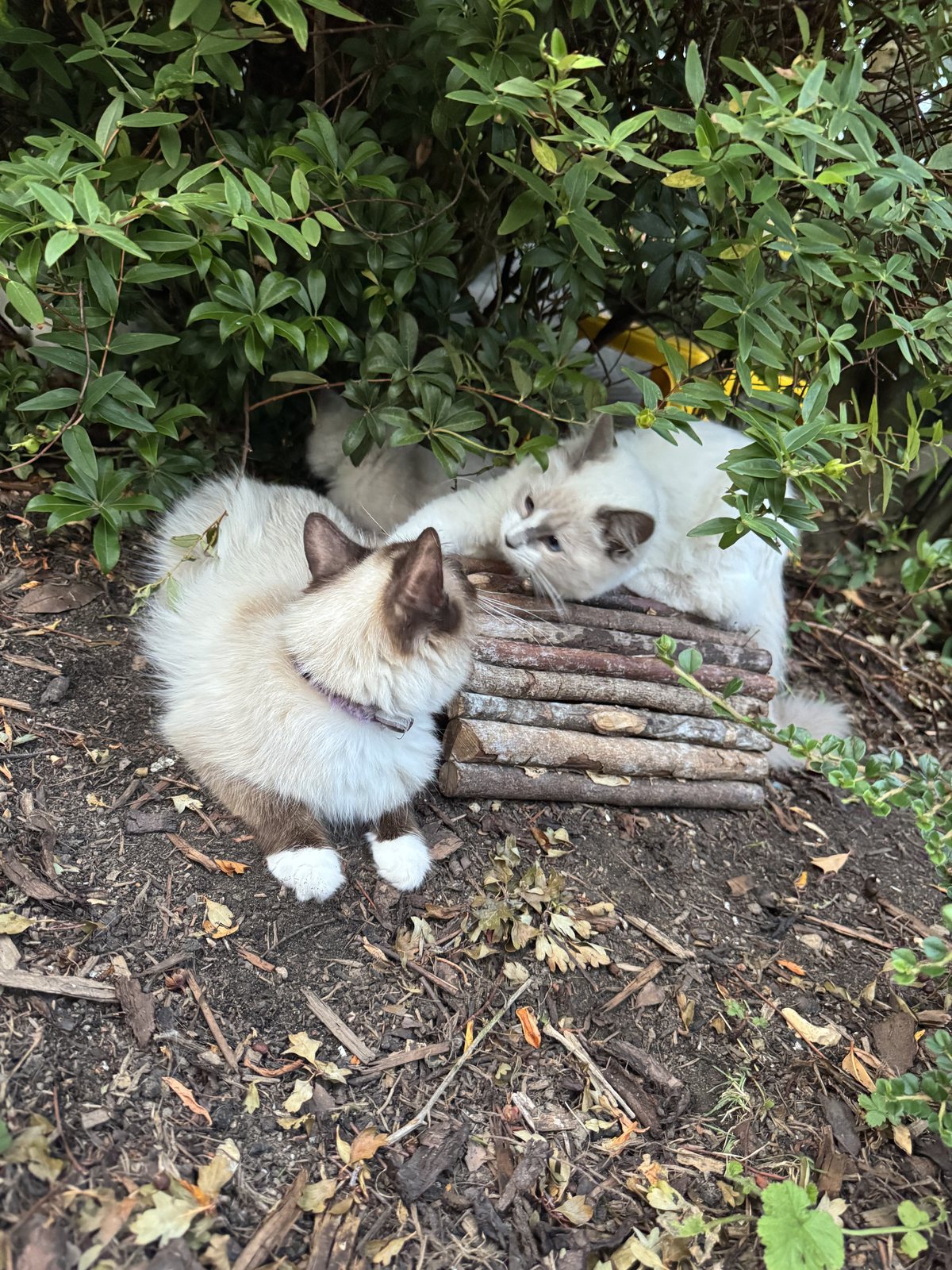
Our colony at the log pile. A Siberian would be on top of it; a Ragdoll is content to sit beside it.
Ragdoll vs Siberian: the key differences
Both are large, affectionate, semi longhaired cats that get on with families and other pets, which is why people weigh one against the other. The differences are these.
- Origin. The Siberian is a natural breed, a landrace cat from Russia shaped by centuries of cold rather than by breeders. The Ragdoll was created in 1960s California from a handful of founding cats; see Ragdoll history.
- Size. Siberians are medium to large, roughly 4 to 9 kg with males heavier. Ragdolls are larger framed on average, roughly 3.5 to 9 kg, but softer and less muscular for their size.
- Coat. The Siberian wears a dense triple coat with a heavy undercoat; the Ragdoll a silkier semi long coat with much less undercoat.
- Energy. Siberians climb, jump and play hard; Ragdolls are calmer and live at floor and lap level.
- Allergies. Siberians are often said to produce less of the main cat allergen. The truth is more complicated and gets its own section below.
If you want a cat on top of the fridge, read on. If you want one asleep on your feet, you are probably in the right place already.
Two coats for two climates
The Siberian coat is the breed's defining feature. It is a true triple coat: long guard hairs, a middle layer of awn hairs and a thick, woolly undercoat, with a full ruff, britches and a bushy tail. It is water resistant and built for a Russian winter, which means it is also thick, heavy and prone to big seasonal moults. Siberians come in nearly every colour and pattern, including tabbies, solids and silvers, and the pointed variety known as the Neva Masquerade, which looks Ragdoll like at first glance.
The Ragdoll coat is semi long, silky and plush with a thin undercoat, which is why it mats less and sheds less bulk than the Siberian's. Ragdolls come only in pointed colours and patterns, every one with blue eyes; Ragdoll colours and patterns has the full set.
In build, the Siberian is barrel chested, round and powerful, with strong hindquarters that make it a formidable jumper. The Ragdoll is long, broad and heavy boned but softer in the body and slower to move, and it tends to go limp when picked up where a Siberian stays compact. Both take three to five years to reach full size.
Ragdoll vs Siberian: hypoallergenic or not?
Siberians are widely advertised as hypoallergenic, and the claim is not invented from nothing. The main cat allergen, Fel d 1, is a protein made in the skin and saliva and spread over the coat by grooming. Some studies and many breeders report that some Siberian lines produce lower levels of it than average, and some allergic people do react less to some Siberians.
The problem is the word some. Fel d 1 levels vary enormously cat by cat within every breed, including the Siberian, and no breed is hypoallergenic in the sense of being safe for an allergic person. A low allergen Siberian is a particular cat, not a guarantee that comes with the pedigree, and the same breeder's next litter may be different. Ragdolls are sometimes also sold as low allergen because of the thin undercoat; that claim has even less behind it, as Ragdoll myths explains.
The only sensible approach for anyone with an allergy is to spend time with the actual cat, ideally more than once and in the breeder's home, before committing. Rehoming a cat because the allergy turned out to be real is miserable for everyone, and a few visits are cheap insurance.
Grooming and moulting
The Siberian coat is the heavier job. For most of the year a thorough comb two or three times a week keeps on top of it, but in spring, and to a lesser degree in autumn, a Siberian drops its undercoat in a serious moult and needs daily attention for a few weeks, or the woolly layer felts into mats close to the skin. Expect hair on everything during those weeks. Siberians are also, usefully, more tolerant of water than most cats, so a bath during the moult is often possible.
The Ragdoll coat is easier: a weekly comb through, a little more during the moults, concentrating on the armpits, britches and behind the ears. The thin undercoat means less bulk to shed and fewer mats. Ragdoll grooming covers the routine and the tools, and hairballs is worth a read for either breed.
Both need the usual claw trimming and dental care. The practical difference is the spring: a Ragdoll owner notices more hair about; a Siberian owner empties the comb several times a day.
Siberian cat vs Ragdoll personality
A Siberian is playful, agile and often described as dog like: it greets you at the door, follows you about, learns tricks, fetches, and is interested in everything, including water. Many Siberians play in the water bowl and some join you at the sink. They are affectionate but more independent than a Ragdoll, happy to entertain themselves, and they need vertical space: tall trees, shelves and somewhere to jump to.
A Ragdoll is more laid back and more people dependent. It follows you too, but at walking pace, and it wants to end up on you rather than above you. It plays in shorter bursts, is less inclined to climb, and is the easier cat for a house that would rather not have a cat on the curtain pole. The flip side is that a Ragdoll copes less well with long empty days and does best with company, feline or human; Ragdoll temperament and home alone go into that.
Both are gentle, quiet voiced and good with children and dogs. In our house of sixteen Ragdolls the busiest cat is Aqua, our blue bicolour stud, whose hobby is collecting objects. A Siberian would have had the top of the kitchen cupboards cleared by Tuesday.
Health, lifespan and price in the UK
The Siberian is generally a robust breed, as natural breeds tend to be, with a lifespan often cited at 12 to 15 years and plenty going beyond. Hypertrophic cardiomyopathy has been reported in Siberians too, so ask any breeder what heart screening they do; heart scanning of the parents is the usual answer, since the Ragdoll DNA test does not apply to Siberians. A few other conditions are reported at low rates, so ask what the line has been screened for.
The Ragdoll's two main inherited risks, HCM and PKD, both have DNA tests, and a responsible breeder tests every breeding cat before mating; health testing explains what the certificates mean. Ragdoll lifespan is usually given as 12 to 17 years.
On price, the two are broadly similar in the UK. A pedigree kitten of either breed from a breeder who health tests, vaccinates, microchips and socialises properly costs a comparable amount, and the cheapest kitten of either breed is almost always the one that has had the least done. Ragdoll kitten prices covers what you are paying for. For the other big longhaired comparison, see Ragdoll vs Maine Coon.
Quick questions, answered
Ragdoll vs Siberian hypoallergenic: which is better for allergies?
No breed is hypoallergenic. Some Siberian lines are reported to produce less Fel d 1, the main cat allergen, and some allergic people react less to some Siberians, but levels vary cat by cat and a pedigree is no guarantee. Ragdolls have no such claim behind them. Spend time with the actual cat before committing.
Which is bigger, a Siberian or a Ragdoll?
They overlap. Siberians run roughly 4 to 9 kg and Ragdolls roughly 3.5 to 9 kg, with males of both breeds at the top. The Ragdoll is larger framed and longer on average, the Siberian more compact, muscular and heavier for its size. Both keep growing until three to five years old.
Siberian or Ragdoll: which is easier to groom?
The Ragdoll. Its silky semi long coat has a thin undercoat and needs a weekly comb. The Siberian's dense triple coat needs combing two or three times a week and daily attention during the big spring moult, when the woolly undercoat comes out in handfuls and mats quickly if it is left.
Which is calmer, a Siberian or a Ragdoll?
The Ragdoll. Siberians are athletic, playful, dog like cats that climb, jump and need vertical space and plenty of interaction. Ragdolls are laid back, floor and lap based and more people dependent. Both are gentle and good with children and dogs; the difference is how much of your house is used as a climbing frame.
Sources and further reading
- Wikipedia: Origin, coat, Neva Masquerade variety and the allergen claim for the Siberian.
- International Cat Care: Advice on cat allergies and why no breed is reliably hypoallergenic.
Thinking about a Ragdoll kitten?
Our Ragdoll and Ragcoon kittens grow up in our home in Ryde, Isle of Wight, with health tested parents and our support for life. See who is available now, or join the waiting list for the next litter.