
From our colony to your sofa
Ragdoll vs Ragamuffin: The Real Differences
Cousin breeds compared properly, and how to choose between them.
Last reviewed
Cousin breeds compared properly, and how to choose between them.
Last reviewed
These two breeds get confused constantly, and no wonder: they share history, size, and a talent for going boneless in your arms. As Ragdoll breeders we obviously have a favourite, but here is the fair version of the comparison, because the right cat for you matters more than our bias.
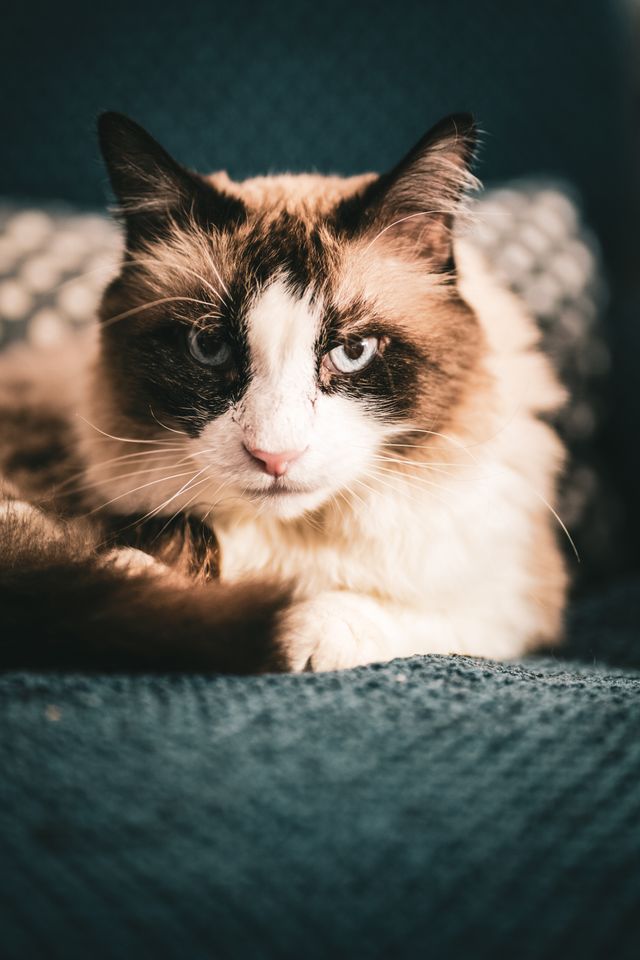
The Ragamuffin is not a Ragdoll lookalike by coincidence; it is a relative by history. When breeders parted ways with the original franchise era of the Ragdoll’s founding, one group continued the Ragdoll to its modern standard, while another line, developed with wider outcrossing, became the Ragamuffin, recognised as its own breed in the 1990s.
That split explains both the resemblance and the differences: shared foundations gave them the size and sweetness in common, and separate decades of breeding gave each its own look and rulebook. Cousins, not copies.
Side by side, the faces diverge first: the Ragamuffin carries a shorter, sweeter muzzle and large walnut shaped eyes that come in many colours, while the Ragdoll wears its longer, balanced head and always, without exception, blue eyes. The Ragamuffin’s coat runs slightly denser and plusher to the touch.
Colour rules are the cleanest test: Ragdolls come only in the pointed patterns, pale bodies with coloured extremities, while Ragamuffins are welcome in nearly every colour and pattern in the book, solids, tabbies, torties and more, with any eye colour to match. A solid chocolate cat with green eyes cannot be a Ragdoll and might well be a Ragamuffin.
Temperament will not decide this for you: both breeds are large, relaxed, affectionate companions bred for exactly the family life most buyers are shopping for, and both carry the same company contract, wanting people about and involvement in the day.
So the choice usually settles on aesthetics and availability: the pointed, blue eyed signature look belongs to the Ragdoll, the rainbow wardrobe to the Ragamuffin, and in Britain the Ragdoll is far easier to find from health tested lines, with Ragamuffin breeders rarer. Meet both if you can; either way the sofa ends up magnificently occupied.
Side by side the cousins separate at the details: RagaMuffin eyes are walnut shaped and come in any colour, gold, green, odd eyed, against the Ragdoll’s oval blue standard; the Muffin’s coat runs plusher and denser, famously rabbit soft, where the Ragdoll’s lies silkier and closer.
Faces differ subtly too: the RagaMuffin carries a rounder skull and a sweet, slightly puffed whisker pad expression against the Ragdoll’s broader modified wedge. On a sofa across the room they blur; in the hands, breeders tell them instantly.
The RagaMuffin’s registries opened the whole paintbox: solid blacks and blues, tabbies, torties, smoke and silver, with or without white, alongside pointed coats, where the Ragdoll standard holds to pointed patterns with blue eyes. A black smoke RagaMuffin is a breed legal cat with no Ragdoll equivalent.
For buyers this is the honest fork: hearts set on a solid or a green eyed tabby in this temperament package are shopping for a RagaMuffin; hearts set on the classic blue eyed pointed look are shopping Ragdoll. The colour freedom is the visible legacy of the two breeds’ split.
The practical difference at buying time is supply: RagaMuffin breeders are genuinely scarce in the UK, waiting lists run longer, travel distances stretch, and imported lines feature more often. The Ragdoll, among Britain’s most popular pedigrees, is simply easier to find well bred.
Rarity changes diligence, not standards: the same health testing, socialising and paperwork questions apply, asked of a smaller pool. Beware rarity pricing on cats without the paperwork to justify any pricing at all; scarce and well bred are different claims.
Bring either cousin home and the manual is effectively shared: weekly combing that rises in moult season, measured feeding for a large slow maturing frame, indoor or catio life for a trusting temperament, daily play, and the same devotion returned with interest.
Health watchlists overlap heavily too, built on shared foundations, with screened lines the answer in both breeds. Whichever name is on the pedigree, you are running the same excellent household; this entire library serves both cats.
Ragdolls and RagaMuffins share history, size and the boneless flop, because the RagaMuffin grew out of the Ragdoll world before becoming its own breed. Telling them apart: Ragdolls are always pointed with blue eyes, while RagaMuffins come in every colour with any eye colour, on a slightly rounder face. Temperament and care are nearly identical, so choosing between cousins is mostly about looks and availability, and in Britain the RagaMuffin is the rarer find. The care manual is the same either way.
Close but not quite: decades of separate breeding built subtle differences in eye shape, coat texture and face alongside the colour freedom. Cousins, distinctly, rather than twins.
Neither concedes: both were selected for the same lap seeking, people following devotion. Individual kittens vary more than the breeds do.
The registries write it that way, a small typographic flourish from the breed’s founding era. It is also a handy spot check on whether a seller knows their breed.
UK scarcity often prices them at or above Ragdoll level, plus travel. Paperwork, testing and raising quality justify price in both breeds; rarity alone justifies patience, not premiums.
Registries treat them as separate breeds with their own rules, and mainstream registered breeding does not mix them. A seller offering Ragdoll Muffin crosses is selling unregistered cats, whatever the charm.
Many relax happily in arms in the family tradition, with the same individual variation the Ragdoll shows. The flop follows the shared temperament, not the breed name.
Both, equally: the shared temperament is the family friendly part. Choose by look, availability and breeder quality rather than expecting a difference in patience.
Both breeds trace back to the same 1960s Californian founding cats. The Ragamuffin emerged decades later when a group of breeders parted ways with the tightly controlled original Ragdoll programme and developed their own line with broader looks. Cousins, genuinely, which is why so much feels similar between them.
Eyes and coat patterns are the giveaway. A Ragdoll is always a pointed cat, darker on the ears, face, legs and tail, and always blue eyed. A Ragamuffin can wear almost any colour or pattern, pointed or not, with eyes of any shade. Ragamuffins tend towards a slightly rounder face and a fraction plusher, denser coat, while the Ragdoll carries that silky semi longhaired look with the lighter undercoat. Both are large, slow maturing cats, with males often reaching a very lap filling size.
In personality they are more alike than different: relaxed, people orientated, gentle with children, happy to be handled, and best kept as indoor cats because both share the same trusting nature. Owners of each will tell you theirs follows them everywhere, and both breeds famously flop. If pushed on differences, Ragamuffins are sometimes described as a touch more adaptable to varied households, Ragdolls as a touch more devoted to their chosen people, but individual upbringing swamps breed generalisation here. A well socialised kitten of either breed beats a poorly raised kitten of both.
Both need the weekly comb through described in our grooming guide, with the Ragamuffin’s denser coat asking for slightly more diligence around the friction points. Neither breed carries the heavy matting workload of a Persian. Feeding, litter, claw and health care are essentially identical between the two.
If blue eyes and the classic pointed look have your heart, that is a Ragdoll, and only a Ragdoll. If you want the same gentle giant temperament in a rainbow of colours, the Ragamuffin deserves your research. What matters most with either breed is the raising: health tested parents, kittens socialised underfoot in a real home, and a breeder who stays in your corner for life. That last part is the bit we can help with directly, and our current kittens are the evidence.
For further breed comparisons and profiles, International Cat Care maintains impartial breed information worth browsing.