
Should I Get a Ragdoll? Ragdoll Pros and Cons
The pros, the cons, the households the breed suits and the ones it does not, and the lifetime bill.
Last reviewed
Should I get a Ragdoll is a question we are asked most weeks, and the fair answer is: yes if you are home a good deal, can afford a large indoor cat for fifteen years and want a companion rather than an ornament; no if the house is empty all day or you were hoping for a cat that comes and goes through a flap. Are Ragdolls good pets? Among the best, for the right household. This guide sets out the Ragdoll pros and cons without the sales pitch, who the breed suits, what it costs over a lifetime and the questions worth asking yourself first.
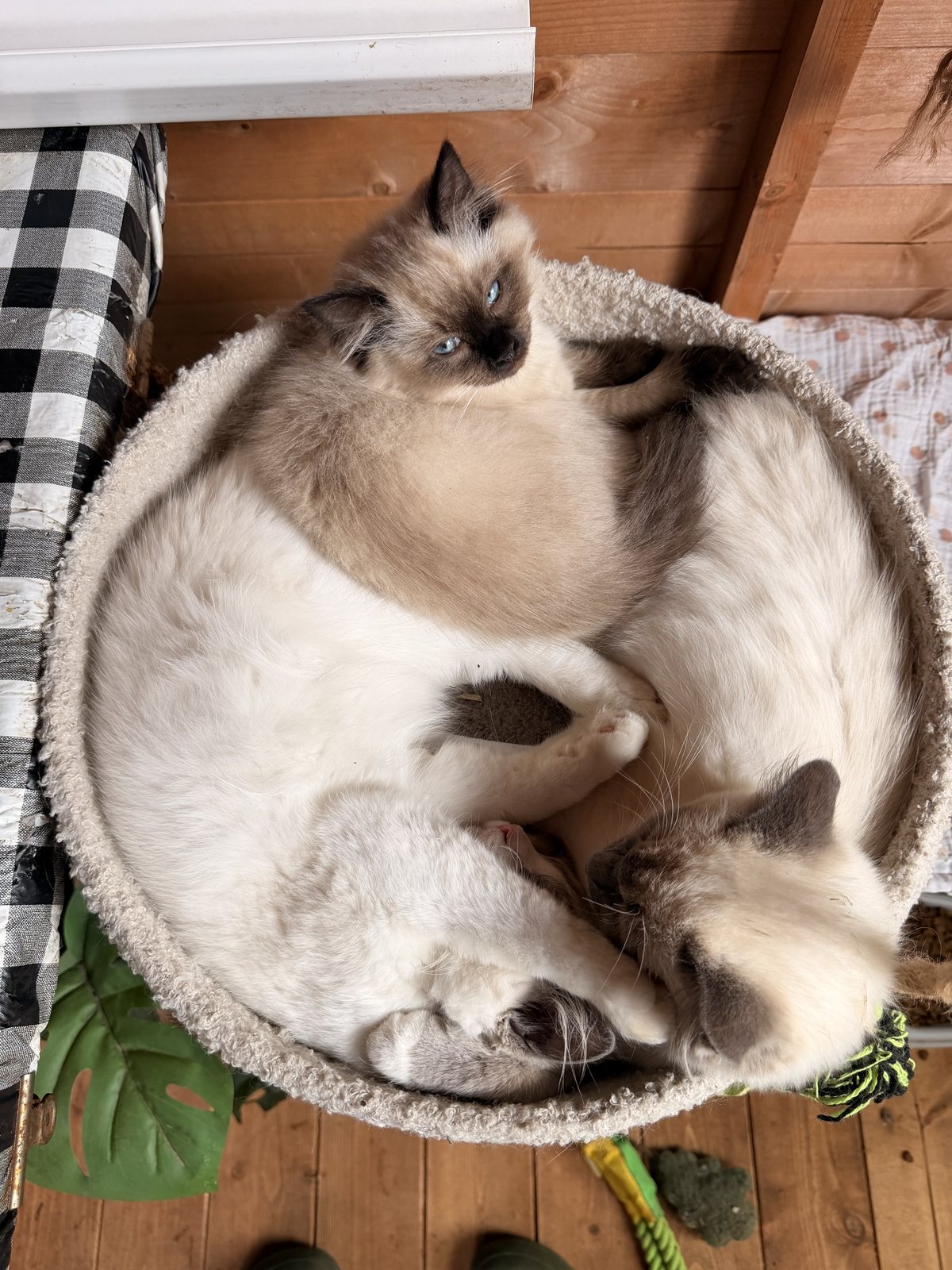
Four of the colony in one heap. Company is the breed's great strength and its main demand.
Are Ragdolls good pets? The pros
For a household that can meet their needs, Ragdolls are very good pets. The case for them:
- Affectionate and people centred. The breed was selected for a cat that wants to be where you are: on the lap, on the desk, in the bathroom doorway. Ragdoll temperament has the full picture.
- Tolerant with children. Most Ragdolls put up with a great deal from considerate children and walk away rather than lash out. Children and kittens covers the house rules.
- Quiet. A soft voice and not much of it, compared with a Siamese or a Bengal.
- Trainable. Food motivated and biddable: carrier, harness, recall and tricks are all realistic.
- Long lived. Typically 12 to 17 years with good care, as Ragdoll lifespan explains.
- Less matting than most longhairs. A silky coat with a light undercoat, so weekly combing usually keeps it right.
- Suited to indoor life. Calm enough to be content in a house with a catio, which is where the breed belongs.
- Often good with dogs. A confident, unflappable cat and a steady dog usually work it out; cats and dogs covers the introductions.
Sixteen of them live with us, and that list is the daily experience rather than the brochure.
Ragdoll cat disadvantages: the cons
- They need company. A Ragdoll alone from eight until six, five days a week, is a lonely cat, and lonely Ragdolls get clingy, loud or withdrawn. Home alone sets out what is reasonable.
- They are large. Adults of 4 to 9 kg eat more and need a bigger tray and a bigger carrier, and the food and litter bills follow.
- Grooming is weekly, not never. Plus two heavy moults a year. Ragdoll grooming is the routine.
- Indoor life takes effort. You provide the climbing, the hunting games and ideally a catio, because the cat cannot provide them for itself. Indoor cats explains what enough looks like.
- Breed health risks. HCM and PKD run in the breed, so the breeder's testing matters more than the colour. Ragdoll health covers both.
- A well bred kitten is not cheap. £800 to £1,500 in the UK, as Ragdoll kitten prices shows, and the cheap ones are cheap for a reason.
- Slow to mature. Kitten behaviour, zoomies and all, lasts a good two years, and full size arrives at three or four.
- Not hypoallergenic. No breed is, whatever the advert says; Ragdoll myths explains why.
- Too trusting to roam. A cat that greets strangers and does not run from cars should not be loose near a road.
Who a Ragdoll suits, and who it does not
The breed suits:
- Home based or part time households. Someone working from home, a retired couple, shifts that overlap, or a house with more than one person coming and going, so the cat has company most of the day.
- Families with considerate children. A Ragdoll will tolerate a child who has been taught how to handle a cat, and the two can be very close.
- First time cat owners who will do the reading. Ragdolls forgive beginners, provided the beginner understands indoor life, grooming and what a cat costs. Are Ragdolls good first cats? Yes, with homework.
- Multi pet homes. With a steady dog or a second cat, a Ragdoll is rarely the problem. One kitten or two is worth reading if the house is empty for stretches.
The breed suits less well:
- Long absences. Full time out of the house with nobody else at home, frequent travel, or a life in which the cat is a weekend pet.
- Anyone wanting an outdoor cat. A Ragdoll that roams gets stolen, lost or hit, and its trusting nature is the reason. If you cannot keep a cat in, with a catio or a secure garden, choose a different cat.
- Allergy sufferers hoping for a safe breed. There is no such thing, and the thin undercoat does not help.
- Anyone who wants a low contact cat. A Ragdoll will follow you to the loo. Some people find that charming and some do not.
What a Ragdoll costs over a lifetime
Rough UK figures; every household's will differ.
- The kitten. £800 to £1,500 from a breeder who tests. Ours are £850, with a £200 deposit.
- Setting up. A large tray, a sturdy cat tree, scratching posts, an adult sized carrier, bowls, combs and toys: typically a few hundred in total, more if a catio is going in.
- Food. A large cat on good food commonly costs somewhere between £30 and £70 a month, depending on wet, dry or raw. Feeding and wet vs dry explain the choices.
- Litter. Typically £10 to £25 a month for one cat, depending on the type.
- Insurance. Commonly £10 to £30 a month for a young cat on a lifetime policy, rising with age. For a breed with HCM in its history, buy it before the first vet visit finds anything; cat insurance explains why.
- Routine vet care. Annual boosters, a health check, flea and worm treatment and neutering in the first year. Budget in the low hundreds a year, and keep a reserve for the unplanned.
Over 15 years that adds up to many thousands, which is the honest arithmetic of any pet. The price of the kitten is the smallest number on the list, which is why saving a couple of hundred on an untested one is a poor trade.
Questions to ask before you commit
- Who is home, and for how much of the day? Be truthful about a normal week, not the best one.
- Can you keep the cat in for its whole life, and give it a window, a climbing frame and ideally a catio in exchange?
- Is anyone in the house allergic, and have they spent an hour in a room with a Ragdoll to find out?
- Can you afford the insurance and the food every month for 15 years, and a vet bill in the hundreds at short notice?
- Will you comb a cat once a week, every week, including the weeks it is moulting onto the sofa?
- Are the children old enough to learn the rules, and are you prepared to enforce them?
- Would two kittens suit the house better than one? For households out at work it often would.
- Have you read what a good breeder looks like, so you know what you are paying for?
If the answers are mostly yes, a Ragdoll is likely to be one of the better decisions you make. If several are no, the kindest thing is to wait, or to look at a cat whose needs fit the life you actually have. The breed's great strength, its attachment to people, is the one thing it cannot do without.
Which cat breeds are most like a Ragdoll?
The Ragamuffin is the closest, split from the same founding lines and sharing the size, the soft body and the easy nature; our Ragdoll vs Ragamuffin guide covers the differences. Then the Birman, which shares the points, blue eyes and gentle temperament in a smaller frame, and the Maine Coon and Siberian, which match the size and friendliness with more athleticism and more coat. The British Shorthair offers the calm without the fur; the Persian offers the lap habit with far more grooming. Our comparison guides take each in turn.
Quick questions, answered
Are Ragdolls good first cats?
Yes, for a first time owner who reads up on indoor life, grooming and costs before the kitten arrives. Ragdolls are forgiving, calm and easy to handle, which suits beginners. The things that catch new owners out are the need for company, the weekly comb and the size of the vet and insurance bills for a large cat.
Are Ragdolls high maintenance?
Moderately. The coat needs a weekly comb and more during the two seasonal moults, but it mats less than most longhairs. The bigger demands are company, because a Ragdoll does not cope well with an empty house, and enrichment, because it should live indoors. Food, litter and insurance for a large breed add up.
Is a Ragdoll a good cat for a household out at work all day?
Not on its own. A Ragdoll left alone for nine or ten hours most days tends to become clingy, vocal or withdrawn. If the house is empty for long stretches, two kittens together, a dog the cat gets on with, or a neighbour or family member who calls in makes the difference. Otherwise consider a more independent cat.
What are the main Ragdoll cat disadvantages?
The need for company, the size and the bills that go with it, weekly grooming and seasonal moulting, the effort of keeping an indoor cat entertained, the breed's inherited heart and kidney risks, the price of a well bred kitten, a two year kittenhood, and the fact that no Ragdoll is hypoallergenic or safe to roam.
Sources and further reading
- Cats Protection: General guidance on the cost and commitment of owning a cat.
- PDSA: Advice on the lifetime cost of a cat and on choosing a breed.
Thinking about a Ragdoll kitten?
Our Ragdoll and Ragcoon kittens grow up in our home in Ryde, Isle of Wight, with health tested parents and our support for life. See who is available now, or join the waiting list for the next litter.