
From our colony to your sofa
Preparing Children for a Kitten
Gentle holds, house rules and proper jobs by age for young cat lovers.
Last reviewed
Gentle holds, house rules and proper jobs by age for young cat lovers.
Last reviewed
A kitten raised with kind children gets socialisation money cannot buy, and a child raised with a kitten learns gentleness with a purring reward attached. It goes beautifully when the grown ups stage manage the first few weeks.
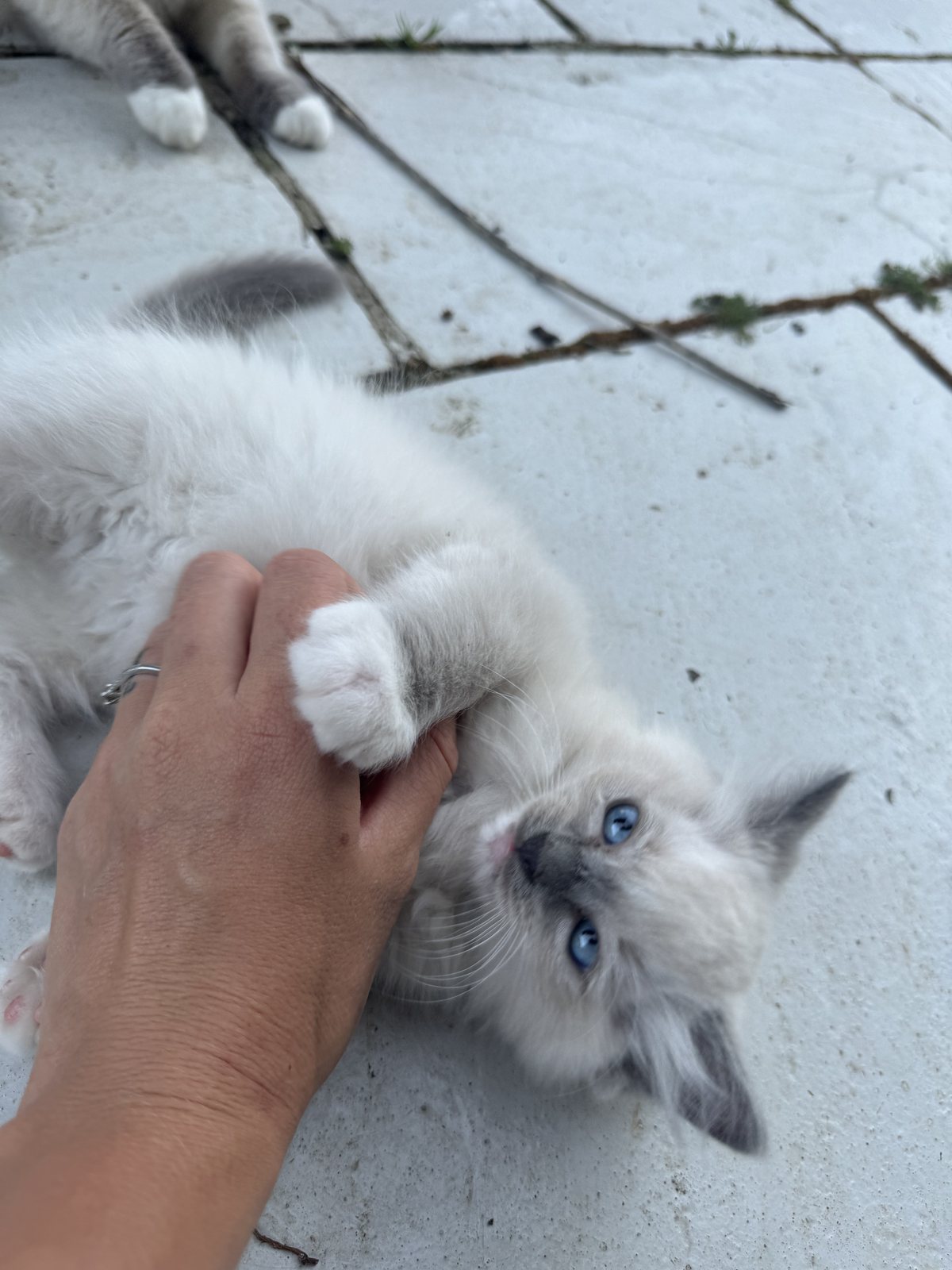
Floor level, still hand, kitten’s choice: the greeting that starts every good friendship.
The household laws that work are few and absolute: a sleeping or eating cat is invisible and untouchable; greetings happen at floor level with a still, offered finger and the cat voting; and nobody, ever, chases, corners or grabs. Three rules, learnable by any child old enough to want the kitten.
Frame them as cat language lessons rather than restrictions, because children love being the one who speaks cat: the offered finger is saying hello politely, the walk away answer is the cat saying not now, and respecting it is how you get picked next time.
Small arms and wriggly kittens are a dropping hazard, so holding happens sitting on the floor: kitten placed onto the lap, one hand supporting the chest, the other the back legs, and the iron clause that the kitten may leave whenever it likes, ungrabbed. Exit rights are the whole trick, because a kitten that is never trapped stops fearing laps.
Adults model the same handling, narrating it: supporting the bottom, keeping it low, letting go at the first wriggle. Children copy what they watch far more faithfully than what they are told.
Households that run these rules raise a particular kind of cat: one that seeks children out, sleeps in their rooms and tolerates the occasional accidental indignity with a sigh, because its entire history says small humans are safe. They also raise a particular kind of child, one fluent in reading another creature’s yes and no.
The investment period is short, weeks of supervision and repetition, and the dividend is fifteen years of the friendship photographs are made of. Few parenting projects pay this reliably.
Expectations set by age keep everyone safe: toddlers can wave, watch and learn the word gentle, always within arm’s reach of an adult and never left alone with any animal; infant school children can master the three laws, feed under supervision and become surprisingly good greeters; older children can take real ownership of play sessions, brushing and the feeding rota.
The common thread is that supervision scales down as fluency scales up, and fluency is demonstrated, not assumed. A child of any age who reliably reads the cat’s no has earned more access; the calendar alone earns nothing.
Nothing teaches respect for an animal like being partly responsible for one: the measured scoop of breakfast, the water bowl refreshed, the evening wand session, the weekly brushing turn. Each job is a lesson in the cat being a creature with needs rather than a toy with fur, and children promoted into cat staff take the role seriously.
Keep the jobs real but supervised, with an adult quietly guaranteeing that meals actually happen and trays actually get cleaned, because the cat’s welfare can never depend on a nine year old’s memory. The child gets the pride; the adult keeps the safety net.
Even in fluent households, the occasional scratch happens, and the response is a protocol rather than a drama: comfort the child, wash the scratch well with soap and running water, cover it if it is more than a graze, and watch it for redness or swelling over the following days, with anything deep, near an eye, or looking angry seeing a pharmacist or doctor.
Just as important is what does not happen: no punishment of the cat, whose warning signs were almost certainly missed, and no shaming of the child, who has just received a memorable lesson in feline communication. Debrief gently, what was the tail doing, what will we watch for next time, and the scratch becomes tuition.
A baby’s arrival is managed like any big change: begun months early with the nursery furniture appearing gradually, baby sounds played softly and paired with treats, new smells of lotions and laundry introduced on your own hands, and the cat’s core territory, feeding stations, trays and retreats, kept absolutely stable through the upheaval.
Once the baby is home, the cat is included rather than exiled: calm sniffing of a used babygrow, fuss and routine defended daily, and cots and prams kept as cat free zones with nets or closed doors rather than shouting. Most cats file the newcomer under strange loud furniture within weeks and adjust completely.
Cats Protection behaviourist Daniel Cummings runs through his top dos and don’ts for children and cats, the ground rules that keep small hands and small paws safe. Watch it with the children before the kitten arrives.
Watch on YouTube Cats Protection, Kids and Kitties series
Kittens and kind children raise each other: the kitten gains socialisation money cannot buy, the child learns gentleness with a living creature. Teach the rules children can actually keep, show proper two handed holding with the weight supported, and match expectations to age, with adults always refereeing the youngest. Give children real jobs like the treat round and the wand game, treat scratches as lessons in reading signals rather than blame, and plan again when a new baby changes the household.
A confident adult with a known child friendly history is often the easier match: temperament is proven and patience installed. Kittens work well too with slightly older children, but they are fragile, sharp and nocturnal, which tests toddler households.
The real risks sit in undercooked meat and unwashed garden produce far more than in cat contact, and a daily scooped tray handled with gloves, or delegated for nine months, covers the cat side almost entirely. Our toxoplasmosis guide walks through the honest risk table.
See your GP or an allergy service before making any big decisions: confirmed allergies range widely in severity and management. Meanwhile, bedrooms become cat free zones, soft furnishings get washed hot, and many families manage well with hygiene and medical advice combined.
Completely firm, calmly enforced: cots, cribs and prams are closed territory, protected by doors or nets rather than vigilance. It is a safe sleep rule, not a comment on the cat, and a warm alternative bed nearby settles the argument.
Make the cat’s signals the teacher: turn tail reading into a game, celebrate every successful floor level greeting, and praise the child whenever the cat chooses them. Children repeat what earns them pride, and being the person the kitten trusts is powerful currency.
Before collection day, agree the family law: a kitten is a baby, not a toy, so quiet voices, no chasing, and the kitten always chooses, we never grab. Let children help prepare the safe room from our settling in guide, choosing where the bed and bowls go, so day one arrives with proud jobs attached rather than just excitement.
Small children sit on the floor and let the kitten climb aboard, which the kitten will, endlessly. Older children learn the two hand hold, one hand under the chest and one under the back legs, and the golden finish: put the kitten down at the first wriggle, so being held never becomes being trapped. A sleeping kitten is invisible, no exceptions, because as our development guide shows, the growing is done asleep.
Our house rule from the teething guide matters double with children: fingers waggled at a kitten today become fingers bitten by a cat next year. Wand toys make children absolutely brilliant playmates at a claw safe distance, with games from our play guide, and letting a child pour the biscuits under supervision quietly makes them the kitten’s favourite human.
Accidents happen in the best families: wash a scratch with soap and water, teach the quiet ow and walk away routine rather than shouting, and the kitten learns gentleness faster than anyone expects. Toddlers stroke with a grown up’s hand guiding theirs, five and up captain the wand game and scoop the biscuits, eight and up learn the comb from our grooming guide, and teenagers graduate to real co ownership. By the time the kitten is grown, so is the friendship.
For family focused advice, Cats Protection covers children and cats thoughtfully, and International Cat Care adds the handling science.