
From our colony to your sofa
Wet vs Dry Food
A partnership, not a fight: what each format does well, and the both answer.
Last reviewed
A partnership, not a fight: what each format does well, and the both answer.
Last reviewed
The oldest argument in cat feeding has a boring, brilliant answer: it is not a fight, it is a partnership. Here is what each format genuinely does well, what each does badly, and why our whole colony eats both.
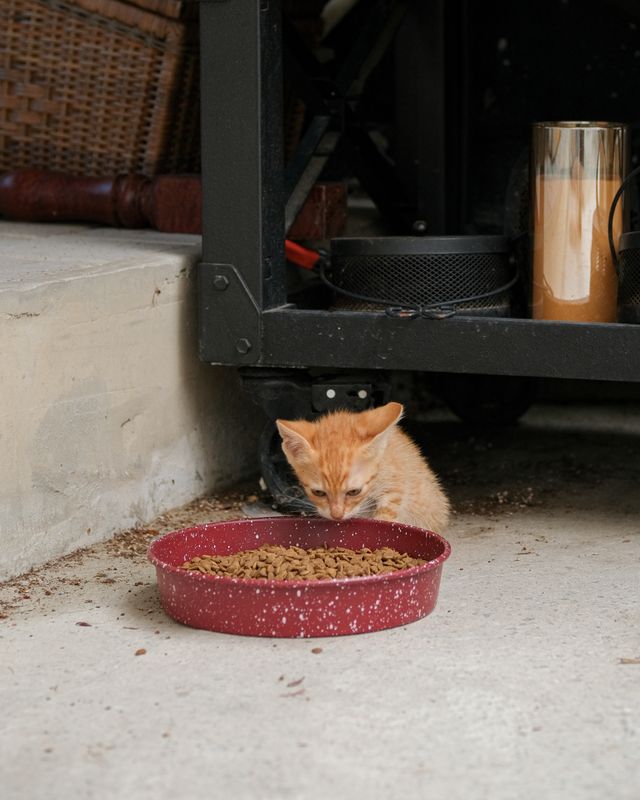
The headline difference between the formats is water: wet food runs around four fifths moisture, mirroring prey, while kibble sits near a tenth, and cats, descended from desert hunters, carry a famously lazy thirst drive that often fails to make up the gap at the bowl. A wet fed cat drinks most of its water at dinner without noticing.
That ledger matters most wherever urine matters: vets lean on wet feeding in urinary trouble precisely because dilute urine is protective, and for big laid back males the extra moisture is cheap insurance. Dry fed households can close some of the gap with fountains, multiple bowls and broth style toppers, but the tinned shortcut is the easy win.
The folklore says crunching cleans teeth; the honest version is narrower. Ordinary kibble shatters on contact and scrubs very little, which is why dry fed cats develop dental disease enthusiastically too. Specific dental diets are the real exception, engineered in texture and size so teeth sink through a cleaning matrix, and those carry evidence ordinary biscuits do not.
So the dental decision is separate from the wet versus dry decision: whichever bowl wins dinner, teeth are looked after by the dental care playbook, brushing, checks and professional cleans, rather than by crunching hopes.
Most real households land on a mixed economy, and it is a genuinely good answer: wet meals delivering moisture and mealtime structure, a measured ration of dry serving puzzle feeders, timed feeders and busy days, with both formats chosen as complete foods and the combined calories counted as one budget rather than two.
Practicalities round it out: opened tins live covered in the fridge and get served takeaway warm rather than fridge cold, kibble lives sealed against staleness and is bought in bags the household actually finishes while fresh, and any format switch runs on the same gradual gearbox as every other food change. Format is preference; the constants are complete, counted and transitioned slowly.
Cats imprint food preferences young: kittens raised on varied textures accept variety for life, while single format kittens often refuse the other format forever after. The fussy adult who will not touch wet food is usually a kitten whose menu never included it.
The practical inheritance: our kittens meet both formats during weaning, and wise households keep both in rotation through the first year even if one dominates. Preserving format flexibility is a genuine gift to the adult cat, whose future medical diets may arrive in either form.
Dry food’s convenience has fine print: opened bags oxidise, fats stale and vitamins fade, so buy bag sizes the household finishes within a month or so, sealed in the original bag inside an airtight bin, cool and dark. The giant value sack for one cat is a freshness false economy.
Wet food runs opposite logistics: sealed pouches keep long, opened ones live covered in the fridge a day or two at most, served at room temperature rather than fridge cold. Uneaten wet food’s twenty minute summer lifespan on the floor is a food hygiene rule, not a suggestion.
Some diagnoses vote on format: urinary and kidney cases generally benefit from wet’s water content, dental considerations occasionally favour specific dry designs, diabetic management often leans wet, and prescription diets arrive in whichever formats the manufacturer makes.
The point is not to memorise the table but to stay flexible: the cat who accepts both formats can follow any medical recommendation without a hunger strike. Format flexibility, built young and maintained, is quiet insurance for the decade ahead.
Comparing wet and dry on the label is famously misleading: dry’s percentages look richer because water is absent, so honest comparison converts both to dry matter or simply follows the practical tells, named meat sources leading the list, a complete declaration, and a manufacturer who answers questions.
Price per day beats price per kilo across formats too, since feeding amounts differ wildly. Our food labels guide walks the decoding in full; the summary is that quality exists in both formats and marketing exists in both formats, and the label tells you which you are holding.
The oldest feeding argument has a boring, brilliant answer: partnership. Wet food carries water, the silent half of feline health, and suits bladders and kidneys; dry offers convenience, puzzle feeding and grazing. The dental claim for kibble is weaker than the marketing. Most households run the mixed economy, wet meals as the base with measured dry for enrichment, and the kitten window sets texture preferences for life, so serve both early. Store each properly, and read quality across formats with the label skills.
Many cats live well on complete dry with genuinely good water provision, though desert descended thirst drives make wet’s hidden water valuable insurance. If all dry is the choice, fountains and multiple bowls stop being optional extras.
Sudden wet food causes protest the way any sudden change does; transitioned properly, most cats digest it beautifully. Persistent looseness on any food is a vet question, not a format verdict.
Wet usually wins the appeal contest, warmed slightly to raise aroma, and fussiness often yields to scheduled meals rather than grazing. A fussy cat losing weight, though, has a medical question before a menu one.
Only in feeders with sealed chilled compartments designed for it; open wet food in a standard feeder is a bacteria timetable. Standard feeders belong to dry; wet wants freshness discipline.
Wet’s water bulks portions helpfully for dieters, while measured dry suits disciplined routines; blended plans use both. The measuring, not the moisture, remains the method.
Better in separate servings: dry left on wet turns to paste and stales fast, and separate services let you see exactly what was eaten of each. Same day, different bowls, is the tidy habit.
Because the food already carries most of the day’s water inside it, which is precisely wet’s quiet virtue. Total intake usually rises even as bowl visits fall.
Hydration, above all. Cats descend from desert animals with a famously weak thirst drive, and wet food smuggles water into every meal, which quietly protects the urinary system for life, a point our health guide takes seriously. Wet food is also more aromatic, which wins over fussy eaters and tempts unwell or elderly cats, and its portions are easy to see and serve. Its weaknesses are practical: it spoils once down, costs more per calorie, and does nothing for teeth.
Convenience and grazing. Biscuits keep all day, suit puzzle feeders and slow feeder bowls beautifully, cost less, and let a cat who prefers many tiny meals eat like a cat. The weaknesses mirror the wet side: almost no moisture, and calories that are dangerously easy to over pour, which is where measured portions from our feeding guide earn their keep. The teeth cleaning reputation of ordinary biscuits is mostly myth; only specific dental diets are designed for that job.
Our routine, and the one our kittens go home on, is wet food as scheduled meals with measured dry alongside for grazing, which captures the hydration of one and the convenience of the other. Whatever balance you choose, the word that matters on any main food is complete, meaning nutritionally whole on its own, and changes between foods happen gradually over a week, never overnight.
Ignore the front of the packet and read the back: a named meat high in the ingredients list, the word complete, and a life stage that matches your cat. Price and quality correlate loosely at best, grain free is a fashion rather than a need for most cats, and the finest judge of a food is the cat: good weight, good coat, good litter tray output and enthusiasm at the bowl. The exact foods our kittens are weaned onto stay stocked on our Cat Shop page for continuity.
For the nutrition detail behind the formats, International Cat Care compares diets thoroughly, and Cornell Feline Health Center covers feline nutrition clinically.