
Cats and Autism: How a Colony Raised Ragdoll Could Help
For autistic adults, parents and carers: why a predictable, people loving cat can be good company, and how to find the right one.
Last reviewed
A calm cat that chooses your company, asks nothing of you and keeps to a routine can be one of the steadiest presences in an autistic person's day. Research is beginning to back up what families tell us: children rated as more at ease and more connected after a gentle cat joined the family, autistic adults as attached to their pets as anyone and leaning toward cats, and cats observed making fewer demands on a child's attention than dogs. The Ragdoll is the breed vets rate the most affectionate and least aggressive, and the way we raise ours, inside a colony of sixteen adult cats with handling from birth, is designed to give every kitten the best start toward a predictable, people loving temperament. This guide sets out why, what the evidence does and does not show, and how we help you choose the right kitten.
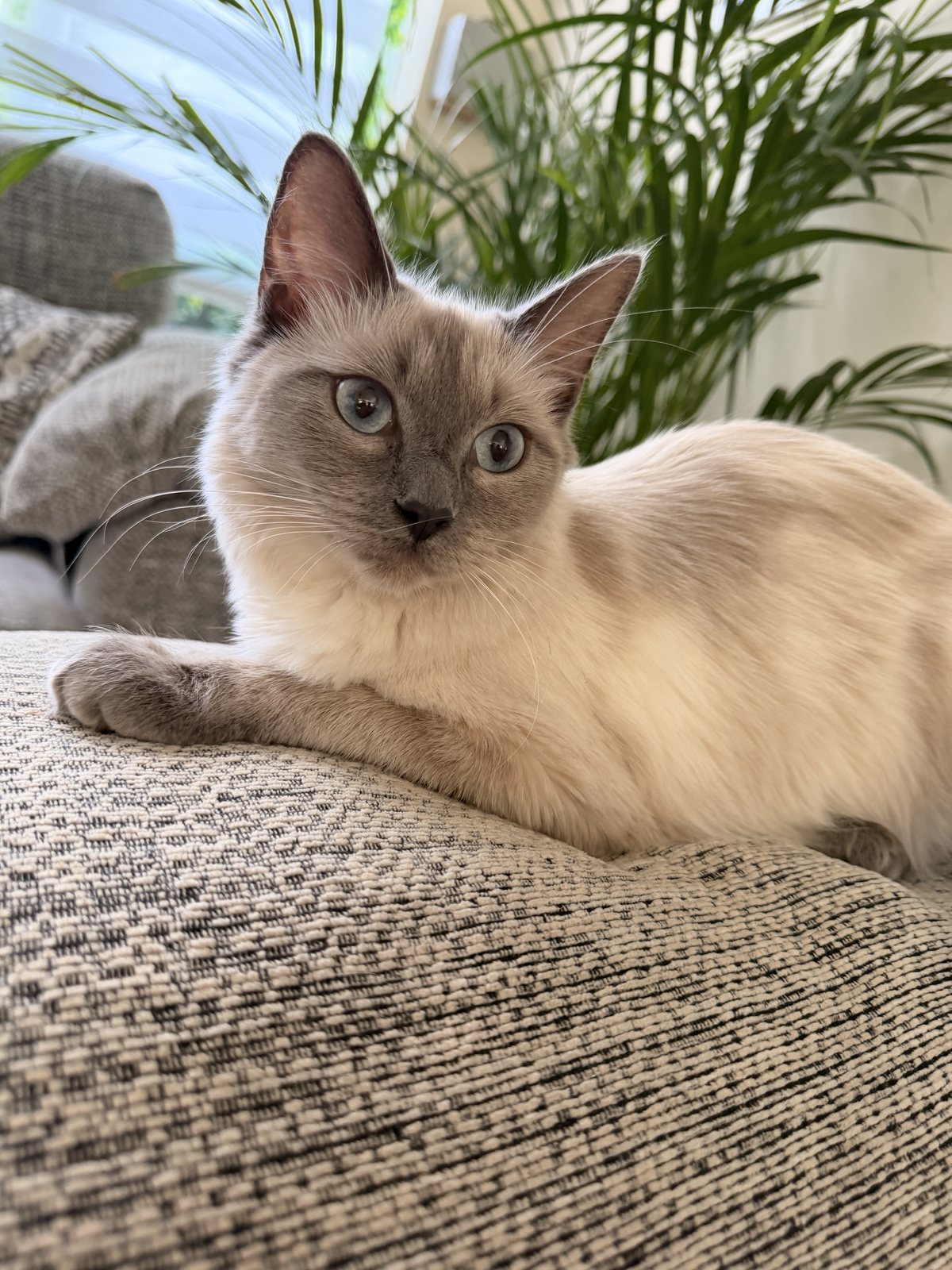
One of our colony Ragdolls at ease: a quiet, predictable companion is what many people are looking for.
The short version
- Cats can be real support. In the one controlled trial, parents rated their children as more empathetic and less anxious about separation after a temperament screened cat joined the family, and bonds formed within days. Parents interviewed in the UK and US describe calming, bonding and a child trying out ways of interacting on the pet.
- Autistic adults bond with pets as strongly as anyone and, in a study of 735 adults, were more likely than others to choose cats, often because a cat asks less. Pet owners in both groups reported higher life satisfaction.
- The Ragdoll is the breed most often described as calm and affectionate. Eighty feline vets ranked it the most affectionate, most socially outgoing and least aggressive pedigree; breed bodies describe a relaxed, people oriented cat that wants to be in the room with you.
- Colony raising gives a kitten the ingredients the research points to. Temperament is set in the first weeks, by handling from many people, calm parents and adult cats to learn from. Our kittens get all of it, every day, because that is how a colony works.
- Fit still matters. Every cat is an individual, sensory needs differ, and no cat is a treatment or a substitute for support a person uses. We help you choose the kitten whose temperament suits the person.
- We say where the evidence stops. The research is small and mostly about children, and nothing has been studied on Ragdolls specifically; purring is pleasant, not medicine. The evidence section lays it out.
Contents
- Animals and autism: pets, therapy animals and assistance animals
- Why cats, and why autistic people so often choose them
- What a cat can give: comfort, routine, connection
- Why the Ragdoll: the breed made for calm company
- Why colony raised: how we build the temperament that matters
- Sensory fit: what to think about
- Choosing the right cat, with our help
- A gentle start for person and cat
- What the research shows, and where it stops
- Questions people ask and sources
A note on language: in a UK survey of 3,470 people, most autistic adults preferred "autistic person" while most professionals preferred "person with autism", and no term suited everyone (Kenny and colleagues, 2016). We use "autistic people" here and respect whatever an individual chooses for themselves.
Animals and autism: pets, therapy animals and assistance animals
Animals turn up in autistic people's lives in four quite different roles, and the words get muddled, so it helps to separate them.
A companion pet
An ordinary cat or dog living with the family. This is what almost all of the cat research is about, and it is what this guide is about. No training, no legal status, no special access rights: just a relationship.
A therapy animal
In the UK this usually means a volunteer's own animal that visits hospitals, care homes and schools. Pets As Therapy assesses cats as well as dogs: the cat must be over a year old, settled with its owner for at least nine months, happy with strangers in new places, calm on a harness, and relaxed when held. Cats that vocalise or struggle during the assessment are deferred, which tells you how individual this is. Animal assisted therapy in a clinical sense means a health professional building an animal into a treatment plan; most of that research involves dogs and horses, not cats.
An emotional support animal
A pet whose presence helps a person's wellbeing. In the UK the term has no legal definition. The Equality and Human Rights Commission says emotional support animals are not defined in the Equality Act 2010, though allowing one may sometimes be a reasonable adjustment (EHRC guidance). A landlord or shop is not obliged to admit one as they would an assistance dog.
An assistance or service animal
A trained animal that performs tasks for a disabled person. In UK law this means an assistance dog (Equality Act 2010, section 173); there is no recognised assistance cat. In the United States the Americans with Disabilities Act defines service animals as dogs, with a separate provision for miniature horses, and says plainly that animals whose only role is comfort do not qualify (ADA requirements). Definitions and rights differ by country, so check the law where you live before relying on any of these labels.
Why cats, and why autistic people so often choose them
In interviews, autistic adults often describe wanting the same things from a pet: company without pressure, a relationship that runs at their pace, and a living thing that is pleased to see them and never judges. Cats are built for that, and the research is starting to show why. Not every autistic person likes cats, and those who do are not all drawn to them for the same reasons, so we say below what comes from studies and what comes from families.
Fewer social demands
A cat does not require eye contact, conversation or a performance of feelings. In a French observational study filming children at home with their own pets, cats gave their humans short glances where dogs held longer gazes, and autistic children paid far more visual attention to their cat than children in the dog group paid to their dog. The authors suggested the brief, undemanding glances of a cat may feel more comfortable (Grandgeorge and colleagues, 2020; only 16 cats were filmed, so treat it as a pointer rather than proof).
A chosen pace
In interviews with autistic adults, one study's title came straight from a participant: pets "ask no questions and pass no criticism". The same study surveyed 735 adults and found autistic adults were as attached to their pets as neurotypical adults, less likely ever to have owned one, and more likely to choose cats, rodents or birds rather than dogs, sometimes because they felt more manageable (Atherton and colleagues, 2023).
Routine, play and sensory preference
Cats keep to routines of their own, which can sit comfortably alongside a person's. Mothers interviewed in a small UK study described stroking, warmth and purring as calming during distress, and a bond in which the cat accepted the child exactly as they were, without the reactions the child sometimes met from people (Keville, De Vita and Ludlow, 2022). The same fur and movement can be too much for someone else, which is why the sensory section matters as much as this one.
What a cat can give: comfort, routine, connection
Here is what families and autistic adults tell us a cat gives them, matched against the evidence that backs it. Each of these is something we see in our own house every day, in sixteen cats who have never known a quiet life.
Emotional comfort, stress and anxiety
The one controlled trial, at the University of Missouri, followed 11 families of autistic children aged 6 to 14 for 18 weeks after they adopted a shelter cat chosen for a calm temperament. Parents rated their children's empathy higher and separation anxiety lower after the cat arrived, with no such change during the waiting period before adoption. Bonds formed within two to three days (Carlisle and colleagues, 2021). Eleven families is a very small number, drawn from 534 contacted, and the ratings came from parents, so this is promising rather than settled.
Loneliness and daily structure
Across the adult survey above, pet owners in both the autistic and neurotypical groups reported higher life satisfaction, and interviewees described the pet as a reason to get up and a steady presence. That is a correlation: people who feel well may be more likely to keep a pet.
Communication and connection
A Scottish survey of 65 parents of autistic children found that a positive child and pet relationship went with higher parent rated prosocial behaviour, with no difference between cats and dogs; parents described their child practising social skills on the pet, in the words of one, "he's practising his learned social skills on the cat". Six parents also reported their cat had scratched or bitten the child (Wilson, Ballantyne and Hawkins, 2025).
Illustrations, not evidence
- A teenager who finds conversation draining spends the evening with a cat across her lap and describes it as the one relationship that asks nothing of her.
- A child's bedtime settles because the cat arrives at the same time every night and the routine now has a fixed point.
- An adult who dislikes being touched by people finds the weight and warmth of a cat choosing to sit against him tolerable, even welcome.
These are the kinds of stories families tell us and that appear in the interview studies. They show what is possible, not what is typical.
What we cannot say
Claims you will see elsewhere that cats "reduce autism symptoms", lower a child's cortisol or trigger oxytocin release have no cat specific study behind them. The only cortisol measured in the cat and autism research was the cats' own, and it fell after adoption (Carlisle and colleagues, 2021, cat welfare study). A cat can be good company; it is not a therapy and it does not replace any professional support a person relies on.
Why the Ragdoll: the breed made for calm company
If you were to design a cat for someone who needs calm, predictable, affectionate company, you would end up somewhere close to a Ragdoll: a large, slow moving, soft voiced cat that follows you from room to room, settles beside you and tolerates handling that many cats would not. That reputation is not marketing. It is what the breed bodies describe and what the one expert survey of the pedigrees found. No study has yet looked at Ragdolls and autism specifically, so what follows is the temperament evidence and why it matters for this purpose.
What the breed bodies say
The GCCF describes "an easy, laid back temperament" and a cat that "loves interaction with people and other animals", and in the same breath calls the famous floppiness "pure hype", noting that the breed is physically no different from other cats and that how a kitten is raised, with frequent loving handling and play, shapes the adult (GCCF Ragdoll profile). TICA calls the Ragdoll "a loving, quiet cat with a very laidback disposition", says many will go limp when cuddled, warns that kittens and young adults "can be very rambunctious", and adds that if you want a very active or talkative cat the Ragdoll is probably not for you (TICA breed page).
What the studies say
Two veterinary scientists at UC Davis asked 80 feline practitioners to rank 15 pedigree breeds on 12 behaviours. The Ragdoll came out most affectionate, most socially outgoing and least aggressive to cats and people (Hart and Hart, 2013). That is expert opinion, not measured behaviour. A Finnish owner survey of 5,726 cats placed the Ragdoll in the cluster of breeds described as least aggressive, least extroverted and least fearful, and among the least active. The same study found substantial genetic variation within the breed, with traits such as contact seeking and aggression moderately heritable, and the authors raised the possibility that some longhaired breeds' tolerance of handling reflects low activity rather than a wish for contact (Salonen and colleagues, 2019). A later paper from the same group noted Ragdolls among the breeds most often reported for excessive grooming, a stress related behaviour (Mikkola and colleagues, 2021).
Why those traits matter here
A cat that is slow to startle, slow to bite, tolerant of handling and inclined to stay in the room with you is a cat that behaves predictably, and many autistic people say predictability is one of the things they value most. A calm, lower energy cat produces less of the sudden movement that overwhelms some people, a quiet cat adds less noise to a sensitive household, and a cat that seeks company rather than demanding it lets the person set the pace. The Ragdoll scores on every one of those, which is why families thinking about a cat for an autistic child or adult have often settled on the breed before they find us.
Why they are not a guarantee
- Breed averages describe populations. Individual Ragdolls vary, and the Finnish heritability figures are a measure of exactly that variation.
- Some Ragdolls are vocal, some are busy, some dislike being picked up, and the floppiness is far from universal.
- Age matters: a Ragdoll kitten is still a kitten, with teeth, claws and zoomies, and the settled adult temperament takes two to three years to arrive.
- Socialisation matters at least as much as breed, which is the subject of the next section.
- A Ragdoll is a large, long coated indoor cat with grooming needs and an inherited heart condition to screen for. Our pros and cons guide is the fair version.
Nobody can promise you a therapy cat, and we will not. What we can offer is a breed with a strong record for calm, affectionate company, raised the way that makes the most of it, with a kitten whose individual personality you have met before you decide.
Why colony raised: how we build the temperament that matters
Breed sets the ceiling; the first weeks of life decide how much of it a kitten reaches. A Ragdoll raised quietly by one queen in a spare room and a Ragdoll raised underfoot in a house of sixteen adult cats, chickens, a peacock, a hoover and a family will grow into different cats, and the science on why is consistent. This is the part of our set up we are proudest of, and the part that matters most when predictability is the point.
The sensitive period
Kittens have a window for learning what is safe, roughly two to seven weeks of age, with some flexibility to about nine weeks; fear responses begin to appear from five to seven weeks (International Cat Care; Cats Protection). What a kitten meets calmly in that window it tends to accept for life; what it never meets, it may fear. Handling by several different people, including men, women and children, produces cats less fearful of strangers than handling by one person; Cats Protection puts the minimum at four handlers and says as little as 40 minutes a day during the window has a profound effect.
Handling, parents and the mother's example
In a study that followed kittens to a year old, those handled regularly from two to twelve weeks were quicker to approach, touch and rub against people and were less distressed when strangers held them; boldness toward new objects, by contrast, followed the father rather than the handling (McCune, 1995). Friendliness to people has been traced to the father in two separate colonies (Turner and colleagues, 1986), and how a cat reacts to being held by a stranger is a stable trait from four months onward (Lowe and Bradshaw, 2002). Kittens also learn by watching: those that watched their mother perform a task learned it faster than kittens shown an unfamiliar adult (Chesler, 1969), and International Cat Care notes a mother's kittens "often learn to respond to people in the same way" she does.
Weaning and leaving
The large Finnish survey found that cats weaned before eight weeks showed more aggression as adults, and that those weaned later showed less (Ahola, Vapalahti and Lohi, 2017). The study compared weaning age bands, not rearing set ups, and it could not separate leaving the mother from leaving the littermates and the home. No kitten leaves us before nine weeks, weaned by its mother rather than by a timetable, and our thinking on nine to ten weeks is set out candidly on our story page.
Why colony raised is different
A conventional set up is one queen and her litter, kept apart from other cats in a quiet room, with handling that depends on who has time. Ours is a domesticated colony of sixteen adult Ragdolls living in the house, and kittens are born into it. In practice that means:
- Many adult teachers, not one. Kittens grow up inside a group with a settled social order, learning cat manners, tolerance and how to share space from a dozen calm adults rather than from a single mother and their own siblings.
- Parents chosen for temperament. We breed from cats we live with every day, so we know which lines are bold, which are gentle and which are busy, and we keep only the calm, people loving ones in the programme.
- Daily handling by the whole household from birth: adults, children and visitors, with brushing, paw and ear checks and carrying built into the routine. Our kittens meet ducks, chickens, a peacock, guinea pigs, parrots, the hoover, the washing machine and the general bustle of a working family home before the fear window closes.
- Underfoot, not in a spare room. They are raised in the kitchen and living room, which is where they will live with you.
No study has compared colony rearing with conventional rearing head to head, and we would rather say so than pretend. What the research does show is which ingredients make a confident, people loving cat: several handlers, calm parents, adults to learn from and a long time with the mother. A colony delivers every one of them every day, not as a programme someone has to remember to run, but as the way the house works. That is why our kittens tend to arrive already used to people, noise and other animals, and why families often tell us the kitten became a steady presence.
What we can do for an autistic person choosing a kitten
- Tell us what you need. Sensory sensitivities, a preference for a quiet cat or a playful one, a need for predictability, whether the cat will be an only pet. The more we know, the better the match.
- Temperament notes on every kitten. We watch each litter daily and will tell you plainly which kitten is the bold explorer, which is the lap sitter and which startles easily. The bold one is not the right kitten for everyone.
- Meet before you decide. Visits are by appointment in our home, where you meet the kitten, the mother and the colony it grew up in, at whatever pace suits the person. Nobody is handed a kitten who does not want to hold one.
- Photo and video updates between visits, so a child or adult can get used to a kitten's face and movement before it arrives.
- A gentler transition. The kitten pack includes a blanket carrying the scent of the colony, which helps the kitten settle, and collection is always at our home, never a car park or a courier.
- Support that continues. We check in at one week and one month, then for life, and if the relationship is not working we would rather know and help than leave a family struggling. Every kitten can come back to us.
Sensory fit: what to think about
The same cat can be soothing to one person and overwhelming to another, and sensory differences are a common part of autism. Thinking this through before a cat arrives avoids a lot of distress on both sides.
What some people find pleasant
- The texture and warmth of a long coat, and the weight of a cat choosing to sit against you.
- The vibration and sound of purring, which sits in a low frequency range of roughly 25 to 150 Hz.
- Slow, predictable movement: a cat that walks into the room and settles, rather than one that bounces off the furniture.
On purring, be careful with claims you will read online. The idea that purr frequencies heal bones or treat illness comes from a 2001 conference abstract noting that purr frequencies overlap with those used in vibration therapy. No clinical study in humans has tested it, and cats also purr when frightened or in pain (Library of Congress; PDSA). Enjoy a purr for what it is; do not buy a cat as a medical device.
What some people find hard
- Sudden movement: zoomies, a cat leaping onto a surface, play that turns into a pounce. Kittens do far more of this than adults.
- Noise: meowing, yowling at night, scratching on a post, the crunch of dry food. Ragdolls are usually quiet but not always.
- Smell: litter trays, wet food, the cat itself. Litter type and tray placement make a big difference; see our litter types guide.
- Touch that is not chosen: a cat walking across you, kneading with claws, fur on clothes and furniture. Long coats shed; our grooming guide explains the weekly routine, which is itself a task someone has to tolerate.
- Unexpected behaviour: a cat that bites when overstimulated, or hides for a day. Learning cat body language removes much of the surprise (our body language guide).
Where a person finds several of these hard, a cat may still work with planning: a quiet adult rather than a kitten, a covered tray in a utility room, a routine for grooming, and a rule that the cat has its own space. Where they are intolerable, the kind answer is not to get a cat, and that is a perfectly good answer.
Choosing the right cat, with our help
Two sets of needs have to fit together: the person's and the cat's. A mismatch is hard on both.
Start with the person
- What do they want from a cat: company in the room, physical contact, play, or simply something alive to care for?
- Which sensory things are pleasant and which are hard, from the list above?
- How do they cope with change? A new animal is a big change, and the first fortnight is the hardest.
- Who does the daily work if they cannot: feeding, trays, grooming, vet trips? A cat is a 12 to 16 year commitment (lifespan guide).
Then the cat
- Meet the individual. Spend time with the actual cat or kitten, more than once if possible. Watch how it responds to being approached, to noise and to being picked up. A breeder or rescue that will not let you do this is not the right one.
- Adult or kitten? An adult cat has a known temperament and has finished the chaotic stage; a kitten is a blank page with teeth, and needs a year or two of patience. For someone who needs predictability now, a calm adult may be the better choice. For someone who will enjoy shaping the relationship and can manage the kitten phase, a well socialised kitten gives the longest bond.
- Allergies. No cat is hypoallergenic, Ragdolls included (myths guide). Spend time around the breed before committing.
- Costs. Purchase price is the small part. Insurance, food, litter, routine vet care and the occasional emergency add up; our insurance guide and price guide give realistic figures.
- Grooming and vet care. A Ragdoll needs combing two or three times a week and the same vaccinations, parasite control and check ups as any cat. If handling the cat for grooming will be difficult, plan who does it.
- One or two? A pair can keep each other company and take pressure off the person, or double the noise and movement. Our one kitten or two guide weighs it.
Make the decision with the autistic person, not for them, at whatever level of involvement suits them. A cat chosen for someone, rather than with them, starts at a disadvantage.
A gentle start for person and cat
The gentler the start, the better the relationship, and the cat's welfare is not an afterthought: a stressed cat is an unpredictable cat.
A step by step start
- One quiet room first. Set up a single room with food, water, a tray, a bed and a hiding place, and let the cat live there until it is relaxed. Cats Protection suggests settling can take three to four weeks (Welcome home guide).
- Let the cat come to you. Sit on the floor, read, be boring. The cat approaches when it is ready; the person is never asked to approach first.
- Short, voluntary contact. A hand offered to sniff, a stroke along the back if the cat leans in, then stop. End every interaction while it is still going well.
- Build the routine. Feeding at the same times, play at the same time, lights out at the same time. Routine is where cats and many autistic people meet.
- Expand the territory gradually, one room at a time, keeping the original room as the retreat.
Never force contact
No forced cuddling, no carrying a cat to a person who has not asked, no holding a cat still for a child. A cat made to tolerate handling learns to avoid the person, and a bite or scratch can end the relationship. Contact initiated by the cat is the goal.
Learn the stress signals
Flattened or rotated ears, a twitching or thrashing tail, dilated pupils, a crouched body, hiding, eating less, over grooming or toileting outside the tray are all signs to give the cat space. Cats Protection's cat stress page and its visual guide show the faces and postures, and International Cat Care covers chronic stress (stress in cats). For anyone who prefers a clear visual system, learning these signals turns the cat from unpredictable into readable.
Give the cat somewhere to go
A high shelf, a covered bed, a room with the door ajar. A cat that can leave an interaction will come back to it; a cat that cannot will defend itself. Supervise young children and the cat together, and separate them calmly when either has had enough.
What the research shows, and where it stops
A proportionate summary, in three strands, so that you can see how much weight each claim can bear.
Cat specific research
- One exploratory randomised trial (11 families, children aged 6 to 14, temperament screened shelter cats, 18 weeks): parent rated empathy up, separation anxiety down; cats' own stress hormone fell and they held their weight, so the cats coped too. Tiny and underpowered (Carlisle 2021; cat welfare paper).
- Parent surveys and interviews: 64 US families (cats described as affectionate to autistic children, a minority showing some aggression, no higher than in other homes; Hart 2018); six UK mothers (calming, bonding, responsibility; Keville 2022); 65 UK parents of cats and dogs (Wilson 2025). All parent report, all self selected.
- One observational study of visual attention with 16 cats (Grandgeorge 2020).
- One adult study of 735 people: autistic adults equally attached to pets, leaning toward cats; no cat specific outcomes (Atherton 2023).
- A scoping review of 12 studies found the same picture: reported reductions in stress and anxiety and more social interaction, alongside cost, time, toileting and aggression as the downsides, with no studies of cats as service animals and no risk of bias assessment (Cleary 2023).
Broader animal assisted intervention research
- Systematic reviews of animal assisted intervention for autism report increased social interaction and communication and reduced stress across dozens of studies, but call the field preliminary because of weak methods, and nearly all of it concerns dogs and horses in structured programmes (O'Haire 2013; O'Haire 2017).
- The often quoted finding that animals lowered autistic children's physiological arousal in a social setting used guinea pigs, not cats (O'Haire 2015).
- Findings about dogs, horses or guinea pigs should not be assumed to apply to a cat on a sofa.
Ragdoll specific evidence
- None. No study has examined Ragdolls and autism. The breed's reputation rests on a veterinary opinion survey and on owner surveys of temperament, described in the temperament section.
In short: the evidence is small, mostly parent reported, and mostly encouraging. A calm cat can help an autistic person feel calmer, more connected and more settled; the breed most consistently described as calm and affectionate is the Ragdoll; and the rearing the research links to confident, people loving cats is what a colony provides every day. The right question is never "do cats help autism" but "would this cat suit this person", and that is the question we help you answer.
Where to start with us
If you think a Ragdoll might be right for you, or for someone you care for, this is how it works with us.
- Tell us about the person. Sensory sensitivities, whether a quiet cat or a playful one would suit, how much predictability matters, whether the cat will be an only pet. Use the enquiry form or message us.
- We match, not just sell. We watch every litter daily and will tell you plainly which kitten is the bold explorer, which is the lap sitter and which startles easily, so the kitten that comes home is the one most likely to suit.
- Visit at your own pace. Appointments in our home, where you meet the kitten, the mother and the colony it grew up in. Nobody is handed a kitten who does not want to hold one, and nobody is rushed.
- Updates between visits. Photos and video so a child or adult can get used to a kitten's face and movement before it arrives.
- A gentle handover. Collection at our home, never a courier, with a kitten pack that includes a blanket carrying the colony's scent to help the kitten settle, and our check ins at one week and one month, then support for life.
Our current litters are on the kittens page, and the waiting list hears first about the next one. If after reading all this you decide a cat is not right, that is a good decision too, and we will say so if we think it.
Questions people ask
Are Ragdolls suitable companions for autistic people?
Some are, for some people. Vets rate the breed the most affectionate and least aggressive of the pedigrees and breed bodies describe a calm, people oriented cat, which can suit someone who needs predictability and gentle contact. But no study has looked at Ragdolls and autism, individual cats vary, kittens are boisterous, and the coat needs regular grooming. Meet the individual cat and judge the fit, not the label.
Can any cat be a therapy cat?
In the UK a therapy cat usually means a volunteer's own cat assessed by Pets As Therapy to visit hospitals, care homes and schools; it must be over a year old, relaxed with strangers, calm on a harness and happy to be held. Many cats, Ragdolls included, would not pass and should not be asked to. A pet that comforts you at home is a companion, which needs no assessment and carries no legal status.
What if I find cats overwhelming?
Then a cat may not be right, and that is a sound decision rather than a failure. Sudden movement, noise, smell and uninvited touch are real sensory loads. Some people manage them with a quiet adult cat, a covered tray out of the way, a strict routine and a rule that the cat has its own space; others are happier watching cats on a screen or visiting ours. Try before you commit.
Is there evidence about autistic adults?
A little. A study of 735 adults found autistic adults as attached to their pets as anyone, less likely to have owned one, and more likely to choose cats over dogs, with pet owners reporting higher life satisfaction. Interviews describe pets that ask nothing and judge nothing. No study has measured cat specific outcomes in autistic adults, so the children's research should not be assumed to apply.
Sources and further reading
- Carlisle et al 2021, Journal of Pediatric Nursing: the 11 family randomised trial of cat adoption in families of autistic children
- Carlisle et al 2021, Frontiers in Veterinary Science: the cats' own stress and weight after joining those families
- Hart et al 2018, Frontiers in Veterinary Science: 64 families on how cats behave with autistic children
- Keville, De Vita and Ludlow 2022, People and Animals: six UK mothers on cat ownership for an autistic child
- Wilson, Ballantyne and Hawkins 2025, Behavioral Sciences: 65 UK parents on pets and autistic children's social skills
- Atherton et al 2023, Journal of Autism and Developmental Disorders: 735 adults on pet ownership and autism
- Grandgeorge et al 2020, Frontiers in Psychology: visual attention between children and their cats or dogs
- Cleary et al 2023, Issues in Mental Health Nursing: scoping review of cats in therapy and companionship for autistic people
- O'Haire 2013 and 2017 reviews: animal assisted intervention for autism, mostly dogs and horses
- Salonen et al 2019, Scientific Reports: breed differences and heritability in 5,726 cats, including Ragdolls
- Hart and Hart 2013, Your Ideal Cat (UC Davis release): 80 feline vets rank 15 breeds; Ragdoll most affectionate, least aggressive
- McCune 1995, Applied Animal Behaviour Science: early handling and the father's influence on friendliness and boldness
- Ahola, Vapalahti and Lohi 2017 (University of Helsinki): weaning age and adult aggression in the Finnish survey
- Cats Protection: kitten socialisation: the two to seven week window and what a kitten should meet
- Cats Protection: welcome home and cat stress: settling a new cat and reading stress signals
- International Cat Care: stress in cats: acute and chronic stress and letting cats initiate contact
- PDSA: cat body language: posture, tail, ears and why purring is not always happiness
- Equality and Human Rights Commission: assistance dogs: UK law on assistance dogs and the status of emotional support animals
- Pets As Therapy: volunteer with your cat: what a UK therapy cat is and how it is assessed
- National Autistic Society: how to talk about autism: language guidance; the NAS has no pet specific advice page
- Kenny et al 2016, Autism: UK survey on the terms autistic people and professionals prefer
Thinking about a Ragdoll kitten?
Our Ragdoll and Ragcoon kittens grow up in our home in Ryde, Isle of Wight, with health tested parents and our support for life. See who is available now, or join the waiting list for the next litter.