
From our colony to your sofa
Understanding the Ragdoll Temperament
The flop, the following, and why this breed belongs indoors.
Last reviewed
The flop, the following, and why this breed belongs indoors.
Last reviewed
People buy a Ragdoll for the looks and stay for the personality, because there is genuinely nothing else like it in the cat world. Living with fifteen of them, we can tell you exactly what the famous temperament means day to day, where the myths overreach, and how to raise a kitten into the best version of it.
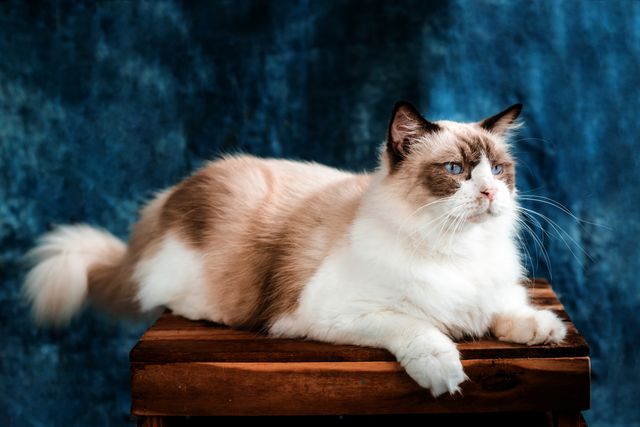
The defining Ragdoll behaviour is not the flop but the following: from room to room, to the door when the key turns, to the edge of the bath for supervisory duties. It is companionship as a hobby, closer to a quiet dog than to the aloof cat of folklore, without the neediness of either stereotype.
They tend to be where you are rather than on you by force, settling within sight, joining laps by invitation and preference. For people who wanted a cat that actually seems pleased to live with them, this is the breed’s whole sales pitch, delivered daily.
Ragdolls talk, but softly: little chirps, trills and polite questions rather than operatic demands, a genuine mercy at five in the morning and a real difference from the famously chatty breeds. Many owners report whole conversations conducted in near whisper.
The volume setting has one practical consequence: a quiet cat’s requests are easy to miss, so a Ragdoll standing meaningfully by a bowl, door or tray deserves the benefit of attention. They rarely shout, which means the small announcements are the announcements.
A breed built for companionship holds you to it: Ragdolls do poorly as leave at dawn, return at dusk solo pets, and the classic answers are a household with people about, a feline companion, or honest planning around absence, with the one kitten or two question worth reading before deciding.
They also stay playful and trainable well into adulthood, happily learning fetch, names and routines, which is enrichment gold if you use it. Meet the company contract and the return on investment is a fifteen year shadow with excellent manners.
Ragdoll temperament is not an accident; it is the breed’s founding selection target: from the first litters, breeding choices favoured tolerance, sociability and calm, and six decades of selection have made the temperament as much a breed feature as the blue eyes.
Genetics loads the dice; raising throws them: the same lines produce their best natures where kittens meet handling, visitors, noises and gentle novelty through the early weeks. That is why how kittens are raised is a buying question fully as important as what the parents are like.
The famous mellow arrives on a schedule: kittens are kittens, chaotic, bitey in play, gloriously undignified, and adolescence adds parkour before the adult calm consolidates somewhere in the second or third year. Buyers expecting a serene lap cat at five months have pre ordered next year’s model.
The through line is visible early even so: the kitten that seeks hands, recovers fast from surprises and settles against you between chaos sessions is showing the adult underneath. Judge trajectory, not the current speed.
The same wiring that makes Ragdolls attuned to their people makes them genuinely sensitive to household weather: tension, shouting matches, upheaval and long absences land harder on this breed than on more self contained cats, showing as hiding, over grooming or appetite drift.
It is a small price with a clear invoice: these cats do best in reasonably stable, reasonably kind households that notice them. In exchange for being noticed back with uncommon attention, they ask that the home’s emotional thermostat be kept somewhere civilised.
The temperament pays practical dividends across a lifetime: vet visits with a cat that tolerates handling, grooming sessions that stay pleasant, medication that can actually be administered, introductions to children and dogs that start from patience rather than panic.
None of it is unconditional, stressed Ragdolls are still cats with full equipment, but the baseline tolerance genuinely changes ownership. Ask any vet team which breeds they are quietly pleased to see on the list; this one features.
We film the colony most days and put the clips out as Ragdoll Drama. Real cats, no script, no idea what they will do next.
Ragdoll temperament is companionship played softly: a cat that follows you room to room, supervises everything, greets visitors rather than vanishing, and prefers company to solitude without demanding centre stage. It is a breed direction, not a guarantee, shaped by lines, socialising and the home, and it asks one honest price: presence. These cats do people.
They are attached and present, supervising rather than smothering for most individuals. Genuine separation distress exists at the far end and responds to enrichment, companionship and routine.
Given a cat respecting dog and a properly staged introduction, often famously well. The breed’s patience helps; the dog’s manners decide.
Most keep a daily play appetite for life, delivered with adult economy of motion: shorter bursts, same enthusiasm for the wand. Senior Ragdolls still hunt; they just prefer the ground floor.
Averages whisper, boys often more openly soppy, girls often more self possessed, and individuals shout. Choose the kitten whose nature fits, not the chromosome.
Yes, in homes with real presence and daily engagement. Empty house households serve the breed better with a companion; the sociability needs an outlet with a heartbeat.
Individuals vary and some are simply reserved; sudden change from a previously social baseline is the version worth investigating. Character is fine; character change is information.
They forgive fast by feline standards, which is part of the charm. What looks like a grudge is usually a cat quietly recalibrating trust after a fright, and gentleness restores it.
The breed name comes from the way many Ragdolls relax completely when picked up, melting over a shoulder like a warm scarf. It reflects an unusually trusting, low tension temperament rather than a party trick, and it varies by individual, so a Ragdoll who prefers four feet on the floor is not faulty, just personal. What is consistent is the softness of the temperament underneath: these are gentle, unflappable, deeply people oriented cats.
Expect to be followed from room to room, supervised in the bathroom, greeted at the door, and helped with all typing. Many Ragdolls fetch, most learn their names quickly, and nearly all choose company over solitude, which is the trait to plan around: a Ragdoll alone all day every day is a sad Ragdoll. Busy households do well to think in pairs, and our waiting list has seen many families conclude exactly that.
That trusting nature is the reason Ragdolls are an indoor breed: a cat this friendly walks up to strangers, cars and dogs with the same open heart it shows you. Indoor living with a secure catio or supervised garden time gives them everything safely, and they adapt to it more contentedly than almost any breed, provided the play and enrichment side of life is taken seriously, which our play guide covers properly.
The gentle giant reputation sometimes gets exaggerated into helplessness, so for balance: Ragdolls play hard, climb, zoom at midnight, and defend a feather toy with genuine athleticism. The difference is the off switch, and the near total absence of aggression with people. Raised underfoot in a colony, handled daily from birth, they arrive already believing humans are wonderful, and your only job is to keep proving them right.
Wondering whether the temperament fits your household? Ask us straight and we will answer the same way.
For the science of feline social behaviour, International Cat Care publishes excellent guides on cat companionship and needs.