
25 Ragdoll Cat Facts: What Makes Them So Special?
Twenty five short, accurate facts about Ragdoll cats, checked by a family that lives with sixteen of them.
Last reviewed
Ragdoll cats are known for going limp when picked up, for being among the largest domestic breeds, and for following their people about like a quiet dog with blue eyes. Those are the three facts everyone knows. Here are 25 Ragdoll cat facts in total, grouped by where the breed came from, how it looks, how it behaves, what living with one involves, and a handful of fun facts about Ragdoll cats for kids. Every one is mainstream and checked, and where sources disagree we give the range. We live with sixteen Ragdolls, so some of this Ragdoll cat information we can confirm from the sofa.
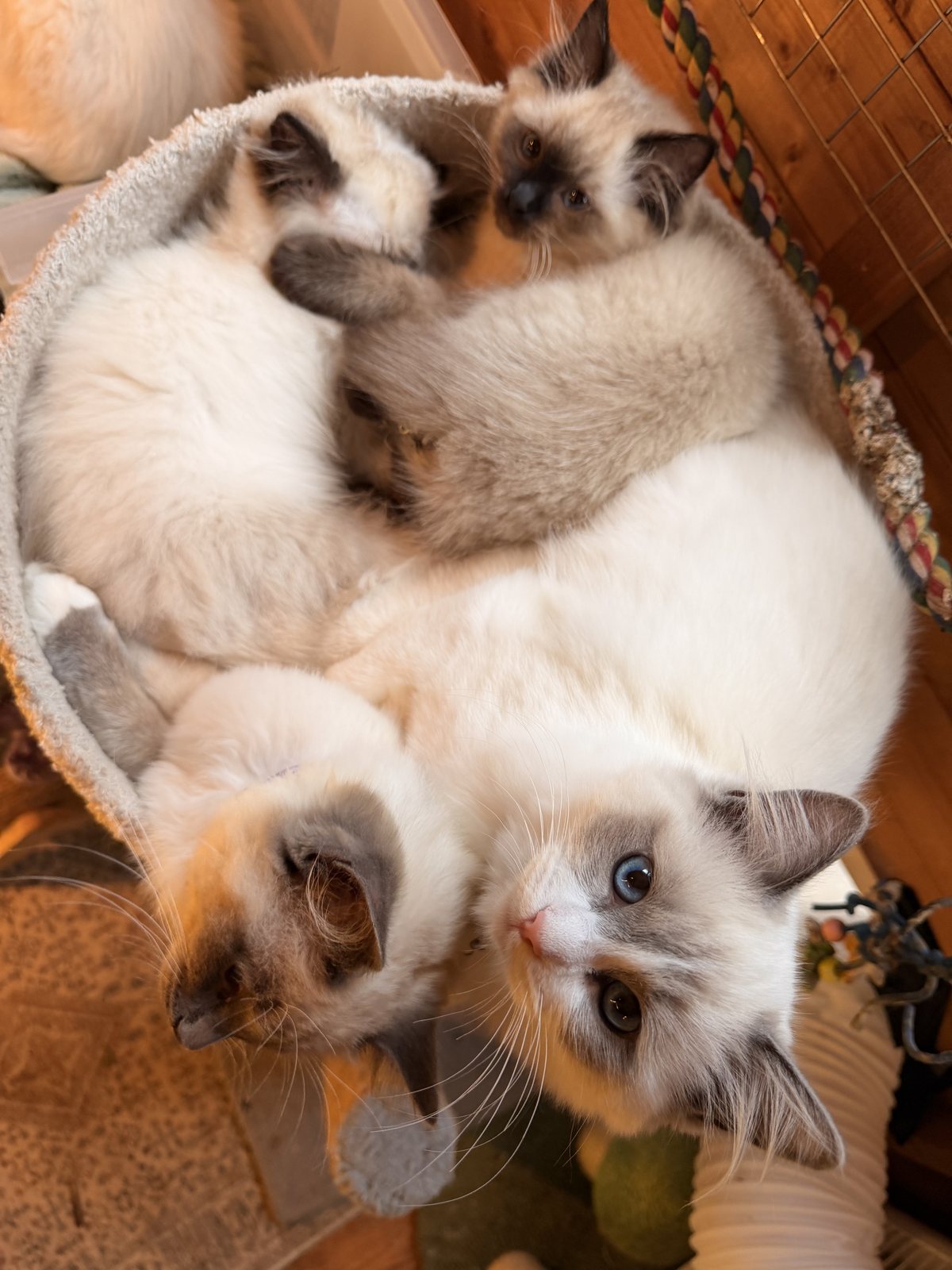
Four of the colony in one basket: the breed's size is easier to believe once they stack.
Where Ragdoll cats came from
1. The breed began with one cat called Josephine
Ragdolls were developed in California in the 1960s by a breeder named Ann Baker, starting from a white longhaired cat called Josephine whose kittens were unusually relaxed and easy to handle.
2. They are one of the youngest pedigree breeds
Sixty years is nothing in cat terms. Persians and Siamese were being shown in the 1800s; the Ragdoll arrived after television did, and the breed is still, in a sense, settling in.
3. The name describes the flop
Josephine's kittens tended to go limp when picked up, like a rag doll, and the name stuck. It remains the single most famous thing about the breed, for better and worse.
4. They reached Britain in the early 1980s
The first Ragdolls arrived in the UK in the early 1980s, and the breed is now recognised by the main UK and US registries. Our history guide tells the full, slightly odd story.
5. The founder trademarked the name
Ann Baker registered the word Ragdoll as a trademark and ran her own registry for years, which is partly why the early politics of the breed were so tangled and why other breeders went their own way.
How Ragdoll cats look
6. They are among the largest domestic breeds
Adult males usually weigh 5.5 to 9 kg and females 3.5 to 6.5 kg, which puts them alongside the Maine Coon at the heavy end of the pet cat scale. See Ragdoll vs Maine Coon for the comparison.
7. Every Ragdoll has blue eyes
Blue eyes are written into the breed standard. A Ragdoll with green or gold eyes is a cross or a mislabelled cat, however lovely it is.
8. Kittens are born pure white
The colour develops over the first weeks and goes on deepening for years. Our colours guide shows what comes in and when.
9. Four patterns and six main colours
The patterns are colourpoint, mitted, bicolour and lynx, which adds tabby stripes to any of the first three. The main colours are seal, blue, chocolate, lilac, red and cream, with tortie versions on top.
10. They take three or four years to grow up
A Ragdoll is slow to mature, physically and in character. Most do not reach full size and full coat until three or four, so the cat you meet at a year old is still a draft.
How Ragdoll cats behave
11. The flop is real, but not universal
Many Ragdolls relax completely when held, which is how the breed got its name. Not every individual does it, and the ones that do choose their moments. More on that in temperament and myths.
12. They are called puppy cats for a reason
Ragdolls follow people from room to room, greet visitors at the door and often learn to fetch a toy. They would rather be where you are than anywhere else, which is a joy and occasionally a trip hazard.
13. They have quiet voices
A Ragdoll's meow is small for the size of the cat, and some barely use it. The purr makes up the difference. See purrs and meows.
14. They are usually kept as indoor cats
Ragdolls are trusting and not streetwise, so most breeders and charities recommend indoor life with a catio or enclosed garden. Our indoor cats guide explains how to do it well.
15. They are not hypoallergenic
The rumour persists because Ragdolls shed less undercoat than some breeds, but the allergen comes from skin and saliva, and every cat produces it.
What living with a Ragdoll involves
16. They live 12 to 17 years
Most sources give a lifespan of 12 to 15 years, with plenty reaching 17 and beyond. Insurance from day one and a sensible weight do more for those numbers than anything else. See senior cats.
17. The coat needs a weekly comb, not daily
The semi longhaired coat is silky with little undercoat, so it mats less than you might fear. Once a week with a comb keeps it that way. Details in grooming.
18. Breeders test for two inherited conditions
HCM, a heart condition, and PKD, a kidney condition, both have DNA tests, and a responsible breeder tests every breeding cat. See health testing before you buy.
19. The kitten does not look like the adult
A nine week old Ragdoll is a pale, short coated scrap. The ruff, the britches, the full colour and the bulk arrive over years. Kitten development shows the stages.
20. A Ragdoll crossed with a Maine Coon is a Ragcoon
The cross combines the two largest companion breeds. We breed them alongside our Ragdolls, and the Ragcoon guide explains what you get.
Fun Ragdoll cat facts for kids
21. A grown Ragdoll is about as long as a metre ruler
Nose to tail tip, a big adult male can stretch close to a metre. Lay a ruler on the floor next to a kitten and come back in three years.
22. The breed is named after a toy
A rag doll is a soft cloth doll that flops however you hold it. The first Ragdoll kittens did the same, so the name was more or less inevitable.
23. The blue eyes and the dark points come from the same gene
The gene that gives a Ragdoll its colour only works on the cooler parts of the body, the ears, face, paws and tail, and it is the same gene that keeps the eyes blue. The warm middle stays pale.
24. They wear trousers
The long fur on the back legs is called britches, and the thick fur around the neck is a ruff. Both take years to grow in fully.
25. Sixteen Ragdolls live in our house
Ten adults and six rising girls share our home, and they star in a daily show called Ragdoll Drama. A day in the colony shows what sixteen of them get up to.
Quick questions, answered
Are Ragdoll cats good with kids?
Usually, yes. Ragdolls are tolerant, slow to use their claws and happy to be carried about, which makes them one of the better breeds for a family. Children still need to learn how to hold a cat and when to leave it alone, and our guide to children and kittens covers that side.
How big do Ragdoll cats get?
Adult males usually weigh 5.5 to 9 kg and females 3.5 to 7 kg, and a big male can measure close to a metre from nose to tail tip. They take three or four years to reach full size, so a one year old Ragdoll is nowhere near finished.
Do Ragdoll cats shed a lot?
Less than most longhaired breeds, because the coat has little undercoat, but they are not a low shedding cat and they are not hypoallergenic. Expect a seasonal moult in spring and autumn, a weekly comb all year, and a fine layer of pale fur on dark clothing regardless.
Are Ragdoll cats expensive to keep?
The kitten is the expensive part: a well bred Ragdoll costs several hundred pounds, ours are £850 and a Ragcoon £600. After that the running costs are those of any large cat: good food, litter, insurance and an annual vet check. Insurance is the one not to skip.
Are Ragdoll cats rare in the UK?
No. The Ragdoll is one of the most popular pedigree breeds in Britain, among the top few for registrations and for kitten adverts year after year, so finding one is never the problem; finding a well bred one is. Within the breed some colours are less common, chocolate and lilac points and the lynx and tortie patterns in particular, and a breeder may quote rarity as a reason for a higher price. Rarity in colour changes nothing about the cat. The rare thing worth paying for is a breeder who health tests, raises kittens underfoot and keeps supporting you afterwards.
Sources and further reading
- Wikipedia: Ragdoll: Breed history, Ann Baker and Josephine, size and recognition
- International Cat Care: Breed welfare, inherited conditions and indoor cat guidance
Thinking about a Ragdoll kitten?
Our Ragdoll and Ragcoon kittens grow up in our home in Ryde, Isle of Wight, with health tested parents and our support for life. See who is available now, or join the waiting list for the next litter.