
From our colony to your sofa
A Day in the Colony
Breakfast parliament to last headcount: where every guide was lived first.
Last reviewed
Breakfast parliament to last headcount: where every guide was lived first.
Last reviewed
People ask what living with fifteen Ragdolls is actually like, and the truthful answer is: organised. A colony runs on rhythm, and it seems only right to show you the day every guide in our library was learned in.
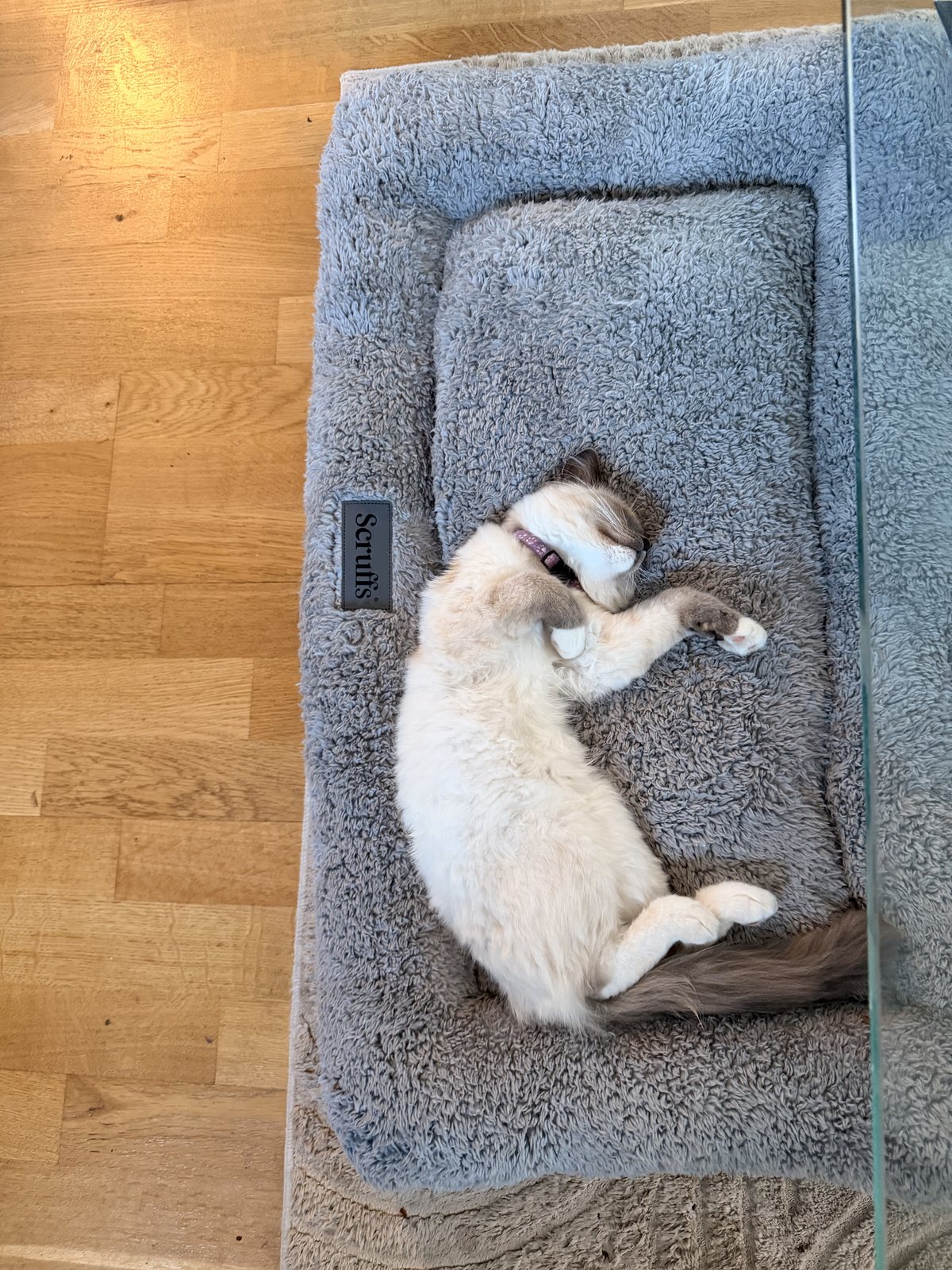
An ordinary afternoon on the shelves: the calm this whole routine exists to produce.
Before anything photogenic happens, mornings here start with a walkthrough that is really a health screen wearing overalls: every cat clocked awake and moving normally, breakfasts watched because appetite is the first page of feline news, trays read like a bulletin board, and anyone whose manner is a shade off noted for a second look later.
It is deliberately boring, the same loop in the same order, because routine is what makes the unusual visible. Almost everything this site’s health guides teach about noticing early begins life here as a morning habit.
The colony’s technology earns its keep quietly: cameras let us check on sleeping kittens and nursing mums without opening doors at silly hours, the feeding station’s recognition means each cat’s eating pattern is genuinely known rather than guessed, and the collar trackers answer where is she before it becomes a search party.
None of it replaces hands and eyes; it extends them into the hours we are asleep and the corners we are not standing in. The pattern it all serves is the same one as the morning audit: know normal precisely, so abnormal announces itself early.
Evenings are the social curriculum: kittens handled in relaxed laps with the television doing its important desensitisation work, visitors’ voices and household clatter filed under ordinary, claws and ears touched gently so future grooming and vet visits arrive pre rehearsed, and the adults collecting their individual fuss on their own terms.
It looks like a family watching telly in a heap of cats because it is one; it is also the manufacturing floor of the confidence buyers notice at viewings. The relaxed kitten on your lap at eight weeks was built in these evenings, one unremarkable night at a time.
Once a week, every kitten crosses the gram scales and every adult crosses the big ones, with the numbers logged against last week’s. Weight is the earliest honest signal in feline health, and in kittens it is practically a live feed: a litter gaining steadily is a litter thriving, and a single flat or falling line gets attention the same day, long before anything else would show.
The habit continues right up to leaving day, which is why every kitten’s folder carries a growth record rather than a guess. It is also the habit we most hope new owners inherit: a monthly weigh at home keeps the same early warning system running for the next fifteen years.
Behind every photogenic blanket pile is a rotation: beds and throws cycled through hot washes on a fixed rhythm, extra loads whenever a litter is at the messy stage, and separate handling for anything from a room housing a mum with young kittens. Fabric is where smells, flea eggs and germs would like to live, so fabric never stays still long enough to host them.
Hard surfaces run their own loop of animal safe disinfection, trays are scrubbed on schedule rather than on smell, and the boring truth underneath it all is that hygiene here is a calendar, not a reaction. Clean that happens by appointment is clean that never gets behind.
Viewings are run for the kittens’ benefit first: arranged in advance, shoes off and hands cleaned at the door, and handling matched to the litter’s age, with the youngest admired mostly from the sofa while mum keeps her veto. It is not ceremony; tiny immune systems and anxious queens both do better when the routine holds.
What visitors get in exchange is the real thing: kittens underfoot in the rooms they actually live in, mum present and relaxed, and every question answered without a script. We would rather show the ordinary truth of the setup than stage a perfect hour, because ordinary truth is what you are buying.
Battersea follow a cattery support volunteer through a full day of looking after the charity’s cats: the charity scale version of the routine this page describes, and a good look at how much of colony life is simply calm, repeated care.
Watch on YouTube Battersea, 24 Hours in Battersea series
We film the colony most days and put the clips out as Ragdoll Drama. Real cats, no script, no idea what they will do next.
A fifteen cat colony runs on rhythm: the breakfast parliament doubles as the first health check, trays are read like tea leaves at midday, grooming and socialisation run on rotation, and the evening hunt ends in the sofa census. Technology backs the routine, with CCTV, facial recognition feeding stations and tracker collars, kittens are weighed every day, wash day never stops, and visitors come by appointment. It is more work than any other way of raising cats, and it is exactly why our kittens arrive so settled.
Squabbles are rare and brief, because the environment is built to prevent them: space to spread out, high routes and rest spots everywhere, and food, water and trays multiplied past the point of competition. Most disputes here are settled by one cat simply taking a different shelf.
Scooping happens promptly through the day, trays are washed on a schedule, ventilation runs constantly and fabric is laundered relentlessly. Visitors regularly say the same slightly surprised sentence at the door, and it is the rotation above that earns it.
Absences are planned around the colony: trusted cover that knows every cat and every routine, notes that leave nothing to memory, and nothing booked during due dates or the fragile first weeks of a litter. The animals’ calendar outranks ours.
Yes, and we would rather you did: viewings are arranged once kittens are old enough, you will meet mum with her litter in the rooms they live in, and you are welcome to take your time. Choosing a kitten should never be done from photographs alone.
Mostly from their mother, with the nursery arranged to help: low sided trays within toddling distance, the same litter throughout, and trays kept spotless so the lesson is always pleasant. By the time kittens leave us, the habit is fully installed and travels with them.
The day starts before we agree to it, with a parliament of trills outside the bedroom door, because cats are crepuscular and dawn is their rush hour, as our zoomies guide explains. Breakfast is served the way our multi cat feeding guide describes: everyone at their own station, kittens and queens separately, plates lifted when the last diner finishes. The bowls are also the first health check of the day, because in a house where every cat has a plate, the one who leaves food behind is noticed by nine in the morning.
By late morning the colony is asleep in sun patches and the humans do the unglamorous work: trays cleaned and read like tea leaves, water refreshed, and the grooming rotation from our grooming guide, a few cats a day so every coat gets the comb every week. When there is a litter, midday is the socialisation shift, the gentle handling, household noises and visitor cuddles that our development guide calls the most valuable thing a breeder ever does, and kittens are weighed so their growth writes itself down daily.
Evenings begin with wand games in shifts, the hunt, catch, eat, sleep ritual from our play guide, which spends the day’s stored mischief before it can be reinvested at three in the morning. In fair weather the catio hosts the sunset shift, all birdwatching and blackbird commentary, and then dinner repeats the morning’s calm arithmetic. Afterwards comes the sofa census, a carpet of flopped cats that explains the breed’s name better than any paragraph ever has.
The day ends with rounds a ship’s watch would recognise: doors and windows checked, the catio latched, a headcount that must reach fifteen, and a last quiet look at any queen with kittens, because our pain guide taught us that cats whisper their troubles and night is when whispers are easiest to miss. Then the house goes dark, already booked for tomorrow’s parliament. A whole library has grown from this routine, and every guide in it was lived in this routine first, somewhere between the breakfast trills and the last headcount.
For the science behind socialisation and rearing, International Cat Care covers kitten development beautifully.