
From our colony to your sofa
Ragdoll Colours & Patterns, Explained
Seal, blue, mitted, bicolour and lynx decoded, plus the born white magic.
Last reviewed
Seal, blue, mitted, bicolour and lynx decoded, plus the born white magic.
Last reviewed
Seal, blue, mitted, bicolour, lynx: Ragdoll adverts read like a paint chart, and buyers understandably ask what it all means. Here is the plain English decoder, plus the magic trick every Ragdoll kitten performs.
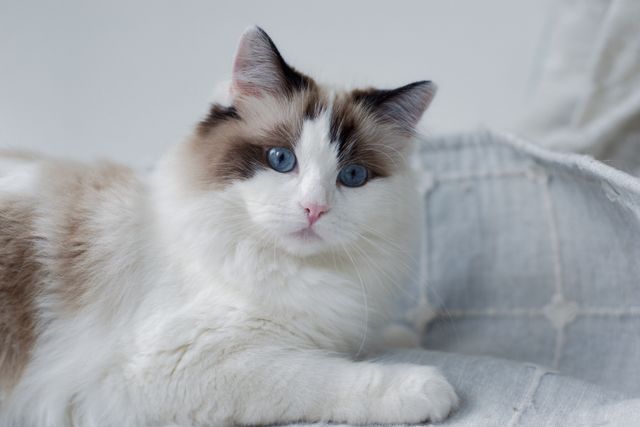
Every Ragdoll wears temperature sensitive colouring: the pigment machinery works properly only where the body runs cooler, which is why colour lives on the ears, face, paws and tail while the warm core stays pale. It is the same genetic mechanism the Siamese made famous, dialled into the Ragdoll’s palette.
The mechanism explains the party tricks: kittens are born effectively white, because the womb is uniformly warm, with points developing over the first weeks and deepening for a couple of years. It even explains why coats can shade subtly with the seasons. The blue eyes come as part of the same genetic package, which is why every true Ragdoll has them.
Colourpoint is the classic full mask, ears, legs and tail in colour with no white anywhere. Mitted keeps the pointed face but adds white gloves on the front paws, white boots behind, a white chin and a white stripe up the tummy. Bicolour paints the boldest look: an inverted white V through the mask, white legs and an overall impression of a cat wearing colour as a cape.
Each pattern comes in the breed’s colours, seal and blue the best known, with others recognised alongside, so the full menu is a grid of colour times pattern. None outranks another except in personal taste; the differences are wardrobe, not character.
Because kittens are born pale and develop for months, the eight week old you meet is a preview, not the finished portrait: seal points darken dramatically, blues deepen to their slate glory, and the pattern edges sharpen as the coat matures. Photographs of the parents are the best forecast of where a kitten’s colour is heading.
And a friendly truth from everyone who has lived with the breed: colour is what catches the eye in the listing, temperament is what you live with for fifteen years. Choose the kitten whose character fits your household and let the wardrobe be the bonus it really is.
Ragdoll kittens are born white because the womb is uniformly warm, and their colour arrives like a photograph developing: points shading in across the first weeks, pattern edges clarifying over months, and the full depth of a seal coat or the true silver of a blue not finalised until two or three years old.
For buyers this means patience with predictions: we can name a young kitten’s colour and pattern with confidence, but its final richness is a slow reveal. The kitten you collect at thirteen weeks is wearing a preview, and the film keeps developing on your sofa.
The pointing gene builds a heat sensitive pigment enzyme: warm skin produces little colour, cool skin produces lots, which is why the coldest real estate, ears, face, paws, tail, wears the darkest fur. The cat is, quite literally, a temperature map of itself.
The same physics writes small footnotes: coats can deepen slightly in cold winters, shaved patches sometimes regrow darker until the cycle normalises, and older cats often darken as circulation changes. None of it is a fault; it is the mechanism showing its workings.
Pedigrees and adverts compress colour into code: the breed’s registries abbreviate colours and patterns into letter number strings that look like algebra but simply stack colour, pattern and overlays in order. Sellers should be able to translate any code they advertise, plainly.
You do not need fluency to buy well; you need consistency: the kitten, the paperwork and the advert should all tell one story. Where a code and a photograph disagree, ask, because honest breeders explain happily and the explanation itself is part of what you are buying.
Folklore assigns personalities to colours, fiery reds, dignified seals, clownish bicolours, and the science declines to cooperate: no robust link ties point colour to temperament. Character comes from genetics beyond colour, early socialising and the home that raises the kitten.
The practical translation: choose colour with your eyes and character with your visits. The kitten whose nature fits your household is the right kitten in every colour, and the photogenic one with the wrong energy is the wrong kitten in all of them.
Floppycats, one of the longest running Ragdoll owner resources, walks through seals, blues, colourpoints, mitteds, bicolours and lynx markings on real cats, so the paint chart on this page comes to life. Very handy to watch before choosing a kitten.
Watch on YouTube Floppycats
We keep a page for each colour and pattern, with photos, the GCCF and TICA standard, how it develops and which of our cats carry it. Tap any card to go deeper.
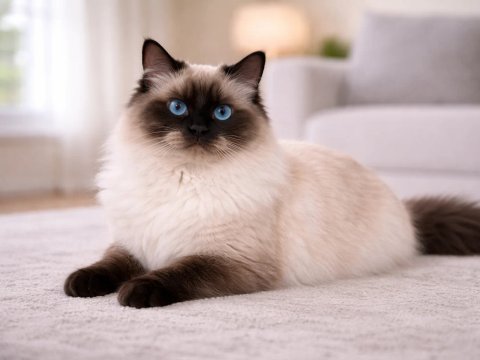 Seal pointDark brown points on warm cream
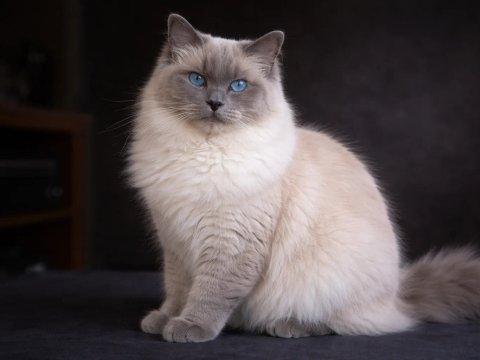 Blue pointSlate grey points on bluish white
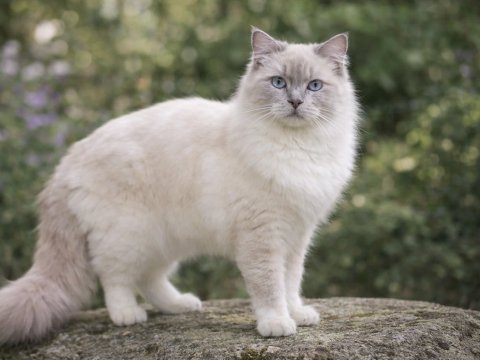 Lilac pointFrosty pink-grey points on milk white
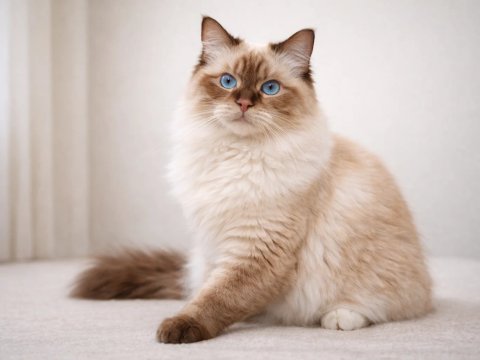 Chocolate pointMilk chocolate points on ivory
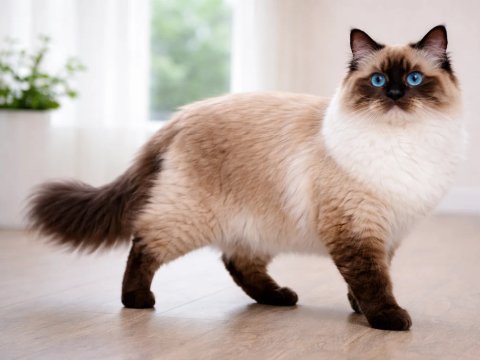 ColourpointFull mask and points, no white
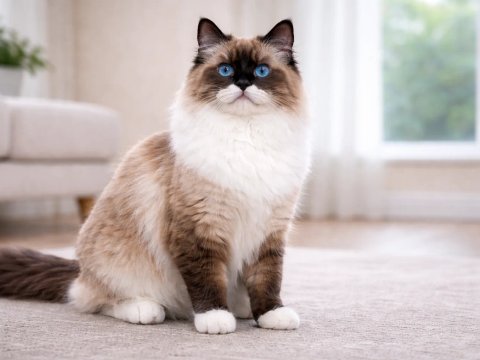 MittedWhite mittens, boots, chin and chest
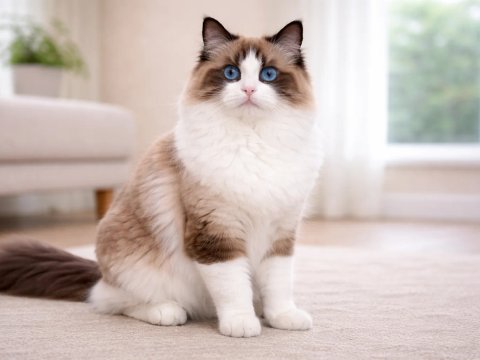 BicolourWhite V on the face, white legs and belly
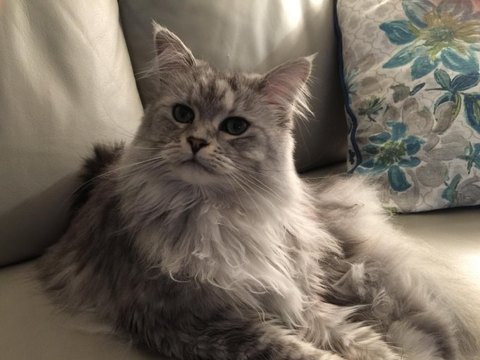 RagcoonRagdoll and Maine Coon cross
Ragdoll adverts read like a paint chart, and it decodes simply: pointing genetics paint the cool parts of the cat, so colour arrives gradually on ears, face, legs and tail, deepening for months. Seal and blue lead the palette; mitted, bicolour and colourpoint set the pattern; lynx adds tabby stripes over any of it. Choose by temperament first and colour second, enjoy watching the colour develop, and let this page retire the myths, no colour is rarer in temperament, only in genetics.
Yes: pointed Ragdolls keep blue eyes for life, in shades from pale sky to deep sapphire that can enrich as the cat matures. Blue is part of the breed’s standard equipment.
Chocolates and lilacs are scarcer than seals and blues in most lines, and red series girls are relatively uncommon for genetic reasons. Rarity affects waiting time more than price honesty should allow it to affect quality.
Tabby barring on a lynx point stays for life, often reading strongest on legs, tail and face. What changes is the background depth around it as the coat matures.
No: blue is the dilute of seal, and two dilutes cannot produce the dense colour. It is one of the tidy rules that lets breeders predict litters and lets buyers sanity check claims.
Gradual deepening with age, colder seasons and circulation changes is normal pointing behaviour. Sudden patchy darkening with skin changes, though, is a vet question rather than a colour one.
Pattern affects show categories and personal taste, not pet quality or temperament. Pay for health, socialising and honesty; the pattern is the wrapping paper.
Torties carry both black based and red based genes, so their litters can span a delightfully wide palette depending on the sire. It is the colour breeder’s box of chocolates.
Ragdoll kittens are born white. The breed carries a temperature sensitive colour gene, so pigment develops on the cooler parts of the body, the ears, face, legs and tail, which is why points darken over the first weeks and a Ragdoll’s full colour keeps deepening for two years or more. It is also why our newborn announcements cannot tell you exact colours yet, and why watching a litter develop is half the fun of a waiting list.
The classic four are seal, a rich dark brown, blue, a soft slate grey, chocolate, a warmer lighter brown, and lilac, a pale pinkish grey. Red and cream points exist too, along with tortie versions where red mingles into the point colour. Whatever the colour, the body stays paler than the points, and the eyes are always blue, from sky pale to deep sapphire.
Colourpoint means the classic look: dark points, no white. Mitted adds white front paws, white back boots, a white chin and belly stripe, as if dressed for the snow. Bicolour goes further, with an inverted white V on the face, white legs and a paler body. Any of these can also be lynx, which overlays tabby stripes into the points. So a “blue lynx mitted” decodes as: grey points, tabby striping, white mittens. Simple once you have the key.
Nothing that matters: temperament, health and size do not follow colour, whatever folklore says. Choose the coat your heart likes and the personality your visit reveals, in that order of importance reversed. Our kittens page lists each kitten’s developing colour, and we are always happy to explain what a particular kitten is likely to become, silver surprises included, as our Ragcoon guide describes.
For the genetics behind coat colour and pattern, International Cat Care covers feline inheritance in owner friendly language.