
Cats and Older People: Company and Routine in Later Life
For people in their sixties, seventies and beyond, and the families choosing with them: why a quiet, affectionate cat fits, what the evidence shows, and how to plan it well.
Last reviewed
For many people in later life a cat is simply good company: something warm asleep on the chair, a reason to get up at the same time each morning, a presence in the house that talks back in its own way. That matters more than it used to, because Age UK estimates around 940,000 people over 65 in the UK are often lonely, and a cat, while it fixes nothing on its own, can make the days better company. The research agrees in the main: in a study of 830 patients over 60, pet owners were 36% less likely to feel lonely, and living alone without a pet carried the highest risk of all. The Ragdoll, the breed that came out most affectionate and least aggressive in a survey of 80 feline vets, is a quiet, indoor, lap seeking cat, and ours usually arrive already calm with people, noise and change because of the way they are raised. This guide sets out the evidence and its limits, why the breed suits, the practical questions worth settling first, and how we help.
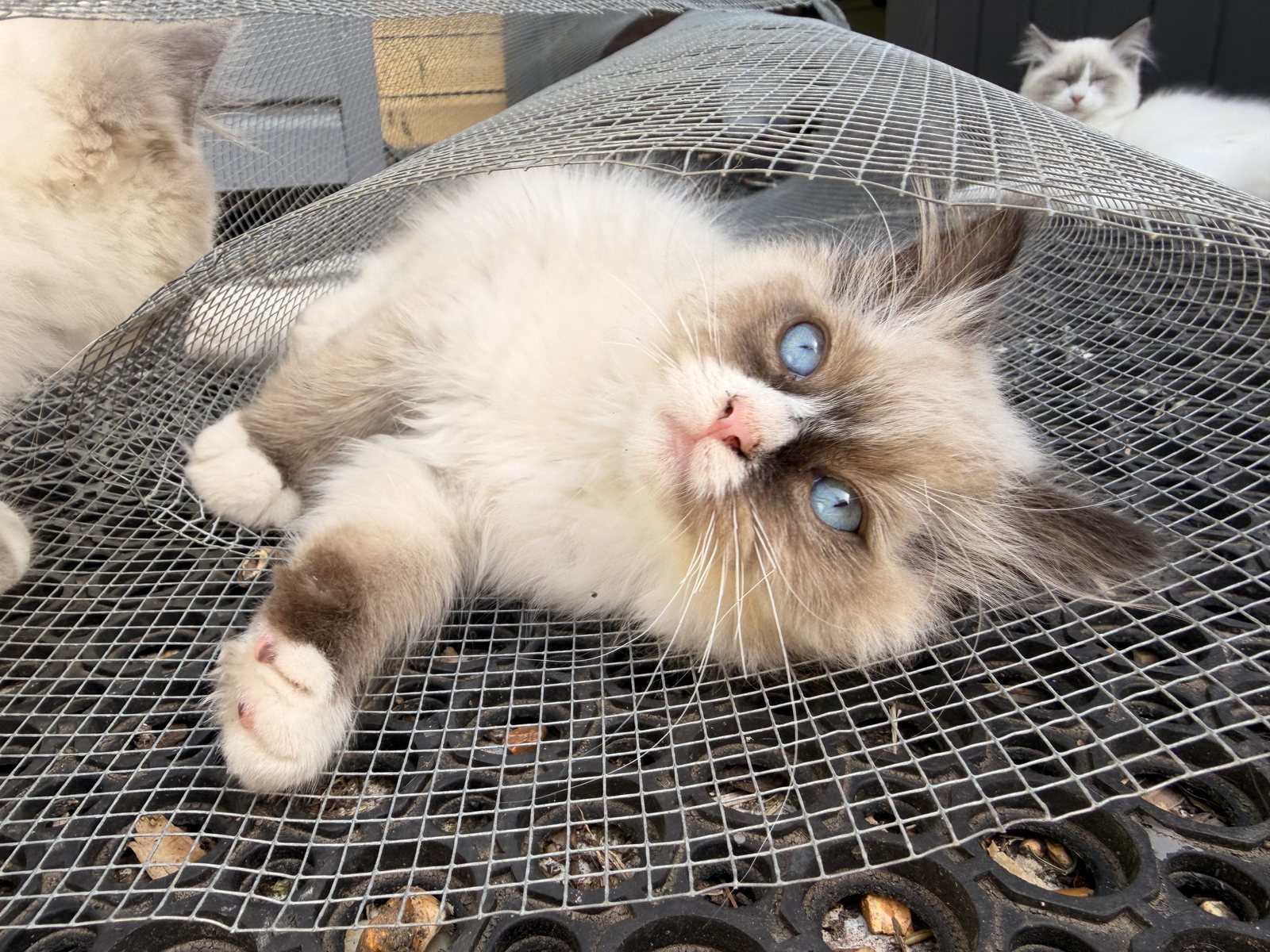
A colony kitten at ease on the hammock: a Ragdoll is content indoors and happiest close to its people.
The short version
- Loneliness in later life is common and serious. One in fourteen people over 65 is often lonely, and nine in ten of those are also unhappy or low (Age UK). Living alone and poor health raise the odds most.
- Pet owners over 60 were a third less likely to feel lonely in one study, and interviews with older owners describe purpose, routine, comfort and a reason to talk to neighbours. Owners in Cats Protection's surveys say their cat gives them a reason to get up in the morning.
- The evidence is mixed, not glowing. Reviews find mixed results in older people, a six year English study found no change in low mood from owning a pet, and lonely people may acquire pets rather than pets curing loneliness. A cat is company, not a treatment.
- Temperament decides whether it works. A nervous or boisterous cat is harder to live with at any age. The Ragdoll is quiet, indoor, affectionate and slow to startle, and a colony raised kitten arrives already settled around people.
- Plan the practical side first. Trip hazards, the grooming, who helps if you are unwell or in hospital, and what happens to the cat if it outlives you. Cats Protection's Cat Guardians and the Cinnamon Trust exist for exactly this.
- Kitten or adult? A well raised kitten can give fifteen years of company; a calmer adult or retired queen skips the boisterous stage. We will tell you which suits.
Contents
- Loneliness in later life: the facts
- Why a cat, and why older people so often choose one
- What a cat can give: company, routine, purpose
- Why the Ragdoll suits later life
- Why colony raised: a settled cat from day one
- The practical questions
- Planning for the cat's future
- A gentle start
- What the research shows, and where it stops
- Where to start with us
- Questions people ask and sources
Loneliness in later life: the facts
Loneliness is not a given of getting older, and most older people are not lonely, but for those who are it is a serious matter. Age UK's December 2024 report found that 7%, one in fourteen people aged 65 and over, are often lonely, which is about 940,000 people in the UK, and that 270,000 older people in England go a week without speaking to a friend or family member. Nine in ten older people who are often lonely are also unhappy or depressed, against four in ten of those who are hardly ever lonely, and the charity expects 1.2 million over 65s in England to be often lonely by 2034 (Age UK, 2024).
The Office for National Statistics found that circumstance matters as much as age: living alone, being widowed and living with a long term health condition are all linked to loneliness. Among widowed older homeowners living alone with a long term condition, 69% felt lonely at least occasionally, against 46% of adults overall (ONS, 2018). Across Britain, chronic loneliness rose from 6% of adults in 2020 to just over 7% in 2022 (Campaign to End Loneliness, 2023).
Age UK's own advice on pets for older people is measured: a pet brings routine and companionship, and the charity suggests weighing the costs and considering an older animal (Age UK, A passion for pets). That is the spirit of this guide.
Why a cat, and why older people so often choose one
A dog needs walking in all weathers; a cat needs feeding, a clean tray and a lap. For someone who would rather not walk a dog in all weathers, a cat offers most of what a pet gives with far less of the physical demand, and a Ragdoll is happiest indoors, which suits a quieter life.
A meaningful role
When researchers interviewed 14 pet owners aged 65 and over in depth, four themes came through: a meaningful role, a purposeful routine and structure, comfort and safety, and social inclusion. Caring for an animal that depends on you is a job that does not retire (Hui Gan and colleagues, 2020).
Something to talk to, and about
In Cats Protection's survey of over 10,000 people, 72% of owners said they often talk to their cat and 92% consider it part of the family (CATS Report 2023). A cat is also a topic: the neighbour who asks after it, the grandchild who comes to see it, the vet receptionist who knows its name.
Quiet physical company
Cats Protection's own advice to older people is that an older, calmer cat in particular can be an ideal companion, and it cites a survey in which 87% of owners felt their cat had a positive effect on their wellbeing and 76% said they coped better with everyday life because of it (Cats Protection: am I too old to own a cat?). The weight of a cat choosing to sit against you is a kind of contact that asks nothing in return.
What a cat can give: company, routine, purpose
What older owners report, matched against the evidence that exists.
Less lonely
The clearest study is of 830 primary care patients aged 60 and over. Pet owners were 36% less likely to report feeling lonely than non owners, after allowing for age, mood and living arrangements, and the combination of living alone without a pet carried the highest odds of loneliness of all (Stanley and colleagues, 2014). In the UK lockdown survey of about 6,000 adults, pet owners reported slightly less loneliness, an effect the researchers called small and not a reason to get a pet for your mental health, and cats and dogs were equally bonded (Ratschen and colleagues, 2020).
A shape to the day
Breakfast at the same time, the tray, the brush, the evening on the sofa. In Cats Protection's surveys 45% of owners agreed that their cat gives them a reason to get up in the morning and 73% said having a cat brings them joy (CATS Report 2023). Older owners interviewed in the Australian study described the routine as purposeful rather than a chore (Hui Gan 2020).
Calmer in the moment
Ten minutes stroking a cat or dog lowered the stress hormone cortisol in a randomised trial (Pendry and Vandagriff, 2019), pet owners show a smaller rise in heart rate and blood pressure under stress (Allen, Blascovich and Mendes, 2002), and in a Swiss study a cat eased a bad mood in the moment about as much as a partner did (Turner, Rieger and Gygax, 2003).
Illustrations, not evidence
- A widower who has let breakfast slide starts making it again, because the cat sits by the bowl at seven and will not be ignored.
- A woman whose children live on the mainland finds the house less silent with something padding about in it, and has something new to tell them when she phones.
- A couple in their seventies choose a Ragdoll because it stays in, sleeps on the bed and never needs a walk in the rain.
These are the kinds of stories families tell us. They show what is possible, not what is guaranteed.
What a cat cannot do
The fair reading of the research is mixed. A review of 54 studies found that none of the 15 studies with only older participants showed a clear positive effect on mental health (Scoresby and colleagues, 2021). A six year study of 7,617 English adults over 50 found that owning a pet did not change the course of low mood (Sharpley and colleagues, 2020), and an analysis of the same English study suggests that loneliness can come first and the pet second, so some of the link runs from loneliness to pet rather than the other way (Pikhartova, Bowling and Victor, 2014). A cat makes the days better company; it does not replace people, a GP, or the support a person needs. The best outcome is a cat that becomes one more reason to stay connected, not a substitute for it.
Why the Ragdoll suits later life
Cats Protection's advice that a calmer cat suits an older person is right, and breed is one good way to improve the odds. The Ragdoll was bred for exactly the temperament that fits a quieter home.
What the breed bodies say
The GCCF describes the Ragdoll as having an easy, laid back temperament and in general loving interaction with people and other animals, and notes that how a kitten is raised, with frequent loving handling and play, contributes enormously to its socialisation (GCCF Ragdoll profile). TICA calls the Ragdoll a loving, quiet cat with a laid back disposition, and warns that if you want a very active or talkative cat the Ragdoll is probably not for you (TICA breed page).
What the studies say
Two veterinary scientists at UC Davis asked 80 feline practitioners to rank 15 pedigree breeds on 12 behaviours. The Ragdoll came out most affectionate, most socially outgoing and least aggressive to cats and people (Hart and Hart, 2013). A Finnish owner survey of 5,726 cats placed the Ragdoll among the least active breeds, in a group of breeds that were the least fearful and least aggressive, with aggression and shyness both moderately heritable, which is why choosing calm parents matters so much (Salonen and colleagues, 2019).
Why those traits suit an older owner
- Content indoors. A Ragdoll does not need to roam, so there is no worry about roads, no cat flap to manage and no searching the garden at night. Our indoor cats guide explains how to keep one happy inside.
- Lap seeking and tolerant of handling. The breed is known for settling on people and accepting brushing, carrying and cuddling, which is the kind of company many people want from a cat.
- Slow to startle, slow to bite. A cat that does not react sharply is easier and safer to live with, especially if your skin bruises or tears easily.
- Quiet. Ragdolls tend to be soft voiced, and night time yowling is uncommon.
- Lower energy. The breed sits among the least active in the Finnish survey, which means less tearing round the furniture and fewer surprises underfoot.
Being honest about the limits
Breed averages describe populations, and every Ragdoll is an individual. Some are vocal, some are busy, some dislike being picked up. A Ragdoll kitten is still a kitten, with teeth, claws and zoomies, and the settled adult temperament takes two to three years to arrive. The coat needs combing a few times a week and the breed has an inherited heart condition to screen for; our pros and cons guide is the fair version. Nobody can promise you a calm cat. What a good breeder can offer is a kitten from calm parents, raised to be confident, whose individual personality you have met.
Why colony raised: a settled cat from day one
Breed sets the ceiling; the first weeks of life decide how much of it a kitten reaches. A Ragdoll raised quietly by one queen in a spare room and a Ragdoll raised underfoot in a house of sixteen adult cats, chickens, a peacock, a hoover and a family will grow into different cats, and the science on why is consistent. For an older owner who wants a cat that settles in quickly and is not thrown by visitors, carers or a change of routine, this is the part that matters most.
The sensitive period
Kittens have a window for learning what is safe, roughly two to seven weeks of age (International Cat Care; Cats Protection). What a kitten meets calmly in that window it tends to accept for life; what it never meets, it may fear. Handling by several different people, including men, women and children, produces more sociable adult cats than handling by one person.
Handling, parents and the mother's example
In a study that followed kittens to a year old, those handled regularly from two to twelve weeks were quicker to approach, touch and rub against people and were less distressed when approached and handled by strangers; boldness toward new things followed the father (McCune, 1995). Friendliness to people has been linked to the father in two separate colonies (Turner and colleagues, 1986), and how a cat reacts to being held by a stranger is a stable trait from four months onward (Lowe and Bradshaw, 2002). Kittens also learn by watching their mother, and International Cat Care notes that a poorly socialised mother holds back her kittens' socialisation.
Weaning and leaving
The large Finnish survey found that cats weaned before eight weeks showed more aggression and repetitive behaviour as adults, and the researchers suggested keeping kittens with their mother to at least fourteen weeks (Ahola, Vapalahti and Lohi, 2017). No kitten leaves us before nine weeks, weaned by its mother rather than by a timetable, and our reasoning on nine to ten weeks, and why it differs from that and from the usual guidance, is set out on our story page.
Why colony raised is different
A conventional set up is one queen and her litter, kept apart from other cats in a quiet room, with handling that depends on who has time. Ours is a domesticated colony of sixteen adult Ragdolls living in the house, and kittens are born into it. In practice that means:
- Many calm adults to learn from, not one. Kittens grow up inside a group with a settled social order, copying the unbothered way a dozen adults react to the doorbell, the hoover and visitors.
- Parents chosen for temperament. We breed from cats we live with every day, so we know which lines are bold, which are gentle and which are busy, and we keep only the calm, people loving ones in the programme. Because shyness and aggression are heritable, this matters.
- Daily handling by the whole household from birth: adults, children and visitors, with brushing, paw and ear checks and carrying built into the routine. Our kittens meet ducks, chickens, a peacock, guinea pigs, parrots, the washing machine and the general bustle of a working family home before the fear window closes.
- Underfoot, not in a spare room. They are raised in the kitchen and living room, which is where they will live with you.
No study has compared colony rearing with conventional rearing head to head, and we would rather say so than pretend. What the research does show is which ingredients make a confident, settled, people loving cat: several handlers, calm parents, adults to learn from and a long time with the mother. A colony delivers every one of them every day, as the way the house works rather than a programme someone has to remember to run. That is why our kittens have usually arrived already at ease with people, noise and change, and why families often tell us the kitten settled into a quieter home within days rather than weeks.
The practical questions
Most of these have easy answers, and settling them before the cat arrives is what makes the difference between a cat that is a pleasure and a cat that becomes a worry.
Trips and falls
This is the one real physical risk. American emergency department data counted about 86,600 pet related fall injuries a year, nearly 12% of them involving cats, with the highest rates in people over 75; two thirds of cat related falls were from tripping over the cat (Stevens, Teh and Haileyesus, 2009). The fixes are simple: a cat that is fed in the same place rather than one that winds round your legs in the kitchen, a collar bell or a light coloured cat that is easy to see, no toys left on the stairs, and a lamp on at night. Never carry the cat on the stairs, and keep the litter tray off any route you walk in the dark. A Ragdoll's low energy helps; any calm adult cat is less likely to dart between your feet than a young kitten. One more line worth adding: if you take blood thinning medication or your immune system is weakened, keep the cat's nails trimmed and ask your GP what to do about scratches.
Lifting and bending
An adult Ragdoll weighs 4.5 to 9 kg (size guide), which is a real lift for anyone with a bad back or a weak shoulder. The answer is not to lift: a cat that comes to your lap of its own accord never needs carrying, a raised feeding station and a litter tray with a low entrance save bending, and a carrier that opens from the top makes vet trips easier. Our cat friendly home guide covers the set up.
Grooming
A Ragdoll needs combing two or three times a week to stop mats forming (grooming guide). Many people find it a pleasant, calming few minutes, but if arthritis makes it hard, a family member, a visiting groomer or a mobile grooming service can take it on.
Cost
Food, litter, insurance and routine vet care add up to a steady monthly sum, and the occasional emergency can be large. Insurance from day one takes much of the worry away; our insurance guide and price guide give realistic figures.
Hospital stays and holidays
Decide now who feeds the cat if you are unwell, and who drives it to the vet if you no longer drive. A neighbour, a family member, a cat sitter or a cattery all work; the Cinnamon Trust, the national charity for older people and their pets, has volunteers who help with day to day care and can foster a pet during a hospital stay (Cinnamon Trust).
Housing
If you may move to sheltered housing or a care home, ask early for the written pet policy. The Society for Companion Animal Studies has guidance on finding pet friendly housing and notes that pet bans are the second most common reason pets are given up to UK shelters (SCAS: pets and housing), and the Cinnamon Trust keeps a register of pet friendly care homes and retirement housing (pet friendly care home register).
Planning for the cat's future
A kitten can live fifteen years or more, so it is worth deciding now who would care for it if you could not. That is not a reason not to have one; it is a reason to plan, and the planning is easier than people expect.
- Cats Protection's Cat Guardians is a free service: you register, add a clause to your will, and if you die the charity collects your cat, health checks it and finds it a new home, with a promise never to put a healthy cat to sleep because it is hard to rehome (Cat Guardians).
- The Cinnamon Trust offers lifelong care for pets whose owners have died or gone into care, through its own foster homes and sanctuaries, and will become the pet's legal guardian (Cinnamon Trust).
- Family first. If a son, daughter or friend would take the cat, write it down and tell them. A cat that already knows them, from visits and the occasional stay, moves more easily.
- Our kittens can come back to us. If circumstances change and nobody can take the cat, we ask to be the first call: we will take the cat back or help find it the right home.
With one of these in place, one of the biggest worries about getting a cat later in life is answered.
A gentle start
Our kittens have usually settled within days, but the first fortnight still deserves care, for the cat's sake and for yours.
- One room first. Food, water, a tray, a bed and somewhere to hide, and let the cat come out at its own pace; Cats Protection's advice is to go at the cat's pace and not rush (Welcome home guide).
- Let the cat come to you. Sit, read, be boring. Most of ours come to a lap within the first few days, though every kitten sets its own pace.
- Build the routine early. Feeding, play and bed at the same times; this is the structure that helps you as much as the cat.
- Keep walkways clear and feed the cat in one spot away from where you walk, from the first day.
- Expand the territory gradually, one room at a time.
Learn the stress signals
Flattened ears, a twitching tail, dilated pupils, a crouched body, hiding, eating less, over grooming or toileting outside the tray are all signs to give the cat space. International Cat Care's stress in cats and the PDSA body language guide show what to look for, and Cats Protection's cat stress page covers the subtler signs.
Children and grandchildren
Visiting grandchildren are usually welcome to a Ragdoll raised among children, as ours are, but a cat still needs somewhere to retreat to. Our children and kittens guide has the house rules.
What the research shows, and where it stops
A proportionate summary, so you can see how much weight each claim can bear.
Older people specifically
- Pet owners over 60 less likely to be lonely: 830 primary care patients, adjusted odds a third lower, living alone without a pet the loneliest group (Stanley 2014). Cross sectional, so it shows association, not cause.
- Interviews with 14 owners over 65: meaning, routine, comfort and social inclusion (Hui Gan 2020). Small and qualitative.
- Mixed or null in the reviews: none of 15 older adult only studies in a 54 study review were clearly positive (Scoresby 2021); a systematic review of 145 studies graded the evidence topic by topic and set out where better designs are needed (Gee and Mueller 2019); a scoping review of 62 sources listed wellbeing and activity as pros, grief and falls as cons (Obradović and colleagues, 2020).
- English longitudinal data: no change in low mood over six years with a pet (Sharpley 2020); lonely women more likely to acquire a pet later (Pikhartova 2014). A 2025 meta analysis of 21 studies found no overall link between pet ownership and depression, and a small raised risk among cat owners which the authors could not explain and which may reflect who chooses a cat (Moshfeghinia and colleagues, 2025).
Cats and wellbeing in general
- Short term calming effects are well supported: cortisol (Pendry 2019), stress reactivity (Allen 2002), negative mood (Turner 2003).
- Owners overwhelmingly say their cat helps: 94% in a 2019 Cats Protection survey (Cats Protection), and companionship, feeling less lonely and feeling less stressed together make up the most common reasons for having a cat (CATS Report 2024).
Ragdolls specifically
- No study has looked at Ragdolls and older owners. The breed's suitability rests on the temperament evidence above.
In short: a cat can make an older person's days better company and give them structure, and most owners surveyed say it helps, but it does not treat loneliness or low mood and the better studies say so. The right question is whether this cat would make your days better, and for many people the answer is yes.
Where to start with us
If you think a Ragdoll might suit you, or a parent, this is how it works with us.
- Tell us about the home. Who lives there, whether stairs are an issue, how much lifting is possible, whether a kitten's first year of energy is welcome or a calmer cat would suit better. Use the enquiry form or message us.
- Kitten, or a calmer adult. We will tell you plainly which kitten in a litter is the quiet lap sitter and which is the explorer, and we will say if we think a retired adult from our colony, when one is available, would suit you better than a kitten (retired queens are covered here).
- Visit at your own pace. Appointments in our home in Ryde, where you meet the kitten, the mother and the colony. Bring the family if they are helping choose.
- A gentle handover. Collection at our home, never a courier, with a kitten pack that includes a blanket carrying the colony's scent, and our check ins at one week and one month, then support for life.
- Mainland families choosing for a parent on the Island, or the other way round, can use our mainland collection page.
Our current litters are on the kittens page, and the waiting list hears first about the next one.
Questions people ask
Am I too old to get a cat?
Age on its own is not the issue. Cats Protection's own advice is that a calmer cat can be an ideal companion for an older person. The questions that matter are practical ones: who helps if you are unwell, whether lifting and bending are a problem, and who takes the cat if it outlives you. Cats Protection's free Cat Guardians service and the Cinnamon Trust both exist to answer the last one, and every kitten of ours can come back to us.
Are Ragdolls a good cat for an older person?
On temperament, one of the better suited breeds. In a survey of 80 feline vets the Ragdoll came out the most affectionate and least aggressive of 15 pedigree breeds, owner surveys place it among the least active, and it is usually content indoors and on a lap. It is also a large cat that needs combing two or three times a week, so plan who does the grooming and avoid lifting. A calm adult may suit better than a kitten for someone who wants quiet company now.
Do cats help with loneliness in older people?
The evidence says often yes, within limits. Pet owners over 60 were 36% less likely to feel lonely in a study of 830 patients, older owners describe purpose and routine, and nearly half of Cats Protection's respondents say their cat gives them a reason to get up. Reviews also find mixed results, and lonely people may acquire pets rather than pets curing loneliness. A cat is good company alongside people, not instead of them.
What happens to my cat if I go into hospital or a care home?
Plan it before you need it. A neighbour, family member or cattery covers a hospital stay, and the Cinnamon Trust has volunteers who help with daily care and can foster a pet while you are in hospital. For a move into care, ask early for the home's written pet policy; the Cinnamon Trust keeps a register of pet friendly care homes and retirement housing.
Is a cat a trip hazard?
It can be, and it is the one physical risk worth taking seriously: American emergency data found the highest rates of pet related falls in people over 75, most cat related ones from tripping over the cat. Feed the cat in one place away from where you walk, keep stairs clear of toys, use a collar bell, keep a light on at night, never carry the cat on the stairs, and choose a calm, low energy cat. An adult Ragdoll is less likely to dart between your feet than a young kitten.
Sources and further reading
- Age UK: you are not alone in feeling lonely (2024): 940,000 over 65s often lonely; 270,000 go a week without a conversation
- Age UK: a passion for pets: routine, structure and companionship, and the costs to weigh
- ONS: loneliness, characteristics and circumstances (2018): living alone, widowhood and long term conditions as the drivers
- Campaign to End Loneliness: the state of loneliness 2023: chronic loneliness in Britain, 2020 to 2022
- Stanley et al 2014, Aging and Mental Health: 830 older primary care patients: pet owners 36% less likely to be lonely
- Hui Gan et al 2020, Aging and Mental Health: interviews with 14 owners over 65: role, routine, comfort, inclusion
- Pikhartova, Bowling and Victor 2014, BMC Geriatrics: English Longitudinal Study: loneliness and pet ownership run both ways
- Sharpley et al 2020, Journal of Affective Disorders: 7,617 English adults over 50: pets did not change depressive symptoms over six years
- Scoresby et al 2021, Veterinary Sciences: 54 study review; none of the older adult only studies clearly positive
- Gee and Mueller 2019, Anthrozoös: systematic review of 145 studies on pets and older adults
- Obradović et al 2020, Ageing and Society: scoping review: pros and cons of pets for independence in later life
- Moshfeghinia et al 2025, Annals of General Psychiatry: meta analysis of 21 studies on pet ownership and depression
- Ratschen et al 2020, PLOS ONE (University of Lincoln release): 5,926 UK adults in lockdown: pets and loneliness
- Pendry and Vandagriff 2019, AERA Open: ten minutes stroking cats and dogs lowered cortisol
- Allen, Blascovich and Mendes 2002, Psychosomatic Medicine: pet owners calmer under stress
- Turner, Rieger and Gygax 2003, Anthrozoös: cats reduce negative mood about as much as a partner
- Stevens, Teh and Haileyesus 2009, MMWR: fall injuries involving cats and dogs by age
- Cats Protection: CATS Report 2023: reasons for having a cat, reason to get up, talking to the cat
- Cats Protection: CATS Report 2024: the 2024 edition
- Cats Protection: 2019 mental health survey: 94% of owners say their cat helps their mental health
- Cats Protection: am I too old to own a cat?: the charity's advice to older owners
- Cats Protection: Cat Guardians: free service to rehome your cat after your death
- The Cinnamon Trust: volunteer help, fostering and lifelong care for older people's pets; also listed in the NHS service directory
- Cinnamon Trust: pet friendly care home register: care homes and retirement housing that accept pets
- Society for Companion Animal Studies: pets and housing: finding pet friendly sheltered housing and care
- Cats Protection: welcome home guide: settling a new cat at its own pace
- Salonen et al 2019, Scientific Reports: breed differences and heritability in 5,726 cats, including Ragdolls
- Hart and Hart 2013, Your Ideal Cat (UC Davis release): 80 feline vets rank 15 breeds; Ragdoll most affectionate, least aggressive
- GCCF and TICA Ragdoll breed profiles: the breed bodies on temperament; TICA at tica.org/breed/ragdoll
- McCune 1995, Applied Animal Behaviour Science: early handling and the father's influence on friendliness and boldness
- Ahola, Vapalahti and Lohi 2017 (University of Helsinki): weaning age and adult behaviour in the Finnish survey
- Cats Protection: kitten socialisation: the two to seven week window and what a kitten should meet
- Cats Protection: cat stress: reading stress signals in cats
- International Cat Care: stress in cats: causes, signs and prevention of stress
- PDSA: cat body language: posture, tail, ears and what purring does and does not mean
Thinking about a Ragdoll kitten?
Our Ragdoll and Ragcoon kittens grow up in our home in Ryde, Isle of Wight, with health tested parents and our support for life. See who is available now, or join the waiting list for the next litter.