
Cats and Anxiety: How a Calm Ragdoll Could Help
For anyone living with anxiety, and the people who care about them: why a quiet, affectionate cat can make the day easier, what the evidence says, and how to choose well.
Last reviewed
Anxiety is common, exhausting and often hidden: a UK survey of 6,000 adults found nearly three quarters had felt anxious in the previous fortnight and almost half were keeping it to themselves. A calm cat that settles against you, asks nothing and keeps the same gentle routine every day can be one of the steadiest things in the life of someone living with anxiety, and the research is starting to explain why: ten minutes stroking a cat or dog lowers the stress hormone cortisol, pet owners, cats included, show a smaller physical stress response under pressure, and many people living with long term mental health conditions place their pets at the very centre of their support. The Ragdoll is the breed vets rate the most affectionate and least aggressive, and the way we raise ours, inside a colony of sixteen adult cats with handling from birth, is designed to give a kitten the best possible start toward the calm, predictable, people loving temperament that helps most. This guide sets out what a cat can and cannot do for anxiety, why the Ragdoll suits, and how we help you choose the right one.
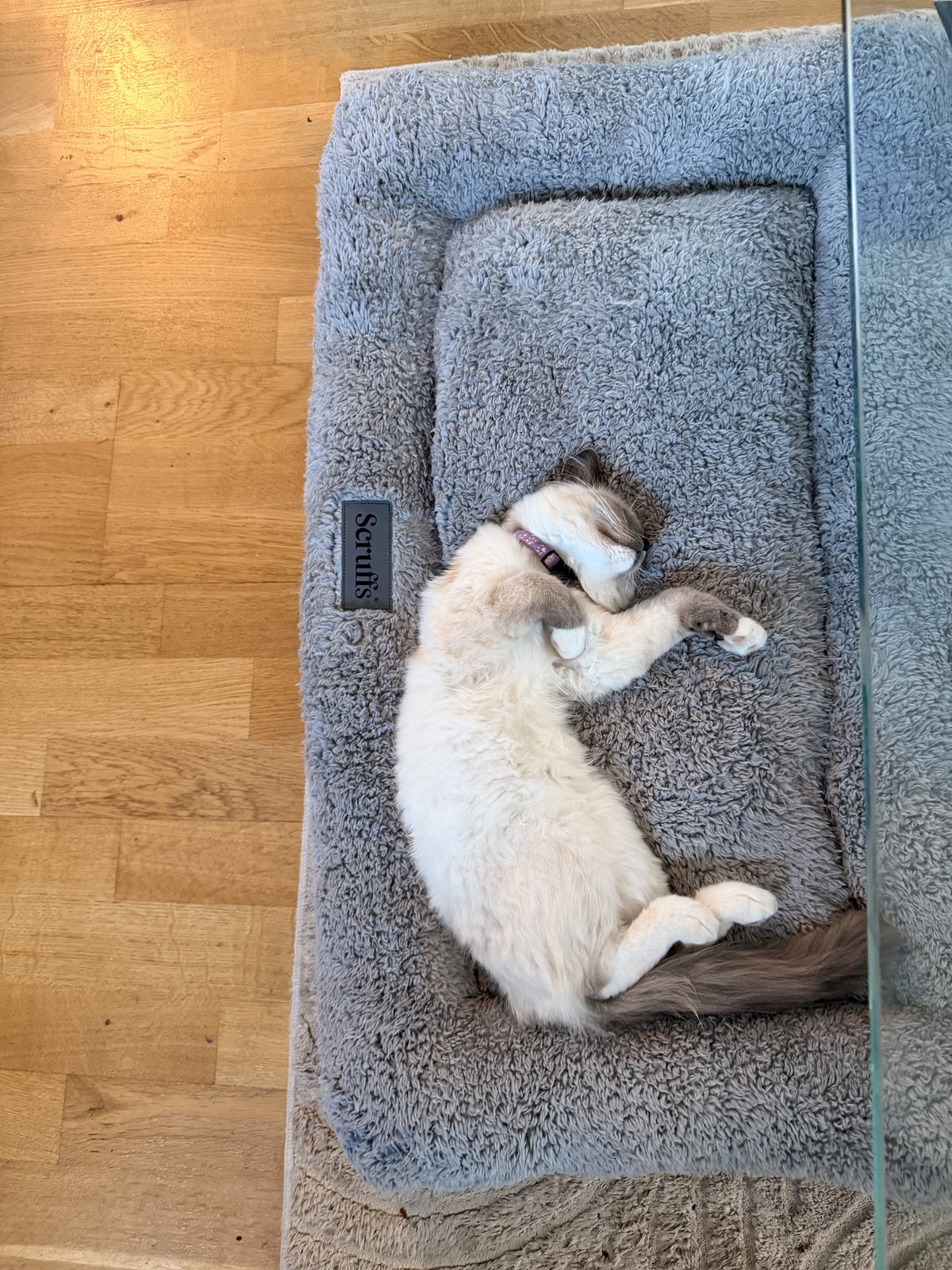
Two of our colony Ragdolls at rest: slow, quiet company is what many anxious people find most calming.
The short version
- A cat can help you feel calmer, and the evidence is real. Stroking a cat or dog for ten minutes lowered cortisol in a randomised trial of 249 students. Pet owners, cat owners among them, had lower resting blood pressure and a smaller spike under stress than non owners in a study of 240 couples. People with cats reported less negative mood, about as much as having a partner.
- Owners say the same. In Cats Protection's 2023 survey of over 10,000 people, a quarter of owners said their cat helps them feel less stressed or anxious, 45% said their cat gives them a reason to get up in the morning, and in an earlier survey 94% said their cat helps their mental health.
- A cat is not a treatment. Reviews of the research find mixed results, no randomised trials of pet ownership for anxiety, and small effects at population level. A cat sits alongside talking therapy, medication, exercise or whatever else helps a person, never instead of it.
- Temperament is what matters. A jumpy, aloof or demanding cat can add to anxiety. The Ragdoll is rated the most affectionate and least aggressive of the pedigree breeds, and a colony raised Ragdoll has every chance of arriving already at ease with people, noise and change.
- The care is part of the benefit. Feeding, play and grooming at the same times each day give a shape to the day that many anxious people find steadying, and that is one of the themes that comes through strongest in the research.
- Fit matters more than breed. Meet the individual cat, be honest about cost, allergies and who does the daily work, and let the cat choose contact.
Contents
- Anxiety: what it is and how common it is
- Why a cat, and why so many anxious people choose one
- What a cat can give: calm, routine, company
- Why the Ragdoll: the breed built for calm company
- Why colony raised: how we build the temperament that matters
- What to think about before you decide
- A gentle start for person and cat
- What the research shows, and where it stops
- Where to start with us
- If you need support now
- Questions people ask and sources
A note on language: we follow Mind's guidance and write about people living with anxiety, not defined by it, and we do not describe any animal as a cure. Anxiety is something a person experiences, not what they are.
Anxiety: what it is and how common it is
Everyone feels anxious sometimes. The Mental Health Foundation describes anxiety as a normal response to feeling threatened, under pressure or stressed, which can become a mental health problem when it gets out of control, and says up to 1 in 20 people in the UK have a generalised anxiety disorder. The NHS describes generalised anxiety disorder as a common condition where a person often feels very anxious, notes it is more common in women than men, and says adults can refer themselves to NHS talking therapies without going through a GP.
How widespread it is became clear in the Foundation's 2023 survey of 6,000 UK adults: 73% had felt anxious at least sometimes in the previous two weeks, one in five felt anxious most or all of the time, 45% were keeping their anxiety secret and nearly a third said they were not coping well (Mental Health Awareness Week 2023 report). Among 18 to 24 year olds the figure was 86%, and for over half of them it had stopped them doing everyday things.
What that means for this guide: a great many of the people reading it, and probably some of the families who come to us for a kitten, are living with anxiety in some form. The question is not whether a cat can make anxiety vanish, which is not what any companion animal does, but whether the right cat can make the days steadier. The evidence suggests it often can, and our experience with families agrees.
Why a cat, and why so many anxious people choose one
Dogs get most of the attention in the research on animals and wellbeing, but for someone living with anxiety a cat can be the easier fit, and many people seem to feel that themselves. A University of California survey of 1,239 cat owners found that those who scored higher for anxiety reported more trust in and affection for their cats (Delgado and Reevy, 2020). Cats Protection found the same pattern from the other direction: stress relief mattered especially to 18 to 24 year olds, the age group the anxiety survey found most affected, with 30% giving it as a reason for having a cat (CATS Report 2023).
A cat asks little of you
A cat does not need walking at seven in the morning, does not need you to be sociable, and does not mind if you have not spoken to anyone all day. People living with long term mental health conditions described their pets to researchers as offering acceptance without judgement, constant company and a reason to keep going: in a Manchester and Southampton study, 60% of the pet owners interviewed placed their pet in the innermost circle of their support network, closer than most family and friends (Brooks and colleagues, 2016).
Low effort company that fits an anxious day
On an anxious day there may not be much energy to spare. A cat is still company on a bad day: it sits with you on the sofa, follows you to bed, purrs on your chest. In a Swiss study comparing people with cats, people with partners and people with neither, having a cat reduced negative mood by about as much as having a human partner did (Turner, Rieger and Gygax, 2003). That is a remarkable finding for an animal that mostly sleeps.
Touch that is chosen
Most Ragdolls choose to be close: on the lap, against the leg, draped over an arm. The weight, warmth and slow breathing of a cat that has settled on you is grounding in a very physical way, and unlike human contact it carries no social obligation. For some people it is the easiest kind of closeness there is.
What a cat can give: calm, routine, company
Here is what people report, matched against the evidence that exists. We have kept the research separate from the stories so you can see how much weight each claim can bear.
Calmer in the moment
The clearest evidence is about the short term. In a randomised trial at Washington State University, 249 students were assigned to ten minutes of hands on stroking of cats and dogs, watching others do it, a slideshow of the animals, or a waiting list. Only the hands on group showed lower cortisol, the body's main stress hormone, afterwards (Pendry and Vandagriff, 2019). In an earlier study of 240 married couples put through mental arithmetic and an ice water test at home, pet owners had lower resting heart rate and blood pressure, a smaller rise under stress and a faster recovery than non owners, and the response was calmest of all when the pet was in the room; cat owners and dog owners did not differ (Allen, Blascovich and Mendes, 2002). A Dutch study that prompted 55 owners ten times a day for five days found negative feelings were lower whenever the pet was present, and positive feelings rose with interaction (Janssens and colleagues, 2020).
A shape to the day
Anxiety can make days formless; a cat makes them regular. Breakfast at seven, play in the evening, the same spot on the bed every night. In the systematic review of 17 studies of pet owners with mental health conditions, routine, activity and a sense of purpose came through as some of the strongest benefits, alongside distraction from symptoms and unconditional company (Brooks and colleagues, 2018). Cats Protection's owners put it simply: 45% said their cat gives them a reason to get up in the morning, and 72% said they often talk to their cat (CATS Report 2023).
Less lonely
Anxiety and loneliness feed each other. Among 830 older primary care patients, pet owners were 36% less likely to report feeling lonely, and living alone without a pet carried the highest odds of all (Stanley and colleagues, 2014). During the UK lockdown, a survey of 5,926 adults found pet owners had smaller declines in mental health and smaller rises in loneliness than non owners, with over 90% saying their animal helped them cope emotionally; cats and dogs were equally bonded (Ratschen and colleagues, 2020).
Illustrations, not evidence
- Someone who wakes anxious at three in the morning finds a cat already curled against their back, and the breathing of another living thing is enough to get them back to sleep.
- A person who dreads leaving the house still gets up, because the cat needs feeding, and finds that being needed by something small and uncomplicated is easier than being needed by people.
- A teenager who cannot explain to anyone how bad the day was sits on the floor and lets the cat climb into their lap, and nothing needs explaining.
These are the kinds of stories families tell us and that appear in the interview studies. They show what is possible, not what is guaranteed.
What a cat cannot do
A cat does not treat an anxiety disorder, and no study claims it does. Reviews of the field find the results mixed, the studies mostly small and self reported, and no randomised trial of owning a pet for anxiety (Scoresby and colleagues, 2021; Herzog, 2011). The widely repeated claim that cat owners are 30 to 40% less likely to die of a heart attack comes from a single observational analysis of American survey data that has not been replicated and should not be relied on (Qureshi and colleagues, 2009). A cat also brings cost, vet worries and, one day, grief; in the lockdown survey 68% of owners were worried about their animals. The right way to think of a cat is as one steady, living part of a life that also includes whatever professional support a person uses. The Mental Health Foundation puts it well: a pet can be a great source of comfort and motivation, and it is a serious commitment, not something to do on a whim.
Why the Ragdoll: the breed built for calm company
If the benefit comes from a cat that is calm, affectionate and predictable, then the breed and the individual matter a great deal. A skittish cat that hides, a cat that bites when stroked or a cat that yowls through the night can make an anxious person more anxious. The Ragdoll has a reputation for the opposite, and the evidence below shows why.
What the breed bodies say
The GCCF describes the Ragdoll as having an easy, laid back temperament and in general loving interaction with people and other animals, and notes that how a kitten is raised, with frequent loving handling and play, shapes the adult (GCCF Ragdoll profile). TICA calls the Ragdoll a loving, quiet cat with a laid back disposition, and warns that if you want a very active or talkative cat the Ragdoll is probably not for you (TICA breed page). For an anxious person, quiet and laid back are exactly the point.
What the studies say
Two veterinary scientists at UC Davis asked 80 feline practitioners to rank 15 pedigree breeds on 12 behaviours. The Ragdoll came out most affectionate, most socially outgoing and least aggressive to cats and people (Hart and Hart, 2013). A Finnish owner survey of 5,726 cats placed the Ragdoll among the least active breeds, in a group of breeds that were the least fearful and least aggressive, with aggression and shyness both moderately heritable, which is why choosing calm parents matters so much (Salonen and colleagues, 2019).
Why those traits help with anxiety
- Slow to startle, slow to bite. A cat that does not react sharply does not give you anything to brace for.
- Seeks you out. Ragdolls are typically follow you from room to room, sleep on your feet, climb into your lap cats. The company arrives without being asked for.
- Quiet. Most Ragdolls are soft voiced, which matters at three in the morning.
- Happy indoors. A Ragdoll is content as an indoor cat, so there is no late night worry about where it is.
- Tolerant of handling. Brushing, carrying, cuddling: the breed generally accepts all of it, which makes the physical closeness many anxious people find grounding easy to come by.
Being honest about the limits
Breed averages describe populations, and every Ragdoll is an individual. Some are vocal, some are busy, some dislike being picked up. A Ragdoll kitten is still a kitten, with teeth, claws and zoomies, and the settled adult temperament takes two to three years to arrive. The coat needs combing a few times a week and the breed has an inherited heart condition to screen for; our pros and cons guide is the fair version. Nobody can promise you a calm cat. What a good breeder can offer is a kitten from calm parents, raised to be confident, whose individual personality you have met.
Why colony raised: how we build the temperament that matters
Breed sets the ceiling; the first weeks of life decide how much of it a kitten reaches. A Ragdoll raised quietly by one queen in a spare room and a Ragdoll raised underfoot in a house of sixteen adult cats, chickens, a peacock, a hoover and a family will grow into different cats, and the science on why is consistent. For someone living with anxiety, who needs a cat that is settled rather than one that adds to the household's nerves, this is the part that matters most.
The sensitive period
Kittens have a window for learning what is safe, roughly two to seven weeks of age (International Cat Care; Cats Protection). What a kitten meets calmly in that window it tends to accept for life; what it never meets, it may fear. Handling by several different people, including men, women and children, produces more sociable adult cats than handling by one person.
Handling, parents and the mother's example
In a study that followed kittens to a year old, those handled regularly from two to twelve weeks were quicker to approach, touch and rub against people and were less distressed when approached and handled by strangers; boldness toward new things followed the father (McCune, 1995). Friendliness to people has been linked to the father in two separate colonies (Turner and colleagues, 1986), and how a cat reacts to being held by a stranger is a stable trait from four months onward (Lowe and Bradshaw, 2002). Kittens also learn by watching their mother, and International Cat Care notes that a poorly socialised mother holds back her kittens' socialisation.
Weaning and leaving
The large Finnish survey found that cats weaned before eight weeks showed more aggression and repetitive behaviour as adults, and the researchers suggested keeping kittens with their mother to at least fourteen weeks (Ahola, Vapalahti and Lohi, 2017). No kitten leaves us before nine weeks, weaned by its mother rather than by a timetable, and our reasoning on nine to ten weeks, and why it differs from that and from the usual guidance, is set out on our story page.
Why colony raised is different
A conventional set up is one queen and her litter, kept apart from other cats in a quiet room, with handling that depends on who has time. Ours is a domesticated colony of sixteen adult Ragdolls living in the house, and kittens are born into it. In practice that means:
- Many calm adults to learn from, not one. Kittens grow up inside a group with a settled social order, copying the unbothered way a dozen adults react to the doorbell, the hoover and visitors.
- Parents chosen for temperament. We breed from cats we live with every day, so we know which lines are bold, which are gentle and which are busy, and we keep only the calm, people loving ones in the programme. Because shyness and aggression are heritable, this matters.
- Daily handling by the whole household from birth: adults, children and visitors, with brushing, paw and ear checks and carrying built into the routine. Our kittens meet ducks, chickens, a peacock, guinea pigs, parrots, the washing machine and the general bustle of a working family home before the fear window closes.
- Underfoot, not in a spare room. They are raised in the kitchen and living room, which is where they will live with you.
No study has compared colony rearing with conventional rearing head to head, and we would rather say so than pretend. What the research does show is which ingredients make a confident, settled, people loving cat: several handlers, calm parents, adults to learn from and a long time with the mother. A colony delivers every one of them every day, as the way the house works rather than a programme someone has to remember to run. That is why our kittens tend to arrive already at ease with people, noise and change, and why families often tell us the kitten became a steady presence rather than one more thing to worry about.
What to think about before you decide
A cat chosen in a low moment, before the practical questions have been thought through, can become a source of worry rather than relief. These are the honest questions, and the answers to most of them are fine.
Start with you
- What do you want from a cat? Company in the room, physical closeness, something to care for, a reason to keep a routine? Different answers suit different cats.
- Will the care feel like structure or like pressure? A cat's needs are usually light: two meals, a tray, a brush, play. If daily tasks already feel overwhelming, think about who shares them.
- How do you cope with change? A new animal is a big change, and the first fortnight is the hardest. Plan it for a settled period, not a crisis.
- Money. Worry about vet bills is one of the most common pet related stresses. Insurance from day one takes much of that worry away; our insurance guide and price guide give realistic figures.
- Allergies. No cat is hypoallergenic, Ragdolls included (myths guide). Spend time around the breed before committing.
- The long view. A Ragdoll lives 12 to 16 years (lifespan guide). That is a long, steady companionship, and one day a loss. Many owners say it is worth it; it is right to know it is coming.
Then the cat
- Meet the individual. Spend time with the actual kitten, more than once if possible. Watch how it responds to being approached, to noise and to being picked up. A breeder who will not let you do this is not the right one.
- Kitten or adult? A well raised kitten gives the longest bond but needs a year or two of patience through the boisterous stage. For someone who needs calm now, a settled adult, or the quietest kitten in a litter, may be the better fit, and we will tell you which that is.
- One or two? A pair keeps each other company when you are at work or having a low day, and takes some of the pressure off you; it also doubles the cost and the activity. Our one kitten or two guide weighs it.
- Grooming. A Ragdoll needs combing two or three times a week. Many people find the few minutes of brushing calming in itself; if handling will be hard, plan who does it (grooming guide).
If after all this you decide a cat is not right for now, that is a sound decision, not a failure, and we will say so if we think it.
A gentle start for person and cat
The gentler the start, the sooner the calm arrives, and the cat's welfare is not an afterthought: a stressed cat is an unpredictable cat, and an unpredictable cat is no help to someone living with anxiety.
A step by step start
- One quiet room first. Set up a single room with food, water, a tray, a bed and a hiding place, and let the kitten live there until it is relaxed. Cats Protection's advice is to go at the cat's pace and not rush (Welcome home guide). Our kittens, raised in a busy house, often settle quickly, but give them the room anyway.
- Let the cat come to you. Sit on the floor, read, be boring. The kitten approaches when it is ready.
- Short, voluntary contact. A hand offered to sniff, a stroke along the back if the cat leans in, then stop. End every interaction while it is still going well.
- Build the routine early. Feeding at the same times, play at the same time, lights out at the same time. This is the structure that helps you as much as the cat.
- Expand the territory gradually, one room at a time, keeping the original room as the retreat.
Never force contact
No forced cuddling, no holding a cat still. A cat made to tolerate handling learns to avoid the person. Contact initiated by the cat is the goal, and it is the kind of contact that calms.
Learn the stress signals
Flattened ears, a twitching tail, dilated pupils, a crouched body, hiding, eating less, over grooming or toileting outside the tray are all signs to give the cat space. Cats Protection's cat stress page, International Cat Care's stress in cats and the PDSA body language guide show what to look for. Knowing what your cat is telling you removes the guesswork, which for many people is where worry starts.
On purring
Many people find a purring cat on their chest deeply calming, and that is reason enough to enjoy it. Be wary of claims online that purr frequencies heal bones or treat illness: the Library of Congress notes that one researcher has suggested purring may be a natural healing mechanism, and that is where it stands, a suggestion rather than evidence. Cats also purr when frightened or in pain. Enjoy a purr for what it is.
What the research shows, and where it stops
A proportionate summary in three strands, so that you can see how much weight each claim can bear.
Cats specifically
- Cats reduce negative mood about as much as a human partner does, though unlike a partner they do not lift positive mood (Turner 2003, a Swiss study of several hundred people). People living alone who felt less low after two hours with their cat had cats more responsive to them (Rieger and Turner 1999, 96 owners).
- Cat owners show a calmer stress response in the laboratory, with no difference from dog owners (Allen 2002, 240 couples).
- Stroking cats and dogs lowers cortisol for a short while (Pendry 2019, randomised, 249 students). Cats and dogs were used together, so there is no cat only trial.
- Anxious people bond strongly with cats (Delgado and Reevy 2020, 1,239 owners), which shows the attachment rather than proving the cat reduces the anxiety.
- Even cat videos help a little: in a survey of nearly 7,000 people, most reported a better mood after watching them (Myrick 2015); self selected and self reported.
- UK owners overwhelmingly say their cat helps: 94% in a 2019 Cats Protection survey (Cats Protection), and in the 2023 and 2024 CATS Reports companionship, feeling less lonely and feeling less stressed were together the most common reasons for having a cat at all (CATS Report 2024).
Pets in general and mental health
- A systematic review of 17 studies of pet owners with mental health conditions found consistent reports of emotional support, routine, purpose and distraction from symptoms, alongside cost, housing problems and grief, with no randomised trials and mostly small samples (Brooks 2018).
- A review of 54 studies of dog and cat owners found 17 positive, 19 mixed, 13 with no effect and 5 negative, and concluded the results are variable and not wholly supportive of a mental health benefit (Scoresby 2021).
- A review of 69 controlled studies found most reported lower heart rate, blood pressure or stress responses with an animal present and proposed oxytocin as the mechanism, but most of that work used dogs (Beetz 2012).
- In a six year study of 7,617 older English adults, owning a pet did not change the course of depressive symptoms (Sharpley and colleagues, 2020), and the lead author of the UK lockdown survey said its effects were unlikely to be clinically significant (Ratschen 2020).
Ragdolls specifically
- No study has examined Ragdolls and anxiety. The breed's suitability rests on the temperament evidence in the breed section and on the socialisation science in the colony section.
In short: a calm cat often helps people feel calmer in the moment, gives structure and company that people with mental health conditions value highly, and is loved by the overwhelming majority of owners; whether it changes the course of an anxiety disorder is not something the research can say, and we would rather say so plainly. The right question is not "do cats cure anxiety" but "would this cat make my days steadier", and for many people the answer turns out to be yes.
Where to start with us
If you think a Ragdoll might be right for you, or for someone you care about, this is how it works with us.
- Tell us about the person. Whether a quiet lap cat or a playful one would suit, how much routine and predictability matter, whether the cat will be an only pet, anything that worries you. Use the enquiry form or message us; there is no pressure and no hard sell.
- We match, not just sell. We watch every litter daily and will tell you plainly which kitten is the bold explorer, which is the lap sitter and which is the quiet one, so the kitten that comes home is the one most likely to suit.
- Visit at your own pace. Appointments in our home, where you meet the kitten, the mother and the colony it grew up in. Nobody is rushed, and if a visit feels like too much on the day, we rearrange.
- Updates between visits. Photos and video so you can get used to your kitten before it arrives, and so the wait is something to look forward to rather than worry about.
- A gentle handover. Collection at our home, never a courier, with a kitten pack that includes a blanket carrying the colony's scent to help the kitten settle, and our check ins at one week and one month, then support for life. If something is worrying you about your kitten at any point, you can ask us, which is a worry fewer.
Our current litters are on the kittens page, and the waiting list hears first about the next one.
If you need support now
A cat is good company; it is not a crisis service. If anxiety is hard to cope with right now, these UK services are there, and reaching for them is the sensible thing to do.
- NHS talking therapies: adults can refer themselves for anxiety and depression without a GP referral.
- NHS 111: call 111 and select the mental health option for urgent mental health help (NHS urgent help page). Call 999 if someone's life is at risk.
- Samaritans: 116 123, free, any time, day or night.
- Mind infoline: 0300 123 3393, 9am to 6pm, Monday to Friday.
- Anxiety UK: anxietyuk.org.uk, the charity specialising in anxiety conditions, infoline 03444 775 774.
The NHS anxiety, fear and panic page has self help steps and says to see a GP if you are struggling to cope or what you are trying yourself is not helping.
Questions people ask
Can a cat help with anxiety?
For many people, yes, in a practical everyday way. Research shows stroking a cat or dog lowers cortisol in the short term, pet owners, cats included, show a calmer physical stress response, cats reduce negative mood about as much as a partner does, and many people with long term mental health conditions place their pets at the centre of their support. A cat does not treat an anxiety disorder and sits alongside, never instead of, talking therapy, medication or whatever else a person uses.
Are Ragdolls good cats for anxious people?
On the temperament evidence, they are among the better suited breeds. Vets rate the Ragdoll the most affectionate and least aggressive of the pedigrees, owner surveys place it among the least active and least fearful, and breed bodies describe a quiet, laid back cat that loves people. A calm, predictable, lap seeking cat is the kind many people say helps. Individuals vary and kittens are boisterous for the first year or two, so meet the kitten and ask the breeder which is the quiet one.
Is a cat an emotional support animal in the UK?
Not in law. The Equality and Human Rights Commission says emotional support animals are not defined in the Equality Act 2010, though allowing one may sometimes be a reasonable adjustment. In UK law an assistance animal means an assistance dog, so there is no assistance cat, and shops and services are not obliged to admit an emotional support animal as they would an assistance dog. A cat that steadies you at home is a companion, which needs no label and carries no special rights.
Will looking after a cat add to my anxiety?
It can if the cat is a poor fit or money is tight, so plan for it. Choose a calm, well raised cat rather than a nervous one, insure it from day one so a big vet bill is not the worry it would otherwise be, keep the routine simple, and share the daily care if you can. Many owners find the care itself steadying: in Cats Protection's survey 45% said their cat gives them a reason to get up in the morning.
Does purring really calm people down?
Many people say it does, and the warmth and vibration of a purring cat settled on you is for many the most calming thing about owning one. Claims that purr frequencies heal bones or treat illness are a suggestion from one researcher, not tested evidence, and cats also purr when frightened or in pain. Enjoy a purr for the comfort it is rather than as a medical device.
Sources and further reading
- Mental Health Foundation: anxiety: what anxiety is and the up to 1 in 20 figure for generalised anxiety disorder
- Mental Health Foundation: Mental Health Awareness Week 2023 anxiety report: survey of 6,000 UK adults on how common and how hidden anxiety is
- Mental Health Foundation: pets and mental health: comfort, motivation and the warning that a pet is a serious commitment
- NHS: generalised anxiety disorder: definition and self referral to talking therapies
- Pendry and Vandagriff 2019, AERA Open: randomised trial: ten minutes stroking cats and dogs lowered cortisol in 249 students
- Allen, Blascovich and Mendes 2002, Psychosomatic Medicine: 240 couples: pet owners calmer under stress, cat and dog owners alike
- Turner, Rieger and Gygax 2003, Anthrozoös: cats reduce negative mood about as much as a human partner
- Rieger and Turner 1999, Anthrozoös: people living alone with cats, mood and the cat's responsiveness
- Janssens et al 2020, Anthrozoös: pet presence and momentary mood in daily life
- Brooks et al 2018, BMC Psychiatry: systematic review of 17 studies of pet owners with mental health conditions
- Brooks et al 2016, BMC Psychiatry: 54 people with long term conditions on where pets sit in their support networks
- Stanley et al 2014, Aging and Mental Health: 830 older adults: pet owners less lonely
- Ratschen et al 2020, PLOS ONE (University of Lincoln release): 5,926 UK adults during lockdown: pets, mental health, loneliness and worry
- Delgado and Reevy 2020, Anthrozoös (UC Davis release): 1,239 cat owners: anxious owners report stronger bonds
- Myrick 2015, Computers in Human Behavior: nearly 7,000 people on cat videos and mood
- Scoresby et al 2021, Veterinary Sciences: review of 54 studies: mixed evidence on pets and mental health
- Herzog 2011, Current Directions in Psychological Science: why the pet effect is a hypothesis rather than a fact
- Beetz et al 2012, Frontiers in Psychology: 69 controlled studies on animals, stress and oxytocin, mostly dogs
- Sharpley et al 2020, Journal of Affective Disorders: 7,617 older English adults: pets did not change depressive symptoms over six years
- Qureshi et al 2009, Journal of Vascular and Interventional Neurology: the single flawed study behind the heart attack claim
- Cats Protection: CATS Report 2023: 10,392 people on why they have a cat and what it gives them
- Cats Protection: CATS Report 2024: the 2024 edition, 10,522 people
- Cats Protection: 2019 mental health survey: 94% of owners say their cat helps their mental health
- Salonen et al 2019, Scientific Reports: breed differences and heritability in 5,726 cats, including Ragdolls
- Hart and Hart 2013, Your Ideal Cat (UC Davis release): 80 feline vets rank 15 breeds; Ragdoll most affectionate, least aggressive
- McCune 1995, Applied Animal Behaviour Science: early handling and the father's influence on friendliness and boldness
- Ahola, Vapalahti and Lohi 2017 (University of Helsinki): weaning age and adult behaviour in the Finnish survey
- Cats Protection: kitten socialisation: the two to seven week window and what a kitten should meet
- Cats Protection: cat stress: reading stress signals in cats
- International Cat Care: stress in cats: causes, signs and prevention of stress
- PDSA: cat body language: posture, tail, ears and what purring does and does not mean
- Equality and Human Rights Commission: assistance dogs: UK law on assistance dogs and the status of emotional support animals
- Mind: media guidelines on talking about mental health: the language guidance this page follows
- Mind: helplines: Mind infoline and other support numbers
Thinking about a Ragdoll kitten?
Our Ragdoll and Ragcoon kittens grow up in our home in Ryde, Isle of Wight, with health tested parents and our support for life. See who is available now, or join the waiting list for the next litter.