
From our colony to your sofa
Designing a Cat-Friendly Home
Routes, heights and quiet zones: invisible to guests, obvious to cats.
Last reviewed
Routes, heights and quiet zones: invisible to guests, obvious to cats.
Last reviewed
You do not need a house that looks like a climbing wall, and your sofa is not doomed. The best cat friendly homes are ordinary rooms with a few deliberate decisions layered in, most of them invisible to guests and all of them obvious to the cat.
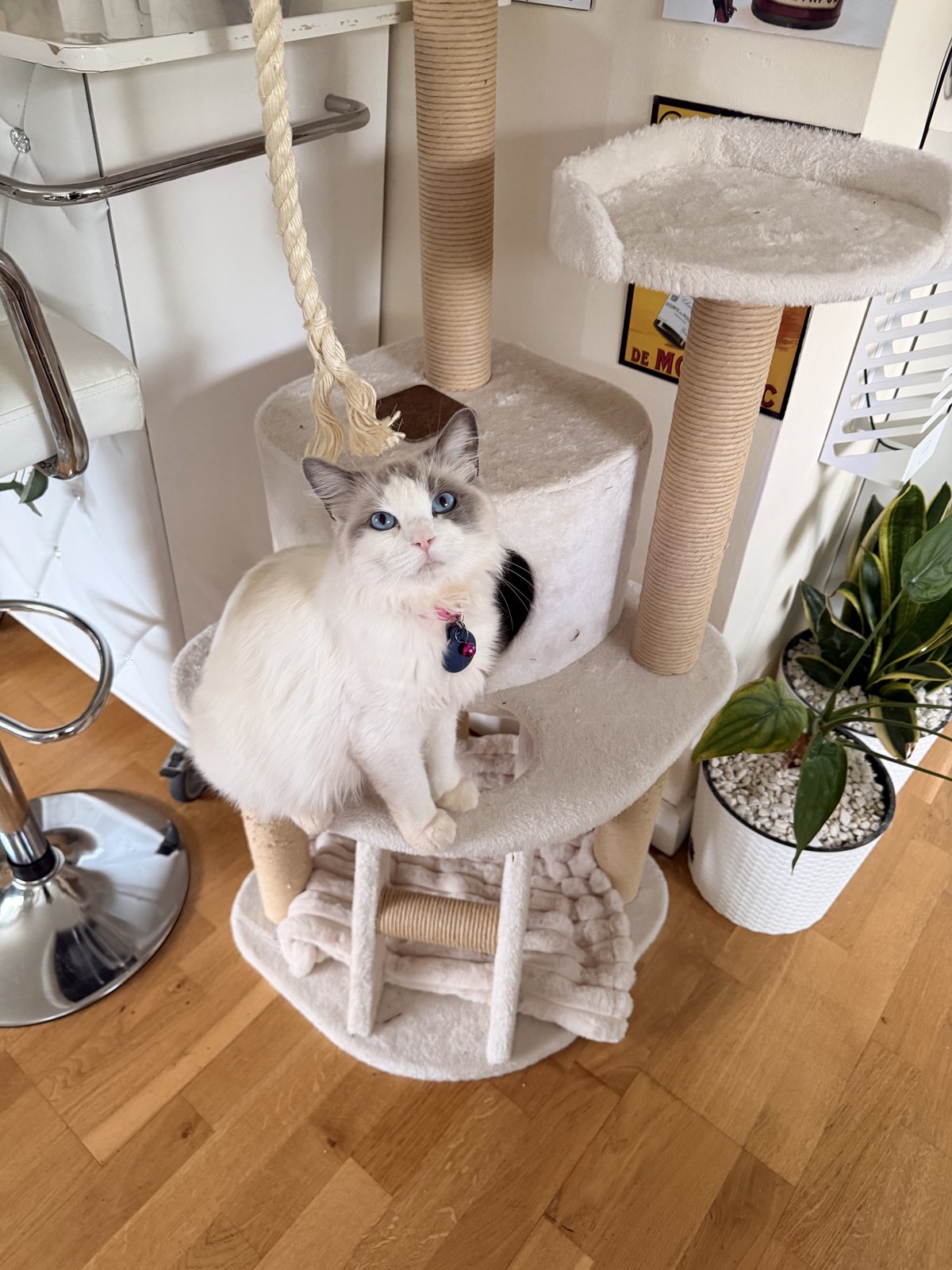
Altitude, sunlight and a view: the three currencies of feline interior design.
Cats measure a home in cubic metres: shelf circuits, cat trees at windows, wardrobe top access and a clear route across a room without touching floor turn a flat into a territory. Height is security infrastructure, the observation post from which a confident cat supervises its estate.
Audit each main room for one legal high spot with grippy landing and easy dismount, then watch usage redistribute. Half of feline mischief on counters and bookcases is simply unmet altitude demand finding its own solutions.
A home reads differently by nose: cheek rubbed corners are ownership certificates, scratching stations are public notices, and your role is providing official channels, sturdy posts at the room entrances and beside sleeping spots where announcements naturally go. A post by the sofa arm usually retires the sofa arm.
Respect the filing system when cleaning: strong citrus and heavy fragrance on a cat’s marked furniture erases their paperwork and invites re marking. Clean around the signage, not through it, and the system polices itself.
Every cat needs a place where nothing can follow: a covered bed on a shelf, a gap behind a sofa, a room the dog cannot enter. Retreat rights are not luxury but pressure release, and homes that provide them see less of everything difficult, less spraying, less scrapping, less stress illness.
The rule that makes a retreat real is that it is never breached: no extraction for medicine, visitors or affection. A cat certain of one inviolable square metre spends the rest of the day braver everywhere else.
Walk your home reading doorways the way a cat does: every threshold is a potential ambush point, and rooms with a single exit are rooms a nervous cat enters reluctantly. The audit fixes are simple, furniture arranged so doorways can be seen from resting spots, more than one route through busy rooms, and nothing important, food, water or trays, positioned where using it means being cornered.
Litter trays deserve the strictest version of this review: approach visible, escape available, no dead ends. A tray a cat can be trapped at is a tray that eventually gets abandoned, and half the mysterious toileting problems in multi cat homes are doorway problems wearing a disguise.
Every high spot a cat uses has a dismount, and the dismount surface matters more as cats age: a windowsill over laminate asks joints to absorb what a strategically placed armchair or rug would cushion. Audit the favourite perches and make sure each has a staged route down, sill to chair to floor, rather than a single heroic drop.
Comfort engineering finishes the job: perches wide enough to turn on, a non slip mat where paws land on smooth surfaces, and bedding in the sun traps the house already owns. Cats will use what feels secure under their feet and quietly abandon what does not.
Cats run a rota of sleeping spots and redraw it by season, following warmth in winter and cool air in summer, so the well designed home offers options along that gradient: a covered bed near a radiator, a hammock in a sunny window, something cool and shaded for July. The cat choosing between good options is the design working.
The human bed question settles itself household by household: sharing is a pleasure many owners would not trade, and a closed door is equally legitimate, provided the alternative on the far side of it is genuinely comfortable. What ruins nights is inconsistency, a door that is sometimes open, which converts sleep into a nightly negotiation.
No drill, no problem: freestanding cat trees deliver altitude without a single wall plug, tall bookcases with a cleared top shelf become official territory, tension pole systems climb where landlords forbid screws, and thick window ledge cushions convert existing sills into premium seating.
Protect the deposit with washable throws on favourite furniture, scratching posts stationed at the sofa’s most tempting corners, and soft nail caps discussed with your vet if claws and rental carpets are truly at war. The three dimensional map works in any tenancy; it just assembles instead of installs.
Battersea’s guide to arranging beds, trays, scratching posts and quiet corners shows the three dimensional thinking from this page working in an ordinary house. Practical, affordable and very watchable.
Watch on YouTube Battersea Dogs & Cats Home
A cat friendly home is an ordinary house mapped in three dimensions: routes, heights, window seats and warm retreats where nobody is ever disturbed. Respect scent politics rather than fighting them, guarantee retreat rights in every busy room, audit doorways and sight lines where ambushes happen, and give soft landings under favourite perches. The night map matters as much as the day one, and every idea here has a renter’s version that leaves no marks on moving day.
A box answers several feline needs at once: enclosed sides that guard the back, insulation, and a defined territory in a large confusing room. It is security in cardboard form, which is why the expensive bed loses to the packaging it arrived in.
They need owned, comfortable options more than any specific product: a folded fleece on a shelf counts completely. What matters is that resting spots exist at different heights and temperatures and are never disturbed while occupied.
At least one sturdy vertical post at full stretch height near the main resting area, plus a horizontal option, with busy multi cat homes scaling up by the resource formula. Position beats quantity: posts live where the cat already announces, by doorways and sofas, not in spare corners.
In smaller homes they are the single best space multiplier: a room gains a whole cat highway without losing floor. Fit them with grippy surfaces, sensible spacing for ageing joints, and a soft landing below, and they get used daily for years.
You are briefly captive, seated at stroking height, in a small defensible room your cat finds cosy: from a feline point of view it is the perfect social appointment. It is affection plus opportunism, and closing the door merely produces paws under it.
A cat maps your house as journeys: windowsill to sofa back to bookcase top, not lounge and hallway. Clear one or two routes at height, even if that is just a tidied shelf and a repositioned armchair, and make sure every room offers an exit that does not pass through another animal’s favourite spot. Cornered is the feeling to design out of a house, a point our harmony guide makes at length.
Scratchers work where the scratching happens, beside the sofa arm and near sleeping spots, not exiled to the hall, and a mix of upright posts and flat cardboard covers both schools of technique. Beds belong in sun patches and warm corners, though the cardboard box economy will undercut you anyway. The single best purchase remains a sturdy cat tree by a window, which to a cat is a television permanently tuned to the bird channel, as our indoor life guide explains.
Trays live in low traffic, private corners, away from food and away from machinery, because a tumble dryer starting mid visit can put a cat off a tray for weeks, and our litter guide covers the rest of that science. Feeding stations want calm and a wall behind them. Above all, give the cat one sanctuary, a shelf, a wardrobe top or a spare room corner, where nobody bothers them, a rule children learn beautifully as our children’s guide describes.
Audit the houseplants, with lilies gone entirely, tie up blind cords and cables, keep the washing machine door shut as a habit, and secure upstairs windows and balconies, all covered properly in our kitten proofing guide. If there is any outdoor space, a catio is the best room you can add to a cat’s house. None of this costs the look of your home: sisal comes in neutral colours, wooden trees exist, and the house remains yours, simply annotated for cats.
For environment design in depth, International Cat Care publishes the definitive cat friendly home resources.