
Ragdoll vs Scottish Fold: Personality, Health and Welfare
Both are calm and affectionate. Only one of them has a health condition built into its looks.
Last reviewed
Ragdoll vs Scottish Fold is a comparison between two calm, cuddly cats with one difference that outweighs the rest: the Fold's ears come from a gene that affects cartilage throughout its body, and the Ragdoll's looks come with no such cost. On welfare the answer is lopsided, which is why Britain's main cat registry does not recognise the Fold and British vets advise against buying one. If you are deciding between a Scottish Fold or Ragdoll, read the health section before the photographs win.
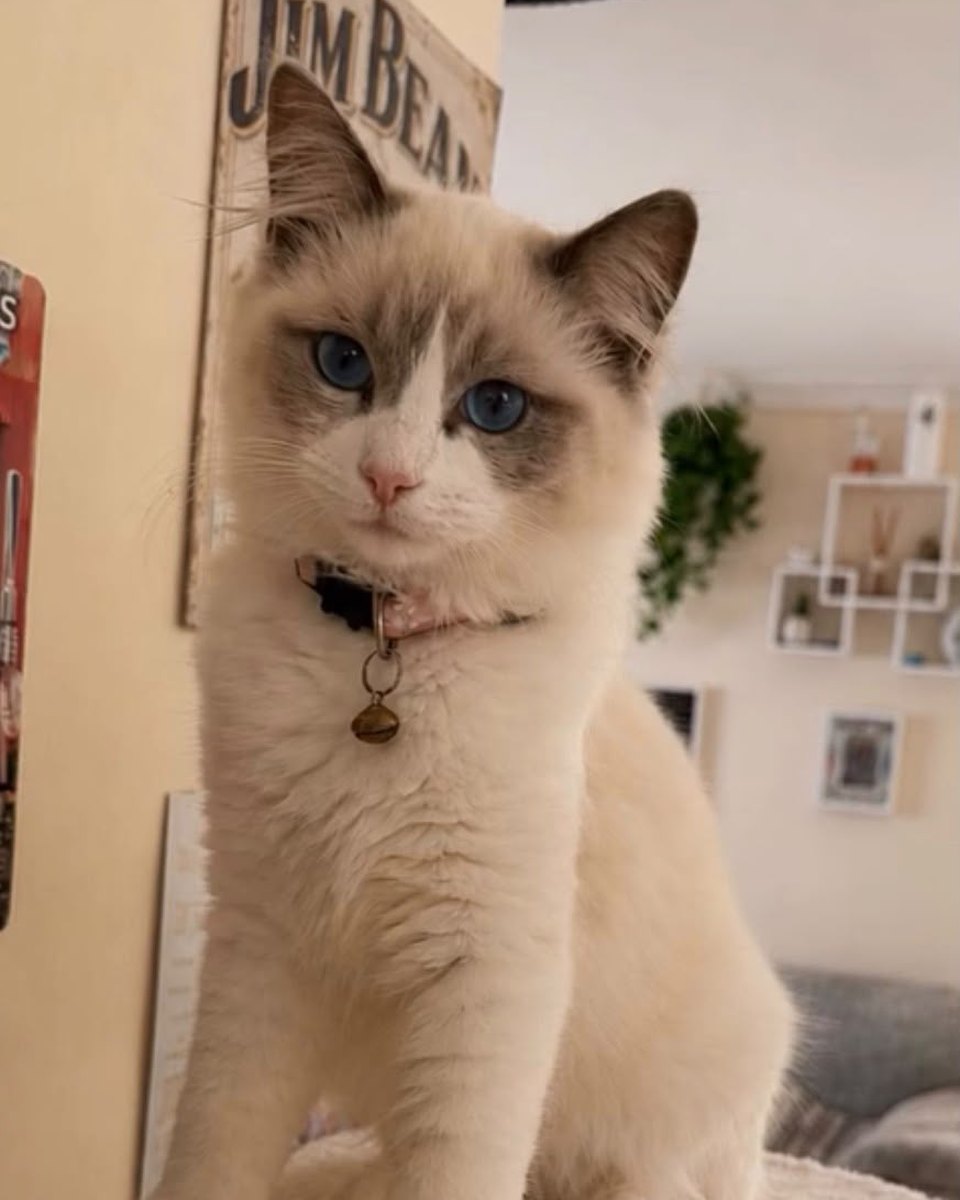
Kitty, one of our rising girls: upright ears, blue eyes and no gene working against her joints.
Ragdoll vs Scottish Fold: the key differences
Both breeds are gentle, quiet, people friendly cats that suit a family home, which is why they end up on the same shortlist. The differences are these.
- Size. The Scottish Fold is medium sized, roughly 3 to 6 kg, round faced and compact. The Ragdoll is one of the largest breeds, roughly 3.5 to 9 kg, long and heavy boned; see Ragdoll size and weight.
- Coat and colour. The Fold has a dense coat in a short or a longer version and comes in most colours and patterns. The Ragdoll is semi longhaired, always pointed and always blue eyed.
- Ears. The Fold's ears fold forward and down, giving it the owl look. The Ragdoll's ears are ordinary, which matters.
- Temperament. Both are calm and affectionate. Folds are quieter and a little more self contained; Ragdolls follow you from room to room.
- Health. The Ragdoll's two main inherited risks, HCM and PKD, both have DNA tests. The Fold's folded ears are themselves a health condition, and no test can separate the ears from the problem.
That last line is the whole comparison. The rest of this guide explains it, as fairly as we can.
Two very different cats to look at
The Scottish Fold began in 1961 with a white barn cat called Susie on a farm in Perthshire, whose ears folded forward. The trait was bred on, mostly to British Shorthairs, and the result is a rounded, medium sized cat: round head, full cheeks, large round eyes set wide apart, a short nose and a sturdy body that is cobby rather than long. Kittens are born with straight ears; in those carrying the gene the ears begin to fold at around three to four weeks. The coat is dense and plush, short in most Folds and semi long in the longhaired variety, in almost every colour and pattern.
The Ragdoll is a bigger, longer, softer cat: broad chest, long body and tail, and oval blue eyes in every one of them. The coat is semi long and silky with a thin undercoat, and it only comes pointed, in the colours and patterns described in Ragdoll colours and patterns. Side by side, the Fold looks like a teddy bear and the Ragdoll like a large, elegant cat that has retired to the sofa.
Scottish Fold vs Ragdoll personality
On temperament the two are closer than they look. Both are placid, soft voiced cats that tolerate handling, settle into family life, get on with children and other pets, and prefer company to solitude.
The Fold is usually described as sweet natured, quiet and a touch independent: it likes to be near you, sits upright in odd poses, and is content to watch the room from a cushion. It is affectionate on its own terms rather than clingy. Some of that stillness, vets will point out, can be a cat that finds jumping uncomfortable rather than a cat that is simply serene.
The Ragdoll is the more people following of the two. Ours trail from room to room, assemble on whichever bed has a person in it, and treat a lap as a right. It is a floor level, slow moving, heavy breed that flops when picked up and wants to be wherever you are; Ragdoll temperament has the detail and Ragdoll pros and cons is candid about the downsides. If you want a cat that joins in, the Ragdoll. If you want a quiet companion that keeps a little to itself, the Fold's nature would suit, if only it came without the ears.
Why the folded ears are the problem
The fold is caused by a single dominant gene that changes how cartilage forms. Cartilage is not only in the ears: it is the cushioning in every joint and the material from which a kitten's bones grow. The condition is called osteochondrodysplasia, and every cat with folded ears has it to some degree. There is no such thing as a folded cat with normal cartilage, because the fold is the abnormality made visible.
In practice that ranges from a short, stiff tail and some reluctance to jump through to swollen joints, abnormal bone growth in the legs and feet, lameness and painful, progressive arthritis, sometimes starting in cats under a year old. Cats with two copies of the gene are the worst affected, but cats with one copy are affected too, less severely and often later. There is no cure, only lifelong pain management under a vet.
The British position is unusually united. The GCCF, Britain's main cat registry, has not recognised the Scottish Fold since the early 1970s, on welfare grounds. The British Veterinary Association advises against breeding Folds and against buying one. In 2023 the Scottish Animal Welfare Commission, in the breed's own country, recommended against breeding them, and several countries, the Netherlands among them, restrict or ban it. None of that makes every Fold miserable. It does mean a kitten with folded ears is a kitten with a known, inherited, incurable condition, chosen on purpose.
Ragdoll health against Fold health
The Ragdoll is not a breed without a health list. Its two main inherited conditions are hypertrophic cardiomyopathy and polycystic kidney disease. The difference from the Fold is that both have DNA tests, so a breeder can screen every breeding cat before mating and a buyer can ask to see the certificates. Every breeding cat in our colony is DNA tested clear for HCM and PKD, tested negative for FeLV and FIV, blood typed and screened for more than 50 inherited conditions. Ragdoll health and HCM in Ragdolls explain what the tests do and do not promise, and choosing a breeder shows how to tell a breeder who tests from one who says so.
The Fold's problem has no equivalent. You cannot test a kitten's way out of osteochondrodysplasia, because the gene you would be testing for is the one that folded the ears you chose it for. The only Fold free of it is the Scottish Straight: the straight eared littermate, the same round, plush, placid cat without the gene, and a perfectly sensible pet. Folds can also carry PKD, and HCM has been reported in the breed, so a Fold breeder should be testing for those too.
Scottish Fold or Ragdoll: which should you choose?
If what draws you to the Fold is the temperament, a calm, quiet, affectionate cat that is easy to live with, you can have all of that without the ears. The Ragdoll offers it in a bigger, more people centred package. The British Shorthair, the breed the Fold is most often crossed with and most resembles, offers it in a compact, round faced one; Ragdoll vs British Shorthair and Persian compares those two. A Scottish Straight offers you the Fold itself, minus the gene.
If what draws you to the Fold is the ears, that is the thing to sit with. The ears are not a decoration on a healthy cat; they are the visible end of a condition that runs through its skeleton. The Fold's charm is its ears, and its ears are the problem.
So our answer, from a house full of upright ears: if you want a calm, cuddly cat and you care about welfare, choose the Ragdoll or the British Shorthair. If you already have a Fold, love it, insure it, keep it lean, and tell your vet the moment it is slow to jump.
Quick questions, answered
Scottish Fold vs Ragdoll personality: which is friendlier?
Both are gentle and affectionate, so neither will disappoint on that score. The Ragdoll is the more people following cat: it trails you about, wants your lap and copes badly with long empty days. The Fold is quieter and a little more independent, affectionate on its own terms and content to watch from a cushion. Choose by how much cat you want on you.
Is it cruel to buy a Scottish Fold?
Every cat with folded ears has osteochondrodysplasia, a cartilage and bone condition that cannot be bred out while keeping the ears, and many develop painful arthritis. That is why the GCCF does not recognise the breed and British vets advise against buying one. Buying a Fold funds breeding more. If you love the look and nature, a straight eared Scottish Straight has neither the fold nor the problem.
Why doesn't the GCCF recognise the Scottish Fold?
On welfare grounds. The GCCF registered Scottish Folds briefly after the breed appeared in the 1960s, then stopped in the early 1970s once the link between the folded ears and skeletal problems was understood, and it has not recognised the breed since. The Fold is recognised by some overseas registries, which is why kittens are still bred and imported, but not by Britain's main one.
Which is bigger, a Scottish Fold or a Ragdoll?
The Ragdoll, by a clear margin. A Scottish Fold is a medium sized cat of roughly 3 to 6 kg with a compact, rounded body. A Ragdoll is one of the largest breeds, roughly 3.5 to 9 kg, long in the body and heavy boned, with males at the top of that range. Both take three to four years to finish growing, the Ragdoll noticeably longer.
Sources and further reading
- British Veterinary Association: Vets' advice against breeding Scottish Folds and against buying one on welfare grounds.
- GCCF: The UK registry's position: the Scottish Fold is not recognised on welfare grounds.
- International Cat Care: Scottish Fold disease (osteochondrodysplasia): what the gene does to cartilage and bone.
Thinking about a Ragdoll kitten?
Our Ragdoll and Ragcoon kittens grow up in our home in Ryde, Isle of Wight, with health tested parents and our support for life. See who is available now, or join the waiting list for the next litter.