
How Much Do Ragdolls Sleep? Sleeping Habits Explained
A Ragdoll asleep on the sofa all afternoon is not lazy. It is doing its job.
Last reviewed
How much do Ragdolls sleep? A great deal, like every cat. Cats Protection puts the figure for a domestic cat at roughly 12 to 18 hours a day, and PDSA gives an average of 15, with kittens and older cats closer to 20. Ragdolls sit at the calm end of that range, and they do it in plain view: on the sofa, across the doorway, flat on their backs in the middle of the floor. Here is why they sleep so much, what the positions tell you, where a Ragdoll should sleep at night, and how to tell a cat that is resting from a cat that is unwell.
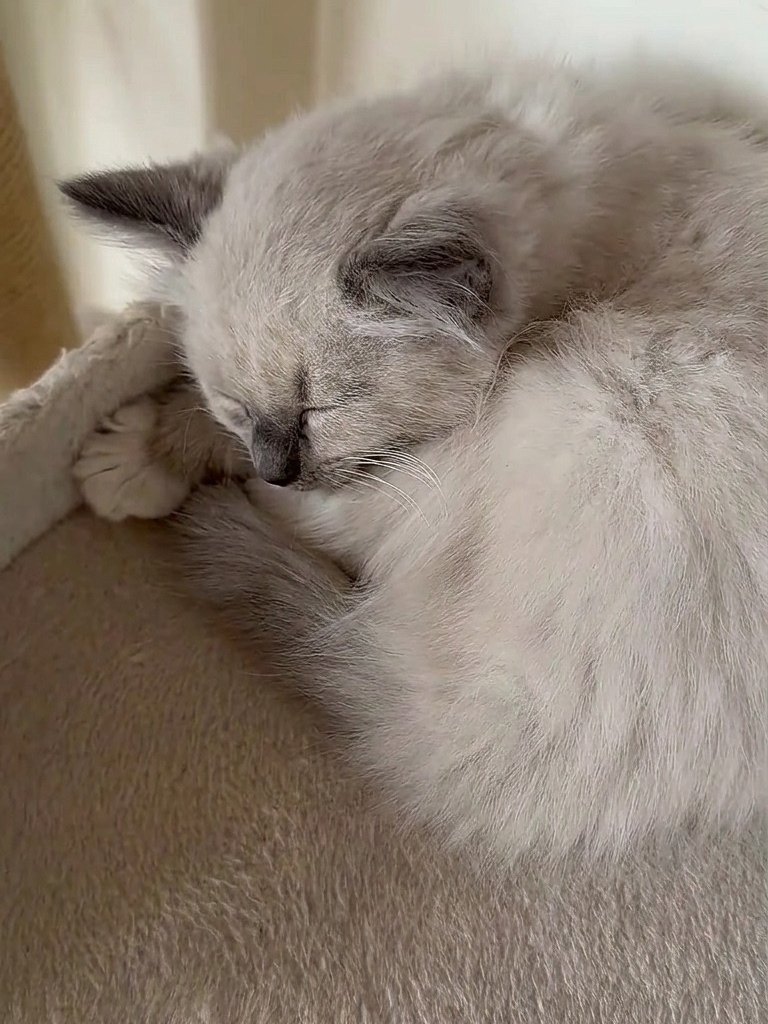
Curled in a ball, nose to tail: keeping warm and protecting the belly.
How many hours a day do Ragdolls sleep?
- Adults: about 12 to 18 hours in every 24.
- Kittens: more, up to around 20. Growing takes a great deal of rest, and a kitten will go from flat out to fast asleep in seconds.
- Older cats: also more. They tire sooner and recover more slowly.
It is not one long sleep. Cats sleep in many short stretches round the clock, which is why a cat that slept all afternoon can still be wide awake at dawn. PDSA describes two kinds: a light doze, often 15 to 30 minutes, in which the ears still turn towards every sound, and short spells of deep sleep lasting only a few minutes at a time, which make up about a quarter of the total.
Ragdolls are a relaxed, low key breed, so expect yours towards the top of the range, with short bursts of play in between.
Why do cats sleep so much?
Because they are built as hunters, and hunting is expensive. Stalking, sprinting and pouncing burn a lot of energy in a very short time, so a cat's day is designed around brief, intense effort and long recovery. A house cat with a full bowl has kept the timetable even though it has lost the job.
Cats are also crepuscular, meaning they are naturally most active at dusk and dawn, when their prey would be about. The long sleeps fall in the middle of the day and the middle of the night, and the lively hours are the ones on either side. That is the whole explanation for the 5am wake up call.
Weather plays a part too. PDSA notes that cats sleep more in cold and wet weather, and an indoor Ragdoll will often match the mood of a dark winter afternoon.
Ragdoll sleeping positions, and what they mean
- On the back, belly up. The Ragdoll special. A cat only exposes its belly where it feels completely safe, and it is also a good way to lose heat. It is not always an invitation to touch.
- The loaf. Paws tucked under, upright. A doze, not a deep sleep: the cat can be on its feet in a moment.
- Curled in a ball. Nose to tail, keeping warm and protecting the belly. Common in cooler rooms.
- Stretched out on the side. Deeply relaxed and comfortably warm.
- The sprawl. Flat on the floor, legs in all directions, usually on a cool surface in warm weather.
- In a heap. Cats that sleep touching are cats that are bonded. Ours pile up three and four deep.
- On you. Warmth, your scent and security in one place.
Twitching paws, whiskers and mouth in deep sleep are normal. Cats Protection's view is that the cat is probably dreaming. Ears and tail that move during a doze mean the cat is only half asleep and still listening. Why Ragdolls go limp explains the flop that goes with the back sleeping.
Where Ragdolls like to sleep
Somewhere warm, comfortable and safe, and for most cats somewhere raised. Cats Protection adds a detail that explains a lot: cats rotate their sleeping places, a habit inherited from their wildcat ancestors that helped keep parasites down. So the bed you bought will be loved for three weeks, abandoned, and loved again later. That is normal.
- Offer several places at different heights: a cat tree platform, a window perch, a box on its side with a blanket, a bed by a radiator.
- Buy big. An adult Ragdoll needs room to stretch out to its full length, which most standard cat beds do not allow.
- Keep one at floor level for kittens and for older cats with stiff joints.
- Put one near you. A Ragdoll would rather sleep in the room you are in than in the best bed in the house.
Designing a cat friendly home has more on laying out the space.
Should my Ragdoll sleep in my bed?
It is your choice, and both answers work if you hold to them. A cat on the bed is warm company and, for most Ragdolls, exactly where they want to be. It also means dawn patrols, a large cat across your legs, and hair on the pillow. A cat with its own comfortable place elsewhere, and the bedroom door closed, sleeps perfectly well once the protest phase is over.
What does not work is changing your mind: in on quiet nights and out after bad ones teaches a cat that persistence opens doors. Decide early, ideally before the kitten arrives.
Do Ragdoll kittens sleep through the night?
Not at first. A kitten in a new home wakes, plays and sometimes cries in the small hours, and its body clock runs hottest at dusk and dawn for the whole of the first year. A play session and a meal last thing at night, a warm bed in a small safe room, and patience get most households through it. Bringing a Ragdoll kitten home covers the first nights and night zoomies the months after.
Helping a Ragdoll sleep well
- Let sleeping cats lie. Cats Protection points out that a cat woken suddenly can be disorientated and may lash out before it knows where it is. Teach children that a sleeping cat is not to be stroked, picked up or carried off.
- Tire the cat out at the right time. Play in the early evening and again before bed, each time followed by food.
- Keep the routine steady. Meals, play and bedtime at the same times each day. Cats sleep best in a house they can predict.
- Mind the temperature. A Ragdoll in full coat seeks out cool floors in summer and warm spots in winter. Offer both, and never shut a cat in a hot room or a conservatory. See summer heat and winter cold.
- Give each cat its own places. In a house with more than one, there should be more beds than cats, at different heights, so nobody has to queue. Multi cat harmony explains why that matters.
- Check the favourite spots. Tumble dryers, airing cupboards, car bonnets and open drawers are all warm and all dangerous. Look before you shut anything.
When sleep is a warning sign
Because cats sleep so much, a sick cat can hide in plain sight. The question is never how many hours, but whether anything has changed. See the vet if your cat:
- Sleeps a lot more than usual, or has started hiding away to do it.
- Is hard to rouse, or flat when awake: no interest in food, play or fuss. That is lethargy, not sleepiness.
- Has stopped sleeping in its usual places, particularly high ones. Stiff joints make the jump not worth it.
- Is restless at night, pacing or calling, after years of sleeping soundly. In an older cat this can be pain, an overactive thyroid or confusion.
- Breathes fast or with effort while asleep. A resting cat's breathing should be slow and easy.
A healthy sleepy cat wakes for food, comes when something interesting happens and is bright in between. The suddenly quiet cat explains how to tell the difference, and health basics shows what to check at home.
Quick questions, answered
How many hours a day do Ragdolls sleep?
About 12 to 18 hours in every 24, in many short stretches. Kittens and older cats sleep more, up to around 20 hours. Ragdolls are a relaxed breed and tend towards the top of the range.
Why does my Ragdoll sleep on its back?
Because it feels safe. A cat only exposes its belly where it is completely relaxed, and lying belly up also helps it cool down. Ragdolls are known for it.
Is my Ragdoll sleeping too much?
Probably not, if it wakes for meals, plays in short bursts and is bright when awake. A cat that suddenly sleeps much more than usual, hides, or shows no interest in food or play should see a vet.
Should I let my Ragdoll sleep in my bed?
That is up to you. Either rule works if you keep to it every night. Letting the cat in some nights and shutting it out on others teaches it to keep asking.
Do Ragdolls sleep at night?
They sleep for part of it. Cats are most active at dusk and dawn, so expect an early start. A play session and a meal before your bedtime move the lively hour earlier.
Why does my Ragdoll twitch in its sleep?
Twitching paws, whiskers and mouth during deep sleep are normal, and the cat is probably dreaming.
Is it normal for a Ragdoll to snore?
Usually, yes. Petplan's vet advice is that snoring in cats is not unusual and is generally nothing to worry about: the soft tissues of the nose and throat relax in deep sleep, and a head pressed against the edge of the bed narrows the airway. Being overweight makes it more likely. See a vet if the snoring is new and comes with a runny nose, sneezing, coughing or wheezing, if the breathing is noisy when the cat is awake, or if breathing ever looks like an effort.
Sources and further reading
- Cats Protection: Cats and sleep: How long cats sleep, where they choose to, dreaming, and when to check with a vet.
- PDSA: Why do cats sleep so much?: Average hours, kittens and seniors, dozing and deep sleep, and the signs that need a vet.
Thinking about a Ragdoll kitten?
Our Ragdoll kittens grow up in our home in Ryde, Isle of Wight, with health tested parents and our support for life. See who is available now, or join the waiting list for the next litter.