
From our colony to your sofa
Multi-Cat Harmony
One of everything each plus a spare: the arithmetic of a peaceful house.
Last reviewed
One of everything each plus a spare: the arithmetic of a peaceful house.
Last reviewed
A multi cat home is a set of territories laid politely on top of one another, and harmony is mostly arithmetic: enough of everything, spaced so that nobody ever has to queue. Fifteen cats share our house, and the peace is designed rather than lucky.
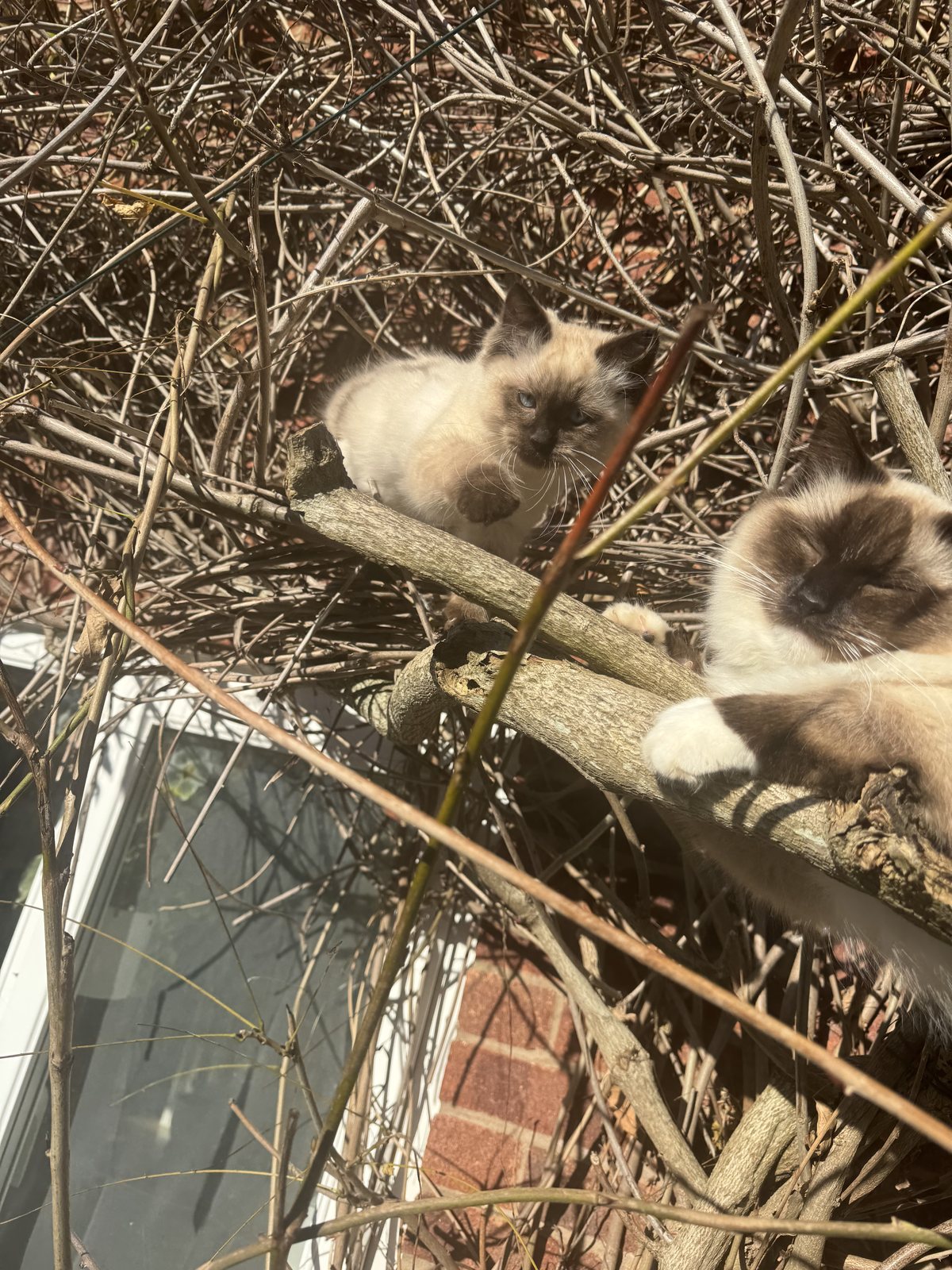
Feline peace is town planning: every critical resource, trays, food stations, water, beds, scratching posts, high perches, provided at one per cat plus a spare, and distributed through the territory rather than clustered, because a resource behind another cat is, to a worried resident, not really available at all.
Sight lines finish the map: stations placed so using one does not mean being watched from another, entrances that cannot be ambushed, and routes through busy rooms at more than one altitude. Most simmering multi cat tension is geography, and geography is fixable by Saturday.
Cat conflict is mostly cold war, and it escalates on a readable ladder: staring first, then blocking, one cat casually occupying doorways, stairs and tray approaches, then resource hovering, then ambushes, with actual fights the late rung most households only notice because they finally made a noise.
Reading the lower rungs changes everything: staring and blocking answered with more routes, more resources and more distance rarely become ambushes. The useful habit is watching who controls the corridors at busy times; corridors are where the politics happen.
The classic harmony wobble follows a vet visit: the returning patient smells of clinic, and a housemate treats them briefly as a stranger. The fix is scent restoration, a shared blanket rubbed between both cats, treats at a calm distance, and a few hours’ patience, rather than letting a misunderstanding rehearse into a habit.
For deeper ruptures, the answer is a scaled reintroduction: territory briefly separated, scent swapped, then barrier time, exactly the second cat playbook rerun at speed. Rewinding a relationship a stage is not failure; it is maintenance, and it works with impressive reliability.
A settled multi cat home shares one blended scent, built by cats rubbing the same corners and each other, and that group smell is the passport politics run on: cats treat right smelling housemates as family and wrong smelling ones as suspects. Peace has a fragrance, and the cats maintain it constantly.
Owners can help the blend: shared soft bedding rotated between favourite spots, one cloth stroked over every cat’s cheeks in turn during calm evenings, and patience after anything that disturbs scent. When harmony wobbles for no visible reason, the passport is often what expired.
The classic ambush from nowhere follows a vet visit: the returning patient smells of clinic instead of colony, and a housemate treats the wrong smelling body as an intruder wearing a friend’s face. It is the scent passport failing at border control, sudden, loud and baffling to owners.
Prevent it by planning re entry: the returner spends an hour or two in a separate room reacquiring house smell, swaps bedding through the door, and rejoins under supervision, ideally around a relaxed feed. If hostility has already flared, a short structured reintroduction resets it; forcing proximity entrenches it.
A meaningful share of intercat tension is unspent hunting energy looking for a target, and the nearest moving housemate volunteers by existing. Daily structured play, wand sessions run separately for each cat, drains exactly the charge that otherwise becomes stalking and ambush.
Separate sessions matter: group play lets the confident cat monopolise while the timid one spectates and stays wound. Ten minutes per cat per day, ending in a catch and a small feed, is the cheapest peace treaty in the multi cat toolkit.
Multi cat trouble is loudest at the swatting end, but its real damage is often silent: the cat who stops crossing the kitchen, waits until the coast is clear to eat, uses the tray at strange hours, or simply spends more time on top of the wardrobe. Withdrawal is conflict too; it just files no complaints.
Audit the quiet ones deliberately: does every cat use every shared space at normal hours, eat calmly, sleep somewhere chosen rather than assigned? A yes down the list is what harmony actually looks like; a no is the earliest, cheapest moment to intervene.
Simon Tofield and Cats Protection behaviourist Nicky Trevorrow explain how cats defend territory and what owners can do to help the more vulnerable cats in a household feel safe, which is the resource and spacing arithmetic this guide teaches. The Battersea multi cat film is still on our colony page if you want a second view.
Watch on YouTube Simon’s Cat with Cats Protection, 5 minutes
We film the colony most days and put the clips out as Ragdoll Drama. Real cats, no script, no idea what they will do next.
Multi cat harmony is mostly arithmetic: one of every resource per cat plus one spare, separated in space so nothing has to be shared or queued for. Learn the tension ladder, staring and blocking come long before claws, and run reset protocols early rather than late. Guard the scent passport when one cat returns from the vet, use play as the pressure valve, and watch the quiet one, because the loser of a cold war goes silent before anything else.
Both: grooming plus wrestling with relaxed bodies, breaks and role swapping is friendship in full. Worry only when wrestling loses the pauses, one cat always flees, or fur and claws come out.
A hiss is punctuation, not war: cats use it to set a boundary, and a hiss that ends an interaction peacefully has worked. Rising frequency, or hisses escalating into chases, is the pattern that means politics need attention.
No: punishment adds fear to a tense system and reliably worsens it. Manage space, drain energy with play, reset scent, and if one cat persistently hunts another, run a structured separation and reintroduction.
Pheromone diffusers can take the edge off tense rooms and ease transitions, as support rather than cure. They work best alongside the geography, play and scent work, not instead of it.
From a serious fallout, think days of separation and one to three weeks of staged reintroduction, moving at the cats’ pace. Slow resets hold; rushed ones relapse, and relapses take longer than doing it properly once.
A small minority of pairings stay incompatible despite good process, and managed separate territories within one home can still give both a good life. It is the honest fallback, not a failure.
Rarely: a third cat adds politics, not mediation, and usually redistributes tension rather than absorbing it. Fix the existing relationship first; add cats to stable systems only.
The rule that prevents most feline friction: one resource per cat, plus one spare, and that means litter trays as our litter guide explains, food stations, water bowls, beds, scratchers and high perches. Placement matters as much as the count, because three trays in one utility room work as one tray with three doors. Spread everything, and most rivalries never find a reason to start.
Cats measure a house in routes and heights, not floor plans. A cat tree, a cleared shelf run and a wardrobe top multiply the territory without an extension, and escape routes matter more than square footage. Doorways, landings and stair bottlenecks are where tension brews, so give busy pinch points a bypass, a second path through or a perch above the traffic.
Actual fights are rare; feline cold war is quieter. Watch for staring, doorway blocking, one cat time sharing a room only when another leaves, or trays visited solely at three in the morning. Our body language guide covers the vocabulary, and one rule sits above the rest: a sudden grump earns a vet check first, because pain is the great personality changer, as our pain guide explains.
Never punish either cat, because punishment glues bad feelings to the other cat’s presence. Separate calmly, let everyone decompress, then reintroduce as though they were strangers: scent swapping, feeding either side of a door, short supervised visits. The full method lives in our second cat guide and works just as well for old housemates. Ragdolls are bred for tolerance and colony raised kittens arrive with manners, which stacks the deck kindly, though every cat remains an individual with a vote.
For multi cat behaviour in depth, International Cat Care is the definitive owner resource, and Cats Protection adds practical conflict guidance.