
Ragdoll Dandruff: Causes, Fixes and When to See a Vet
Dandruff is rarely about the skin alone. It is usually about what stopped the washing.
Last reviewed
Dandruff on a Ragdoll shows up as white flakes in the coat, most often on the lower back and at the base of the tail. A few flakes now and then are normal: skin cells die and are shed all the time. A lot of them, or flakes that keep coming back, mean one of two things. Either the cat is not grooming that area properly, usually because of weight or stiff joints, or something is wrong with the skin itself, from fleas and mites to allergy and infection. The flakes are the easy part. Finding out why they are there is the job, and it starts with a vet.
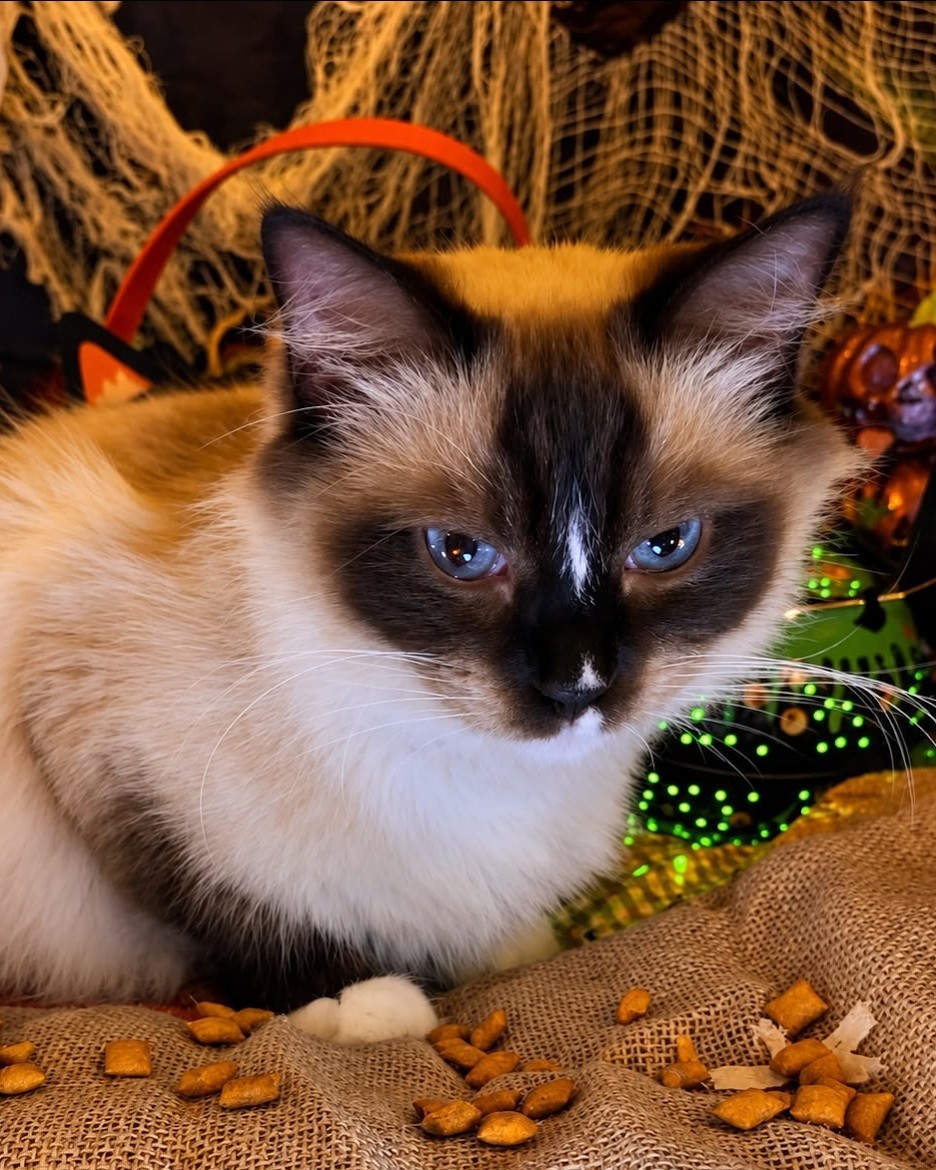
Lola, one of our queens. A healthy coat lies flat, feels soft and carries no flakes.
What is cat dandruff?
Dandruff is dead skin, shed in flakes large enough to see. Every cat sheds skin cells constantly, and normally they are so small, and removed so thoroughly by the cat's tongue, that you never notice.
- Dandruff is the visible white or grey flakes.
- Dander is the microscopic version every cat sheds, and is what carries allergens. It is not the same thing and is not a sign of a problem.
- Flea dirt is black specks, not white. Put some on damp white paper: if it leaves a red smudge, it is flea dirt.
On a Ragdoll the flakes show best on the darker points and on a seal or blue saddle, and they tend to gather where the cat finds it hardest to reach: along the spine, over the hips and at the base of the tail.
A moult can make them more obvious, because loose undercoat holds on to flakes until it is combed out. If a good comb through clears them and they do not come back, that was all it was.
A cat that is not grooming properly
A cat's tongue is its comb. When part of the coat stops being washed, dead skin and loose hair build up there. The commonest reasons are:
- Being overweight. A heavy cat cannot bend round to its lower back and hips. Dandruff in exactly that area on a well covered Ragdoll is very often a weight problem. See the hands on body condition check.
- Arthritis. Twisting hurts, so the back half is left. This is a common cause in older cats. See arthritis in cats.
- Other pain or stiffness, including a sore mouth that makes grooming unpleasant. See dental care.
- Feeling unwell. A cat that is ill for any reason grooms less.
With these, you will usually see other signs too: a coat that looks dull, greasy or clumped on the back half, small mats forming, and a cat that jumps less than it did.
A problem with the skin
- Fleas. A common cause of flaky, itchy skin, in indoor cats too. See fleas.
- Mites. One kind is nicknamed walking dandruff, because the flakes appear to move. See skin mites.
- Lice. Uncommon, and mostly seen in cats that are not grooming. See lice.
- Ringworm. A fungal infection, not a worm, causing scaly patches and hair loss. It spreads to people. See ringworm.
- Skin allergy. To fleas, food or something in the environment, with itching and over grooming. See itchy skin and allergies.
- Skin infection, bacterial or yeast, often on top of one of the above.
- Hormonal illness such as an overactive thyroid, which affects the skin and coat. See hyperthyroidism.
- Autoimmune skin disease, which is very rare.
Several of these pass between pets, and mites and ringworm can affect people, so they are worth identifying properly and not guessing at.
When to see a vet about dandruff
PDSA's advice is to see your vet whenever you notice dandruff, so that the cause can be found before you try anything at home. Go sooner if you also see:
- Scratching, chewing or over grooming
- Red skin, a rash, scabs or sores
- Hair loss or bald patches
- A greasy or smelly coat
- Flakes that seem to move
- Stiffness, limping or jumping less
- A cat that has stopped grooming
- Weight loss, a bigger appetite or more drinking
- Itchy spots on you or the children
The vet will look at the skin and coat, comb for fleas and mites, and may take hair or skin samples, or a blood test in an older cat. Treatment depends entirely on the cause: a parasite treatment, pain relief for arthritis, a weight plan, or medicine for an infection or allergy.
What to tell the vet
- When you first noticed the flakes, and whether they are getting worse.
- Where on the body they are.
- Whether the cat is scratching, licking or pulling at its coat.
- Which flea and worm products you use, and when they were last given.
- Any change of food, litter, washing powder or household.
- Whether other pets, or people, are itchy.
- Whether the cat is grooming, jumping and moving as it used to.
- Its weight now and six months ago, if you know them.
Do not bath or treat the cat just before the appointment. The vet needs to see the skin as it is.
What helps, once the vet has checked
- Comb more often. If the cat cannot reach, you do it. A few minutes on the lower back, hips and tail base every day or two lifts the flakes and the loose hair. See how to groom a Ragdoll.
- Get the weight right. For an overweight cat this is the cure. As the waist comes back, so does the washing.
- Feed a complete, good quality food. The right diet improves skin and coat. See reading food labels.
- Ask about a skin supplement. Many contain fish oil, which may help. Use one made for cats, at the dose your vet gives.
- Keep parasite treatment up to date, for every pet in the house.
- Treat the joints. An arthritic cat on pain relief often starts grooming again.
- Help an old cat with the places it cannot reach, gently and often.
What not to do
- Do not use human dandruff shampoo, or any product not made for cats.
- Do not bath a cat repeatedly. It dries the skin.
- Do not use oils, creams or home remedies on the coat without asking. Whatever goes on a cat gets licked off.
- Do not cover it up. Wiping the flakes away without finding the cause leaves the cause in place.
Dandruff in kittens, adults and older Ragdolls
- Kittens. Think parasites first: fleas and mites, and ringworm if there are scaly bald patches. A kitten with dandruff should see a vet, and so should any other pets if something catching is found.
- Adults. In an indoor adult Ragdoll, weight is a very common reason for flakes on the lower back. Fleas and allergy are the others to rule out.
- Older cats. Arthritis and illness lead the list. Dandruff along the spine of a cat over ten is often the first visible sign that grooming has become difficult. The senior years covers the care that follows.
At any age, dandruff that appears suddenly, spreads, or comes with itching deserves an appointment soon.
Keeping a Ragdoll's skin and coat healthy
- Comb to the skin twice a week, and daily in a moult.
- Keep the cat lean enough to reach its own back.
- Treat for fleas on the schedule your vet sets.
- Feed a complete food suited to the cat's age.
- Look at the skin as you groom: part the coat on the back and at the tail base.
- Have older cats checked twice a year.
The coat is one of the best health reports a cat gives you. Health basics shows what else to look at each week.
Quick questions, answered
Why does my Ragdoll have dandruff?
Usually because it is not grooming that part of its coat, most often through being overweight or having stiff joints, or because of a skin problem such as fleas, mites, allergy or infection. A vet can tell which.
Why does my cat have dandruff on its lower back?
The lower back and tail base are the hardest places for a cat to reach. Flakes there usually mean the cat cannot bend round comfortably, because of weight or arthritis. Fleas also favour that area.
Is cat dandruff contagious?
The flakes themselves are not. Some causes are: fleas, mites and ringworm pass between pets, and mites and ringworm can affect people.
How do I get rid of my cat's dandruff?
Find the cause first, with your vet. Then comb regularly, get the weight right, feed a good complete food, keep flea treatment up to date and treat any pain or skin disease.
Can I use dandruff shampoo on my cat?
Not a human one. Products made for people can be harmful to cats, and frequent bathing dries the skin. Use only what your vet recommends.
Does dandruff mean my cat is ill?
Not always. A few flakes are normal. Heavy or persistent dandruff, or dandruff with itching, hair loss, a greasy coat or stiffness, means something needs treating.
Sources and further reading
- PDSA: Dry skin and dandruff on cats: The causes, what helps at home once a vet has checked, and the other signs to report.
Thinking about a Ragdoll kitten?
Our Ragdoll kittens grow up in our home in Ryde, Isle of Wight, with health tested parents and our support for life. See who is available now, or join the waiting list for the next litter.