
From our colony to your sofa
Itchy Skin & Allergies
Fleas, food and pollen: the three suspects behind the scratch.
Last reviewed
Fleas, food and pollen: the three suspects behind the scratch.
Last reviewed
An itchy cat is a cat with a question attached, and the question has three usual answers: fleas, food, or the environment. Allergic skin disease is the great volume driver of feline scratching, overgrooming and scabby skin, and it untangles logically once the suspects are interviewed in the right order.
Feline allergy rarely announces itself as politely as a scratch: it appears as overgrooming, licked bald bellies and stripes down thighs, tiny scabs peppered along the spine and neck, crusty chin spots, recurring ear trouble, and faces rubbed raw on carpet. The tongue does the damage as often as the claws.
Because cats groom privately, owners often see only results, thinning fur, damp patches, hairballs multiplying, and read them as coat or behaviour quirks. Any bald patch the cat made itself is an itch by definition, and itches have causes worth naming.
Flea allergy dermatitis is the single commonest allergic disease in cats: sensitised individuals react to flea saliva itself, meaning one bite from one passing flea can ignite weeks of misery. The classic map is scabby rice grain crusts along the back, rump and neck.
This is why every itch investigation begins with ruthless flea control regardless of whether anyone has seen a flea: on a groomed allergic cat you rarely will. Modern prescription prevention, run on every pet in the house without gaps, is both the test and, frequently, the entire cure.
True food allergy is real but rarer than the pet food aisle implies: cats sensitise to specific proteins they have eaten for years, chicken and beef leading simply through exposure, and grain allergy is genuinely uncommon. The signature is year round itching of head, face and ears, sometimes with tummy upsets.
The only trustworthy test is the elimination diet: a strictly novel or hydrolysed protein, prescribed with your vet, fed exclusively for eight to twelve weeks, then challenged. Blood and hair allergy tests for food look scientific and are widely considered unreliable; the diet trial remains the courtroom.
When fleas are controlled and the diet trial acquits the bowl, the remaining suspect is the environment: pollens, dust mites and moulds, feline atopy. Its tell is often seasonality, spring and summer flares for pollens, year round for dust mites, in a cat whose itch survives perfect parasite control.
Atopy is managed rather than cured, and managed well: anti itch medication chosen with your vet, essential fatty acids supporting the skin barrier, dust mite reduction in bedding and hot washes, and flare plans that start treatment at the first lick rather than the tenth bald patch.
Allergic skin rarely stays merely itchy: scratching and licking break the barrier, resident bacteria and yeast move into the damage, and infection adds its own itch on top, a cycle where the original allergy becomes only half the problem. Ears and chins run the same loop in miniature.
It is why vets so often treat two things at once, the infection now and the allergy underneath, and why an itch that improved on antibiotics but returned was never cured, only interrupted. Breaking the cycle and naming the driver are separate jobs; lasting comfort needs both.
Diet trials fail in kitchens, not clinics: one treat, one licked plate, one hunting snack or one generous visitor can reset the clock, because exclusively means exclusively. Multi cat homes run the trial with separate feeding or, commonly, everyone on the trial food for the duration.
Set the household up to succeed: trial food only, water only, treats made of the trial protein if any, a note on the fridge for guests, and a diary of skin and scratching through the weeks. Run properly once, the trial answers a question that half measures can ask forever.
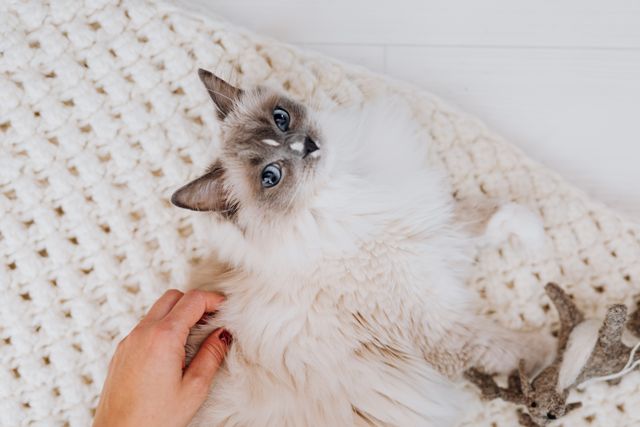
A Ragdoll’s semi longhaired coat is an allergy’s privacy screen: thinning bellies and broken guard hairs hide in the volume, and the first visible sign is often texture, damp spiky licked patches, or arithmetic, hairballs and moulting suddenly beyond season. Hands find what eyes miss.
The weekly groom is therefore the breed’s allergy surveillance: fingertips over spine, rump, neck and belly feeling for the scabby peppering, comb checking for broken coat, a glance at chin and ears. Ten minutes that catches the itch in chapter one, every single week.
An allergic cat, correctly diagnosed, lives a completely normal life on a boringly consistent plan: the flea prevention that never lapses, the diet that never wobbles, the flare medication started early, the skin checked weekly. Allergy is a management story with a genuinely happy ordinary ending.
The owner’s real enemy is drift, the prevention dose slipping a fortnight, the old food creeping back, because allergic skin punishes drift reliably. Calendar the plan, brief the household, and the itch stays a footnote in an otherwise unremarkable, comfortable life.
PDSA vet Olivia explains how an exclusion diet is run to help diagnose a food allergy and what it takes to get a reliable answer. It is the diagnostic step this guide places after fleas have been ruled out.
Watch on YouTube PDSA Petwise Pet Health Hub
Itchy cats have three usual suspects: flea allergy first and commonest, food allergy proven only by a strict eight to twelve week elimination diet, and environmental atopy managed long term once the other two are cleared. Overgrooming, bald bellies and scabby peppering along the spine are itch by definition, secondary infection feeds the cycle, and gapless flea prevention plus a disciplined diet trial solves most cases. Under a Ragdoll coat, hands find what eyes miss.
Dust mites and dry indoor air keep year round allergies running, and central heating concentrates both. Indoor life changes the suspect list without emptying it.
Blood tests have a role in choosing environmental treatments once atopy is diagnosed, but they are unreliable for food and never the starting point. The order remains fleas, then diet trial, then environment.
Once bites truly stop, most cats settle over a few weeks as the skin calms, sometimes with medication to bridge the misery. Continued itching beyond that window moves the investigation on.
Contact reactions to scented or dusty litters happen, usually as paw and belly irritation: an unscented, low dust switch is a cheap experiment. Persistent signs still earn the full workup.
Inconsistently and modestly at best, and only ever specific ones at feline doses from your vet, never the household packet. Modern feline anti itch medications outperform them decisively.
Classically yes: allergy requires prior exposure, so cats sensitise to foods and pollens they have lived with for years. New itching at any age is a real finding, not a personality change.
Occasionally, with vet recommended shampoos for specific conditions, but frequent bathing strips the barrier and most cats vote no. Treating the cause beats washing the symptom.
The vet’s name for that scabby rice grain peppering along the back and neck, a pattern rather than a diagnosis, and most often flea allergy’s signature. Finding it starts the suspect interviews.
It can, but psychogenic grooming is a diagnosis of exclusion: the medical itches get ruled out first, because treating anxiety while fleas bite fails everyone. The order of investigation protects the cat.
Genuine sensitivity to human or dog dander is documented though uncommon; dust mites remain the likelier indoor culprit. The environmental workup covers the household’s whole cast.
Start every itch at the flea guide, keep skin mites and ringworm on the lookalike list, and let the weekly groom be the surveillance system.
For deeper reading, International Cat Care covers feline allergic skin disease and diet trials, and the PDSA explains flea allergy dermatitis for owners.