
Arthritis in Cats: Signs, Treatment and Home Comforts
Common, quiet and treatable. Slowing down is a symptom, not a personality.
Last reviewed
Arthritis in cats is far more common than most owners think, and far quieter. Cats rarely limp. They just stop doing things: the jump to the windowsill, the stairs at a run, the full wash down to the tail. In a big, placid breed with a reputation for lounging it is very easy to read all of that as a Ragdoll being a Ragdoll. Most cats over twelve show some arthritis on an X ray, according to Cats Protection and the PDSA, and it can be treated well, so slowing down is always worth a vet's opinion.
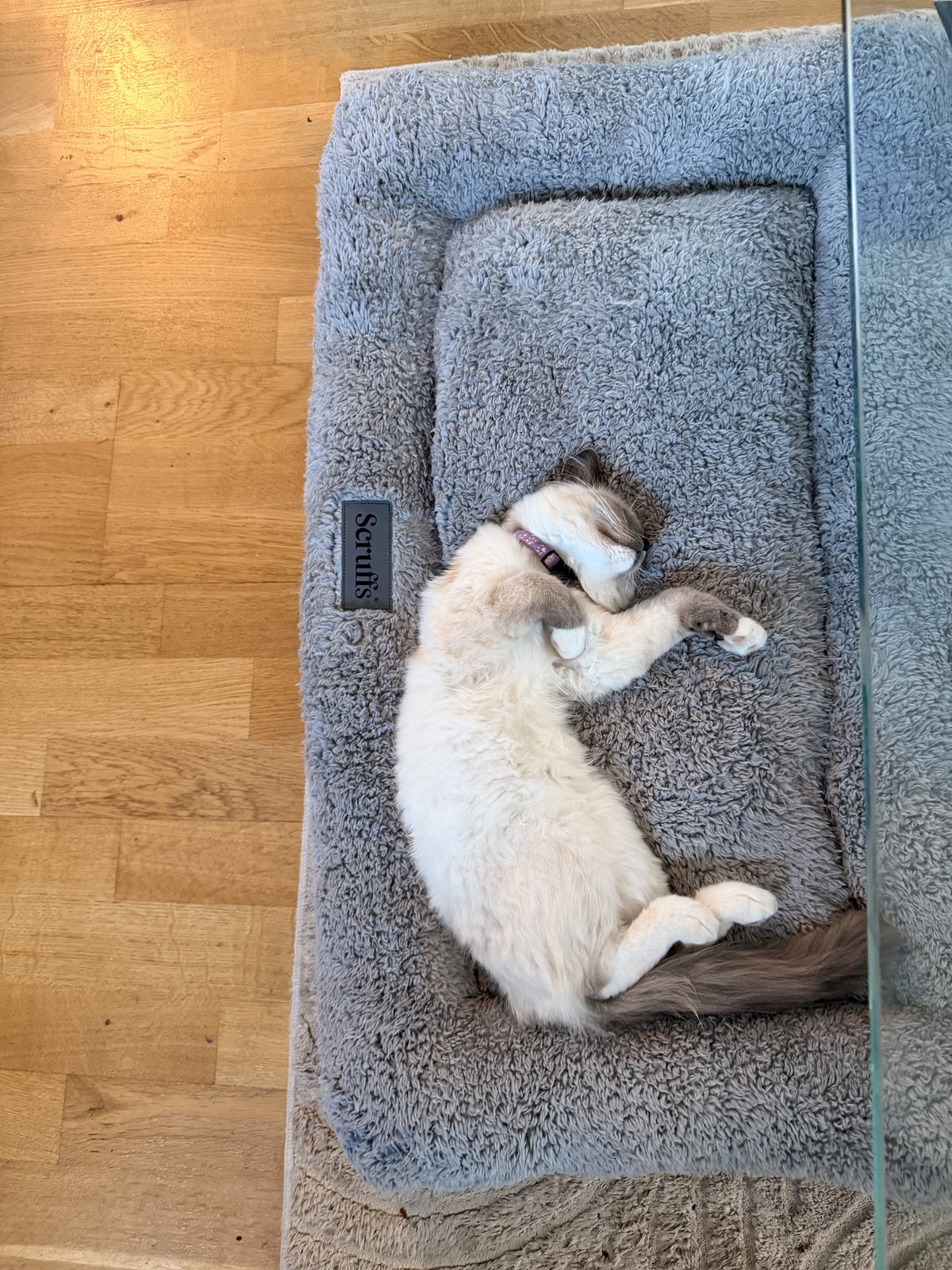
A deep, padded bed somewhere warm and easy to reach: the first home comfort for stiff joints.
What arthritis is and which cats get it
Osteoarthritis is wear in a joint. The smooth surfaces that let the bones glide become rough and uneven, the joint gets inflamed, and movement starts to hurt. It cannot be cured, but the pain can be controlled, and a cat whose pain is controlled moves, plays and grooms again.
It is mostly a condition of age. Younger cats can develop it after an injury or an infection in a joint, or where a joint did not form properly. Extra weight makes every case worse, because every extra gram is carried by the same sore joints, and that matters more in a large, heavy breed than in a small one. Weight and body condition shows how to check yours.
One breed is a special case: the folded ears of the Scottish Fold come from a gene that affects cartilage throughout the body, joints included, which is why our comparison with the Scottish Fold spends so long on welfare. The Ragdoll has no such built in problem. Its risks are the ordinary ones: years and kilos.
How arthritis shows in a cat
Do not wait for a limp. Look for what has changed:
- Hesitating before a jump, taking it in two stages, or no longer going up at all.
- Stiffness on getting up that eases once the cat has moved about.
- Stairs taken one at a time, or avoided.
- A coat going scruffy or matted over the back, hips and tail, because the cat cannot twist round to groom there.
- Overgrown claws, from using the scratching post less.
- Accidents beside the litter tray, or a tray with high sides being avoided.
- Sleeping more, playing less, and choosing lower, easier places to rest.
- Being touchy about stroking over the back or hips, or grumpier with people and other cats.
- All of it worse in cold, damp weather.
The jump audit in our recognising pain guide is the quickest home check: list the places your cat sat two years ago and see which still get visits. A short phone video of your cat walking, jumping and using the stairs at home is one of the most useful things you can take to the appointment, because few cats move normally on a consulting room floor.
Diagnosis and treatment
Your vet will ask what has changed, watch the cat move and feel each joint. X rays can confirm arthritis, but they are not always needed and do not always match how much pain a cat is in, so a vet may suggest a trial of pain relief and judge by the difference it makes.
What a vet can offer
- Anti inflammatory pain relief. The mainstay, given long term under your vet's supervision, with blood tests from time to time to check the cat is coping with it.
- A monthly injection. An antibody treatment for arthritis, given at the surgery once a month, which suits cats that will not take medicine at home.
- Stronger pain relief, added for a while when pain is severe.
- Weight loss, if the cat is carrying too much, planned with the practice so it comes off slowly.
- Supplements such as glucosamine, chondroitin, green lipped mussel and omega 3 oils. The evidence in cats is limited, they do not replace pain relief, and they are best used on your vet's advice.
- Acupuncture from a veterinary acupuncturist, which helps some relaxed cats. Surgery is rare and usually follows an old injury.
Never give a cat human painkillers. Paracetamol is highly toxic to cats and ibuprofen can kill. Our poisoning guide covers what to do if a cat has swallowed something it should not have.
Older cats should see the vet every six to twelve months even when nothing seems wrong, and arthritis is one of the things that visit is for. Senior cats covers the rest of the check.
Home comforts that give a stiff cat its house back
- Steps up. A box, a footstool or a set of pet steps beside the sofa, the bed and the favourite windowsill turns one big jump into two small ones.
- Beds. Deep, well padded and warm, at floor level or one easy step up, and out of draughts. A heat pad made for pets helps on cold days.
- Litter trays. Large, with at least one low side to walk in over, and easy to reach from where the cat spends its day. Litter training has tray sizes for big cats.
- Food and water. On the level the cat lives on, and raised a little off the floor so it does not have to crouch.
- Grooming. Comb the back, hips and tail for the cat, little and often. Ragdoll grooming shows how to deal with a mat without hurting.
- Claws. Check them every couple of weeks. Claws that are no longer worn down can curl round into the pad.
- Play. Short, gentle games every day keep joints moving and muscle on. Run a wand toy along the floor, not up in the air.
None of this replaces pain relief. It works alongside it, and the two together are what get a stiff cat back onto the sofa.
Quick questions, answered
At what age do cats get arthritis?
It becomes common from the early teens and can start sooner. Cats Protection says more than 80 percent of cats over twelve have some arthritis that shows on X rays. Younger cats can develop it after an injury to a joint.
How do I know if my cat has arthritis?
Look for change, not limping: shorter or abandoned jumps, stiffness after rest, a scruffy coat over the back and hips, accidents beside the tray, more sleep and less play. Film your cat moving at home and show your vet.
Can I give my cat paracetamol or ibuprofen for arthritis?
No, never. Paracetamol is highly toxic to cats and ibuprofen can be fatal. Only use pain relief your vet has prescribed for that cat, and ring the practice at once if a cat has swallowed a human painkiller.
Are Ragdolls prone to arthritis?
Not especially, as far as anyone has shown. But a Ragdoll is big and heavy, so extra weight loads the joints harder, and a calm temperament makes slowing down easy to miss. Keep an older Ragdoll lean and have it checked once or twice a year.
Do joint supplements work for cats?
The evidence is limited. Glucosamine, chondroitin, green lipped mussel and omega 3 oils may help some cats a little, but they do not replace pain relief and do not work for every cat. Ask your vet before starting one.
Sources and further reading
- PDSA: Arthritis in cats: Symptoms, diagnosis, treatment and home care from the vet charity.
- Cats Protection: Arthritis: The charity's guide, including the monthly antibody injection and the changes to make at home.
Thinking about a Ragdoll kitten?
Our Ragdoll kittens grow up in our home in Ryde, Isle of Wight, with health tested parents and our support for life. See who is available now, or join the waiting list for the next litter.