
From our colony to your sofa
Dental Care & Teeth Brushing
The minute a day that prevents the most common feline disease.
Last reviewed
The minute a day that prevents the most common feline disease.
Last reviewed
Dental disease is the most common medical problem cats develop and the least visible: a cat with a sore mouth eats around the pain, keeps purring and says nothing. The routine that prevents most of it takes about a minute a day.
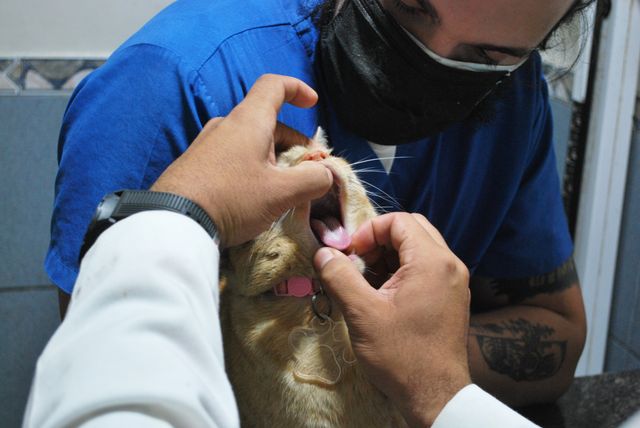
Lift the lip at the side and read the border where tooth meets gum: healthy tissue is salmon pink with a crisp edge, trouble is a red line tracing the teeth like eyeliner, and established disease adds tartar the colour of butterscotch and breath that arrives before the cat. Check both sides, because cats chew around pain and disease loves the neglected side.
The disease most owners have never heard of deserves its own sentence: tooth resorption, where the cat’s own body dissolves a tooth from within, agonising, invisible from above the gumline, and present in a large share of adult cats. It is the single best argument that feline mouths need professional eyes, not just owner ones.
Nobody brushes a cat by ambush. The ladder that works climbs a step every few days: first a fingertip of cat toothpaste as a lickable treat, then the finger resting briefly against teeth, then a wrap of gauze with a gentle rub, then the soft cat brush for seconds, then for longer. Every rung ends in something pleasant, and any hissed rung means stepping back one, not pushing on.
Aim eventually for a slow count of ten per side on the outer surfaces, which is where the trouble lives, most days of the week. Perfection is not required; frequency is the ingredient that matters, and a cheerful forty seconds beats a fortnightly wrestling match by miles.
The honest supporting cast: dental specific diets with kibble engineered to scrub as it shatters have real evidence behind them, dental treats vary from useful to confetti, and water additives sit at the hopeful end of the spectrum. Anything claiming to replace brushing entirely is overreaching.
And when the vet recommends a professional clean under anaesthetic, the fear of the anaesthetic deserves weighing against the certainty of chronic mouth pain: modern feline anaesthesia is very safe, and a proper clean with x rays finds and fixes what no home programme can reach. A pain free mouth changes personalities; owners say so constantly.
Cat breath was never going to be minty, but its character carries information: a sharp rotten note points at dental disease and infection, while breath that turns oddly sweet or chemical, or takes on an ammonia edge, can accompany conditions elsewhere in the body and belongs in a vet conversation quickly.
The useful habit is baseline familiarity: know what your cat’s ordinary breath is like from grooming range, and treat a genuine change as a symptom rather than a quirk. Owners who notice breath early routinely hand their vets a six month head start on the mouth.
Cats suffer a particular misery called tooth resorption: the body’s own cells dissolving a tooth from within, often invisibly below the gum, and it is common, painful and progressive. A cat with a resorbing tooth may chatter its jaw when the spot is touched, drop biscuits, or simply go quietly off dry food.
Resorption cannot be brushed away or reversed; affected teeth are extracted, and the transformation in comfort afterwards routinely astonishes owners. It is a core reason the veterinary dental examination, sometimes with dental radiographs, finds disease that home inspection never could.
Owners dread extractions more than cats do: teeth that hurt are worth losing, and cats manage superbly with partial and even full mouth extractions, gums hardening into capable chewing surfaces within weeks. Many eat dry food again against all expectation; all eat wet food comfortably.
The afterlife is usually the revelation: cats who had quietly stopped playing, grooming or head bumping resume within days of a painful mouth being resolved, and owners realise the old cat was never old, just sore. Fear of the procedure keeps more cats in pain than the procedure ever causes.
A minority of cats develop gingivostomatitis: inflammation that refuses to stop at the gum line and sets the whole mouth ablaze, cheeks and throat included, ferociously red, painful and drooling. It is an immune over reaction rather than simple dirt, and it turns eating into an ordeal for cats too stoic to say so.
It is a veterinary project from the first suspicion: managed medically in some cats, and in stubborn cases treated with full mouth extractions, a drastic sounding surgery after which toothless cats routinely eat, groom and live in comfort that astonishes their owners. If a red mouth looks angry beyond the gum line, book the appointment and say the word.
Cornell’s Feline Health Center narrates a step by step training programme that gets a cat accepting a toothbrush over four patient weeks, with clear close ups of the technique. It is the gold standard routine this guide recommends, shown rather than described.
Watch on YouTube Cornell Feline Health Center, about 7 minutes
Dental disease is the most common medical problem in cats and the least visible, because cats eat around a sore mouth for months. Read the mouth monthly: breath is a barometer, red gum lines and brown crusts are findings. Brushing is the gold standard, built slowly with a finger brush and cat toothpaste, with dental diets and chews as the supporting cast. Resorptive lesions hide below the gum line, extractions transform rather than diminish a cat, and a drooling, chattering or one sided eater needs the vet.
On the vet’s call rather than a fixed calendar: some cats need attention yearly, others sail years between. The annual check up is where that judgement happens, which is one more reason not to skip it.
Modern feline anaesthesia with pre checks and monitoring carries small, well managed risk, and untreated dental disease carries certain, ongoing pain plus infection seeding elsewhere. For most cats the riskier choice is leaving the mouth alone.
Sadly no: cats eat through remarkable pain, adapting technique rather than showing weakness. Appetite is the last thing to fail, which is why gum colour and breath are better informants than the food bowl.
Ordinary kibble helps little; specific dental diets with proven design help somewhat. Nothing chewable replaces brushing or the professional clean, so treat texture as a minor ally rather than a strategy.
Genuinely foul breath almost always means established dental disease or infection, occasionally trouble further inside. It is a book an appointment sign, not a quirk to live with.
Plaque hardens into tartar, tartar inflames gums, and untreated gum disease loosens teeth and seeds bacteria into the bloodstream; most cats show some dental disease by the age of three. The tells are subtle: meaningful breath, drooling, chewing on one side, dropped biscuits, a pawed mouth or a red line along the gums. Cats rarely stop eating until things are serious, which is exactly the hiding habit our pain guide warns about.
Only ever use cat toothpaste, never human paste, and buy a flavour worth licking. The training is gradual: a lick of paste as a treat for a few days, then paste on a finger rubbed along the outer teeth, then a finger brush, keeping every session to seconds and ending on a win. The outer surfaces are where tartar builds, so that is all you need to reach. Start in kittenhood while everything in life is a game, and brushing becomes just another odd thing the humans do.
Dental treats earn their place inside the daily budget from our treats guide, dental diets with proven claims genuinely reduce tartar for cats who will not tolerate a brush, and water additives sit at the hopeful end of the evidence. None of them replace brushing, but all of them beat doing nothing, and a cat who gets a dental stick after the brush forgives the brush faster.
Every annual check includes the mouth, and when the vet recommends a professional clean under anaesthetic, it is worth doing properly rather than postponing until extraction time. Cats also suffer resorptive lesions, painful erosions at the gum line that only an examination or dental imaging reveals. Sudden food dropping, one sided chewing or a cat who approaches the bowl then backs away books an appointment this week, not this month, and the red flag rules from our health basics guide apply to mouths as much as anywhere.
To go deeper on feline dentistry, International Cat Care has an excellent illustrated dental section, and Cornell Feline Health Center covers tooth resorption and gum disease clinically.