
Are Ragdolls Smart? Intelligence, Training and Clinginess
Where the dopey reputation comes from, what Ragdolls actually learn, and how to train one.
Last reviewed
Are Ragdolls smart? Yes. Are Ragdolls dumb? No, and the reputation for being a bit dim says more about what people count as cleverness than about the cat. A Ragdoll is trusting, slow to startle and uninterested in the kind of chaos that gets other breeds called clever, so it looks placid where a Bengal looks busy. Underneath, it learns names, routines, the sound of the fridge and the whereabouts of the treat drawer, fetches, comes when called and takes to clicker training. This guide covers what Ragdoll intelligence looks like, how to train one, and the two questions that always follow: are Ragdolls clingy, and are Ragdolls cuddly?
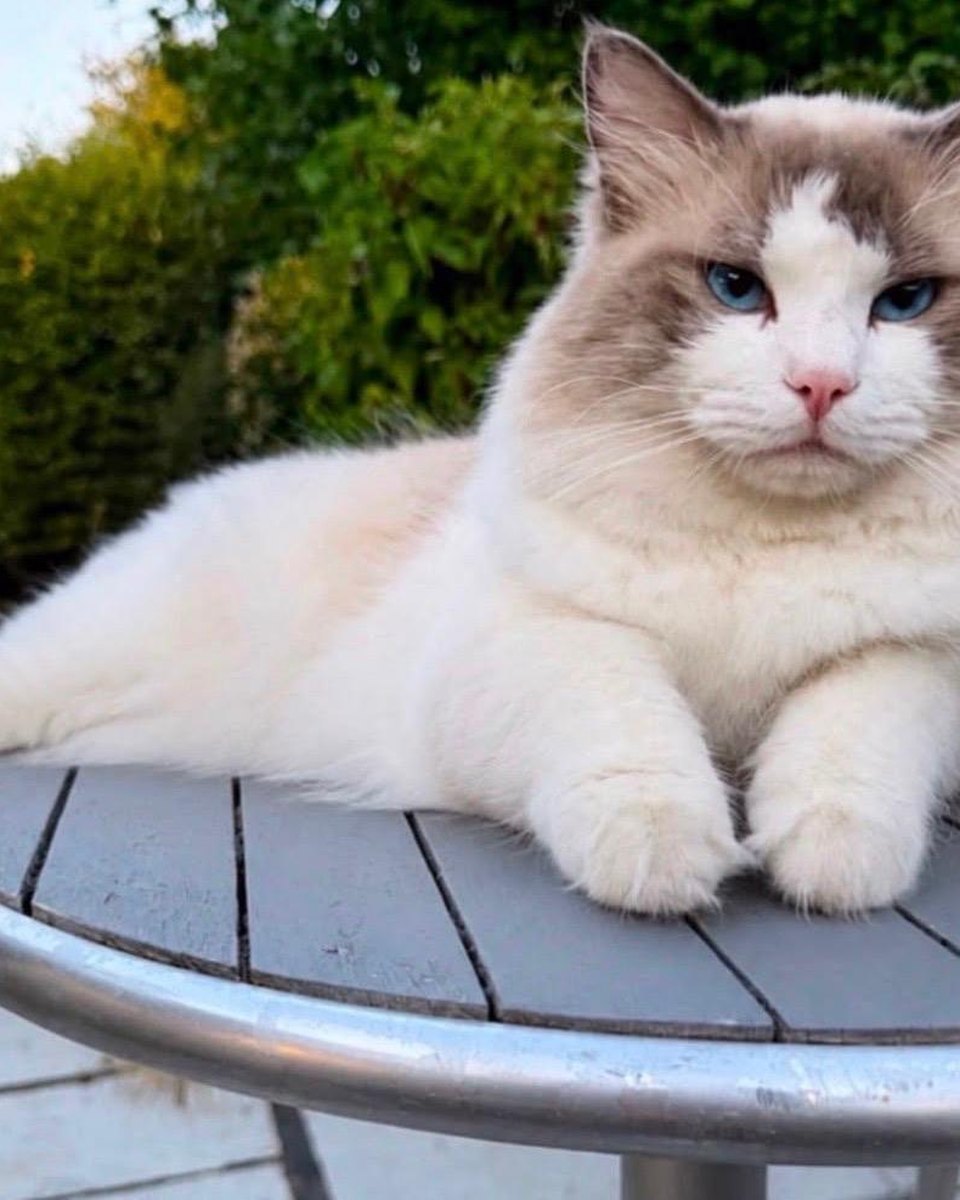
Aqua, blue bicolour stud and the show's resident collector of objects.
Are Ragdolls smart or dumb?
Smart, by any measure that matters to a cat living in a house. The dumb label comes from three traits the breed was selected for. Ragdolls are trusting, so they do not treat a stranger or a new object as a threat. They are slow to startle, so a dropped pan gets a look rather than a vertical take off. And they are not much interested in chaos: they do not spend the evening knocking things off shelves. People read alertness, suspicion and mischief as intelligence, and a cat that shows none of the three gets called a bit slow. Those traits are temperament, covered in Ragdoll temperament, and a cat that is not frightened has no reason to look sharp.
What a Ragdoll does lack is road sense. It has no wariness worth the name, and that is a gap in its survival kit rather than in its brain: it will walk up to a stranger, lie down in a driveway and treat a passing car as scenery. That is the practical argument for an indoor life with a safe outdoor space, which our sixteen have in an enclosed garden and catio; indoor cats explains it.
Are Ragdoll cats intelligent? What ours learn
Living with a colony makes the question easy. Ragdolls in a house learn their own names and a good few of the others' too: call one and a different one looks round, then goes back to sleep. They know the routine to the minute, the sound the fridge makes, and which cupboard the treats live in.
Plenty of Ragdolls fetch. Not all, but a surprising number will bring a toy back to be thrown again, and some invent the game on their own. Aqua, our blue bicolour stud, has made his name on the show for collecting and hoarding objects, which is problem solving of a kind: find the thing, carry the thing, defend the thing. Nobody taught him.
They come when called, especially if the call has ever once been followed by food. They learn doors, including ones they should not, and they learn by watching, so a trick one cat picks up tends to spread. None of this is unusual for a cat. What is unusual about Ragdolls is how little fuss they make about it, so people miss it.
Are Ragdolls easy to train?
Yes, easier than most breeds, because training runs on food and attention and a Ragdoll wants both. The method is the same as for a dog, scaled down.
- Pick a marker. A clicker or a single word like yes. Click, then treat, a dozen times, until the cat looks for the treat on hearing the click.
- Shape a behaviour. Hold a treat above the nose and move it back: the bottom goes down, click, treat, and you have sit. Hold out a chopstick: the cat touches it, click, treat, and you have target, which gets a cat onto scales or into a carrier. A paw lifted towards a treat becomes high five.
- Keep it short. Five minute sessions, once or twice a day, and stop while the cat still wants more. A bored Ragdoll simply lies down.
- Use tiny treats. Pea sized, so twenty repetitions do not add up to a meal. See treats.
Tricks are for fun, and for the cat: being paid to think is as good as a play session. Play and enrichment has the rest: puzzle feeders, treat balls and the games that make a Ragdoll work for its dinner.
Are Ragdolls clingy?
They are people cats, and whether you call that clingy depends on what you wanted. A Ragdoll follows you from room to room, sits on the bathmat while you shower, supervises the washing up and settles wherever the people are. It is less a shadow than a colleague who has decided your desk is the best place to sleep.
Clingy, as a complaint, usually means a cat that is distressed when left, and that is a different thing from a cat that enjoys company. A Ragdoll copes with a working day if the day is set up for it: fed before you go, something to do while you are out, a window, a warm spot, a second cat or a reliable routine, and your return at roughly the same time. The cats that struggle are the ones left for ten hours with nothing to think about, whatever the breed. Home alone and separation anxiety covers how to set the day up and how to tell boredom from distress.
In a house of sixteen nobody is ever alone, which is one of the arguments in one kitten or two.
Are Ragdolls cuddly?
Most of them, yes, on their terms. Most Ragdolls like to be near you or on you: on the lap, against the leg, on the pillow at three in the morning. A good many like to be picked up and carried, and some will hang over a shoulder like a scarf. A few prefer to sit next to you with a paw on your arm and would rather not be lifted. All of them like to be asked.
Asking means reading the cat. A Ragdoll that wants a cuddle leans in, slow blinks and goes soft; one that does not turns its head away, flattens its ears a fraction or twitches the tail tip, and a Ragdoll's polite no is so quiet that people miss it. Cat body language is the guide to read before you pick one up, and children and kittens covers teaching the rules to small people.
Get the asking right and the answer is yes more often than with almost any other breed. That, rather than any trick, is what a Ragdoll is cleverest at: working out where you are going to sit, and getting there first.
Quick questions, answered
Are Ragdolls smart?
Yes. Ragdolls learn names and routines, come when called, fetch and pick up clicker tricks quickly because they are motivated by food and attention. The dim reputation comes from a trusting, unflappable temperament, which people mistake for a lack of brains. It is a lack of suspicion, which is not the same thing.
Are Ragdolls easy to train?
Easier than most breeds. Use a clicker or a marker word, pea sized treats and five minute sessions, and stop while the cat still wants more. Sit, target and high five come quickly; recall and carrier training are the useful ones. Puzzle feeders and treat balls keep the thinking going between sessions.
Are Ragdolls clingy?
They are people cats that follow you from room to room and like company, which is only a problem if you wanted a cat that ignores you. A Ragdoll copes with a normal working day if it is fed, has things to do and a routine, and ideally a second cat. Distress when left is different, and our home alone guide covers it.
Are Ragdolls cuddly?
Most like to be near you or on you, many like to be held, and a few prefer to sit beside you with a paw on your arm. All of them prefer to be asked. Learn the slow blink, the lean in and the quiet turn away, and you will get a yes far more often than with most breeds.
Sources and further reading
- International Cat Care: Advice on training cats with rewards and on enrichment for indoor cats.
- Cats Protection: UK charity guidance on keeping cats happy, stimulated and settled at home.
Thinking about a Ragdoll kitten?
Our Ragdoll and Ragcoon kittens grow up in our home in Ryde, Isle of Wight, with health tested parents and our support for life. See who is available now, or join the waiting list for the next litter.