
From our colony to your sofa
Play, Enrichment & Scratching
The hunting sequence, solo fun, and settling the scratching question.
Last reviewed
The hunting sequence, solo fun, and settling the scratching question.
Last reviewed
A cat’s day has hunting shaped holes in it, and play is how an indoor cat fills them. Ragdolls are famously chilled, but chilled is not the same as furniture, and ten minutes of the right play twice a day keeps a cat lean, confident and out of mischief. Here is what actually works.
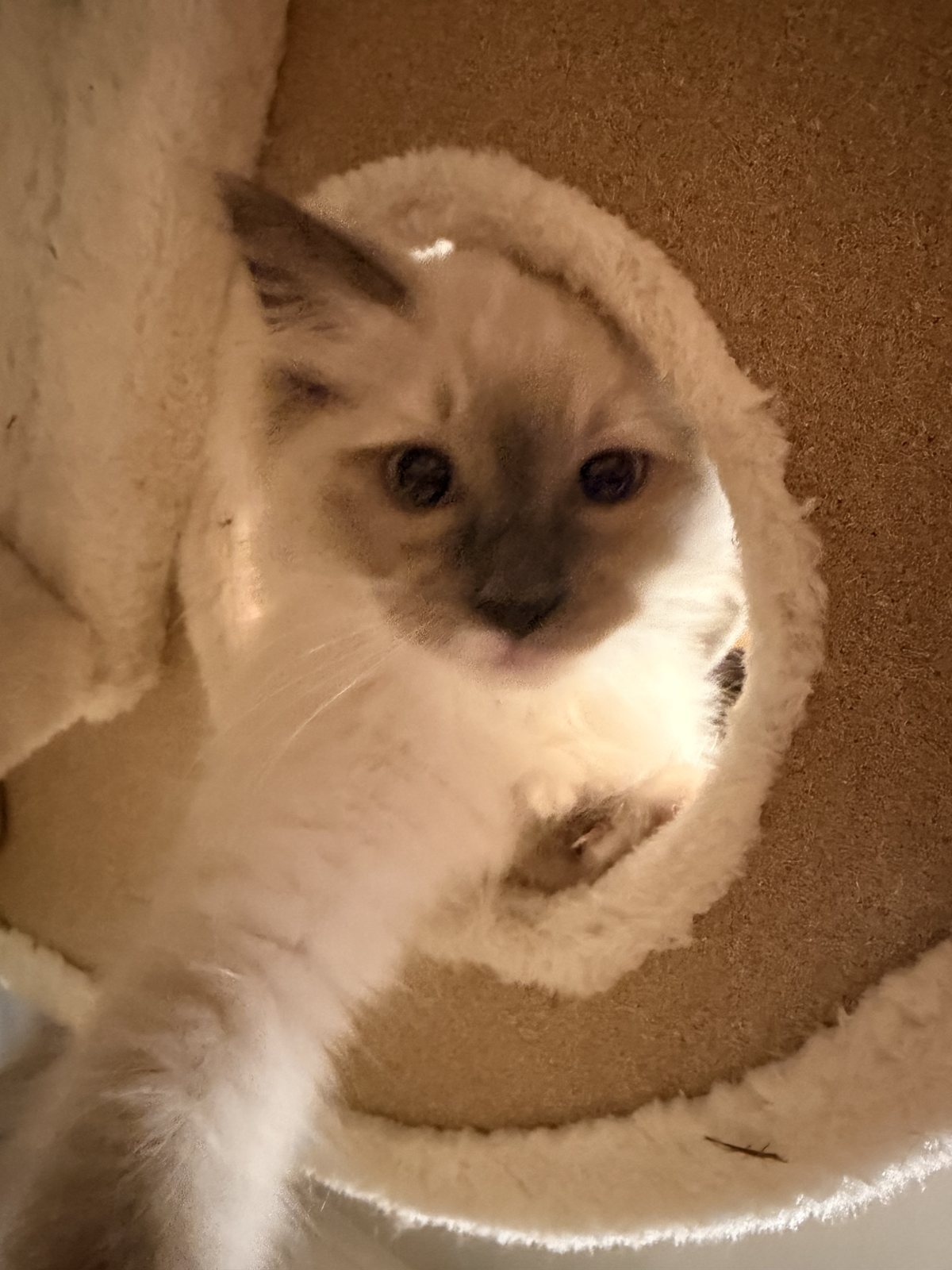
Real feline play follows the hunting script: locate, stalk, chase, pounce, catch, and crucially, the kill, the moment the prey is caught, gripped and defeated. Play that never completes, the laser dot being the famous offender, runs the arousal without the resolution, which is why laser sessions should always end on a physical toy that can actually be caught.
Wand toys are the gold standard because a human on the other end can act like prey: erratic, hiding behind furniture, freezing, fleeing, and eventually, deliberately, losing. Let the predator win on schedule and the predator sleeps like a champion.
Toys do not bore cats; permanence does. The rotation trick keeps a modest box feeling infinite: most toys live away in a drawer, a few are out at a time, and the cast changes weekly, with returning toys reading as new arrivals. A spell in a bag with catnip refreshes the dulled favourites.
Variety across categories beats quantity within one: something to chase, something to wrestle and rabbit kick, something to bat solo, a tunnel to ambush from, a puzzle to work. One from each column outperforms a heap of identical mice, and the drawer costs nothing to run.
The easiest daily enrichment is already in the bowl: a portion of the ration served as work rather than welfare. Puzzle feeders run a difficulty ladder from simple ball dispensers to fiendish boards, scatter feeding turns a room into a foraging ground, and a muffin tin with a few kibble hidden under toy balls is a starter puzzle from the cupboard you already own.
Start easy enough that winning is quick, raise the difficulty as skills grow, and keep hunts short and successful. A cat that forages part of its living gets a busier brain, a slower dinner and a habit that quietly fights boredom, gulping and weight all at once.
Cats issue play invitations in dialect: the sideways hop, the tail question mark, the toy delivered to your feet, the ambush from behind the door that ends in a soft tap. Learn your cat’s versions, because accepting invitations teaches the cat that asking works, and asking cats pester less.
Declining politely matters too: a cat wound up for play and ignored will spend the charge somewhere, usually on ankles at midnight. Thirty seconds of wand work when invited costs less than the alternative economy the cat invents.
Play does not retire with age; it downshifts: shorter sessions, ground level targets, wand toys drawn slowly enough for arthritic joints to win, and puzzle feeders loosened to easier settings. A senior who has stopped playing has usually been offered the wrong game, not lost the drive.
Keep the hunt winnable and the wins frequent, and watch what changes: a senior who declines even easy favourite games is reporting something, often joint pain, and the observation belongs at the next check up. Play doubles as monitoring in the grey muzzle years.
A well placed window is a full time nature channel: birds, weather, deliveries and neighbourhood cats supply hours of engaged watching that costs nothing. Upgrade it deliberately, a padded perch or cat tree at sill height, and the window becomes the most used furniture in the house.
Mind the channel’s content: a bold neighbourhood cat patrolling close to the glass can tip watching into frustration, showing up as redirected swats at housemates. If the window show turns stressful, frost the lower pane or move the perch to a calmer view.
Absence is when enrichment earns its keep: a food puzzle loaded as you leave, a foraging scatter of the day’s biscuit ration around the room, a cardboard box landscape rearranged weekly, and a radio low in another room for the cats who find voices settling.
Resist the always on laser or motorised toy running unattended: hunts that can never be caught frustrate rather than satisfy. The away day kit should be about seeking and finding, and the catchable, killable hunt is yours to provide when you get home.
Simon Tofield and Cats Protection behaviourist Nicky Trevorrow explain how cats play, why the simplest toys often win and the good ways to play with your cat, which is the enrichment argument this guide makes. Five minutes, with animation.
Watch on YouTube Simon’s Cat with Cats Protection, 5 minutes
A cat’s day has hunting shaped holes in it, and play is how an indoor cat fills them: chilled Ragdolls included, because chilled is not the same as unemployed. Run the full prey sequence, stalk, chase, catch, kill bite, feast, and end sessions with a treat so the hunt concludes. Rotate toys so novelty stays cheap, put food to work in puzzles, read the play invitations, keep seniors in gentler games, and stock the window economy and solo circuits for the hours you are away.
Two or three sessions of five to ten minutes daily keeps most adults content, more for adolescents. The measure is the evening cat: settled and affectionate means the quota was met.
Probably moving the toy too much like a toy and not enough like prey: hide it behind furniture, twitch it, let it freeze. Short interest can also mean the session came too soon after food.
Endless uncatchable dots frustrate; lasers used as a warm up and finished onto a physical toy that can be caught give the sequence its ending. Always land the final pounce on something real.
Hands should never be toys: swap in a kicker or wand the moment teeth touch skin, and be boringly consistent. Rough hand play in kittenhood writes cheques adult jaws will cash.
Both: a beloved favourite plus a rotating cast. Store most toys away and change the visible squad weekly; yesterday’s boring mouse returns as a new arrival.
A decent wand toy, by a distance: it turns you into prey director and delivers the full hunt. Everything else on the shelf is a supporting act.
Genuinely: working for food occupies mind and body, slows the gulper and shrinks boredom. Start easy so the puzzle pays out fast, then raise difficulty as skill grows.
The best play copies the hunting sequence. A wand toy that darts, hides and flutters like prey beats a toy waved in circles, and every session should end with a proper catch, a triumphant kill bite, and ideally a few treats or a meal, because a hunt that ends in eating is a hunt that made sense. Two short sessions a day, morning and evening when cats are naturally lively, beat one marathon. Put wand toys away between sessions so they stay thrilling, and rotate the toy box weekly so old toys come back as new ones.
Solo entertainment matters too: ball tracks, kicker toys, crinkle tunnels, puzzle feeders that make biscuits earn their keep, a window perch with bird television, and the finest cat toy ever manufactured, an empty cardboard box. Avoid leaving string, ribbon or hair ties down, because unsupervised string is a surgery story, as our kitten proofing guide explains.
Scratching maintains claws, stretches the whole cat, and leaves scent messages, so the question is never whether your cat will scratch, only where. Offer both vertical and horizontal options, sturdy enough not to wobble, tall enough for a full stretch, placed where the household actually lives rather than hidden in the spare room, with one near the sleeping spot for the wake up stretch. If the sofa is losing, put a scratcher directly beside the crime scene, make it the better option, and reward its use; never punish, which teaches fear rather than furniture law.
Ours play like kittens well into adulthood, favouring floor level chase over ceiling height acrobatics, which suits wand toys and tunnels perfectly. A bored Ragdoll rarely turns destructive; they turn into a rug with sad eyes, and a rug with sad eyes gains weight. Play is their fitness plan. The wand set our own colony rates lives on the Cat Shop page, along with scratchers and ball tracks from the workshop.
For enrichment programmes and play science, International Cat Care publishes the definitive owner guides.