
Are Ragdolls Vocal? Why Your Ragdoll Meows So Much
Ragdolls talk softly and not often. When one will not stop, there is a reason.
Last reviewed
Are Ragdolls vocal? As breeds go, no. Ragdolls are known for soft voices used sparingly: chirps, trills and polite questions, a long way from the running commentary of a Siamese. So when a Ragdoll meows a lot, or loudly, or at four in the morning, it is usually worth asking what the cat is trying to say. Sometimes the answer is breakfast. Sometimes it is boredom, a closed door, or a kitten missing its litter. And sometimes, especially when the meowing is new, it is the first sign that something is wrong. Here is how to tell which.
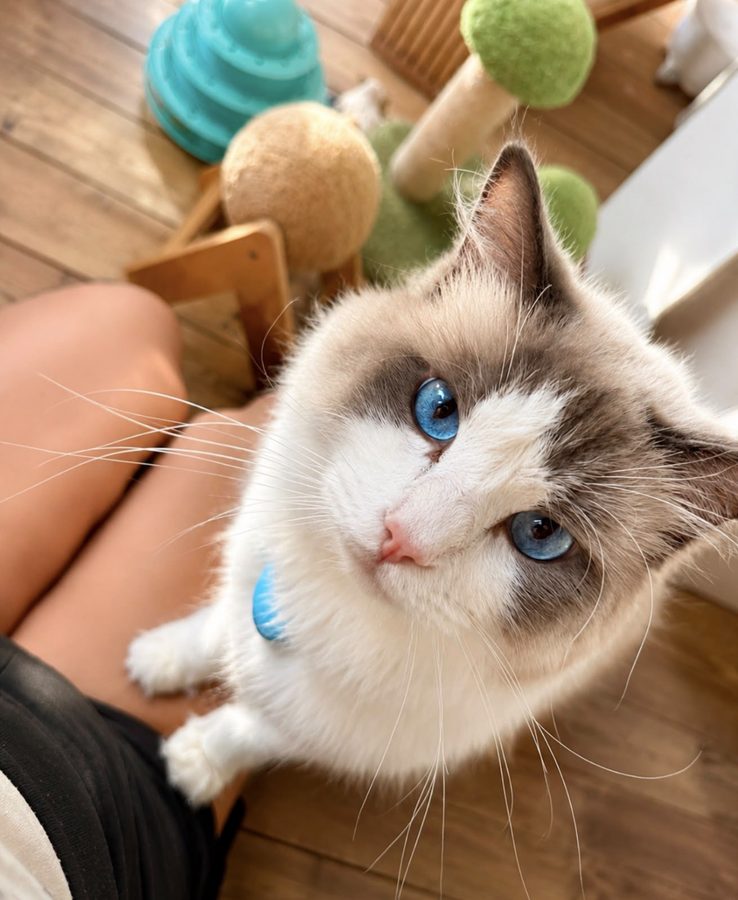
Aqua looking up from the decking. A Ragdoll that stands and looks at you is asking, whether or not it makes a sound.
Are Ragdolls a quiet breed?
Yes. The International Cat Association describes the Ragdoll as a loving, quiet cat, and Petplan's list of the naturally talkative breeds names the Siamese, Orientals, Tonkinese and Burmese. The Ragdoll is not on it.
Quiet is a tendency, not a setting. Individuals chat, trill and demand breakfast with feeling, and two Ragdolls from the same litter can differ. What is consistent is the kind of voice: small and sweet, pitched more like a question than a complaint.
That has one practical consequence. A quiet cat's requests are easy to miss, so a Ragdoll standing meaningfully by a bowl, a door or a litter tray deserves a look even when it has said nothing.
What a Ragdoll sounds like
- The trill or chirrup. A rising, rolled sound, used as a greeting and as a follow me. This is the classic Ragdoll noise.
- The short meow. A hello, or a small request.
- The drawn out meow. A demand: the bowl is empty, the door is shut.
- The chatter. Teeth clicking at a bird through the window.
- The purr. Usually contentment, sometimes self comfort.
- The yowl. Long, loud and low. Distress, a female in season, or confusion in an old cat. Never ignore it.
- The hiss and growl. A warning. Back off.
Purrs, meows and midnight yowls goes through the whole language.
Why does my Ragdoll meow so much?
Adult cats rarely meow at each other. Meowing is something they do to people, and they keep doing whatever works. The usual reasons:
- Food. The commonest by far, and the easiest to train by accident. A cat fed when it shouts learns to shout.
- Company. Ragdolls dislike being alone. A cat that calls when you leave the room, or when you come home, is asking for you.
- A closed door. Being shut out of anywhere is a matter of principle.
- Boredom. An indoor cat with nothing to hunt makes its own entertainment, and you are part of it.
- Change. A new home, a new pet, a new baby or a new routine. A newly arrived kitten often cries for its mother and littermates for the first few nights. Bringing a Ragdoll kitten home covers how to make those nights easier.
- Hormones. A female who has not been spayed calls loudly for days at a time when in season, and a male who has not been neutered answers. In heat: the calling season describes it.
- Something outside. A strange cat in the garden, seen or smelled.
- Pain or illness. Covered below, and the one not to miss.
How a Ragdoll's voice changes with age
Kittens
The noisiest a Ragdoll is likely to be is in its first week in a new home. Until then it has never been alone, and it says so. Crying at night, and when left in a room, is normal and short lived. Kittens also squeak in play and call when they have lost sight of you.
Young cats
Before neutering, hormones make themselves heard. A female in season calls day and night, in a voice owners often mistake for pain, and both sexes become more restless and vocal. Neutering by six months, as our sales agreement asks, means most families never hear it.
Adults
The settled voice: greetings, mealtime reminders, a trill when you sit down. If an adult cat's habits change, something in its life has.
Older cats
Many cats get louder with age. A cat that is going deaf cannot hear how loud it is. One whose sight or memory is failing calls out to find you, most often at night when the house is dark and quiet. Our guide to the senior years covers the changes to expect and the ones to act on.
Why does my Ragdoll meow at night?
Cats are most active at dawn and dusk, so the hours when you want silence are the hours a cat is most awake. Night meowing usually comes down to one of four things.
- Hunger. Supper was a long time ago.
- Energy left over. A cat that slept all day while the house was empty has a full tank at bedtime.
- Loneliness. The household has gone to bed and shut a door.
- Age. In an older cat, night yowling can go with failing sight or hearing, confusion, high blood pressure, sore joints or an overactive thyroid.
For the first three, the fix is in the evening, not at 4am:
- A proper play session before bed, ending with a catch.
- The last meal of the day afterwards, or a timed feeder set for the early hours.
- A warm bed and a toy or two where the cat spends the night.
- A firm decision about the bedroom door, kept every night.
Night zoomies has the full routine. For an older cat that has started calling at night, skip the training and see the vet first.
How to respond without teaching louder
The trap is simple. The cat meows, you give in to make it stop, and the cat learns that meowing works and that longer meowing works better.
- Check the basics first. Food, water, a clean tray, a door shut on something needed. A cat with a real need should have it met.
- Feed by the clock, not the voice. Set mealtimes, or a timed feeder, so food stops being something you can be talked into.
- Reward quiet. Wait for a pause, even a few seconds, then give the attention or the meal. Timing is everything.
- Fill the day. Play, puzzle feeders, window perches and company. A busy cat has less to say.
- Never shout or punish. It frightens the cat, damages trust and teaches nothing.
- Expect it to get worse before it gets better. A cat whose shouting has stopped working tries shouting harder for a few days. Hold your nerve.
And enjoy the conversation. A Ragdoll that trills when you walk in is not a problem to be solved.
When meowing needs a vet
Any sudden change in how much a cat talks, in either direction, deserves a check. See the vet promptly if:
- A quiet cat becomes noisy, or the voice changes, with no change at home to explain it.
- An older cat starts yowling, especially at night. Hearing loss, sight loss, an overactive thyroid, high blood pressure, arthritis and confusion are all treatable or manageable, and all are easy to dismiss as old age. The senior years and hyperthyroidism explain more.
- A cat cries in or near the litter tray, or strains. In a male this can be a blocked bladder, which is an emergency: see urinary problems.
- The meowing comes with other signs: eating or drinking more or less, weight loss, hiding, restlessness, or being off colour.
- A talkative cat goes silent or hoarse.
Cats in pain are more often quiet than loud, so a noisy cat is not necessarily a hurting one, and a silent cat is not necessarily well. Recognising pain in cats lists what else to look for.
Quick questions, answered
Are Ragdolls vocal?
Less than most breeds. Ragdolls have soft voices and use them sparingly, mostly in chirps and trills. Individuals vary, and some are chatty, but the breed is not among the talkative ones such as the Siamese.
Why does my Ragdoll meow so much?
Usually for food, company, a shut door or out of boredom, and because meowing has worked before. A female in season calls loudly. A sudden increase, especially in an older cat, should be checked by a vet.
Why does my Ragdoll meow at night?
Cats are naturally most active at dawn and dusk. Night meowing is usually hunger, unspent energy or loneliness, and a play session and a meal before bed help. In an older cat it can be a sign of illness or confusion.
Why does my Ragdoll kitten cry so much?
A kitten in a new home is missing its mother and littermates and may cry for the first few nights. A small safe room, a warm bed, something that smells of the litter and a steady routine settle most kittens quickly.
Why has my older Ragdoll started yowling?
New yowling in an older cat, particularly at night, can go with hearing or sight loss, an overactive thyroid, high blood pressure, pain or confusion. It is a reason to see the vet, not something to put down to age.
Should I ignore my cat when it meows?
Check first that nothing is wrong and the cat has what it needs. If it is asking for food or attention off schedule, wait for a quiet moment before giving it, so that quiet is what gets rewarded.
Sources and further reading
- The International Cat Association: Ragdoll: Registry profile describing a relaxed, quiet, people loving breed that takes up to four years to mature.
- Petplan: Why is my elderly cat yowling?: Medical and behavioural reasons for a noisier cat, the talkative breeds, and what to do at night.
Thinking about a Ragdoll kitten?
Our Ragdoll kittens grow up in our home in Ryde, Isle of Wight, with health tested parents and our support for life. See who is available now, or join the waiting list for the next litter.