
Why Does My Ragdoll Follow Me Everywhere?
You have not been alone in the bathroom since the kitten arrived. Here is why.
Last reviewed
Why does my Ragdoll follow me everywhere? Because you are the most interesting thing in the house, and this is a breed that chooses company over solitude. Expect an escort to the kitchen, an audience in the bathroom, a welcome at the front door and a paw on the keyboard. It is the habit that earns Ragdolls the name puppy cats, and for most owners it is the best part of living with one. Here is what is going on, how to tell ordinary devotion from a cat that is anxious or unwell, and how to buy yourself a little space without hurting anyone's feelings.
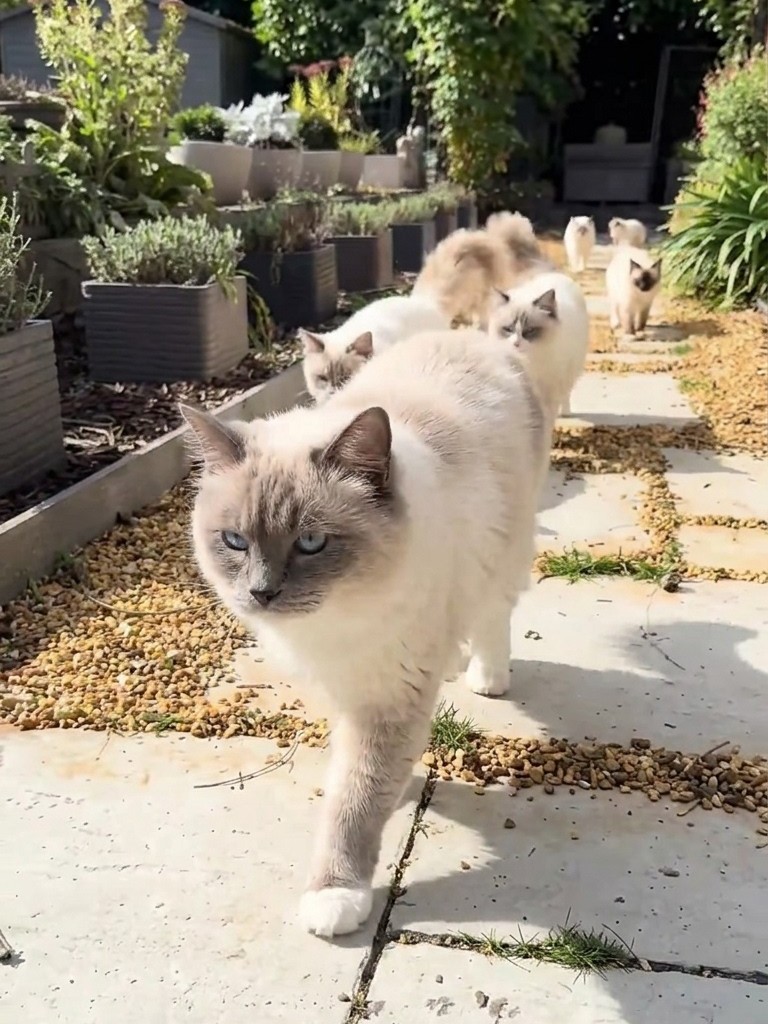
The colony heading up the garden path in single file.
Why do Ragdolls follow you everywhere?
Every cat follows its people some of the time. Ragdolls do it most of the time, and the reason is temperament. The breed was selected for a relaxed, people centred nature, and the registries describe a loving, easy going cat that is happiest in company. A Ragdoll is less a shadow than a colleague who has decided your desk is the best place to sleep.
Cats Protection lists the everyday reasons any cat follows its owner, and all of them apply:
- Attention. Especially when you have been out. The following is the welcome home.
- Food. Before meals, and at dawn and dusk when a cat is naturally most active and hungriest.
- Habit. You walking to the kitchen has ended in food often enough to be worth checking every time.
- Company. A cat with a strong bond wants to be near you, and is usually hoping you will sit down and make a lap.
- Boredom. You are the entertainment, particularly for an indoor cat with no hunting to do.
- Age. Older cats tend to follow their owners more than young ones.
Why does my Ragdoll follow me to the bathroom?
It is the question everyone asks, and the answers are less mysterious than the internet suggests.
- It is a room that is usually shut. A closed door is an invitation. Whatever is behind it must be worth seeing.
- You are a captive audience. You are sitting still, at cat height, with nothing in your hands. From a cat's point of view this is the best chance of attention all day.
- The taps. Running water is fascinating, and many Ragdolls like a drink from a tap or a paw under the stream. Do Ragdolls like water? goes into that.
- The furniture. A cool sink to curl up in, a bath to explore and a warm bathmat to sit on.
- Routine. You go at the same times every day. Cats notice.
None of it is a sign of anxiety. It is curiosity and company. If you would rather have the door shut, be consistent about it, and expect a paw underneath.
Why do Ragdolls act like dogs?
The following is one of a set of habits that make Ragdoll owners reach for the comparison:
- Meeting you at the front door.
- Coming when called, and learning their names quickly.
- Fetching. Many Ragdolls will bring a toy back.
- Flopping at your feet and rolling over.
- Walking on a harness, with patient training. See harness training.
They are still cats. A Ragdoll does all of this because it wants to, not because it was told to, and it will stop the moment it is bored. Are Ragdolls smart? covers what they learn and how to teach it.
Is my Ragdoll too clingy?
A cat that enjoys your company and a cat that cannot cope without it look similar from the outside. The difference shows when you are not there, and in whether anything has changed.
Ordinary devotion
- Follows you, then settles and sleeps once you sit down.
- Is relaxed when you leave and pleased when you return.
- Eats, plays and uses the tray normally while you are out.
Worth a closer look
- Distress when you leave: crying at the door, or a wrecked room when you get back.
- Toileting outside the tray, overgrooming or going off food when left.
- Following that is new, or suddenly much more intense.
The last one matters most. Cats Protection's advice is direct: if your cat becomes a lot more clingy than usual, speak to your vet. A cat that feels ill or is in pain often sticks close to its person, and so does an older cat whose sight, hearing or memory is fading. Following that comes with constant begging for food can also be medical. For the cat that struggles with being alone, can Ragdolls be left alone? sets out what helps.
Putting the following to good use
A cat that wants to be where you are is a cat that is easy to teach, and a few minutes of training gives the following a purpose.
- Come when called. Say the name, then reward the moment the cat arrives, with a treat or a chin rub. Start from a metre away and build up. It is the most useful thing a cat can know, and the day it gets out of the front door you will be glad of it.
- A place to settle. Put a mat or bed where you work or cook and reward the cat for being on it. The cat gets to be near you, and you get your worktop and your keyboard back.
- Follow me, properly. A cat that trots after you will usually learn to walk beside you on a harness in the garden. Harness training shows how.
- Into the carrier. Lead the cat in with a treat, feed it there and leave the door open. Vet days become far easier. See vet visits without the stress.
Keep sessions to a couple of minutes and stop while the cat is still keen.
When following becomes door dashing
The one place the habit is a risk is the front door. A Ragdoll that follows you everywhere will follow you out, and an indoor cat that slips onto the street has no road sense at all.
- Give the cat somewhere else to be. A treat on a perch or a mat well away from the door, every time you leave or arrive, until going there is automatic.
- Look down before you open the door, and ask visitors and delivery drivers to wait while you move the cat.
- Do not make a fuss at the door. Say your hellos once you are in the sitting room.
- Keep the microchip details up to date. It is the law in England, and it is how a lost cat comes home. See microchipping and the law and, if the worst happens, the lost cat action plan.
How to get five minutes to yourself
You do not need to stop a Ragdoll following you, and you would not manage it. You can give it other things to do.
- Play on a schedule. Short, regular sessions with a wand toy, morning and evening, and solo toys such as ping pong balls for the times you are busy.
- Make meals take longer. A puzzle feeder turns a bowl emptied in a minute into a hunt. Feed the right amount for the cat's weight, spread across the day.
- Give fuss by routine, not on demand. A cat that knows attention arrives at set times asks for it less in between.
- Furnish the rooms you work in. A bed on the desk, a perch by the window, a cat tree in the corner. A cat that can be near you without being on you usually takes the offer.
- Think about a companion. Two Ragdolls follow each other as well as you. One kitten or two? weighs it up.
Do not shut the cat away, push it off or tell it off for following. It will not understand, and a worried cat follows more, not less.
Living with a cat underfoot
A shadow has practical consequences. Look before you step back from the worktop, check the washing machine and the tumble dryer before you shut the door, and close doors gently: a trusting cat is slow to move out of the way. Kitten proofing covers the rest.
Quick questions, answered
Why do Ragdolls follow you everywhere?
Because the breed is people centred and prefers company to solitude. On top of that come the reasons any cat follows its owner: attention, food, habit, boredom and the hope of a lap.
Why does my Ragdoll follow me to the bathroom?
The door is usually shut, which makes the room interesting. You are sitting still and available, and the taps, the sink and the bathmat are all attractions. It is curiosity and company, not anxiety.
Is my Ragdoll too clingy?
Not if it settles once you sit down and copes calmly when you go out. A cat that is distressed when left, or that has suddenly become much more clingy, is worth a conversation with the vet.
Why has my cat suddenly started following me everywhere?
A sudden change can mean the cat is unwell, in pain, or unsettled by something new at home. Older cats also follow more as their senses fade. Cats Protection advises speaking to your vet if a cat becomes much more clingy than usual.
Do Ragdolls attach to one person?
Most are friendly with the whole household and often have a favourite, usually the person who feeds them, plays with them and is at home most.
Will a second cat stop my Ragdoll following me?
It usually shares the load. Two cats keep each other company and play together, but both will still want to be where you are.
Sources and further reading
- Cats Protection: Why does my cat follow me around?: The charity's reasons for following, the bathroom included, and when clinginess needs a vet.
- The International Cat Association: Ragdoll: Registry profile describing a relaxed, quiet, people loving breed that takes up to four years to mature.
Thinking about a Ragdoll kitten?
Our Ragdoll kittens grow up in our home in Ryde, Isle of Wight, with health tested parents and our support for life. See who is available now, or join the waiting list for the next litter.