
What Is a Mink Ragdoll? Mink, Sepia and Solid Explained
A darker coat, eyes that are not blue, and a name the breed standards do not use.
Last reviewed
What is a mink Ragdoll? It is a cat from Ragdoll type lines that carries one copy of the Siamese pointed gene and one copy of the Burmese version, instead of the two pointed copies every standard Ragdoll has. The result is a richer, darker body colour with softer contrast at the points, and eyes usually described as aqua, not blue. Sepia cats carry two Burmese copies and are darker still. Solid cats carry no pointed gene at all. All three are sold under the Ragdoll name, and none of them fits the breed standard, which asks for pointed colour and blue eyes. Here is what the words mean and what to check before paying for one.
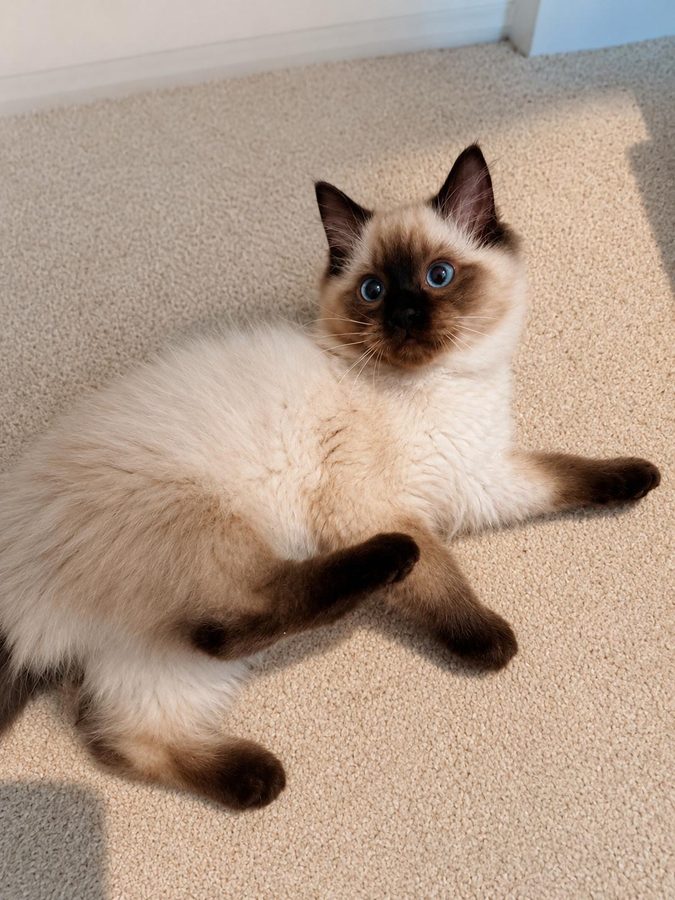
Dotty, one of our rising girls: dark points, a pale body and blue eyes, the three things a standard Ragdoll always has.
Traditional, mink, sepia and solid
- Traditional, or pointed. The Ragdoll of the breed standards. Colour on the face, ears, legs and tail, a clearly paler body, and blue eyes for life. Born white.
- Mink. A darker, more even body colour with points that stand out less, and eyes usually described as aqua, somewhere between blue and green.
- Sepia. Darker again, with little contrast between body and points, and eyes from green to gold.
- Solid. Full colour all over, like any black, blue or tabby cat, with green or gold eyes.
Traditional is a word that only became necessary once the others were being sold. In a registry standard there is only the Ragdoll, and it is pointed.
The genetics, in plain terms
All four come down to one gene, the one that lets a cat make pigment. The Veterinary Genetics Laboratory at the University of California, Davis, which tests for it, describes three versions that matter here.
- Full colour. The ordinary version. Pigment everywhere. It is dominant, so one copy is enough.
- The Siamese version. Pigment is only made in the cooler parts of the body, which gives dark points on a pale coat and blue eyes. This is the pointed gene.
- The Burmese version. A milder form of the same effect. The whole coat is a little lightened, the points only slightly darker.
Every cat has two copies, one from each parent:
- Two Siamese copies: a pointed, blue eyed cat. Every standard Ragdoll.
- One Siamese and one Burmese: a mink, halfway between the two.
- Two Burmese copies: a sepia.
- At least one full colour copy: a solid.
Two things follow. First, two standard Ragdolls can only ever have pointed, blue eyed kittens, because neither has anything else to pass on. A mink kitten means at least one parent carried the Burmese version, which no cat bred to the standard does. Second, a DNA test settles the question in either direction, and a seller of minks should have the parents' results to show. Why Ragdolls change colour explains how the temperature effect works on a pointed coat.
Is a mink Ragdoll a real Ragdoll?
Not by the standards of the main registries, and that includes the one that matters most in Britain.
- The GCCF recognises three patterns, colourpointed, mitted and bicolour, all with eyes that are deep blue. It has no mink, sepia or solid Ragdoll.
- The Cat Fanciers' Association states that all Ragdolls are pointed, and its standard disqualifies eyes of any colour but blue.
- The International Cat Association describes the breed as a blue eyed, pointed cat.
Sellers of minks answer that their cats descend from Ragdoll lines and share the build and temperament, and for many of them that is true. The name Cherubim sometimes travels with these cats as well; our guide to Cherubim Ragdolls explains where it comes from. But the breed is defined by its standard, and the standard has two fixed points: the pattern and the eyes. A mink may be a lovely cat from Ragdoll ancestry. It is not what a judge, a registry or most buyers mean by a Ragdoll.
None of this makes a mink a worse pet. It matters for one practical reason: the word on the advert sets the price.
Solid and sepia Ragdolls on adverts
Solid adverts cause the most confusion, because a solid has lost both of the features people recognise a Ragdoll by.
- Solid black, blue, chocolate or lilac. The same colours a pointed Ragdoll carries on its points, spread over the whole cat, with green or gold eyes. A solid blue is an even grey cat; a solid black is a black cat. A black smoke has white at the base of each hair under a black top coat.
- Solid with white. The mitted and bicolour white markings laid over a solid coat, which gives the black and white or grey and white cats sometimes advertised as Ragdolls.
- Sepia. Often mistaken for a dark pointed cat in photographs. The eyes are the giveaway: green to gold, not blue.
Without the papers and the parents in front of you, there is no way to tell a solid from Ragdoll lines apart from a fluffy cat of no particular breed, or from a Ragdoll cross. That is not a criticism of the cat. It is a reason to see the paperwork before paying a pedigree price. Can Ragdolls be black, orange, tabby or calico? goes through each colour in turn, and Is my cat a Ragdoll? covers what counts as proof.
What sellers say, and what holds up
- They are rare. They are less common, because few breeders produce them. Rare is not the same as valuable. No colour or coat type makes a cat healthier or better tempered, and a premium for rarity is a premium for a word.
- They have a softer, richer coat. The colour is richer, which is simply what the Burmese version of the gene does. Softness is in the hand of the person stroking; there is no evidence the coat differs.
- They are born with colour. Sellers say so, and it fits the genetics: pointed kittens are born white and colour up over weeks, and a kitten with less of the temperature effect shows colour sooner. It is a curiosity, not a quality.
- They go back to the first Ragdolls. Some sellers trace their cats to the breed's earliest lines, a claim that cannot be checked from an advert. Ragdoll history sets out what is known.
- They have the same temperament. Quite possibly. Temperament comes from the parents and from how a kitten is raised, not from coat colour, in either direction.
Buying a mink, sepia or solid in the UK
If you have met one and fallen for it, buy with your eyes open. Ask:
- Which registry are the parents and kittens registered with, and as what? Ask to see the paperwork, and read the breed name on it.
- Can I see the parents' colour DNA results? A breeder working with these colours tests for them.
- Which health tests have the parents had? HCM and PKD matter exactly as much in a mink line as in any other. Certificates, not assurances. Ragdoll health testing explains what to look for.
- What colour will the eyes be? Aqua, green or gold, not blue. If blue eyes are the point for you, a mink is the wrong cat.
- How does the price compare with a pointed kitten? There is no good reason for it to be higher. Ragdoll prices in the UK gives the usual range.
And if an advert offers a Ragdoll kitten with green eyes or a solid coat and no explanation, treat it as a cross until shown otherwise. Choosing a breeder has the wider checklist.
Where our own cats fit
Ours are Ragdolls in the standard sense: seal, blue and chocolate points in colourpoint, mitted and bicolour, every one blue eyed. We do not breed minks, sepias or solids. You can meet the colony and see them for yourself.
Quick questions, answered
What colour eyes does a mink Ragdoll have?
Usually described as aqua, between blue and green. Sepia cats have green to gold eyes and solid cats green or gold. Only pointed Ragdolls have the true blue eyes of the breed standard.
Are mink Ragdolls recognised by the GCCF?
No. The GCCF recognises colourpointed, mitted and bicolour Ragdolls, all with blue eyes. Mink, sepia and solid cats are outside its Ragdoll standard, as they are with the other main registries.
Are mink Ragdolls rare, and are they worth more?
They are less common because fewer breeders produce them, but rarity adds nothing to health or temperament. There is no good reason to pay more for one than for a pointed Ragdoll from health tested parents.
Can two Ragdolls have a mink kitten?
Two standard, pointed Ragdolls cannot. Each has only the pointed gene to pass on, so every kitten is pointed and blue eyed. A mink kitten means at least one parent carried the Burmese version of the gene.
What is the difference between mink and sepia?
A mink has one Siamese pointed copy of the colour gene and one Burmese copy. A sepia has two Burmese copies, so it is darker, with less contrast between body and points and eyes from green to gold.
What is the difference between a mink and a traditional Ragdoll?
A traditional Ragdoll is pointed, with a pale body, dark points and blue eyes, and is born white. A mink has a darker, more even coat and aqua eyes. Only the traditional cat meets the breed standard.
Sources and further reading
- UC Davis Veterinary Genetics Laboratory: Colorpoint restriction: The gene, its Siamese and Burmese versions and what each combination produces.
- Governing Council of the Cat Fancy: Ragdoll: The UK registry's profile: recognised colours and patterns, coat care, size and maturity.
- Cat Fanciers' Association: Ragdoll breed profile and standard: The coat description, the seasonal shed and the slow road to full coat, colour and size.
- The International Cat Association: Ragdoll: Registry profile: a semi long, silky coat, light seasonal shedding and up to four years to mature.
Thinking about a Ragdoll kitten?
Our Ragdoll kittens grow up in our home in Ryde, Isle of Wight, with health tested parents and our support for life. See who is available now, or join the waiting list for the next litter.