
Why Do Ragdolls Change Colour and Get Darker?
The temperature sensitive gene that leaves kittens white, then darkens the points and the coat for years.
Last reviewed
Ragdoll kittens are born white, or close to it, and the reason they change colour is temperature. The pointed gene every Ragdoll carries makes the pigment enzyme heat sensitive, so it only works properly in cooler skin: inside a warm womb it hardly works at all, and a newborn arrives blank. Once the kitten is out in the world the cooler parts darken first, the body shades in over months, and a Ragdoll keeps getting darker, slowly, for years. So why do Ragdolls change colour, when do they get their colour, and when do they get fluffy? Here is the timeline.
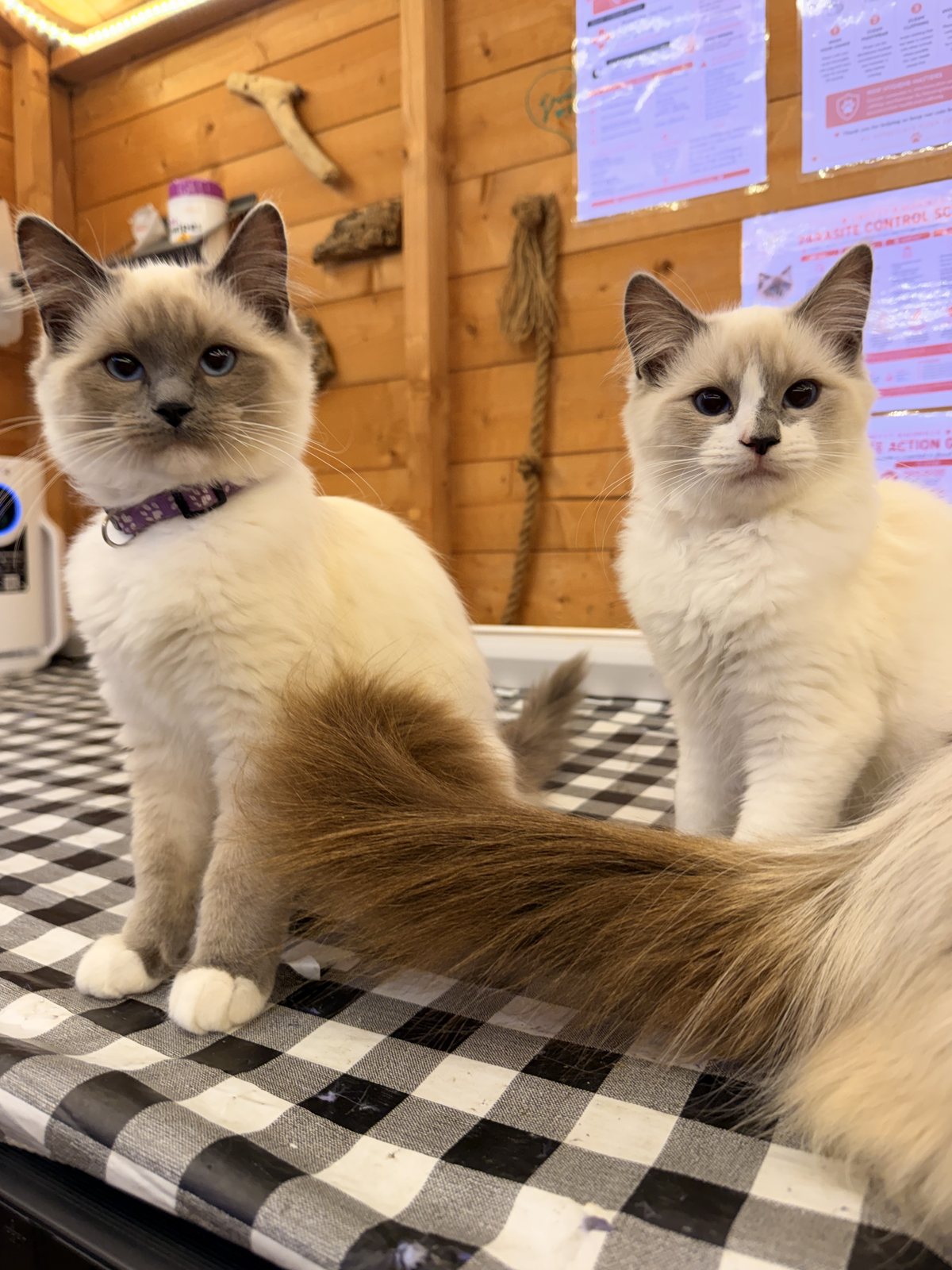
Kittens in the cat house. The points are in; the body colour has years of shading still to come.
Why do Ragdolls change colour?
Every Ragdoll is a pointed cat, carrying two copies of the pointed version of the tyrosinase gene, the same version a Siamese carries. Tyrosinase is the enzyme that builds melanin, the pigment that colours hair and skin. The pointed version is temperature sensitive: it works in cool skin and stops working in warm skin, and at full body temperature it barely functions at all.
A kitten in the womb sits at its mother's core temperature, which is warm everywhere, so no part of the coat gets any pigment and the kitten is born white or cream from nose to tail. Only once it is out in the air, with ears, face, paws and tail running a degree or two cooler than the body, does the enzyme switch on in those places and the points begin to show. The body never gets as cool as the extremities, so it never gets as dark.
The colours and patterns that result, seal, blue, chocolate, lilac, colourpoint, mitted and bicolour, are a separate story told in Ragdoll colours and patterns. This guide is about the timing.
When do Ragdolls get their colour?
Faster than most people expect at the start and slower than they expect at the end.
- Birth. White or cream. A seal point and a lilac point look much the same on day one.
- The first week or two. The ear tips, nose and paw pads begin to shade, and by about ten days you can usually tell a seal from a blue.
- Four to twelve weeks. The mask spreads across the face, the ears and tail fill in, and the pattern becomes clear: a mitted kitten's white feet and a bicolour's inverted V show against the darkening points.
- Three to twelve months. The body takes on a shade of its own, cream to fawn to pale brown or grey depending on the colour, and the points deepen.
- Two to three years. The full depth settles. Most breeders would not call a Ragdoll's colour finished before its third birthday.
That is why a kitten and its mother can look like two different colours: Dorothy, our seal point queen, carries years of shading that her newborns have not started. Every litter born in our house goes through the same slow reveal, ear tips first. Size and behaviour week by week are in kitten development.
Do Ragdolls get darker with age?
Yes, and it is normal. The slow shading does not stop at three; it just slows down. A Ragdoll keeps gaining pigment through adult life, and a seal point in particular can look markedly darker at five than at one, with a body gone from cream to warm brown. Blue points go from pale silver to a deeper grey. Lilacs and chocolates change least, but they change.
Why do Ragdolls get darker? Partly the enzyme keeps working, and partly, breeders suspect, older cats run a little cooler at the skin as circulation slows, which lets more pigment through. Neither is a sign of anything wrong. Temperature shows in the coat in other ways too, by the same rule: warm skin stays pale, cool skin darkens.
- A cat in a very warm house stays a shade paler.
- A fever can lighten the hair that grows during it.
- A patch shaved for surgery grows back darker, because the bare skin was cooler while the hair came in. It usually lightens again once the coat is back to full length.
Old age and some illnesses can also darken or dull the coat, so a sudden or patchy change, rather than the slow drift of years, is worth mentioning to your vet. Senior cats covers the other changes to expect.
When do Ragdolls get fluffy?
Later than the colour. Ragdoll kittens have a soft, short, slightly fuzzy baby coat, and the long silky adult coat comes in gradually through the first year. By twelve months most Ragdolls have the shape of their adult coat, the ruff, the britches on the back legs and the plume of a tail, but it keeps filling out to around two or three years, which is also when the body has finished growing.
Seasons matter too. The winter coat is fuller and sheds out in spring, so a Ragdoll in July can look like a different cat from the same one in January. Our sixteen live indoors with an enclosed garden, which keeps the seasonal swing smaller than an outdoor cat's, but the spring moult still fills the brush.
The coat is semi longhaired with less undercoat than a Persian or a Maine Coon, which is why it mats less than you might fear. A weekly comb through the first year gets a kitten used to the idea before the adult coat arrives, and Ragdoll grooming covers the tools and the routine.
What the kitten you see will become
Two practical points for anyone choosing a kitten.
First, the kitten you see at nine weeks is a sketch of the adult. A pale seal point kitten will become a rich brown cat with a dark mask; a blue point will go from silver to slate. If you have a strong preference for a lighter or darker look, ask to see the parents, who show you roughly where the kitten is heading, which is one more reason to visit a kitten with its mother rather than buy from a photo.
Second, a white Ragdoll kitten in an advert is a newborn, not a white Ragdoll. There is no such colour in the breed, and a kitten with no colour at all on its ears and nose at eight weeks is not a pointed cat. The breed was founded on pointed cats in the 1960s and has stayed pointed ever since, which Ragdoll history explains, and choosing a breeder lists the questions that catch the rest.
Beyond that, enjoy it: watching the colour arrive is one of the quiet pleasures of the breed, and it goes on for years.
Quick questions, answered
Why are Ragdoll kittens born white?
Because the pointed gene makes the pigment enzyme temperature sensitive, and a womb is warm all over. The enzyme only works in cooler skin, so no colour is laid down before birth. Once the kitten is out, the cooler ears, nose, paws and tail start to darken within the first week or two and the rest follows over months.
When do Ragdolls get their full colour?
Points show within the first week or two, the pattern is clear by about twelve weeks, the body shades in over the first year, and the full depth settles at around two to three years. After that a Ragdoll still darkens slowly for the rest of its life, which is normal and nothing to worry about.
Why do Ragdolls get darker with age?
The temperature sensitive enzyme keeps adding pigment through adult life, and older cats are thought to run a little cooler at the skin, which lets more colour through. A seal point can look much darker at five than at one. A sudden or patchy change is different and worth a word with your vet.
When do Ragdoll kittens get fluffy?
The long adult coat comes in through the first year and keeps filling out until around two or three, when the cat has finished growing. Winter coats are fuller than summer ones. A weekly comb from kittenhood makes the change easy, and our grooming guide covers the tools and the routine.
Thinking about a Ragdoll kitten?
Our Ragdoll and Ragcoon kittens grow up in our home in Ryde, Isle of Wight, with health tested parents and our support for life. See who is available now, or join the waiting list for the next litter.