
When Do Ragdolls Get Fluffy? Coat Stages Explained
The fluff arrives in instalments, and the last one takes about three years.
Last reviewed
When do Ragdolls get fluffy? Later than most people expect. A Ragdoll kitten is born white and short coated, turns into a ball of fuzz by the time it leaves home, then spends much of its first year looking leggy and surprisingly sleek. The ruff, the full trousers and the plume of a tail come in over the next two winters, and the breed standards put the finished coat at about three years old. So if your six month old Ragdoll is not fluffy, it is almost certainly on schedule. Here is what happens when, and the few reasons a coat stays thin that are worth a second look.
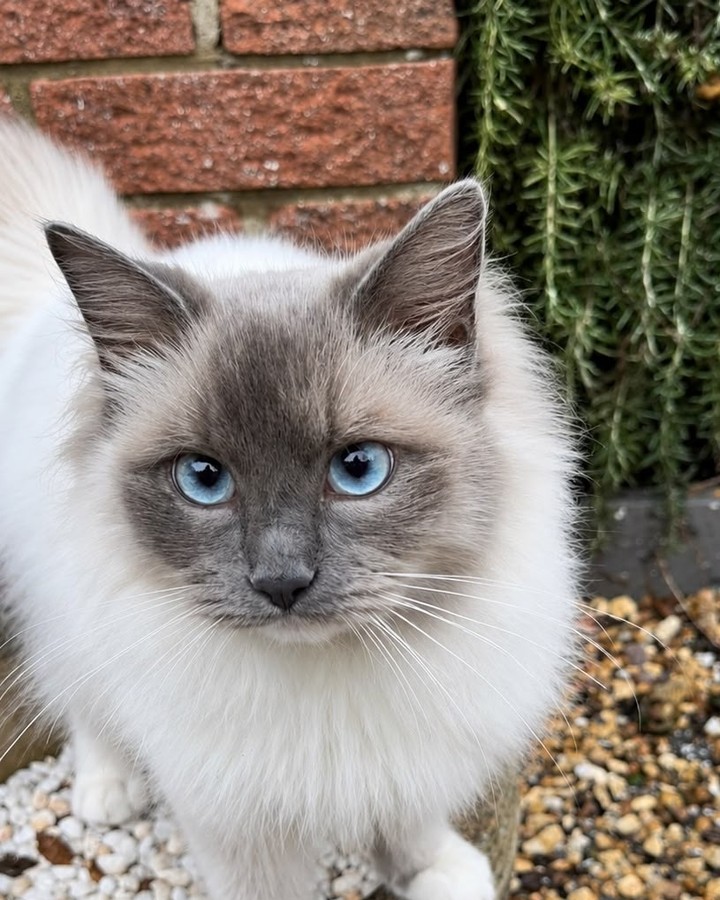
Skye, one of our rising girls, wearing the ruff that arrives with age.
When do Ragdolls get their full coat?
At about three years old. The Cat Fanciers' Association standard describes Ragdolls as slow maturing and reaching full coat and colour at around three, and full size and weight at four. The International Cat Association and the GCCF both give up to four years for the breed to mature. Nothing else about a Ragdoll is quick either: size and weight covers the body, and why Ragdolls change colour covers the slow darkening of the points.
That makes the first two years a long preview. The coat you see on a kitten, and even on a yearling, is not the coat the adult will wear. If you want to know what is coming, look at the parents: coat is inherited, and a breeder should be glad to show you both.
The Ragdoll coat, from newborn to adult
Newborn to leaving home
Every Ragdoll kitten is born white, with a short, close coat. The point colour starts to show within days, and by the time our kittens leave at nine to ten weeks they are wearing soft, fuzzy kitten coat that stands off the body. This is the round, fluffy stage that everyone photographs.
The leggy months
Between about four and twelve months the body does its fastest growing in height and length, and the coat does not keep up. The kitten fuzz goes, the adult coat is only starting, and what is left lies flatter and looks thinner, especially over the back and shoulders. This is the stage that worries new owners most, and it is normal.
The first winter coat
The first cold season often brings the first hint of a ruff around the neck and longer fur on the back legs. It may thin out again the following summer. That coming and going is the seasonal coat, not a problem.
Two to four years: the finished cat
With each winter the coat comes back fuller. The finished adult has the pattern the standard describes: short on the face, a longer ruff framing it, shorter fur over the shoulder blades, then lengthening along the body to a full, feathery tail, with long fur on the back legs that the GCCF calls knickerbockers and most owners call trousers.
What a fluffy Ragdoll should feel like
It helps to know what you are waiting for. A Ragdoll coat is semi long, not long, and silky rather than woolly. The registries describe plenty of long outer hair, very little woolly undercoat and a soft, rabbit like feel. It lies with the body instead of standing out from it.
So a Ragdoll in full coat is still a sleeker shape than a Persian, a Siberian or a Maine Coon in theirs, and many of the photographs online show mature cats in full winter coat. If you are comparing your eight month old kitten in July with one of those, the kitten will lose every time. The same light undercoat is the reason the coat mats less and sheds less than it looks as if it should: see do Ragdolls shed?
The winter coat and the summer coat
Even a finished Ragdoll does not look the same all year. Cats grow a thicker coat as the days shorten and shed it as they lengthen, so the fullest ruff of the year is a midwinter ruff and the sleekest outline belongs to high summer. PDSA's vets note that the cycle follows daylight more than temperature, which is why an indoor cat under lamps and central heating changes coat less sharply than one that lives by the sun, and sheds a little all year instead.
For a young Ragdoll the two clocks run together. The coat is thickening with age and swelling and thinning with the seasons at once, so progress looks like two steps forward and one back: fluffier in the first winter, plainer again the next summer, fluffier still the winter after. Judge the coat against the same month a year earlier, not against last season.
The colour keeps the same slow time. Points deepen and the body shades in over the same three years, and a pale kitten can become a much darker adult. Why Ragdolls change colour follows that side of it.
Why is my Ragdoll not fluffy?
In rough order of likelihood:
- Age. Under two, the answer is nearly always time. Under one, it is certain.
- Season. The summer coat is lighter and shorter. The winter coat grows in through the autumn, so the same cat can look half as fluffy in August as in January.
- The individual. Coats vary inside the breed. Some lines carry a longer, fuller coat and some a shorter, sleeker one, and two kittens from one litter can differ. A sleek Ragdoll is still a Ragdoll.
- It is a cross, or a lookalike. A truly short, close coat on an adult cat points to a Ragdoll cross or a pointed cat of another kind. Is my cat a Ragdoll? and Ragdoll cross cats explain how to tell.
- The coat has been clipped. A shaved or clipped coat takes months to return, and on a pointed cat it often grows back darker at first.
- Health. A coat that is dull, greasy, scurfy, patchy or thinning, rather than simply short, is a sign to act on. Worms, fleas, a poor diet, skin disease and illness all show in the coat, and a cat that is overweight, stiff or unwell stops grooming properly. That is one for the vet, not for a supplement.
If the coat is clean, soft, even and shiny, and the cat is young, the missing ingredient is birthdays.
Looking after the coat as it comes in
You cannot hurry a coat, but you can make sure nothing holds it back.
- Start the comb early. A kitten that learns a short, pleasant combing session will accept the longer ones the adult coat needs. How to groom a Ragdoll shows the routine.
- Feed for growth. A complete kitten food through the first year, then a good adult food. The coat is built from the diet. See feeding a Ragdoll.
- Keep parasites off the list. Regular worming and flea treatment remove two common reasons for a poor coat. See worming.
- Check where mats start. As the ruff and trousers arrive, so do the tangle spots: behind the ears, the armpits, the trousers and the belly.
- Bath rarely. Frequent washing strips the oils that make the coat lie well.
Then take a photograph every few months. The change from one to the next is too slow to see day to day and remarkable in the album.
Quick questions, answered
When do Ragdolls get their full coat?
At about three years old, according to the breed standards, with the body still filling out until four. The ruff and the long fur on the back legs build up over the second and third winters.
Why is my Ragdoll kitten not fluffy?
Because of its age. Between about four and twelve months the kitten fuzz has gone and the adult coat has barely started, so most young Ragdolls look leggy and sleek. A clean, soft, shiny coat on a growing kitten is normal however flat it lies.
When do Ragdolls get their winter coat?
It grows in through the autumn as the days shorten, and is at its fullest in midwinter. It thins again in the spring moult. Indoor cats show the change less sharply.
Will my Ragdoll's tail get fluffier?
Yes. The tail keeps gaining length and fullness as the cat matures, like the rest of the coat.
Do Ragdolls lose their kitten fluff?
Yes. The soft, fuzzy coat a kitten leaves home in is replaced during the first year by adult coat, which starts out flatter and sleeker. The fullness comes back, and then some, over the following two or three winters.
How can I tell if a kitten will have a full coat?
Look at the parents. Coat length and fullness are inherited, so a kitten from full coated parents is likely to follow them in its own time. No kitten shows its adult coat at ten weeks.
Can a Ragdoll have short hair?
The breed standards call for a semi long coat, so an adult with a truly short, close coat is likely to be a Ragdoll cross or another pointed cat. Young Ragdolls and summer coats can look short without being so.
Can food or supplements make the coat fluffier?
A good diet lets the coat reach what the cat's genes allow, and a poor one holds it back. Nothing in a bowl adds length or fullness beyond that. Ask a vet before giving supplements.
Sources and further reading
- Cat Fanciers' Association: Ragdoll breed profile and standard: The coat description, the seasonal shed and the slow road to full coat, colour and size.
- Governing Council of the Cat Fancy: Ragdoll: The UK registry's profile: recognised colours and patterns, coat care, size and maturity.
- The International Cat Association: Ragdoll: Registry profile: a semi long, silky coat, light seasonal shedding and up to four years to mature.
Thinking about a Ragdoll kitten?
Our Ragdoll kittens grow up in our home in Ryde, Isle of Wight, with health tested parents and our support for life. See who is available now, or join the waiting list for the next litter.