
From our colony to your sofa
Feeding a Multi-Cat Household
Stations, spacing and calm bowls when one cat becomes several.
Last reviewed
Stations, spacing and calm bowls when one cat becomes several.
Last reviewed
Cats hunt alone and prefer to dine the same way, which surprises people who imagine a happy row of bowls like a farmyard scene. Mealtimes for fifteen have taught us that peace at the bowl is arranged, not hoped for.
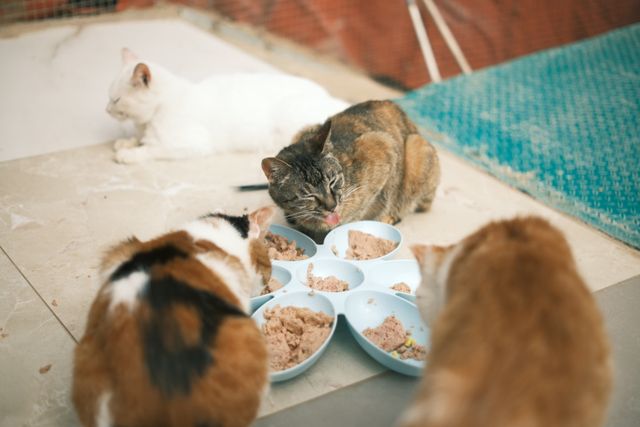
Multi cat feeding peace rests on a simple formula: at least one feeding station per cat plus a spare, spaced so no cat dines while watching another cat’s back, because in feline politics a shared bowl is not sharing, it is a queue with tension. Corners with escape routes beat dead ends; separate rooms beat corners.
Water follows the same arithmetic, generously scattered and away from the food. The quiet test of a working layout is that every cat eats unhurried and whole portions disappear; guarding, gulping and hovering are the layout asking to be redrawn.
Every multi cat home eventually stars a gobbler and a grazer, and unmanaged they trade problems: the gobbler inhales both portions, the grazer returns to an empty plate. The fixes are structural, not disciplinary: fed in separate rooms behind closed doors for the minutes that matter, or timed sessions where bowls go down together and come up together.
Technology offers the elegant endgame, microchip feeders that open only for their registered diner, which pay for themselves the first time one cat needs a prescription diet the other must not eat. Whatever the method, the goal is identical: each cat eats its own portion, at its own pace, unpoliced by colleagues.
Group feeding’s greatest danger is arithmetic: bowls empty, everyone looks fine, and nobody notices that one cat has quietly stopped eating because the others are covering the evidence. Appetite loss is the earliest page of most feline illness, and group living can hide it for a costly week.
The countermeasures are small and worth it: separate feeding even occasionally so individual appetites get witnessed, the monthly weigh rotation covering every cat, and attention to whoever lingers or leaves early. In a crowd, weight and witnessed meals are the only honest attendance registers.
Cats are solitary hunters by design, wired to eat alone with an exit in view, so the elbow to elbow feeding line violates deep instinct: the anxious bolt their food, the polite eat too little, and the tension leaks into the rest of the day as friction nobody connects to breakfast.
The fix is privacy without ceremony: stations placed so no cat dines in another’s sight line, each with an open escape route. Most mysterious mealtime edginess dissolves within days of nobody being watched.
Vertical separation is the multi cat feeder’s cheapest trick: a station on a counter end, a sturdy shelf or a cat tree platform gives the timid a dining room the confident floor eaters never contest, and lets a bullied cat eat in full view of the room while feeling untouchable.
Height also solves the dog problem and the toddler problem in mixed households, and it suits the athletic cat who was always going to end up on the worktop anyway. Assign the altitude deliberately and the counter stops being a crime scene and becomes a place setting.
Sooner or later one cat needs different food, a prescription diet, a weight plan, kitten rations among adults, and the household becomes a border control problem. Microchip feeders solve it elegantly, opening only for the registered cat, and earn their cost in the first month of not policing doorways.
The manual alternative is separation by room and schedule, meals supervised and bowls lifted after. What never works is hope: cats do not respect labels, and the dieting cat will eat the kitten’s rations with a clear conscience every single time.
When a new cat is settling in, meals become diplomacy: feeding resident and newcomer on opposite sides of the closed introduction door, gradually closer over days, teaches both that the stranger’s smell predicts good things. It is the oldest trick in the introduction book because it works on instinct directly.
Keep the treaty generous on both sides, no resident rations cut, no newcomer fed visibly better, and carry the separate stations habit forward once doors open. Cats that have never had to compete over food find remarkably little else worth fighting about.
Simon Tofield and Cats Protection behaviourist Nicky Trevorrow explain the feeding habits behind the mealtime chaos and how to get a cat working for its food rather than shouting for it. It is the behaviour that makes the station arithmetic in this guide necessary once there is more than one cat at the bowl.
Watch on YouTube Simon’s Cat with Cats Protection
Feeding several cats fairly is architecture: one station per cat plus spares, spread across rooms and heights so nobody eats watched, measured portions per cat rather than a communal trough, and prescription diets protected by microchip feeders or closed doors. Mealtime harmony is designed, not hoped for, and the design pays off in data: you always know who ate.
One per cat plus a spare, spread through the home rather than lined up in one kitchen corner. A row of bowls is a single station with extra plates as far as feline politics is concerned.
If both share the same food and hold healthy weights, it is harmless quirk. The moment diets diverge or one starts losing ground, the swap becomes the reason for protected stations.
Break the chokepoint: spread stations so no single body can oversee them all, add a height option for the intimidated, and feed the guard first in a separate room. Guarding runs on geography, and geography is yours to change.
Yes: multiple water points, away from food and trays, so drinking never means crossing another cat’s ground. Hydration falls quietly in tense households, and extra bowls are the cheapest fix available.
Because the communal bowl stops being data: you cannot see who is eating, who is not, and who eats for two. Measured meals per cat are the only honest census a multi cat home has.
Eating shoulder to shoulder is tolerated by cats, never enjoyed. The confident ones gulp and raid, the polite ones eat fast and anxious or hang back and quietly lose condition, and the humans see full bowls and assume all is well. Watch for hovering, guarding, gulping and one cat forever finishing everyone else’s leftovers: those are queue politics, not personality.
Give each cat their own station, plus a spare, spread across rooms and heights rather than lined up in one kitchen corner. A nervous eater does best with a wall behind them and an exit in view, water sits away from food, and nothing sits next to a litter tray. It is the same arithmetic of one each plus one spare that keeps the whole house calm in our multi cat harmony guide.
A kitten on kitten food, an adult on a diet and a senior who needs building up cannot share a buffet, so scheduled meals beat free feeding the moment there is more than one cat. Feed the special case behind a closed door, or let a microchip feeder play doorman by opening for one cat only. A slow feeder bowl settles the household gulper, which is exactly why a personalised one lives in our kitten starter pack.
Routine does most of the heavy lifting here: same times, same places, kittens and nursing queens fed separately, and plates lifted once everyone finishes so there is nothing left to guard. The quiet bonus of orderly mealtimes is information, because when every cat has their own plate, the first cat to leave food behind is noticed the same day, and our feeding guide explains why that early notice matters.
For multi cat household planning, International Cat Care covers resource layouts and feline social needs in detail.