
Ragdoll Belly Pouch: The Primordial Pouch Explained
It sways when they trot, and it is meant to.
Last reviewed
That loose flap that swings under your Ragdoll's belly when it trots across the room is the primordial pouch. It is not fat, it is not caused by neutering, and it does not mean your cat needs a diet. Every cat has one, from a farm cat to a lion. On a big, long bodied breed like the Ragdoll it can be generous, and the belly fur makes it look larger still. The useful skill is telling a pouch from a weight problem, because the two can sit on the same cat. Here is what the pouch is, why it is there, and when a belly is worth a vet's opinion.
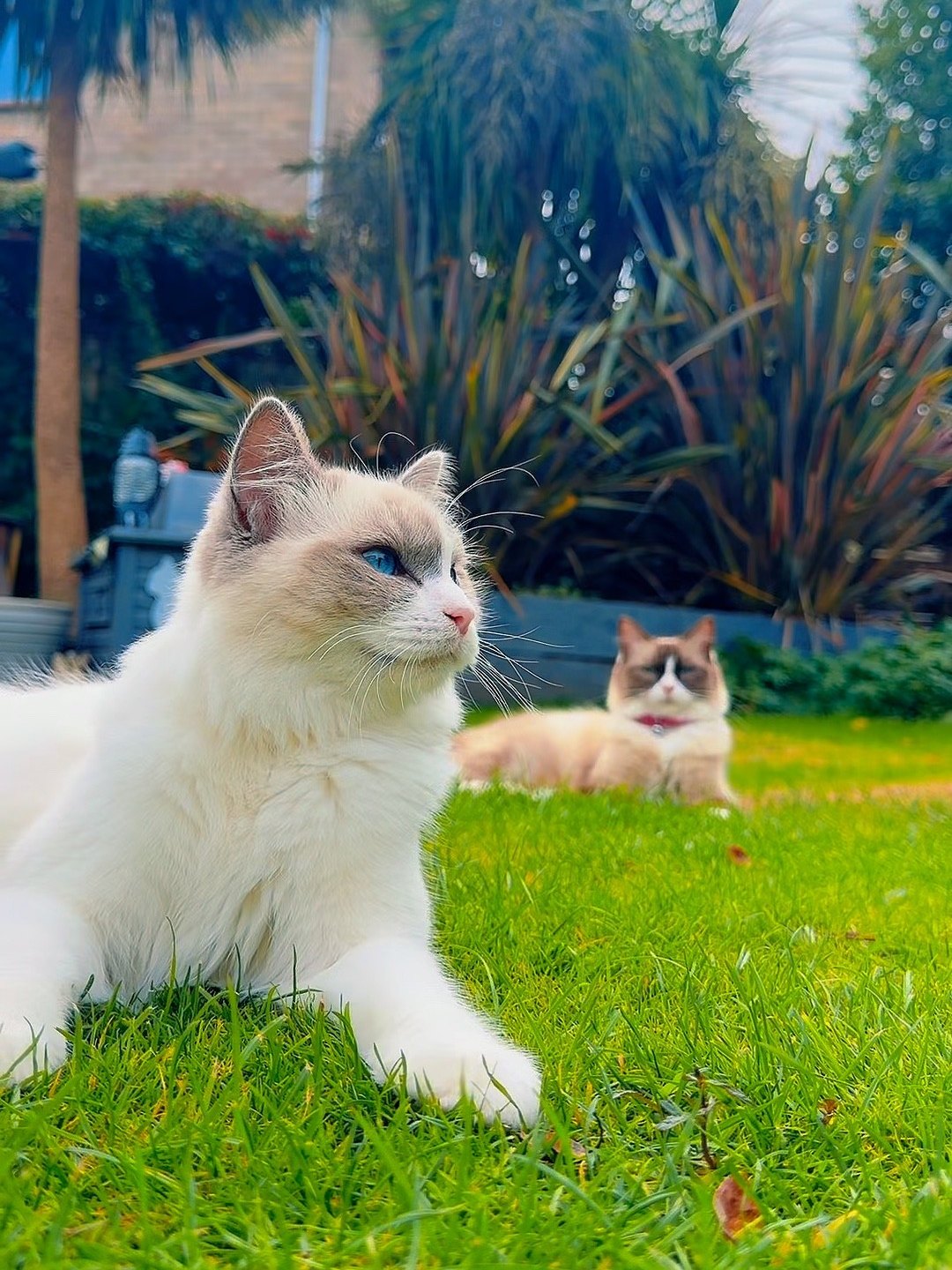
Kitty and Pulaski on the lawn. Under the coat, every cat has a pouch.
What is the primordial pouch?
It is a loose flap of skin, with some fatty tissue and fur, that hangs along the underside of the belly in front of the back legs.
- All cats have one, male and female, neutered or not.
- So do big cats. Lions and tigers have the same flap.
- The size varies. On some cats it is obvious. On others you have to look for it.
- It appears at about six months old and stays for life.
- It gets a little saggier with age, which is normal.
You may also hear it called a belly flap, an apron or, less kindly, a spay sway. That last name is a myth in two words, as we will come to.
Why do cats have a belly pouch?
Nobody knows for certain. There are three main ideas, and they may all be partly right.
- Protection. When cats fight, they grip with the front legs and rake with the back ones, the bunny kick. A loose layer of skin and padding over the belly may protect the organs underneath.
- Movement. The extra skin lets the body stretch out fully in a run or a jump, and twist in the air to land on its feet.
- Room for a big meal. A wild cat may eat a lot at once and then nothing for a while. A belly that can expand would help.
None of these matters much to a Ragdoll on a sofa. The pouch is a piece of standard equipment that came with the cat.
Do Ragdolls have a bigger pouch?
It can look that way, for three reasons.
- They are large, long cats, so there is more belly for the flap to hang from.
- The belly fur is long and soft, and adds its own fringe.
- They mature slowly. A Ragdoll goes on changing shape until three or four, and the pouch often becomes more obvious as the body fills out.
A pouch on a young, lean Ragdoll is not a sign that it will be a fat adult. It is simply more visible on some cats than others.
What Ragdolls do have is a real tendency to put on weight: a big appetite, a calm nature and an indoor life. So it is worth learning to tell the two apart. Ragdoll size and weight gives the healthy ranges.
Pouch or overweight? How to tell
Use your hands and your eyes, not the look of the belly from the side.
- Feel the ribs. Run your fingers along the side of the chest. You should feel each rib under a thin covering, like the back of your hand. If you have to press to find them, the cat is carrying too much.
- Feel the spine and hips. The same rule applies.
- Look from above. There should be a waist behind the ribs. A cat that is the same width all the way down, or wider in the middle, is overweight.
- Watch it walk. A pouch is loose and swings from side to side. A fat belly is rounder, firmer and sways less.
- Feel the flap itself. A pouch is mostly skin and feels thin and empty between your fingers. Fat feels thick.
A cat can have both: a normal pouch, with a layer of fat over the ribs as well. The ribs and the waist are the test, and the pouch tells you nothing either way. The hands on body condition check explains the scoring vets use.
With a Ragdoll you have to put your hands on the cat. The coat hides both a thin cat and a fat one.
The pouch from kitten to old age
- Under six months. No pouch to speak of. A round belly on a young kitten is either a recent meal or, if the kitten is thin elsewhere, a reason to worm it.
- Six months to a year. The flap appears. On a lanky adolescent Ragdoll it can look out of proportion for a while.
- One to four years. The body fills out around it. This is also when the weight needs watching, because growth is slowing and the appetite is not.
- The middle years. The pouch should look and feel the same from one year to the next. Weigh the cat every month and you will know whether a bigger belly is pouch or pounds.
- Old age. Skin loses its spring and the flap hangs lower. If an old cat is losing weight, the pouch can look longer and emptier, and that is a reason to see the vet about the weight, not the pouch.
Does neutering cause the pouch?
No. Cats that have never been neutered have pouches too.
The myth comes from timing. The pouch develops at about six months, which is about when most cats are neutered. And a neutered cat needs less food than before, so if the portions stay the same the cat gains weight, and a fat belly is taken for a pouch that the operation caused.
The answer is to feed a little less after neutering and to weigh the cat every month. Neutering and spaying explains what changes and why is my Ragdoll always hungry? covers the cat that disagrees with its new portions.
Belly changes that need a vet
A pouch that has always been there and has not changed is nothing to worry about. See a vet for:
- Any noticeable change in the size or shape of the belly, especially over days or weeks.
- A belly that is round, tight or swollen and not loose and swinging. A suddenly swollen belly is an emergency. See when to call the vet.
- A lump in or under the flap. See lumps and bumps.
- A pot belly on a thin kitten, which often means worms. See worming.
- A growing belly on an unneutered female, who may be pregnant. Swelling usually shows from four to five weeks. Do not press on it.
- A belly the cat will not let you touch when it used to, or one that seems sore.
- Weight loss elsewhere while the belly grows.
If you are not sure whether your cat is overweight, ask. A vet or a nurse can score its body condition in a minute, and many practices are happy to weigh a cat between appointments.
Looking after the pouch
- Leave it alone. It cannot be dieted or exercised away, and trying will only make a healthy cat hungry.
- Comb it. The belly and the insides of the back legs are where mats start on a Ragdoll. A few gentle strokes at each groom keep it clear. See how to groom a Ragdoll.
- Check it. Run a hand along it now and then for lumps, scabs or sore patches.
- Respect it. Many cats dislike having the belly touched, and a Ragdoll that rolls over is offering trust, not always an invitation. Why Ragdolls go limp explains the flop.
Quick questions, answered
What is the flap of skin on my Ragdoll's belly?
It is the primordial pouch, a loose flap of skin, fatty tissue and fur that every cat has along the underside of the belly. It is normal and not a sign of being overweight.
Why do cats have a primordial pouch?
Nobody is certain. The main ideas are that it protects the belly in a fight, lets the body stretch fully when running and jumping, and gives the stomach room to expand after a large meal.
Is my Ragdoll fat or is it just the pouch?
Feel the ribs and look for a waist from above. If you can feel the ribs under a thin covering and see a waist, it is pouch. A pouch swings loosely, while a fat belly is firmer and sways less.
At what age do cats get a primordial pouch?
At about six months old. It stays for life and may become a little saggier in old age.
Does spaying or neutering cause the belly pouch?
No. Unneutered cats have one too. Neutered cats need less food, so weight gain after the operation is often mistaken for a pouch.
Can I get rid of my cat's primordial pouch?
No, and there is no reason to. It is part of the cat's normal anatomy. If the cat is also overweight, a slow weight loss plan from your vet will reduce the fat, not the pouch.
Sources and further reading
- Cats Protection: Why do cats have a primordial pouch?: What the pouch is, the theories for it, how to tell it from fat and when to see a vet.
Thinking about a Ragdoll kitten?
Our Ragdoll kittens grow up in our home in Ryde, Isle of Wight, with health tested parents and our support for life. See who is available now, or join the waiting list for the next litter.