
Can You Walk a Ragdoll on a Lead? Harness Training
Most Ragdolls accept a harness. What they will not accept is being walked like a dog.
Last reviewed
Yes, you can walk a Ragdoll on a lead, and many take to a harness better than most breeds, because they are calm, people led and used to being handled. The catch is the word walk. A cat on a harness is not going for a dog walk. It is having supervised time in the garden, the catio or a quiet patch of green, at its own pace, with you on the other end as an anchor rather than a driver. Done that way, a Ragdoll harness is a pleasant extra for an indoor cat. Done the dog way, you get a flat, frozen, unimpressed cat on a string.
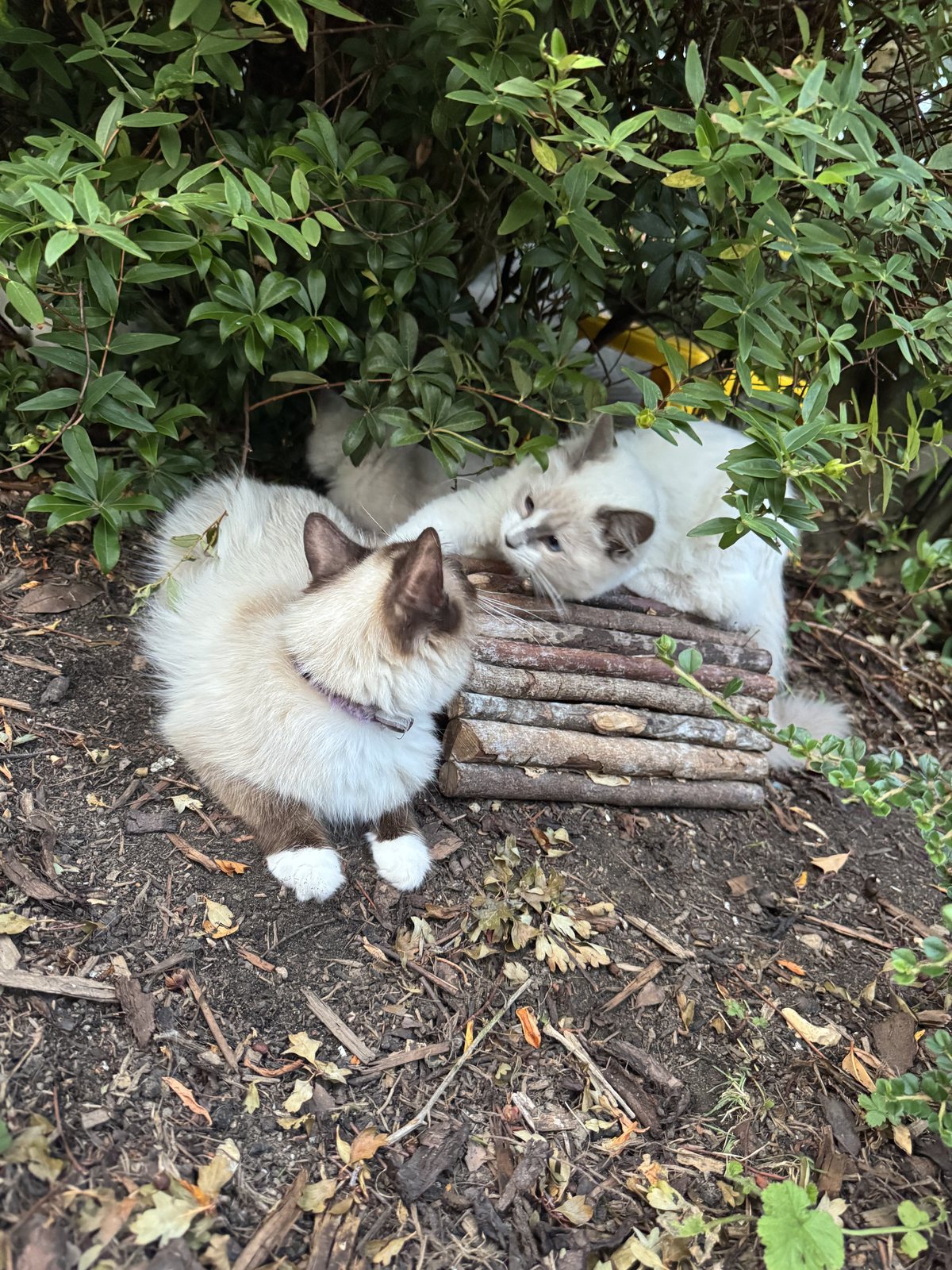
Our colony gets its outdoor time in the enclosed garden and the catio, no lead required.
Do Ragdolls like harnesses, and can you walk one?
Most Ragdolls tolerate a harness and a good number enjoy it, which is more than you can say for many breeds. The traits that make them easy house cats, a calm nature, a liking for company and a high tolerance for being picked up and fiddled with, are the same traits that make a strap round the chest a minor event rather than an outrage. A Ragdoll that follows you from room to room will often follow you round the garden too.
What walking a Ragdoll cat looks like is the part people get wrong. There is no heel, no route and no pace. The cat chooses where to go, which is usually three metres to the nearest interesting plant, followed by ten minutes of sniffing and a sit down. Your job is to hold the lead loosely, keep it from tangling and be the thing the cat retreats to if a pigeon lands. Twenty minutes of that is a full outing.
Two things decide how it goes. Age, because a kitten that meets a harness once its vaccination course is complete usually accepts it faster than a six year old that has never worn anything. And temperament, because a confident, nosy cat will enjoy it and a shy one may never want to, and both are allowed.
The best harness for a Ragdoll
Skip the thin H style harness, the two loops joined by a strap along the back. On a big, soft, loose skinned cat the loops slide, and a Ragdoll that sits down and reverses can walk straight out of one. A vest or jacket style harness spreads the pressure across the chest, has far more fabric to grip and is much harder to shrug off. Look for clips plus hook and loop fabric, with the lead ring between the shoulder blades, never at the neck.
Measure before you buy. Put a soft tape round the chest just behind the front legs, snug but not tight, and note it in cm. Ragdolls are long and heavy rather than barrel chested, but most adults still land in the largest cat size or a small dog size, and many measure 40 cm or more. Kitten sizes are outgrown within months, so expect to buy twice.
Fit is the two finger test: you should be able to slide two fingers under any strap, no more and no less. Add a light lead of 1.5 to 2 metres. Extending leads are for dogs; they pay out line at exactly the moment you want the cat close. Never attach a lead to a collar. A cat that panics against a collar can hurt its neck or slip it, and a breakaway collar, the only safe kind, is built to open under load.
Harness training a cat, one week at a time
The method is dull, slow and works. Every step ends before the cat wants it to, and every step comes with a treat.
- Days one to three. Leave the harness near the food bowl so it becomes furniture that smells of dinner. Do nothing else.
- Days three to five. Drape it over the cat's back for a few seconds while feeding treats, then take it off. Repeat at mealtimes.
- Week one into two. Fasten it for a minute, treat, remove. Build to five minutes, then fifteen, then half an hour of ordinary indoor life in the harness.
- Week two. Clip the lead on and let the cat tow you around the house. Never steer. Keep the lead slack and pick it up only to stop a tangle.
- Week three. Out into the garden or catio with the house door shut behind you, so a startle has nowhere to go. Short sessions, the same spot, a treat at the end.
- Later, if ever. Quiet outdoor spaces beyond the garden, only if the cat plainly enjoys the garden. Many never need this step.
If a step goes badly, drop back one and stay there for a few days. There is no deadline. A harness that took two months to accept still works for fifteen years, and a harness forced on in two days may never work at all.
When a Ragdoll is saying no
A cat tells you how the harness is going with its body, and the signals are not subtle once you know them. Freezing in place, flattening to the floor, tail clamped down, ears back, or a sudden bolt for the door are all the same sentence: not this, not now. Never drag a cat on a lead, not even a gentle tug to get it moving. Dragging teaches the cat that the harness means being pulled, and you lose weeks of goodwill in one go. Pick the cat up, carry it inside, and try again tomorrow or go back a step.
A low, wobbly walk in the first few sessions is different. That is a cat learning that the thing on its back is not a predator, and it usually passes within days. If it does not, the harness is probably too tight or the wrong shape.
Some Ragdolls never get past the door, and that is fine. Plenty of cats prefer a catio, which gives fresh air, birds and weather with none of the lead. Our catio guide covers the options from a window box to a full run, and keeping a Ragdoll indoors explains why the breed does so well inside in the first place. A secure garden or a window perch does much of the same job for a cat that finds the harness an insult.
The risks of walking a Ragdoll cat outside
The garden is the safe version. Beyond it, the hazards are the ones that keep Ragdolls indoor cats in the first place, with a lead adding one or two of its own.
- Dogs. An off lead dog is the biggest danger to a cat on a lead, because the cat cannot run and the harness stops it climbing. Stick to places where dogs are rare and leave if you see one.
- Traffic. A frightened cat on a lead goes in any direction, including the road. Stay well away from it.
- Parasites. Grass, soil and other animals' droppings carry fleas, ticks and worm eggs, so a harness cat needs the same routine cover as an outdoor one. See fleas, ticks and worming.
- Escape. A loose harness is the usual cause. Check the fit every time, and keep the microchip details current, which is the law anyway. If the worst happens, here is what to do.
- Heat. A harness is an extra layer on a cat already wearing a fur coat. Early morning or evening in summer, and read up on heat first.
Our colony gets its outdoor time in the enclosed garden and the catio, which is the arrangement we would suggest to anyone who can manage it: all the sniffing, none of the string. Play and enrichment covers the indoor half of keeping a big cat busy.
Quick questions, answered
Can you walk a Ragdoll on a lead?
Yes, and many take to it well, because Ragdolls are calm and used to handling. Walking means supervised time in a garden, catio or quiet green space at the cat's own pace, not a dog style walk with a route and a heel. Use a vest style harness, never a collar, and let the cat decide how far it goes.
What size harness does a Ragdoll need?
Measure the chest just behind the front legs in cm and buy to that number rather than to the breed. Most adult Ragdolls need the largest cat size or a small dog size, often 40 cm or more round the chest. The fit is right when two fingers slide under each strap. Kittens outgrow a harness within months.
How long does harness training a cat take?
Two to four weeks for most cats to wear it comfortably indoors, longer to enjoy the garden, and some never do. Go in tiny steps with a treat at every stage, never drag, and drop back a step if the cat freezes or flattens. A kitten that has finished its vaccination course usually learns fastest.
Do Ragdolls like harnesses, or is it unkind?
It is not unkind if the cat is choosing. Introduced slowly, with treats and an exit, many Ragdolls enjoy a harness and start asking for the door. It becomes unkind when a cat that freezes, flattens or bolts is dragged on regardless. For those cats a catio or a secure garden gives the fresh air without the strap.
Sources and further reading
- International Cat Care: Cat welfare charity with advice on enrichment, outdoor access and handling.
- Cats Protection: UK charity guidance on keeping cats safe indoors and outdoors.
Thinking about a Ragdoll kitten?
Our Ragdoll and Ragcoon kittens grow up in our home in Ryde, Isle of Wight, with health tested parents and our support for life. See who is available now, or join the waiting list for the next litter.