
Growing Up With a Cat: What It Gives a Child
For parents deciding whether a cat belongs in the family: the evidence, the allergy question, the safety rules, and why a colony raised Ragdoll suits a busy house.
Last reviewed
Ask a child what their cat means to them and the answer is rarely complicated. In a survey of 1,217 Scottish primary school children, 76% said their pet was their best friend and 52% said it tried to comfort them when they were upset. The research is more careful than the children are, but it points the same way: children with pets tend to be less lonely, more socially confident and kinder to animals, and children who grew up with pets were, in some studies, less likely to develop allergies, and in a large pooled study no more likely to develop asthma. What makes the difference is the cat. A nervous or scratchy cat teaches a child to be wary; a calm, people loving cat that has grown up around children teaches them gentleness. That is what we raise our colony kittens to be, and this guide sets out the evidence, the caveats, the safety rules that keep child and cat happy, and how we match kittens to families.
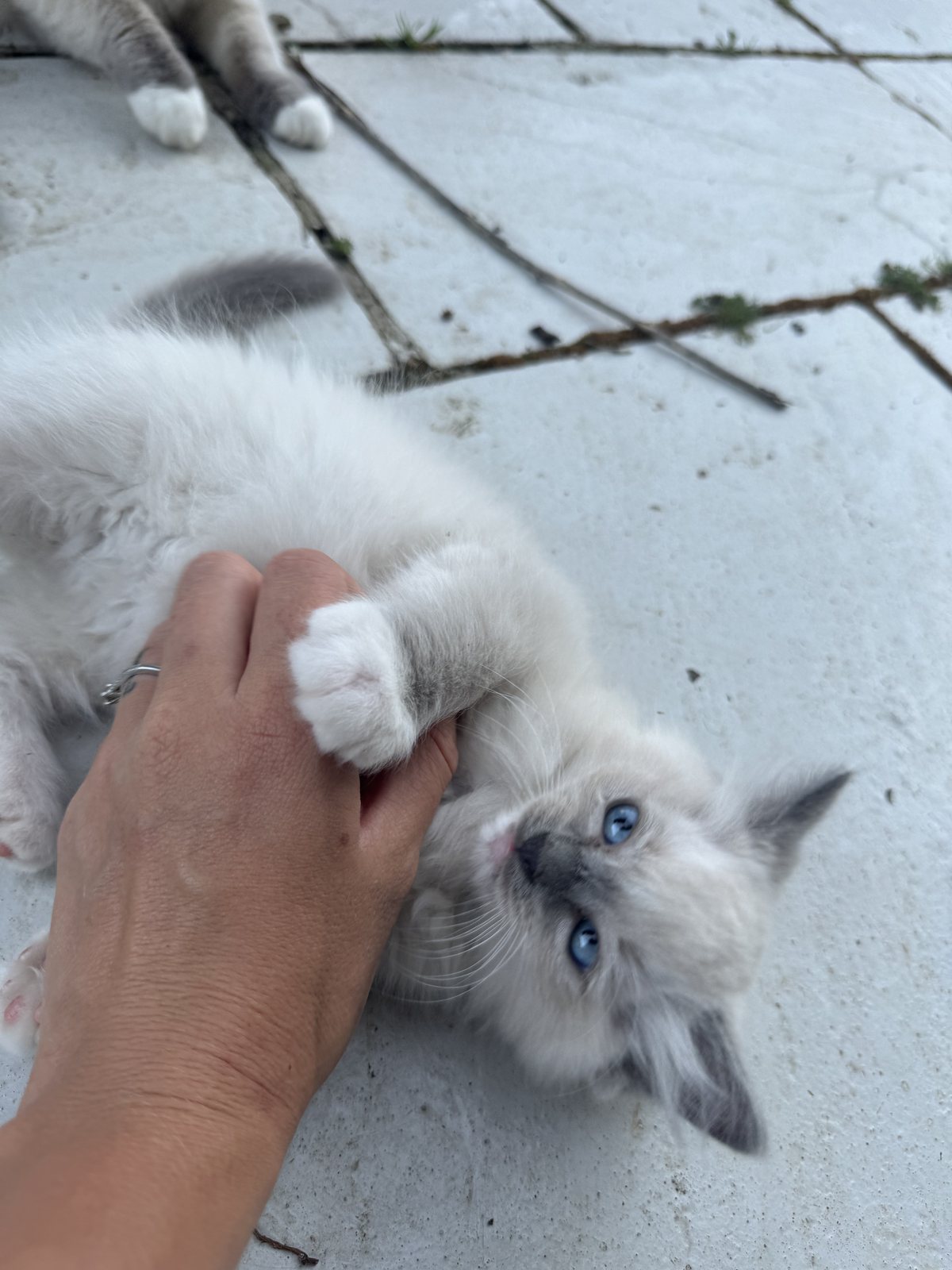
Gentle handling, learned early: our kittens grow up with children in the house, and children learn with them.
The short version
- Children with pets tend to be less lonely and more socially confident. A review of 22 studies found the strongest evidence for self esteem, loneliness and social skills, with the evidence on anxiety and depression inconclusive. A large UK birth cohort found pets linked to better communication at two and language at five, with small effects.
- Attachment to a pet goes with compassion. In the Scottish study of 1,217 children, those more attached to their pet held kinder attitudes to animals and behaved more caringly, and cats and dogs were the pets children bonded with most.
- The evidence does not support the allergy fear for children who are not already allergic. Children exposed to two or more cats or dogs in their first year were half as likely to test positive to common allergens at six or seven in a Detroit study, and a Swedish study found allergy fell the more pets a child grew up with. A pooled analysis of 22,000 European children found cats neither raised nor lowered asthma risk. No cat is hypoallergenic, and a child who is already allergic is a different matter.
- The cat's temperament decides the lesson. In a survey of 80 feline vets the Ragdoll came out most affectionate and least aggressive of 15 pedigree breeds, and a colony raised kitten has already lived with children, noise and other animals before it comes home.
- Supervise, always. Young children and cats are never left alone together, the cat always has somewhere to retreat, and the adult is the carer, with the child helping. That rule protects both.
- Babies and pregnancy: a cat does not have to go. Cat and baby are always supervised together, a cat never shares a cot or pram, and toxoplasmosis is avoided by someone else doing the tray and washing hands.
Contents
- What growing up with a cat gives a child
- What a cat means at each age
- The allergy question
- Why the Ragdoll suits a family
- Why colony raised: kittens that already know children
- Keeping child and cat safe
- Babies, pregnancy and the cat
- Jobs a child can do
- What the research shows, and where it stops
- Where to start with us
- Questions people ask and sources
What growing up with a cat gives a child
Here is what parents and children report, matched against the evidence.
Less lonely, more confident with people
A systematic review of 22 studies of children and companion animals found the most consistent evidence for self esteem, loneliness and social competence: pet owning children and teenagers reported less loneliness, and several studies linked a bond with a pet to better social skills and more social play in three to six year olds (Purewal and colleagues, 2017). In the Longitudinal Study of Australian Children, among 4,242 five year olds those with any pet had lower odds of emotional symptoms and peer problems, and the cat only and dog only groups both showed the pattern (Christian and colleagues, 2020).
Kindness and compassion
In 24 Scottish primary schools, 1,217 children were asked about their pets. Eighty per cent said they loved them, 83% of owners said their pet made them happy, 76% said it was their best friend and 62% said they would be lonely without it. The more attached a child was, the kinder their attitudes to animals and the more caring their behaviour, and cats and dogs were the two kinds of pet children bonded with most (Hawkins, Williams and the Scottish SPCA, 2017). Cats Protection puts it simply: learning to care for a cat can do wonders for a child's self esteem, social skills and sense of responsibility to others (Cats Protection).
Communication and language
The Children of the 90s study followed about 14,000 children born in Bristol. Having a pet at two was linked to better non verbal communication and having one at five to better language comprehension, and the study is one of only a handful to follow children over time (Purewal and colleagues, 2024). The effects were small, and the authors say so.
Someone who does not judge
A cat is the family member who never asks how school went. For a shy child, an only child or a child going through a hard patch, the Scottish finding that half of children felt their pet tried to comfort them when upset is the one parents recognise most.
Illustrations, not evidence
- A seven year old who will not read aloud to anyone reads to the cat every night, and the cat, a patient Ragdoll, stays for the whole chapter.
- A teenager who has stopped talking to the family still talks to the cat, and the cat is the reason the bedroom door stays open.
- An only child learns to wait: the cat comes when it is ready, and not before.
These are the kinds of stories families tell us. They show what is possible, not what is guaranteed.
What a cat cannot do
The research is mostly small, cross sectional and parent reported, and the review authors call the evidence low level. The Bristol study also found a few small negatives: pet ownership went with slightly lower school attainment, and cat ownership specifically with more hyperactivity at three and lower odds of high scholastic competence at eight, effects the authors describe as small and possibly reflecting which families choose a cat rather than anything the cat does (Purewal 2024). A cat does not make a child cleverer and it does not replace friends, parents or help a child needs. It is good company and a daily lesson in gentleness, which is plenty.
What a cat means at each age
Babies and toddlers (0 to 3)
To a toddler the cat is furniture that moves, and the child's job is to learn one word: gently. Supervision is total, the cat has rooms the child cannot reach, and a patient cat is a real advantage, and many Ragdolls are, though no cat should be asked to tolerate a toddler's grip. See the babies section.
Early school years (4 to 7)
This is where the lessons start: the cat does not want to be picked up, the cat is eating, the cat has gone under the bed and that means stop. Children this age can brush with help, top up water and learn to read the ears and tail. The Australian studies found pets linked to fewer peer problems at exactly this age.
Older children (8 to 12)
Real jobs, real attachment. The Scottish survey covered six to twelve year olds, and this is the age at which a cat becomes a confidant. A child can feed, brush and play, and can be taught to clip claws with an adult; the adult still checks the tray and the water.
Teenagers
The cat often becomes the one relationship in the house that is uncomplicated. In one study in the review, teenagers with a pet reported less loneliness, though another found no difference, and a cat that sleeps on the bed is a reason to come home. Our cats and anxiety guide is worth reading alongside this one for an anxious teenager.
The allergy question
The fear that a cat will give a child allergies or asthma stops some families, and the evidence mostly points the other way, with exceptions.
What the studies found
- In Detroit, 474 children were followed from birth to age six or seven. Those who had lived with two or more cats or dogs in their first year were about half as likely to test positive to any allergen at six or seven (15% against 34%), and half as likely to react to cat (8% against 16%) (Ownby, Johnson and Peterson, 2002). More than half the children had allergic parents.
- In Sweden, among 1,029 seven and eight year olds, the proportion who had ever had an allergy fell steadily with the number of cats and dogs in the home during their first year, from 49% with none down to none at all among the few children who grew up with five or more (Hesselmar and colleagues, 2018).
- Across 11 European birth cohorts and more than 22,000 children, having a cat in the first two years made no difference to asthma at six to ten, in either direction, and the authors advised neither avoiding nor acquiring a pet to prevent it (Lødrup Carlsen and colleagues, 2012).
What that means for your family
Early life exposure to cats does not appear to cause allergy and may reduce it, but the protective findings are observational and the UK charity Allergy UK does not claim protection; its factsheet notes that an allergy to an animal can develop at any time and that cat allergen is particularly persistent (Allergy UK). If a child in the family already has a cat allergy or asthma triggered by cats, a cat is a decision for your GP, not for a breeder. If nobody in the family is allergic, the fear of causing an allergy is not, on the current evidence, a strong reason to say no, though the studies are observational and cannot rule out an effect in an individual child. No cat is hypoallergenic, Ragdolls included; our myths guide explains why, and the sensible test is to spend time around the breed before committing.
Why the Ragdoll suits a family
Whatever a cat gives a child depends on the cat being the kind that enjoys children. A cat that hides, swipes or bolts teaches the opposite of what you want.
What the breed bodies say
The GCCF describes the Ragdoll as having an easy, laid back temperament and in general loving interaction with people and other animals, and notes that how a kitten is raised, with frequent loving handling and play, contributes enormously to its socialisation (GCCF Ragdoll profile). TICA calls the Ragdoll a loving, quiet cat with a laid back disposition, and warns that if you want a very active or talkative cat the Ragdoll is probably not for you (TICA breed page).
What the studies say
Two veterinary scientists at UC Davis asked 80 feline practitioners to rank 15 pedigree breeds on 12 behaviours. The Ragdoll came out most affectionate, most socially outgoing and least aggressive to cats and people (Hart and Hart, 2013). A Finnish owner survey of 5,726 cats placed the Ragdoll among the least active breeds, in a group of breeds that were the least fearful and least aggressive, with aggression and shyness both moderately heritable, which is why choosing calm parents matters so much (Salonen and colleagues, 2019).
Why those traits suit children
- Slow to startle, slow to bite. Children are loud and sudden. A cat that does not react sharply forgives a lot of early mistakes, and the mistakes are where children learn.
- Tolerant of handling. The breed generally accepts being held, brushed and carried, within reason, which makes supervised contact easier and safer.
- Seeks company. Many Ragdolls follow the family from room to room and sleep on beds, so the relationship a child wants is one the cat wants too.
- Indoor cat. No roads, no coming home with injuries, no disappearing for days; a child's cat is there every day.
- Playful but not frantic. Among the least active breeds in the Finnish survey, which, once the kitten stage passes, means wand toy games more than ankle attacks.
Being honest about the limits
Breed averages describe populations, and every Ragdoll is an individual. Some are vocal, some are busy, some dislike being picked up. A Ragdoll kitten is still a kitten, with teeth, claws and zoomies, and the settled adult temperament takes two to three years to arrive. The coat needs combing a few times a week and the breed has an inherited heart condition to screen for; our pros and cons guide is the fair version. Nobody can promise you a calm cat. What a good breeder can offer is a kitten from calm parents, raised to be confident, whose individual personality you have met.
Why colony raised: kittens that already know children
Breed sets the ceiling; the first weeks of life decide how much of it a kitten reaches. A Ragdoll raised quietly by one queen in a spare room and a Ragdoll raised underfoot in a house of sixteen adult cats, chickens, a peacock, a hoover and a family will grow into different cats, and the science on why is consistent. For a family, the question is simple: has this kitten met children before, at the age when it learns what is normal? Ours have, every day, because children live here.
The sensitive period
Kittens have a window for learning what is safe, roughly two to seven weeks of age (International Cat Care; Cats Protection). What a kitten meets calmly in that window it tends to accept for life; what it never meets, it may fear. Handling by several different people, including men, women and children, produces more sociable adult cats than handling by one person.
Handling, parents and the mother's example
In a study that followed kittens to a year old, those handled regularly from two to twelve weeks were quicker to approach, touch and rub against people and were less distressed when approached and handled by strangers; boldness toward new things followed the father (McCune, 1995). Friendliness to people has been linked to the father in two separate colonies (Turner and colleagues, 1986), and how a cat reacts to being held by a stranger is a stable trait from four months onward (Lowe and Bradshaw, 2002). Kittens also learn by watching their mother, and International Cat Care notes that a poorly socialised mother holds back her kittens' socialisation.
Weaning and leaving
The large Finnish survey found that cats weaned before eight weeks showed more aggression and repetitive behaviour as adults, and the researchers suggested keeping kittens with their mother to at least fourteen weeks (Ahola, Vapalahti and Lohi, 2017). No kitten leaves us before nine weeks, weaned by its mother rather than by a timetable, and our reasoning on nine to ten weeks, and why it differs from that and from the usual guidance, is set out on our story page.
Why colony raised is different
A conventional set up is one queen and her litter, kept apart from other cats in a quiet room, with handling that depends on who has time. Ours is a domesticated colony of sixteen adult Ragdolls living in the house, and kittens are born into it. In practice that means:
- Many calm adults to learn from, not one. Kittens grow up inside a group with a settled social order, copying the unbothered way a dozen adults react to the doorbell, the hoover and visitors.
- Parents chosen for temperament. We breed from cats we live with every day, so we know which lines are bold, which are gentle and which are busy, and we keep only the calm, people loving ones in the programme. Because shyness and aggression are heritable, this matters.
- Daily handling by the whole household from birth: adults, children and visitors, with brushing, paw and ear checks and carrying built into the routine. Our kittens meet ducks, chickens, a peacock, guinea pigs, parrots, the washing machine and the general bustle of a working family home before the fear window closes.
- Underfoot, not in a spare room. They are raised in the kitchen and living room, which is where they will live with you.
No study has compared colony rearing with conventional rearing head to head, and we would rather say so than pretend. What the research does show is which ingredients make a confident, settled, people loving cat: several handlers, calm parents, adults to learn from and a long time with the mother. A colony delivers every one of them every day, as the way the house works rather than a programme someone has to remember to run. That is why our kittens have usually arrived already at ease with children, noise and the general chaos of family life, and why families often tell us the kitten slotted in as if it had always been there.
Keeping child and cat safe
Most problems between children and cats come from the same three things: a child who does not yet know the rules, a cat with nowhere to go, and a moment when nobody was watching. The rules below are the ones Battersea, International Cat Care and Cats Protection all agree on.
The house rules
- The cat comes to the child, not the other way round. Battersea's advice is that a child touches the cat only when the cat approaches, strokes the chin, cheeks and between the ears, and leaves the tail and tummy alone, and that an adult is ready to lift the child, never the cat, if things get too lively (Battersea).
- Pick up the child, not the cat. Small children do not carry cats. If the two need separating, the adult lifts the child.
- Hands washed. After stroking, after any contact with the tray, and before eating, and the cat kept off food preparation surfaces. Worming and flea treatment kept up to date does the rest.
- Never when eating, sleeping or in the tray. International Cat Care recommends cat only zones for food, litter and rest that children do not enter (International Cat Care).
- Always supervised. Young children and cats are not left alone together, full stop. The PDSA says the same, and adds that an adult is always the main carer (PDSA).
- Somewhere to go. A high shelf, a covered bed, a room behind a baby gate. A cat that can leave an interaction will come back to it; a cat that cannot will defend itself.
Learn the stress signals
Flattened ears, a twitching tail, dilated pupils, a crouched body, hiding, eating less, over grooming or toileting outside the tray are all signs to give the cat space. International Cat Care's stress in cats and the PDSA body language guide show what to look for, and Cats Protection's cat stress page covers the subtler signs.
Scratches and bites
A minor scratch from a kitten is a normal part of childhood and usually heals without trouble. Wash it straight away with soap and running water. A bite that breaks the skin, a scratch near the eye, or any scratch on a child with a weakened immune system is one for the GP or NHS 111 the same day. The other thing worth knowing about is cat scratch disease, an infection with the bacterium Bartonella henselae, which cats pick up from fleas and can pass on through a scratch or bite; it mostly affects children and mostly comes from kittens, and the prevention is flea treatment, no rough play and washing scratches (Vet Help Direct). Our kittens leave us flea treated, and our fleas guide covers keeping it that way. A scratch that swells, or a swollen gland afterwards, is one for the GP.
Babies, pregnancy and the cat
Cats Protection found that more than half of cat owners expecting a baby had worries, that nearly a third were told by someone to give up their cat, usually friends or family, and that of the one in twelve who did, 63% regretted it (Cats Protection survey). Most of the owners who gave up a cat wished they had kept it.
Toxoplasmosis
The infection people worry about in pregnancy is mostly caught from undercooked meat and soil, not cats. NHS advice is that you cannot catch it from stroking a cat or having one as a pet; the precautions are gloves for the litter tray and gardening, and washing hands (NHS 111 Wales). Cats Protection adds that a cat sheds the parasite only for a couple of weeks after its first exposure, that the parasite takes one to five days in the tray to become infectious, so emptying the tray daily, before they can become infectious, greatly reduces the risk, and that someone else should do the tray during pregnancy (Cats Protection toxoplasmosis leaflet). An indoor Ragdoll on cooked or commercial food, never raw meat, is about as low risk as a cat gets.
The cot
Cats Protection's advice is that cat and baby are always supervised together, and safer sleep advice is that a cat never shares a cot, pram or Moses basket and is kept out of the room while the baby sleeps. Follow both and the old worry about smothering is answered. The other rules are the ones you would apply anyway: the nursery off limits to the cat at first, the tray out of a crawling baby's reach, and flea and worm treatment kept up (Cats Protection: cats and babies; Battersea).
Preparing the cat
Battersea suggests playing baby sounds quietly in the weeks before; set up the nursery early so the furniture is old news, keep the cat's routine the same when the baby arrives, and never force an introduction. A colony raised Ragdoll has heard a great deal of noise before; a new baby is one more thing the house does.
Jobs a child can do
The PDSA's rule is the right one: a child helps, an adult is responsible, and the child is never the main carer (PDSA). Within that:
- From about four: topping up the water bowl with help, choosing the toy for play time, learning the gently rule.
- From about six: measuring the food with supervision, brushing the back and sides with a soft brush, a wand toy game every evening.
- From about eight: feeding on the routine, full brushing, checking the water, helping an adult clip claws, reading to the cat.
- Teenagers: most of the daily care, with an adult still checking the tray, the weight and the vet dates.
Reading to an animal is worth a mention. A randomised trial of 102 South African third graders who were poor readers found that those who read to a dog for ten weekly sessions improved more in comprehension than those who read to an adult, a teddy or nobody (le Roux, Swartz and Swart, 2014). Nobody has run the trial with cats, but a Ragdoll that stays for the chapter is a willing listener.
What the research shows, and where it stops
Children and pets
- Review of 22 studies: consistent for self esteem, loneliness and social competence, inconclusive for anxiety and depression, mostly low level evidence (Purewal 2017).
- UK birth cohort of about 14,000: pets linked to better communication at two and language at five; small negatives for attainment and, for cats, hyperactivity at three; effects small and possibly reverse causation (Purewal 2024).
- 4,200 Australian children: any pet at five linked to fewer emotional symptoms and peer problems; cats and dogs both (Christian 2020). A related study of 1,646 households with preschoolers found dog owning children a third more likely to be prosocial; dogs only (Wenden 2021).
- 1,217 Scottish children: attachment to pets, kinder attitudes and caring behaviour; cats and dogs the pets children bond with most (Hawkins 2017).
- Empathy and cats, the fair version: two Canadian studies found higher empathy in dog owning children but not cat owning ones, reported second hand in a 2018 review (Jacobson and Chang, 2018); the review by Endenburg and van Lith concluded that bonding with the animal matters more than simply owning one, and that which animals suit which children is not yet established (Endenburg and van Lith, 2011).
- Autistic children and cats: 65 parents, mostly in the UK, reported that a child's positive behaviour toward the pet went with more prosocial behaviour, and six reported that the cat had injured the child, mostly scratches or bites (Wilson 2025); in 64 US families cats adopted as kittens were more affectionate and less aggressive (Hart 2018). Our cats and autism guide covers this in full.
Allergies
- Protective findings in Detroit and Sweden, a null finding across 22,000 European children, and no UK body claiming protection. Early exposure is not a reason to avoid a cat; existing allergy is a reason to ask a doctor.
Ragdolls specifically
- No study has looked at Ragdolls and children. The breed's suitability rests on the temperament evidence above and on how the kitten was raised.
In short: growing up with a cat can be good for a child in modest, real ways, the cat's temperament and the house rules decide whether it goes well, and nothing here should be read as a cat doing a parent's job.
Where to start with us
If you think a Ragdoll might be right for your family, this is how it works with us.
- Tell us about the children. Ages, how boisterous the house is, whether anyone has allergies, whether a child has particular needs. Use the enquiry form or message us.
- We match, not just sell. We will tell you plainly which kitten in a litter is the confident one that will enjoy a busy family and which would rather have a quiet lap.
- Visit with the children. Appointments in our home, where the children meet the kitten, the mother and the colony, and we show them the gently rule on a cat that has heard it before.
- Read the kitten guide first. Our children and kittens guide has the holds and house rules by age, and the kitten guide covers the first fortnight.
- A gentle handover. Collection at our home, never a courier, a kitten pack with a blanket carrying the colony's scent, and check ins at one week and one month, then support for life.
Our current litters are on the kittens page, and the waiting list hears first about the next one.
Questions people ask
Is a cat good for a child's development?
The research says modestly yes. A review of 22 studies found pet owning children less lonely, with better self esteem and social skills, a UK birth cohort of 14,000 linked pets to better communication at two and language at five, and a Scottish survey of 1,217 children found attachment to a pet went with kinder, more caring behaviour. Effects are small and the studies mostly observational; a cat is good company and a lesson in gentleness, not a developmental programme.
Will a cat give my child allergies?
For a child who is not already allergic, the evidence does not support the fear, and some studies point the other way. Children who lived with two or more cats or dogs in their first year were half as likely to test positive to common allergens at six or seven in a Detroit study, a Swedish study found allergy fell with the number of pets, and a pooled study of 22,000 European children found cats made no difference to asthma. Allergy UK does not claim protection and notes an allergy can develop at any time. A child who already reacts to cats is a question for your GP, and no cat is hypoallergenic.
Are Ragdolls good with children?
On temperament, among the better suited breeds: in a survey of 80 feline vets it came out the most affectionate and least aggressive of 15 pedigree breeds, it usually tolerates handling and follows the family about, and it suits living indoors. Individual cats vary and kittens are boisterous for a year or two, so the house rules still apply: the cat comes to the child, nobody disturbs a cat that is eating or sleeping, and young children and cats are always supervised.
Do I have to give up my cat when I have a baby?
No. Cats Protection found 63% of owners who gave up a cat for a baby regretted it. You cannot catch toxoplasmosis from stroking a cat or keeping one as a pet; the tray is the only risk the cat itself brings, so someone else does it in pregnancy, trays are emptied daily and hands washed. Cat and baby are always supervised together, a cat never shares a cot, pram or Moses basket, and the nursery is off limits at first.
What age can a child look after a cat?
A child helps from about four, with topping up water and the gently rule; measures food and brushes from about six; feeds, brushes and reads to the cat from about eight; and a teenager can do most of the daily care. The PDSA's rule stands at every age: an adult is the main carer and children and pets are never left alone together.
Sources and further reading
- Purewal et al 2017, International Journal of Environmental Research and Public Health: systematic review of 22 studies on pets and child development
- Purewal et al 2024, BMC Pediatrics: Children of the 90s cohort: pets and communication, language, attainment and hyperactivity
- University of Liverpool release on the 2024 cohort study: the authors on why the effects are small
- Hawkins, Williams and Scottish SPCA 2017, IJERPH: 1,217 Scottish children on attachment, compassion and humane behaviour
- Christian et al 2020, Journal of Pediatrics (The Kids Research Institute): 4,200 Australian children: pets, emotional symptoms and peer problems
- Wenden et al 2021, Pediatric Research (HABRI release): 1,646 preschoolers: dog ownership and social emotional development
- Endenburg and van Lith 2011, The Veterinary Journal: narrative review of animals and child development
- Jacobson and Chang 2018, Frontiers in Psychology: review reporting the Canadian empathy studies on cat and dog owning children
- Ownby, Johnson and Peterson 2002, JAMA (Henry Ford release): 474 Detroit children: early pet exposure and allergy at six
- Hesselmar et al 2018, PLOS ONE: 1,029 Swedish children: allergy fell with number of pets
- Lødrup Carlsen et al 2012, PLOS ONE: 11 European birth cohorts: cats and asthma, no association
- Allergy UK: pet and animal allergy factsheet: UK charity guidance; allergy can develop at any time
- Cats Protection: cats and babies: supervision, nets, trays and treatments
- Cats Protection: cats and pregnant women, toxoplasmosis: how the parasite spreads and the tray rules
- NHS 111 Wales: toxoplasmosis: you cannot catch it from stroking or keeping a cat
- Cats Protection: keeping Kit in the family survey: worries in pregnancy and the regret of giving up a cat
- Battersea: introducing your cat to kids: where to stroke, pick up the child not the cat
- Battersea: cats, babies and children: always supervise, never force
- International Cat Care: introducing cats to children: cat only zones and supervision
- Vet Help Direct: cat scratch fever: how it spreads and how to prevent it
- le Roux, Swartz and Swart 2014, Child and Youth Care Forum: randomised trial of reading to a dog
- PDSA: kids and pets: an adult is always the main carer
- Cats Protection: cats and people leaflet: self esteem, social skills and responsibility
- Wilson, Ballantyne and Hawkins 2025, Behavioral Sciences: 65 UK parents of autistic children on pets
- Hart et al 2018, Frontiers in Veterinary Science: 64 families on how cats behave with autistic children
- Salonen et al 2019, Scientific Reports: breed differences and heritability in 5,726 cats, including Ragdolls
- Hart and Hart 2013, Your Ideal Cat (UC Davis release): 80 feline vets rank 15 breeds; Ragdoll most affectionate, least aggressive
- GCCF and TICA Ragdoll breed profiles: the breed bodies on temperament; TICA at tica.org/breed/ragdoll
- McCune 1995, Applied Animal Behaviour Science: early handling and the father's influence on friendliness and boldness
- Ahola, Vapalahti and Lohi 2017 (University of Helsinki): weaning age and adult behaviour in the Finnish survey
- Cats Protection: kitten socialisation: the two to seven week window and what a kitten should meet
- Cats Protection: cat stress: reading stress signals in cats
- International Cat Care: stress in cats: causes, signs and prevention of stress
- PDSA: cat body language: posture, tail, ears and what purring does and does not mean
Thinking about a Ragdoll kitten?
Our Ragdoll and Ragcoon kittens grow up in our home in Ryde, Isle of Wight, with health tested parents and our support for life. See who is available now, or join the waiting list for the next litter.