
Cats for People Who Work From Home: Company at the Desk
For the growing number of people who work from home some or all of the week: why a cat fits that life well, what the evidence shows, and how to make the arrangement work for the cat as well.
Last reviewed
Around 28% of working adults in Great Britain now work partly from home and about one in six work from home entirely, and the quiet cost is well documented: home workers are far less likely to feel close to colleagues, and a large American study found remote capable workers spending an extra hour a day alone. A cat does not replace a colleague, but it is remarkably good at the thing a home office lacks, which is another living presence in the room. The research is encouraging rather than conclusive: during lockdown, over 90% of UK pet owners said their animal helped them cope, cat owners found their cats less distracting while working than dog owners found their dogs, and ten minutes stroking a cat or dog lowered the stress hormone cortisol in one trial. The Ragdoll, a quiet, indoor, lap seeking breed ranked most affectionate of fifteen breeds by feline vets, is one of the breeds best suited to a desk, and ours arrive already used to a busy, noisy house. This guide sets out the evidence, the practical set up, and how to keep the cat happy on the days you go back to the office.
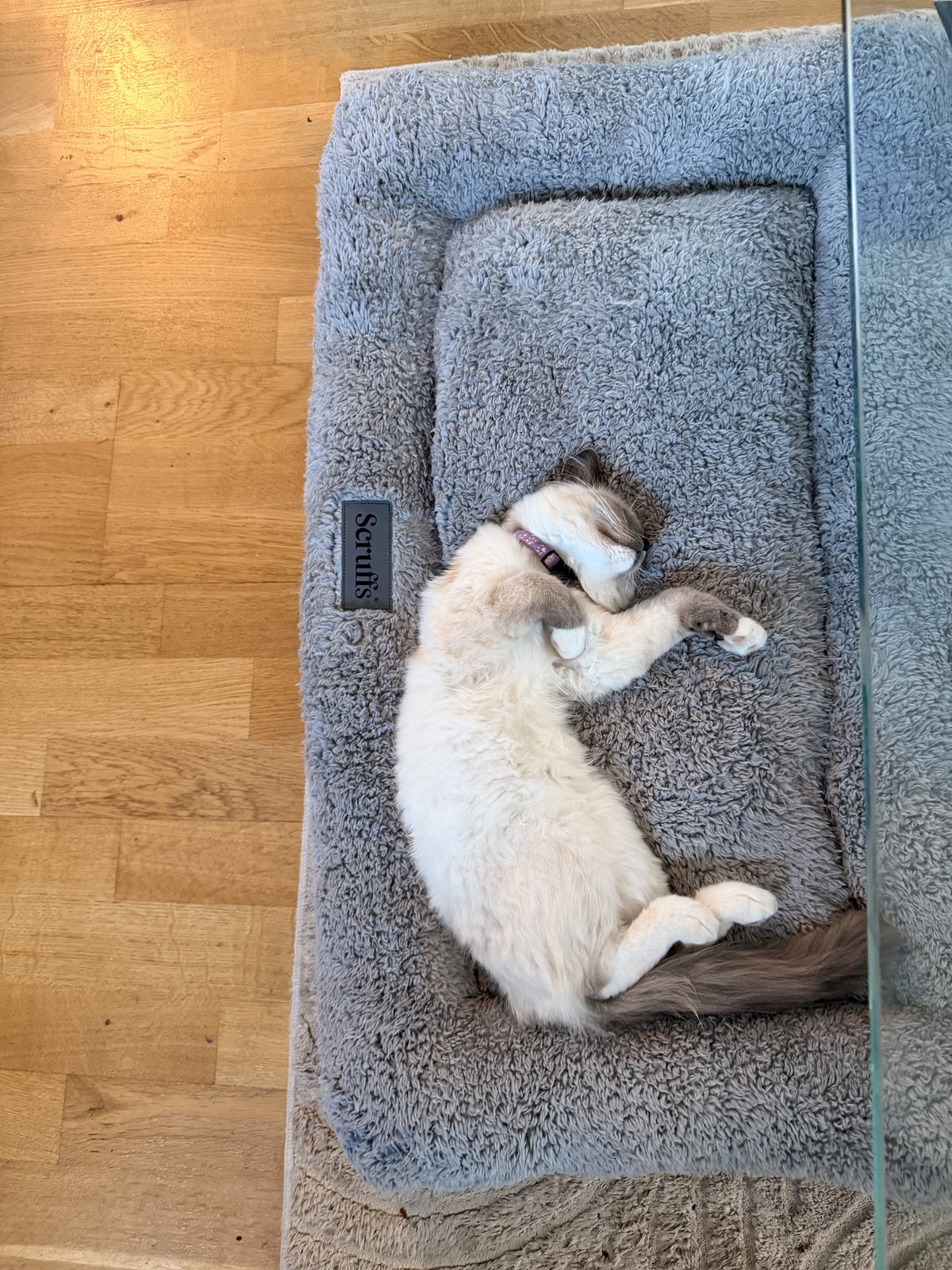
Company that keeps its own hours: two of our colony Ragdolls at rest while the house gets on with its day.
The short version
- Home working is common and can be lonely. 28% of working adults are hybrid and about 16% work from home only. Only 44% of home workers feel close to colleagues, against 84% on site, and remote capable workers in a large US study spent an extra hour a day alone.
- Pets help, and cats interrupt least. In a US survey of 454 home workers, 16% of cat owners found their cat distracting against 29% of dog owners and 46% of people with both; dog owners also reported more work life interference. In the UK lockdown studies, owners described structure, company and distraction from worry, and over 90% said their pet helped them cope.
- Calmer in the moment. Stroking a cat lowers cortisol in a randomised trial, pet presence lowers negative mood through the day, and employees with a dog at work reported stress falling across the day where others reported it rising.
- Breaks are the hidden benefit. HSE guidance is a short break every hour away from the screen, and a meta analysis found micro breaks reduce fatigue and raise vigour. A cat that wants feeding, playing with or letting through a door is a break you are far more likely to take.
- The Ragdoll suits the desk. Quiet, indoor, lower energy, happy to sleep beside the laptop and inclined to sit on you. The coat on the keyboard is the trade off.
- Plan for the cat's side. Around one cat in seven shows separation related problems, and the thing Cats Protection warns about is the switch from always home to suddenly not. Build the cat's routine around your real work pattern from day one, not around a stretch when you happen to be home every day.
Contents
- Home working in the UK, and what it costs
- Why a cat, and not a dog, for the home office
- What a cat gives a home worker
- Why the Ragdoll suits the desk
- Why colony raised: a kitten that sleeps through the calls
- Setting up the home office for a cat
- Office days and the cat's routine
- What the research shows, and where it stops
- Where to start with us
- Questions people ask and sources
Home working in the UK, and what it costs
The Office for National Statistics found 28% of working adults in Great Britain hybrid working in early 2025, a share that has risen gradually since 2022, with the highest rates among graduates, higher earners and people in their thirties and forties (ONS, 2025). Its last detailed breakdown put home only working at 16% of workers, hybrid at 28% and travelling to work only at 56%, with the self employed twice as likely as employees to work only from home (ONS, 2023).
Most remote workers like it. In Buffer's survey of around 3,000 remote workers, 98% wanted to keep working remotely at least some of the time, but a third named staying home too often as a struggle and nearly a quarter named loneliness (Buffer, 2023). A report by the British Red Cross and the Campaign to End Loneliness found home workers no lonelier than office workers overall, but only 44% of home workers felt close to colleagues against 84% of those on site (Campaign to End Loneliness, 2023). The CIPD's own data shows people working from home more than three quarters of the time were more likely to say they often felt lonely at work (CIPD, 2025). The largest study, of 588,000 American workers between 2011 and 2024, found that people in remote capable jobs spent about an hour more a day alone, were half as likely again to spend a whole day without human contact, and showed a small rise in psychological distress, roughly doubled for those living alone (a study in Science, reported by CIDRAP).
None of that is an argument against working from home. It is an argument for noticing what the home office lacks, and one of the things it lacks is simply another presence in the room.
Why a cat, and not a dog, for the home office
Dogs suit many home workers, and the walks were one of the things dog owners valued, but a dog asks for more of the working day. The one study that compared the two directly asked 454 full time American employees about working from home with their pets in 2020. Cat only owners were the least distracted: 16% found their pet distracting, against 29% of dog only owners and 46% of people with both, and dog owners reported more interference between work and home life, mostly from attention seeking such as whining and barking (Hoffman, 2021). Most adult cats keep their own hours, sleep for much of the working day, and ask for attention in short bursts that fit between meetings.
Presence without demands
The thing a home worker misses is not conversation so much as company: a reason to say something out loud, a warm shape in the corner of the eye. In Cats Protection's 2023 survey 90% of owners sit with or stroke their cat in a typical week and 72% agree they often talk to it (CATS Report 2023). A cat asleep on the desk is the office plant that purrs.
Structure for a day with no edges
Home working dissolves the boundaries that an office provides: the commute, the lunch break, the leaving. Owners in the UK lockdown study described their pets as giving the day structure and routine, and the study's authors noted that pet care routines could mark the start and end of a working day (Shoesmith and colleagues, 2021; Hoffman, 2021). Breakfast for the cat is the start of the day; the evening play is the end of it.
What a cat gives a home worker
What people report, matched against the evidence.
Less alone
In the UK lockdown survey of about 6,000 adults, over 90% of owners said their pet helped them cope emotionally, pet owners reported less loneliness than non owners, and cats and dogs were equally bonded with their people (Ratschen and colleagues, 2020). In the written answers from that survey, company and reduced loneliness came through strongest for people living alone, with the honest caveat from owners themselves that a pet is not a replacement for human contact (Shoesmith 2021).
Calmer through the day
Ten minutes stroking a cat or dog lowered cortisol in a randomised trial of 249 students (Pendry and Vandagriff, 2019). When 55 owners were prompted ten times a day for five days, negative feelings were lower whenever the pet was present and positive feelings rose with interaction (Janssens and colleagues, 2020). In a Swiss study, having a cat reduced negative mood about as much as having a partner did (Turner, Rieger and Gygax, 2003). And in the one workplace study to measure it, employees who brought their dog to work reported stress falling over the working day while colleagues without a dog reported it rising (Barker and colleagues, 2012); dogs, one company, preliminary, but it is the right direction.
Breaks you actually take
The Health and Safety Executive's advice for screen work is short, frequent breaks away from the screen, five to ten minutes every hour rather than a long break every two (HSE; HSE FAQ), and a meta analysis of 22 experiments found that micro breaks reliably reduce fatigue and raise vigour, with the gain in performance small and mostly for less demanding tasks (Albulescu and colleagues, 2022). Many people skip those breaks. A cat that wants the door opened, a game with the wand toy or its lunch is a break with a reason, and it comes with a walk to the kitchen.
Illustrations, not evidence
- A freelancer who used to work through lunch now stops at one, because that is when the cat appears on the desk and sits on the keyboard until fed.
- Someone who lives alone and works hybrid finds the home days easier than the office days, because the house is not empty.
- A manager on back to back calls keeps a hand on the cat through the worst of them and says it is the only reason she sounds calm.
These are the kinds of stories people tell us. They show what is possible, not what is typical.
What a cat cannot do
A cat is not a colleague, a team or a reason to leave the house, and the lockdown researchers themselves said the mental health benefit they measured was unlikely to be clinically significant and did not recommend getting a pet to protect mental health (Ratschen 2020). A scoping review of 31 studies of pets at work found most relied on unvalidated surveys and none measured any link between pets and work performance (Gardner, 2024). If working from home is making you lonely, the fix is people: a co working day, a regular call, a walk at lunch. A cat makes the house less empty while you arrange it.
Why the Ragdoll suits the desk
Not every cat is good office company. A cat that yowls through calls, climbs the curtains at ten in the morning or wants the garden every twenty minutes is a colleague you would not choose.
What the breed bodies say
The GCCF describes the Ragdoll as having an easy, laid back temperament and in general loving interaction with people and other animals, and notes that how a kitten is raised, with frequent loving handling and play, contributes enormously to its socialisation (GCCF Ragdoll profile). TICA calls the Ragdoll a loving, quiet cat with a laid back disposition, and warns that if you want a very active or talkative cat the Ragdoll is probably not for you (TICA breed page).
What the studies say
Two veterinary scientists at UC Davis asked 80 feline practitioners to rank 15 pedigree breeds on 12 behaviours. The Ragdoll came out most affectionate, most socially outgoing and least aggressive to cats and people (Hart and Hart, 2013). A Finnish owner survey of 5,726 cats placed the Ragdoll among the least active breeds, in a group of breeds that were the least fearful and least aggressive, with aggression and shyness both moderately heritable, which is why choosing calm parents matters so much (Salonen and colleagues, 2019).
Why those traits suit a home worker
- Quiet. Most Ragdolls are soft voiced; TICA describes the breed as quiet and warns off anyone wanting a talkative cat. A cat that does not shout through meetings is worth a great deal.
- Lower energy. Among the least active breeds in the Finnish survey, which means long sleeps beside the laptop and play in short bursts.
- Suited to indoor life. No door to be opened every half hour and no worry about where the cat is while you are concentrating (indoor cats guide).
- Seeks you out. The breed follows people from room to room and settles on or beside them, so the company arrives at the desk without being fetched.
- Tolerant. A stroke between emails, a lift off the keyboard, a visitor on a video call: the Ragdoll generally takes all of it in its stride.
- The trade offs. A long coat sheds on dark trousers and finds its way into the keyboard, and a Ragdoll is a large, warm cat that will want the exact spot your mouse is in. A lint roller and a second cushion solve both (grooming guide).
Being honest about the limits
Breed averages describe populations, and every Ragdoll is an individual. Some are vocal, some are busy, some dislike being picked up. A Ragdoll kitten is still a kitten, with teeth, claws and zoomies, and the settled adult temperament takes two to three years to arrive. The coat needs combing a few times a week and the breed has an inherited heart condition to screen for; our pros and cons guide is the fair version. Nobody can promise you a calm cat. What a good breeder can offer is a kitten from calm parents, raised to be confident, whose individual personality you have met.
Why colony raised: a kitten that sleeps through the calls
Breed sets the ceiling; the first weeks of life decide how much of it a kitten reaches. A Ragdoll raised quietly by one queen in a spare room and a Ragdoll raised underfoot in a house of sixteen adult cats, chickens, a peacock, a hoover and a family will grow into different cats, and the science on why is consistent. For a home worker the question is whether the kitten will settle beside you and sleep through a day of typing, calls and deliveries, or spend it demanding attention. The first weeks go a long way to deciding that.
The sensitive period
Kittens have a window for learning what is safe, roughly two to seven weeks of age (International Cat Care; Cats Protection). What a kitten meets calmly in that window it tends to accept for life; what it never meets, it may fear. Handling by several different people, including men, women and children, produces more sociable adult cats than handling by one person.
Handling, parents and the mother's example
In a study that followed kittens to a year old, those handled regularly from two to twelve weeks were quicker to approach, touch and rub against people and were less distressed when approached and handled by strangers; boldness toward new things followed the father (McCune, 1995). Friendliness to people has been linked to the father in two separate colonies (Turner and colleagues, 1986), and how a cat reacts to being held by a stranger is a stable trait from four months onward (Lowe and Bradshaw, 2002). Kittens also learn by watching their mother, and International Cat Care notes that a poorly socialised mother holds back her kittens' socialisation.
Weaning and leaving
The large Finnish survey found that cats weaned before eight weeks showed more aggression and repetitive behaviour as adults, and the researchers suggested keeping kittens with their mother to at least fourteen weeks (Ahola, Vapalahti and Lohi, 2017). No kitten leaves us before nine weeks, weaned by its mother rather than by a timetable, and our reasoning on nine to ten weeks, and why it differs from that and from the usual guidance, is set out on our story page.
Why colony raised is different
A conventional set up is one queen and her litter, kept apart from other cats in a quiet room, with handling that depends on who has time. Ours is a domesticated colony of sixteen adult Ragdolls living in the house, and kittens are born into it. In practice that means:
- Many calm adults to learn from, not one. Kittens grow up inside a group with a settled social order, copying the unbothered way a dozen adults react to the doorbell, the hoover and visitors.
- Parents chosen for temperament. We breed from cats we live with every day, so we know which lines are bold, which are gentle and which are busy, and we keep only the calm, people loving ones in the programme. Because shyness and aggression are heritable, this matters.
- Daily handling by the whole household from birth: adults, children and visitors, with brushing, paw and ear checks and carrying built into the routine. Our kittens meet ducks, chickens, a peacock, guinea pigs, parrots, the washing machine and the general bustle of a working family home before the fear window closes.
- Underfoot, not in a spare room. They are raised in the kitchen and living room, which is where they will live with you.
No study has compared colony rearing with conventional rearing head to head, and we would rather say so than pretend. What the research does show is which ingredients make a confident, settled, people loving cat: several handlers, calm parents, adults to learn from and a long time with the mother. A colony delivers every one of them every day, as the way the house works rather than a programme someone has to remember to run. That is why our kittens usually arrive already used to a ringing phone and a parcel at the door, and why home workers often tell us the kitten found the desk early and stayed.
Setting up the home office for a cat
The desk
- A second spot. A cushion or a small bed on the desk, or a shelf at desk height, gives the cat its own place that is not the keyboard. Most cats take it if it is warm and in the sun.
- Cables and small things. Tidy cables into a sleeve, keep paper clips, elastic bands and earbuds in a drawer, close the laptop when you leave it. Kittens chew and swallow; adults mostly do not, but it costs nothing.
- A keyboard rule. Lift the cat off calmly every time and put it on its spot. Consistency is most of the trick; a cat that is sometimes allowed will keep trying.
- Kitten proofing. Put wand and string toys away after play, since swallowed string is an emergency, keep hot drinks away from the edge, watch chair casters and the drop from desk height, and keep upstairs windows closed or screened.
- Mute and camera. A cat tail across the webcam has interrupted better meetings than most. Keep mute within reach and accept that colleagues will ask to see the cat.
The day
- Anchor the routine to your work. Breakfast before you log on, a play session at lunch, dinner when you log off. The cat learns the shape of the day and stops asking in between.
- Play before the long call. Ten minutes with a wand toy before a two hour meeting usually usually buys you a sleeping cat for most of it.
- Use the cat as your break timer. When it stirs, you get up: water, a stretch, a look out of the window. That is the HSE's advice with fur on.
- Puzzle feeders and a window. A puzzle feeder for part of the day's food and a perch by a window give the cat something to do that is not you (play and enrichment guide).
Office days and the cat's routine
This is the part people forget. A cat that has had you home five days a week and suddenly has three empty days is the cat Cats Protection wrote its advice for. Its behaviour manager's guidance after lockdown was to keep the routine, build time apart gradually, play before leaving, make departures low key, and provide high perches, a radio on low and things to do (Cats Protection, 2022). Its general rule is that an adult cat can be left for up to about twelve hours only occasionally, and a kitten for a few hours at most, built up from five or ten minutes (Cats Protection: how long can you leave a cat alone).
Separation related problems are real but not universal. In a study of 223 cats, about one in seven showed at least one sign, most often destructive behaviour, excessive meowing or urinating outside the tray, and cats with no toys or no other animal in the house were more likely to be affected (de Souza Machado and colleagues, 2020). The practical reading: if you work hybrid, build the kitten up to time alone from the first fortnight in short steps, but a young kitten should not be left for a full office day. For the first few months arrange for someone to be home, a midday visit from a sitter or neighbour, or take the office days as home days where you can. A second cat can make the long days easier, since cats with no other animal in the house were more likely to show separation signs, though two is not right for every home (one kitten or two); and leave the house interesting. Our home alone guide goes into the detail.
Signs the office days are too long
Flattened ears, a twitching tail, dilated pupils, a crouched body, hiding, eating less, over grooming or toileting outside the tray are all signs of stress. If they show up on or after office days, shorten the time alone and arrange cover sooner rather than later. International Cat Care's stress in cats and the PDSA body language guide show what to look for, and Cats Protection's cat stress page covers the subtler signs.
What the research shows, and where it stops
Home working and wellbeing
- 28% hybrid, about 16% home only (ONS 2025; ONS 2023). Home workers much less likely to feel close to colleagues (British Red Cross and Campaign to End Loneliness); more time alone and slightly more distress among remote capable workers in the US (Science study via CIDRAP, reported second hand).
Pets and remote work
- 454 US home workers: cats least distracting (16% against 29% for dogs), dogs more work life interference; no difference in job related mood between home and office days (Hoffman 2021). Pandemic conditions, recall based.
- 5,926 UK adults in lockdown: pets linked to smaller declines in mental health and less loneliness, effect small; 68% worried about their animal (Ratschen 2020). Written answers: structure, company, distraction, worry about pets becoming clingy or coping when owners returned to work (Shoesmith 2021).
- 4,105 dog owners: in a coded sample of their answers, 77% said the dog reduced stress during lockdown and 6% said it added to it; guilt about not playing during work hours was a theme (Bussolari 2021). Dogs only.
Pets at work
- Stress fell across the day for employees with their dog present in one company (Barker 2012); a scoping review of 31 studies found pets at work linked to lower stress and better attitudes but measured with weak tools (Gardner 2024). No cat specific workplace study exists.
Cats specifically
- Short term calming effects well supported (Pendry 2019; Janssens 2020; Turner 2003); cat welfare when left: about one in seven cats with separation related signs (de Souza Machado 2020).
Ragdolls specifically
- None. The case rests on the breed's temperament and how the kitten was raised.
In short: a cat is the less distracting of the two pets that have been compared for home working, it can make the working day less lonely and give it edges, and the main thing to get right is the cat's own routine on the days you are not there.
Where to start with us
If you think a Ragdoll might be right for your home office, this is how it works with us.
- Tell us your pattern. Fully home, hybrid, which days, how long the office days are, whether anyone else is home. Use the enquiry form or message us.
- We match, not just sell. We will tell you which kitten in a litter looks like the sleeper and which the explorer, as far as that can be judged at that age, and we will say if we think two would cope with your office days better than one, or if one is the better fit.
- Visit at your own pace. Appointments in our home in Ryde, where you meet the kitten, the mother and the colony it grew up in; we are on the Island, and mainland collection is set out here.
- A gentle handover. Collection at our home, never a courier, a kitten pack with a blanket carrying the colony's scent, and check ins at one week and one month, then support for life.
Our current litters are on the kittens page, and the waiting list hears first about the next one.
Questions people ask
Is a cat a good pet for someone who works from home?
On the one study that compares cats and dogs, the less distracting one. Among 454 home workers, 16% of cat owners found their cat distracting against 29% of dog owners, and dog owners reported more interference from attention seeking. Cats sleep most of the working day, ask for attention in short bursts, and give a day without edges a start and an end. Over 90% of UK owners in lockdown said their pet helped them cope.
Are Ragdolls good office cats?
One of the better suited breeds, on temperament. The breed is quiet, lower energy, content indoors, tolerant of being lifted off the keyboard, and inclined to settle on or beside its person, which is what you want at a desk. The trade offs are a long coat that sheds onto the keyboard and a large cat that wants the exact spot your mouse is in. A second cushion and a lint roller solve both.
Will my cat be lonely on office days?
Some cats struggle; about one in seven showed a separation related sign in a study of 223 cats, and cats with no toys or no other animal were more likely to. Cats Protection's advice is to keep the routine, build time apart gradually, play before leaving, keep departures low key and leave perches, a radio on low and things to do. A young kitten cannot be left for a full office day, so plan cover for the first few months, build time alone in short steps. A second cat sometimes helps, but it is not right for every home; our one kitten or two guide weighs it up.
How do I keep the cat off the keyboard?
Give it somewhere better: a warm cushion or bed on the desk, or a shelf at desk height in the sun. Lift the cat onto it calmly every time it lands on the keyboard, without fuss and without exceptions, and play for ten minutes before long calls so it sleeps through them. Consistency is most of the trick; a cat that is sometimes allowed will keep trying.
Does a cat actually help with stress while working?
In the moment, yes, on reasonable short term evidence: ten minutes stroking a cat or dog lowered cortisol in a randomised trial, pet presence lowered negative mood through the day in a prompt study, and employees with a dog at work reported stress falling across the day where others reported it rising. The lockdown researchers were clear the overall mental health effect is small, so think of a cat as a steadier day rather than a treatment for a bad job.
Sources and further reading
- ONS: who has access to hybrid work in Great Britain (2025): 28% hybrid and who does it
- ONS: characteristics of homeworkers, Great Britain (2023): 16% home only, 28% hybrid, 56% travelling
- Buffer: state of remote work 2023: what remote workers like and struggle with
- Campaign to End Loneliness and British Red Cross: loneliness at work (2023): 44% of home workers feel close to colleagues against 84% on site
- CIPD: evidence on home based working (2025): loneliness and mental health by share of time at home
- Remote work and isolation, Science (reported by CIDRAP): 588,000 US workers: remote capable jobs and time alone
- Hoffman 2021, Animals: 454 home workers: cats least distracting, dogs more interference
- Ratschen et al 2020, PLOS ONE (University of Lincoln release): 5,926 UK adults: pets, mental health and loneliness in lockdown
- Shoesmith et al 2021, IJERPH: 934 written answers: structure, company, worry about returning to work
- Bussolari et al 2021, Animals: 4,105 dog owners on stress in lockdown
- Barker et al 2012, International Journal of Workplace Health Management (VCU release): dogs at work and stress across the day
- Gardner 2024, New Zealand Veterinary Journal: scoping review of 31 studies of pets in the workplace
- Pendry and Vandagriff 2019, AERA Open: ten minutes stroking cats and dogs lowered cortisol
- Janssens et al 2020, Anthrozoös: pet presence and momentary mood
- Turner, Rieger and Gygax 2003, Anthrozoös: cats and negative mood
- Albulescu et al 2022, PLOS ONE: meta analysis of micro breaks
- HSE: display screen equipment, work routine: short frequent breaks away from the screen
- HSE: breaks from screen work FAQ: the five to ten minutes an hour example
- Cats Protection: help your pets cope after lockdown (2022): preparing a cat for owners returning to work
- Cats Protection: how long can you leave a cat alone: the twelve hour limit and building up time apart
- de Souza Machado et al 2020, PLOS ONE: 223 cats: separation related problems
- Cats Protection: CATS Report 2023: how owners spend time with their cats
- Salonen et al 2019, Scientific Reports: breed differences and heritability in 5,726 cats, including Ragdolls
- Hart and Hart 2013, Your Ideal Cat (UC Davis release): 80 feline vets rank 15 breeds; Ragdoll most affectionate, least aggressive
- GCCF and TICA Ragdoll breed profiles: the breed bodies on temperament; TICA at tica.org/breed/ragdoll
- McCune 1995, Applied Animal Behaviour Science: early handling and the father's influence on friendliness and boldness
- Ahola, Vapalahti and Lohi 2017 (University of Helsinki): weaning age and adult behaviour in the Finnish survey
- Cats Protection: kitten socialisation: the two to seven week window and what a kitten should meet
- Cats Protection: cat stress: reading stress signals in cats
- International Cat Care: stress in cats: causes, signs and prevention of stress
- PDSA: cat body language: posture, tail, ears and what purring does and does not mean
Thinking about a Ragdoll kitten?
Our Ragdoll and Ragcoon kittens grow up in our home in Ryde, Isle of Wight, with health tested parents and our support for life. See who is available now, or join the waiting list for the next litter.