
Cats and Grief: Company After a Loss
For anyone grieving a person or a much loved cat and wondering whether a kitten belongs in the house now: the evidence, the timing, the support that exists, and how we approach it.
Last reviewed
Some of the people who come to us have lost someone: a partner, a parent, or a cat that was part of the family for sixteen years. They are usually unsure whether a kitten is a comfort or a betrayal, and whether now is the time. We cannot answer that for anyone, but we can say what is known. A large American study of adults over 50 found that people who lost a spouse, through death or divorce, while they had a cat or dog showed about half the rise in depressive symptoms of those without one, and no greater rise in loneliness than people who had lost nobody. UK bereavement charities advise routine and small achievable targets, and they also warn against taking on too much. A cat is both of those things at once, which is why timing matters. And Cats Protection, which runs a grief line for cat owners, says the decision to get another cat is entirely personal, and that some people want one almost at once while others need time. This guide sets out the research, the honest cautions, the support lines, what the breed and our colony offer a quiet house, and how we go about it with care.
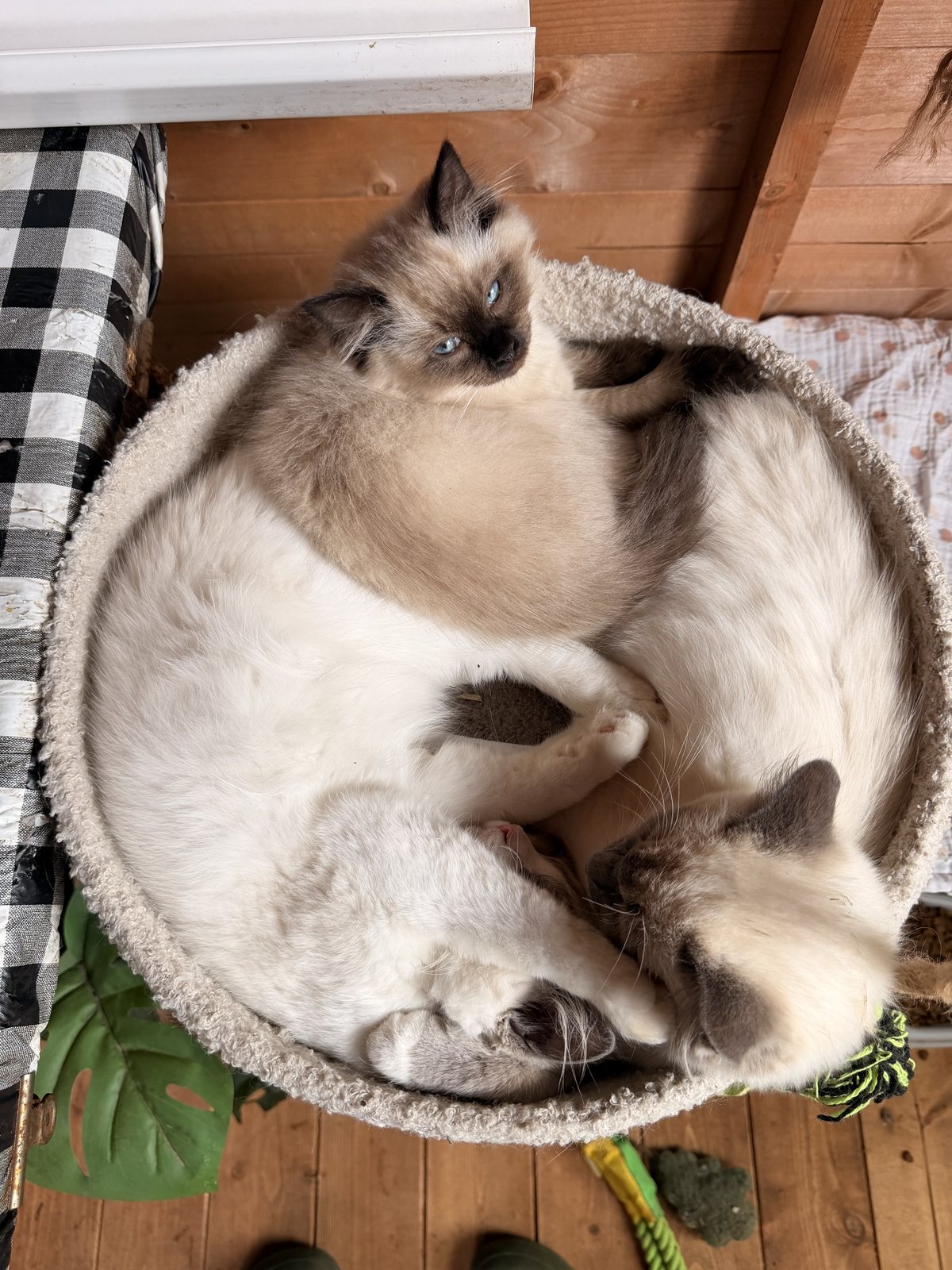
Four of our colony asleep together: a Ragdoll is a cat that stays close, which some quiet houses welcome.
The short version
- The strongest study we found suggests pets may soften a loss. Among American adults over 50 who lost a spouse, those with a cat or dog had about half the rise in depressive symptoms of those without (1.2 symptoms against 2.6), and no greater rise in loneliness than people who had lost nobody.
- Grief charities advise routine and small targets. The NHS suggests regular meals and small achievable goals; Cruse says keeping to a routine of eating, sleeping and a short walk helps, and that early grief is not the time for big changes. A cat is a small routine that will not let itself be skipped, and it is also a change.
- There is no right time. Cats Protection says getting another cat is entirely personal, and International Cat Care says the right time could be weeks, months or years. Nobody should be talked into it, including by us.
- Grief for a cat is real grief. Nearly a third of owners in one study showed complicated grief after a pet died, and 75% of owners surveyed by Cats Protection felt the public underestimates it. Cats Protection's Paws to Listen and the Blue Cross pet loss line exist for exactly this.
- A calm cat suits a quiet house. The Ragdoll tends to be quiet, suited to indoor life and inclined to stay close, and a colony raised kitten tends to settle quickly. It is not a replacement for anyone and it is not a treatment.
- Support comes first. If grief is overwhelming, the support lines at the end of this guide are the place to start, before any decision about a cat.
Contents
- Grief, and what the charities advise
- What the research says about pets after a loss
- After losing a cat
- Is it the right time?
- Why the Ragdoll suits a quiet house
- Why colony raised: a kitten that settles
- If there is a cat still at home
- How we approach it
- Support lines
- Questions people ask and sources
A note on language: we write about loss plainly. Marie Curie's poll found that nearly half of us say someone has passed away and that it does not matter what you call it as long as you talk about it (Marie Curie); we use whatever words a family uses.
Grief, and what the charities advise
There is no right or wrong way to feel after a loss, which is the first thing the NHS says about it. Its advice for coping is practical: talk to someone you trust, consider peer support, keep up regular exercise, eat regular meals to keep your energy stable, set small targets you can easily achieve, and be careful with alcohol. If low mood is increasing, or lasts more than a couple of weeks without lifting, see a GP (NHS: grief after bereavement or loss).
Cruse, the UK bereavement charity, says much the same: keeping to a routine of eating, sleeping and some exercise can help, a short daily walk counts, and fresh air, walking and nature all help (Cruse: ways of coping; Cruse: managing grief). It also advises that early grief is not the time for big changes or resolutions (Cruse). Marie Curie adds: try not to feel you have to take on too much, and it is normal to both grieve and live (Marie Curie).
None of those charities mention a pet, and we are not suggesting they do. We only notice that a cat's needs happen to line up with some of that advice: regular meals, because the cat needs its breakfast; a small task done every day; a reason to open the back door; something alive in the house that needs you and does not need you to talk. None of that is a cure for grief, and a cat is also a change, which is why the timing section matters.
What the research says about pets after a loss
The spousal loss study
The most direct evidence comes from the Health and Retirement Study, a large survey of Americans over 50. Researchers compared people who lost a spouse, through death or divorce, with those who stayed married, with and without a cat or dog at the time. Loss hurt everyone, but people without a pet showed a rise of about 2.6 depressive symptoms against 1.2 for those with one, and loneliness rose for the bereaved without a pet, while those with a pet showed no greater rise than people who had lost nobody (Carr, Taylor, Gee and Sachs Ericsson, 2020). The lead author's suggested explanation, untested, is that a pet lets you feel you still matter to someone (Gerontological Society of America). The study was observational, combined death with divorce, and was part funded by a pet food company.
Loneliness and living alone
Among 830 older primary care patients, pet owners were 36% less likely to feel lonely, and living alone without a pet carried the highest odds of all (Stanley and colleagues, 2014). Cats Protection's latest report says the companionship benefits of cats are felt most keenly by people who live alone (CATS Report 2025), and in its 2023 survey 45% of owners said their cat gives them a reason to get up in the morning (CATS Report 2023).
Mood in the moment
In a Swiss study, having a cat reduced negative mood about as much as having a partner did, though only a partner raised positive mood (Turner, Rieger and Gygax, 2003). Ten minutes stroking a cat or dog lowered the stress hormone cortisol in a randomised trial of university students (Pendry and Vandagriff, 2019).
What the research does not say
A systematic review of 17 studies of pet owners with mental health conditions found the quantitative evidence mixed, and listed the psychological impact of losing a pet among the real costs of ownership (Brooks and colleagues, 2018). The lockdown researchers who found pets linked to less loneliness said plainly that the effect was unlikely to be clinically significant and did not recommend getting a pet for your mental health (Ratschen and colleagues, 2020). A cat can make a grieving house less silent. It does not do the grieving for you, and if the weight of it is too much, the support lines below come before any kitten.
After losing a cat
Some people reading this have lost a cat rather than a person, and may feel awkward about how much it hurts. There is no need to. In a study of 177 owners whose pets had died, nearly 30% showed complicated grief, a rate the reviewers describe as comparable to figures reported after the loss of a person (Adams, Bonnett and Meek, 2000, reviewed by Matte and colleagues). In a Cats Protection survey, 75% of owners felt the public underestimates the effect of losing a cat (Cats Protection, 2016), and in its 2023 report nearly a quarter of people without a cat said the reason was that they could not bear to lose one again (CATS Report 2023).
Support that exists
- Cats Protection Paws to Listen: a free, confidential line staffed by trained volunteer listeners, 0800 024 94 94, Monday to Friday 9am to 5pm, for anyone grieving a cat (Paws to Listen).
- Blue Cross Pet Bereavement Support Service: 0800 096 6606, with email and web chat (listed on NHS Wales bereavement pages).
Guilt, and the word replacement
The two things people most often say to us are that they feel guilty about the decision at the end, and that getting another cat feels like replacing the one they lost. Cats Protection's answer to the second is that the decision to get another cat is entirely personal: some people want one almost immediately, others need time to come to terms with the loss (Cats Protection: coping with the loss of a cat). International Cat Care puts it as a tribute rather than a betrayal, when the time is right, which could be weeks, months or years (International Cat Care: bereavement). A new kitten is not the old cat and will not try to be. Some families have told us that helps.
Is it the right time?
We will not tell you yes. These are the questions we would ask ourselves, and that we gently ask families who come to us soon after a loss.
- Is it a decision, or a reaction to the loss? Cruse's advice that early grief is not the time for big changes is sound. A kitten is a commitment of fifteen years or more, and early grief is a hard time to weigh one. If it helps, the waiting list lets you put a name down without deciding anything; so does simply waiting.
- Who does the daily care on the worst days? If you are the only adult in the house, is there someone who could feed the cat for a week if you could not? If yes, that worry at least is answered.
- Is the house settled? A house move, a probate sale, a change of job or a hospital stay in the next few months are reasons to wait, not to say no.
- Who is the cat for? A kitten bought by a worried family for a grieving parent who has not asked for one can land badly. A kitten chosen by that parent, with the family's help, is a different thing.
- Does a kitten suit, or a calmer adult? A kitten is a year or two of energy and mischief, which some people find exactly the distraction they need and others find exhausting. An adult, or the quietest kitten in a litter, may suit better, and we will say so.
- Have you had the support you need? If grief has become something you cannot carry, talk to someone before you take on an animal. The lines at the end of this guide are free.
If after all this the answer is not yet, that is a sound answer. There will be other litters, ours or someone else's.
Why the Ragdoll suits a quiet house
A house after a loss is often quieter, slower and more fragile than it was. The wrong cat, nervous or demanding or forever at the door, adds to that. The right one settles into it.
What the breed bodies say
The GCCF describes the Ragdoll as having an easy, laid back temperament and in general loving interaction with people and other animals, and notes that how a kitten is raised, with frequent loving handling and play, contributes enormously to its socialisation (GCCF Ragdoll profile). TICA calls the Ragdoll a loving, quiet cat with a laid back disposition, and warns that if you want a very active or talkative cat the Ragdoll is probably not for you (TICA breed page).
What the studies say
Two veterinary scientists at UC Davis asked 80 feline practitioners to rank 15 pedigree breeds on 12 behaviours. The Ragdoll came out most affectionate, most socially outgoing and least aggressive to cats and people (Hart and Hart, 2013). A Finnish owner survey of 5,726 cats placed the Ragdoll among the least active breeds, in a group of breeds that were the least fearful and least aggressive, with aggression and shyness both moderately heritable, which is why choosing calm parents matters so much (Salonen and colleagues, 2019).
Why those traits suit
- Stays close. Many Ragdolls follow their person from room to room and sleep against them, which is the company a quiet house is short of.
- Quiet and low energy. Long sleeps, soft voice, play in short bursts rather than chaos.
- Suited to indoor life. No worry about roads or where the cat is at night, which matters when worry is already in surplus (indoor cats guide).
- Tolerant and slow to startle. Forgiving of a household that is not at its best.
- Not the old cat. If you have lost a Ragdoll, a new Ragdoll will remind you of it every day, which some people want and some cannot bear. Be honest with yourself about it; a different colour or pattern helps some families (colours guide).
Being honest about the limits
Breed averages describe populations, and every Ragdoll is an individual. Some are vocal, some are busy, some dislike being picked up. A Ragdoll kitten is still a kitten, with teeth, claws and zoomies, and the settled adult temperament takes two to three years to arrive. The coat needs combing a few times a week and the breed has an inherited heart condition to screen for; our pros and cons guide is the fair version. Nobody can promise you a calm cat. What a good breeder can offer is a kitten from calm parents, raised to be confident, whose individual personality you have met.
Why colony raised: a kitten that settles
Breed sets the ceiling; the first weeks of life decide how much of it a kitten reaches. A Ragdoll raised quietly by one queen in a spare room and a Ragdoll raised underfoot in a house of sixteen adult cats, chickens, a peacock, a hoover and a family will grow into different cats, and the science on why is consistent. A kitten that hides under the bed for a fortnight or cries through the night is hard work in any house, and harder in a quiet one. Raising kittens to be confident is the most useful thing we can do about that.
The sensitive period
Kittens have a window for learning what is safe, roughly two to seven weeks of age (International Cat Care; Cats Protection). What a kitten meets calmly in that window it tends to accept for life; what it never meets, it may fear. Handling by several different people, including men, women and children, produces more sociable adult cats than handling by one person.
Handling, parents and the mother's example
In a study that followed kittens to a year old, those handled regularly from two to twelve weeks were quicker to approach, touch and rub against people and were less distressed when approached and handled by strangers; boldness toward new things followed the father (McCune, 1995). Friendliness to people has been linked to the father in two separate colonies (Turner and colleagues, 1986), and how a cat reacts to being held by a stranger is a stable trait from four months onward (Lowe and Bradshaw, 2002). Kittens also learn by watching their mother, and International Cat Care notes that a poorly socialised mother holds back her kittens' socialisation.
Weaning and leaving
The large Finnish survey found that cats weaned before eight weeks showed more aggression and repetitive behaviour as adults, and the researchers suggested keeping kittens with their mother to at least fourteen weeks (Ahola, Vapalahti and Lohi, 2017). No kitten leaves us before nine weeks, weaned by its mother rather than by a timetable, and our reasoning on nine to ten weeks, and why it differs from that and from the usual guidance, is set out on our story page.
Why colony raised is different
A conventional set up is one queen and her litter, kept apart from other cats in a quiet room, with handling that depends on who has time. Ours is a domesticated colony of sixteen adult Ragdolls living in the house, and kittens are born into it. In practice that means:
- Many calm adults to learn from, not one. Kittens grow up inside a group with a settled social order, copying the unbothered way a dozen adults react to the doorbell, the hoover and visitors.
- Parents chosen for temperament. We breed from cats we live with every day, so we know which lines are bold, which are gentle and which are busy, and we keep only the calm, people loving ones in the programme. Because shyness and aggression are heritable, this matters.
- Daily handling by the whole household from birth: adults, children and visitors, with brushing, paw and ear checks and carrying built into the routine. Our kittens meet ducks, chickens, a peacock, guinea pigs, parrots, the washing machine and the general bustle of a working family home before the fear window closes.
- Underfoot, not in a spare room. They are raised in the kitchen and living room, which is where they will live with you.
No study has compared colony rearing with conventional rearing head to head, and we would rather say so than pretend. What the research does show is which ingredients make a confident, settled, people loving cat: several handlers, calm parents, adults to learn from and a long time with the mother. A colony delivers every one of them every day, as the way the house works rather than a programme someone has to remember to run. We think that is why our kittens tend to settle quickly in a new house, and why some families tell us the kitten was asleep on their lap by the first evening.
If there is a cat still at home
When one of two cats dies, the one left behind often changes. In a study of 412 owners whose cat had lost a companion animal, the most common changes were eating less, playing less and seeking more attention, strongest in cats that had been close to the one that died (Greene and Vonk, 2024). Cats Protection advises a vet check first to rule out illness, then keeping to the usual routine, and it cautions against getting the remaining cat another cat for company on the assumption it is lonely, since cats are solitary by nature and a bonded pair may not accept a newcomer (Cats Protection).
If you do decide on a kitten, introduce it properly: a separate room to settle in, scent swapping after a few days, controlled sight of each other, then short supervised meetings, over a few weeks to a few months (Battersea). Our multi cat harmony guide covers it in detail, and our kittens, raised in a colony of sixteen adults, are used to other cats from birth, which makes their side of it easier.
Signs the resident cat is struggling
Flattened ears, a twitching tail, dilated pupils, a crouched body, hiding, eating less, over grooming or toileting outside the tray are all signs to give the cat space. International Cat Care's stress in cats and the PDSA body language guide show what to look for, and Cats Protection's cat stress page covers the subtler signs.
How we approach it
If you think a kitten might be right, now or later, this is how it works with us.
- Tell us as much or as little as you like. We do not need the story, but it helps to know whether you want a kitten that will keep you busy or one that will keep you company. Use the enquiry form or message us.
- No pressure, and no deadline. The waiting list is free to join and free to leave. If you reserve and the time turns out to be wrong, say so.
- We match, not just sell. We will tell you which kitten in a litter is the lap sitter and which is the explorer, and we will say if we think a calmer adult from our colony, when one is available, would suit better.
- Visit at your own pace. Appointments in our home in Ryde, where you meet the kitten, the mother and the colony. Bring someone with you if that helps.
- A gentle handover. Collection at our home, never a courier, a kitten pack with a blanket carrying the colony's scent, and check ins at one week and one month, then support for life.
Our current litters are on the kittens page.
Support lines
Free, and there for exactly this.
- Cruse Bereavement Support: 0808 808 1677 (hours and details).
- Marie Curie Support Line: 0800 090 2309, with up to six telephone bereavement support sessions (Marie Curie).
- Sue Ryder: free online bereavement support, including an online community (Sue Ryder).
- Samaritans: 116 123, free, any time, day or night.
- NHS talking therapies: you can refer yourself without a diagnosis.
- Cats Protection Paws to Listen: 0800 024 94 94, for grief about a cat (details).
- Blue Cross Pet Bereavement Support Service: 0800 096 6606.
Questions people ask
Can a cat help with grief?
It can make a house less silent and give the day a shape, and the strongest study we found suggests more than that: American adults over 50 who lost a spouse while they had a cat or dog showed about half the rise in depressive symptoms of those without one, and no greater rise in loneliness than people who had lost nobody. A cat does not do the grieving for you, is not a treatment, and does not replace the support lines or a GP if grief becomes too much to carry.
How soon after losing a cat should I get another?
There is no rule. Cats Protection says the decision is entirely personal, that some people want another cat almost immediately and others need time, and International Cat Care says the right time could be weeks, months or years and that a new cat is a tribute, not a betrayal.
Is a kitten a good idea for a grieving parent?
Sometimes, if the parent wants one. A kitten chosen by the person, with the family's help, stands a far better chance; one bought for them as a surprise can land badly, and a kitten is energetic for a year or two. Ask, involve them in choosing, and consider a calmer kitten or an adult. If they live alone, agree who feeds the cat if they are unwell.
Will a Ragdoll remind me too much of the cat I lost?
If you lost a Ragdoll, probably yes, and whether that is a comfort or a hurt is something only you can judge. Some families choose a different colour or pattern, some choose the same because the likeness is the point, and some wait. A new kitten will not be the old cat and will not try to be, and some families have told us that helps.
Will my remaining cat want a new companion?
Not necessarily. A cat that has lost a companion often eats and plays less and seeks more attention for a while; Cats Protection advises a vet check, keeping to the usual routine, and not assuming the cat wants another cat, since cats are solitary by nature and may not accept a newcomer. If you do bring in a kitten, introduce it slowly over weeks with a separate room, scent swapping and supervised meetings.
Sources and further reading
- Carr, Taylor, Gee and Sachs Ericsson 2020, The Gerontologist (HRS record): pets and depressive symptoms and loneliness after losing a spouse
- Gerontological Society of America release on the 2020 study: the authors on why pets may help
- NHS: grief after bereavement or loss: coping advice and when to see a GP
- Cruse: helpline: 0808 808 1677 and hours
- Cruse: ways of coping with grief (bilingual leaflet): routine, sleep, a short walk
- Cruse: managing grief: fresh air, walking and nature
- Cruse: starting a new year while grieving: early grief is not the time for big changes
- Marie Curie: grief support: support line and telephone bereavement support
- Sue Ryder: find grief support: online support and community
- Samaritans: talk to us by phone: 116 123, free, 24 hours
- Samaritans: media guidelines 2026: the language guidance this page follows
- Marie Curie: poll on the words we use for death: it does not matter what you call it as long as you talk about it
- NHS talking therapies: self referral without a diagnosis
- Cats Protection: Paws to Listen: the grief line for cat owners
- Cats Protection: help is at hand for bereaved cat owners: Pet Remembrance Day release on the service
- Cats Protection: cats and grief survey (2016): 75% feel the public underestimates losing a cat
- Cats Protection: coping with the loss of a cat: getting another cat is personal; the remaining cat
- International Cat Care: bereavement: when the time is right, weeks, months or years
- NHS Wales: pet bereavement: Blue Cross Pet Bereavement Support Service number
- Matte, Khosa and Meehan 2021, Veterinary Evidence: reviews Adams 2000: complicated grief after pet loss
- Greene and Vonk 2024, Applied Animal Behaviour Science (PsyPost report): 412 owners on how cats change after losing a companion
- Battersea: introducing a new cat to your resident cat: the step by step introduction
- Stanley et al 2014, Aging and Mental Health: 830 older adults: pet owners less lonely
- Turner, Rieger and Gygax 2003, Anthrozoös: cats and negative mood
- Pendry and Vandagriff 2019, AERA Open: stroking and cortisol
- Brooks et al 2018, BMC Psychiatry (Manchester record): systematic review; the cost of losing a pet
- Ratschen et al 2020, PLOS ONE (University of Lincoln release): the effect is small and not a reason to get a pet
- Cats Protection: CATS Report 2023: reason to get up; fear of losing a cat again
- Cats Protection: CATS Report 2025 key findings: companionship felt most by people living alone
- Salonen et al 2019, Scientific Reports: breed differences and heritability in 5,726 cats, including Ragdolls
- Hart and Hart 2013, Your Ideal Cat (UC Davis release): 80 feline vets rank 15 breeds; Ragdoll most affectionate, least aggressive
- GCCF and TICA Ragdoll breed profiles: the breed bodies on temperament; TICA at tica.org/breed/ragdoll
- McCune 1995, Applied Animal Behaviour Science: early handling and the father's influence on friendliness and boldness
- Ahola, Vapalahti and Lohi 2017 (University of Helsinki): weaning age and adult behaviour in the Finnish survey
- Cats Protection: kitten socialisation: the two to seven week window and what a kitten should meet
- Cats Protection: cat stress: reading stress signals in cats
- International Cat Care: stress in cats: causes, signs and prevention of stress
- PDSA: cat body language: posture, tail, ears and what purring does and does not mean
If and when the time is right
Our Ragdoll and Ragcoon kittens grow up in our home in Ryde, Isle of Wight, with health tested parents and our support for life. The waiting list is free to join and free to leave, and there is no rush.