
Cats and ADHD: Could a Calm, Settled Cat Help?
For adults with ADHD and parents of children with ADHD: the evidence, the honest gaps, what a cat can realistically give, and how to choose one that makes life easier rather than harder.
Last reviewed
People with ADHD who come to us often tell us the same two things about their cat: it is the one routine that never slips, because the cat will not let it, and it is the calmest thing in a busy day. The research is thinner than the stories. No study has tested cats for ADHD, the animal assisted therapy trials used dogs and found modest gains, and the one piece of cat specific data is a small, probably backwards, association in a UK birth cohort. What is well established is the rest of the picture: NICE's guidance that daily structure and a calmer environment are the first line for ADHD, the finding that emotion regulation is a struggle for roughly a quarter to a half of children and a third to two thirds of adults with ADHD, and the evidence that stroking a cat lowers stress hormones in the moment. A calm, affectionate, predictable cat fits that picture well; a nervous or demanding one does not. This guide sets out what is known, what is not, why a colony raised Ragdoll is the kind of cat that helps rather than adds to the load, and how to decide.
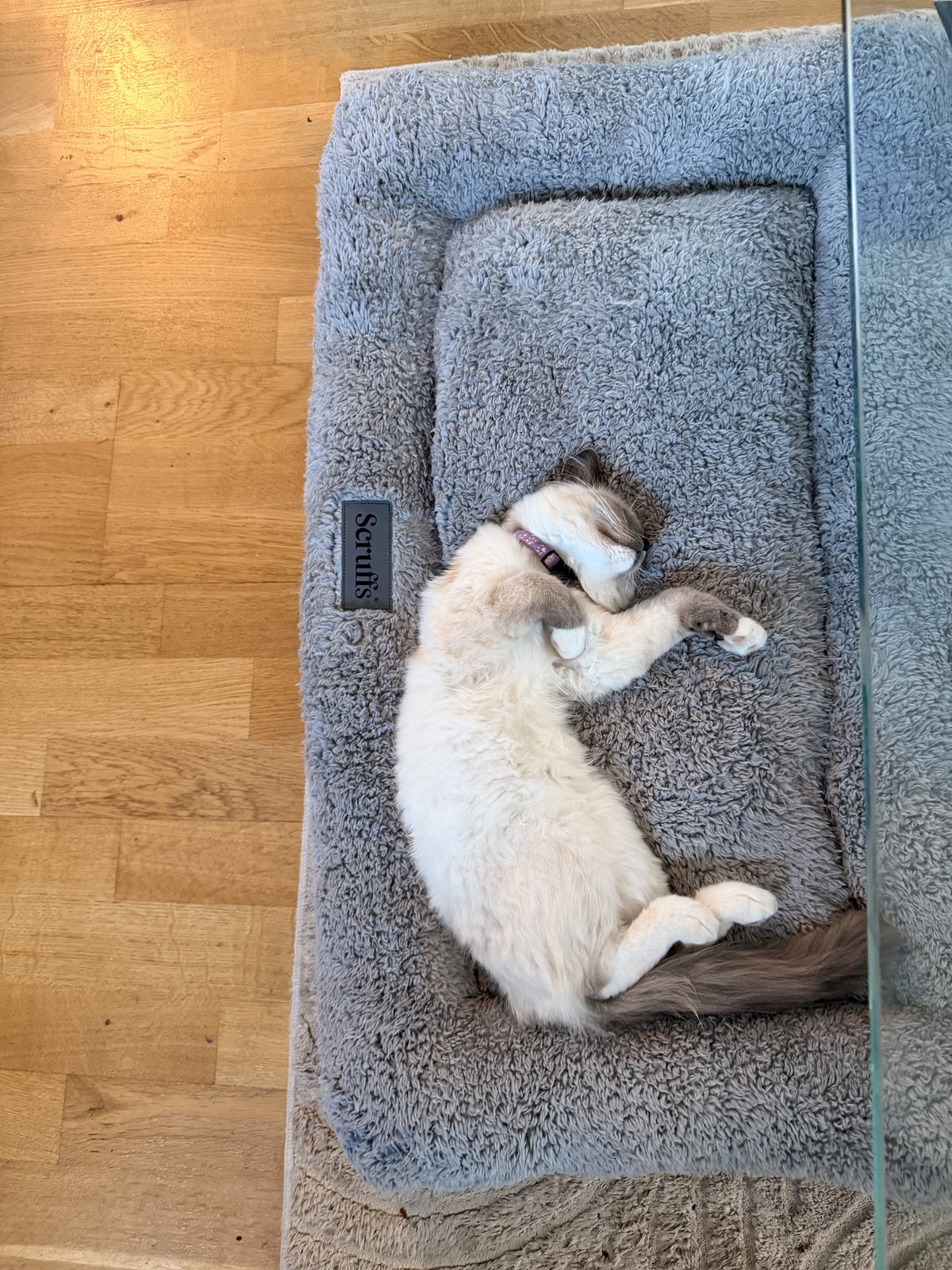
Calm company: two of our colony Ragdolls at rest, the kind of settled presence a busy household needs.
The short version
- There is no cat and ADHD study. The therapy trials used dogs alongside group therapy, children with the dogs improved faster in attention and social skills and gained in self esteem, but hyperactivity and impulsivity improved no more than without the dogs, and a 2025 review found no effect on symptom severity, though attention problems did improve in the pooled trials. Nobody can sell you a cat as an ADHD treatment.
- Routine is the mechanism that matters. NICE advises families to build structure into the day for children and adults with ADHD. A cat is a routine with a voice: feeding and play tend to happen at the same time because the cat asks for them.
- Calm contact helps in the moment. Emotion regulation is hard for many people with ADHD, and ten minutes stroking a cat or dog lowered the stress hormone cortisol in a randomised trial.
- The cat's temperament decides whether it helps or adds to the load. A cat that is slow to startle, tolerant of handling and content indoors forgives an impulsive moment; a nervous cat does not. In the one study that asked 80 feline vets to rank fifteen breeds, the Ragdoll came out most affectionate and least aggressive, and a colony raised kitten has already lived with noise and sudden movement.
- Share the care, and plan it. The sensible advice from ADHD charities is that pet care is shared, planned and never a surprise, and an adult is always the person responsible.
- Cats need predictability too. If routines in the house are hard to hold, plan how the cat's own routine survives it. Automatic feeders, a fixed play slot and a cat that has its own space all help.
Contents
- ADHD: what it is and how common it is
- Why people with ADHD so often choose cats
- What a cat can realistically give
- Why the Ragdoll: a cat that forgives a lot
- Why colony raised: a kitten that already knows noise
- Deciding, and making it work
- Children with ADHD and cats
- The cat's side of it
- What the research shows, and where it stops
- Where to start with us
- Questions people ask and sources
A note on language: we follow ADHD UK's style guide, which recommends "having ADHD", avoids "suffers from", and asks writers to let individuals choose how they are described.
ADHD: what it is and how common it is
The NHS describes ADHD as a condition that can affect how you focus, with symptoms that usually start before the age of twelve, and support that includes lifestyle changes, adjustments at home and school such as breaking tasks into shorter blocks, medicines for some people, and talking therapies (NHS: ADHD in children and teenagers). For adults it is a condition that can affect how you focus, and most adults with ADHD have both inattentive and hyperactive or impulsive symptoms; the NHS notes they may also be more likely to experience anxiety and depression (NHS: ADHD in adults).
How common depends on the definition. NICE gives childhood rates of 1 to 2% under the stricter diagnostic criteria and 3 to 9% under the broader ones (NICE guideline NG87). ADHD UK estimates around three million people in the UK have ADHD, the large majority of them adults (ADHD UK).
Two findings matter for this guide. First, NICE's recommendations put structure and environment first: families are advised on the importance of structure in a child's day and in an adult's daily activities, and medication is considered only after environmental changes have been made and reviewed (NICE rationale). Second, emotional dysregulation, meaning quick, strong reactions that are hard to settle, affects roughly a quarter to a half of children with ADHD and a third to two thirds of adults, and is one of the main sources of difficulty (Shaw and colleagues, 2014). Routine and calm are the two things a well chosen cat is good at.
Why people with ADHD so often choose cats
A dog needs a walk at seven whatever kind of morning you are having. A cat needs breakfast, a tray, play and a lap, and it will remind you. For many people with ADHD that balance, a routine that is real but light, is exactly right.
A routine that reminds you
Executive function, the planning and starting of tasks, is where many people with ADHD say they struggle most, and the advice from NICE down is to build external structure. A cat is external structure with whiskers: most settle into arriving at the bowl at the same time every day. CHADD, an American ADHD charity, makes the same point, that caring for a pet anchors a schedule of feeding, cleaning and play (CHADD).
Calm without demands
After a day of holding it together, a cat asks very little of you. It does not need you to be organised, and it does not mind what the house looks like. The weight of a cat settled on your chest is a way to come down that requires no effort.
Something that cannot be put off
Some adults with ADHD have told us that the cat's routine is easier to keep than their own, and that the fixed point of feeding it drags the rest of the day into shape behind it. That is an anecdote, repeated to us often, not a finding.
What a cat can realistically give
Here is what people report, matched against the evidence, which in this case is thinner than for most subjects on this site.
Structure
Supported by ADHD guidance rather than by pet research: NICE advises structure in the day for children and adults with ADHD (NG87), and the practitioner advice from ADHD charities is that pet care, planned and shared, can be a scaffold for it (CHADD; Understood).
Calmer in the moment
Supported by general research: ten minutes stroking cats and dogs lowered cortisol in a randomised trial of 249 students (Pendry and Vandagriff, 2019), and a review of 69 studies found lower heart rate, blood pressure and stress responses with a friendly animal present, mostly dogs (Beetz and colleagues, 2012). None of this was measured in people with ADHD.
Attention and self esteem
From the dog therapy trials: in a randomised trial of 80 children aged seven to nine, those whose group therapy included therapy dogs improved in self rated conduct, social competence and schoolwork, where the group with toy dogs did not (Schuck and colleagues, 2018), and the same programme found attention and social skills improved faster with the dogs, while hyperactivity and impulsivity improved no more than without them (Schuck 2018, symptoms). Structured therapy with trained dogs is not a cat on the sofa, and the findings do not transfer.
Illustrations, not evidence
- An adult who cannot keep to a bedtime finds that the cat has one, and that going up when the cat goes up works where every alarm failed.
- A child who melts down after school sits on the floor with the cat for ten minutes before anyone asks about homework, and the evening goes better.
- A student who has never remembered to eat breakfast remembers the cat's, and then, standing in the kitchen anyway, makes their own.
These are the kinds of stories people tell us. They show what is possible, not what is typical.
What a cat cannot do
A cat does not treat ADHD, improve attention, or replace medication, therapy, coaching or the adjustments a person uses, and a 2025 review of 17 animal assisted intervention studies, pooling eight randomised trials and 307 children, found no significant effect on ADHD symptom severity (Yu and colleagues, 2025). A cat can also add to the load: a pet that needs feeding on days when nothing gets done, vet appointments that get missed, and guilt when it goes wrong. CHADD's caution is the right one, that pet ownership can increase stress for some people and is not a decision to make lightly (CHADD).
Why the Ragdoll: a cat that forgives a lot
Where someone in the house has ADHD, the cat's temperament matters more than usual. Busy moments happen: a raised voice from another room, a door that bangs, a feeding time missed, a stroke that goes on too long. A cat that startles, hides or lashes out turns each of those into a problem; a cat that shrugs them off does not.
What the breed bodies say
The GCCF describes the Ragdoll as having an easy, laid back temperament and in general loving interaction with people and other animals, and notes that how a kitten is raised, with frequent loving handling and play, contributes enormously to its socialisation (GCCF Ragdoll profile). TICA calls the Ragdoll a loving, quiet cat with a laid back disposition, and warns that if you want a very active or talkative cat the Ragdoll is probably not for you (TICA breed page).
What the studies say
Two veterinary scientists at UC Davis asked 80 feline practitioners to rank 15 pedigree breeds on 12 behaviours. The Ragdoll came out most affectionate, most socially outgoing and least aggressive to cats and people (Hart and Hart, 2013). A Finnish owner survey of 5,726 cats placed the Ragdoll among the least active breeds, in a group of breeds that were the least fearful and least aggressive, with aggression and shyness both moderately heritable, which is why choosing calm parents matters so much (Salonen and colleagues, 2019).
Why those traits help
- Slow to startle, slow to bite. The quality that matters most here. A tolerant cat gives everyone room to get it wrong now and then.
- Seeks you out. A Ragdoll comes to you, which means the calming contact happens without anyone having to remember to go and find the cat.
- Content indoors. No cat flap to forget, no 11pm search of the garden, no road.
- Low maintenance behaviour. Quiet and lower energy as adults, with little of the night time noise some breeds make, which matters when sleep is hard to come by.
- The one daily cost: the coat needs combing a few times a week, which is the kind of regular small task that is easy to lose. Tie it to something that already happens, the evening programme or the kettle, or share it (grooming guide).
Being honest about the limits
Breed averages describe populations, and every Ragdoll is an individual. Some are vocal, some are busy, some dislike being picked up. A Ragdoll kitten is still a kitten, with teeth, claws and zoomies, and the settled adult temperament takes two to three years to arrive. The coat needs combing a few times a week and the breed has an inherited heart condition to screen for; our pros and cons guide is the fair version. Nobody can promise you a calm cat. What a good breeder can offer is a kitten from calm parents, raised to be confident, whose individual personality you have met.
Why colony raised: a kitten that already knows noise
Breed sets the ceiling; the first weeks of life decide how much of it a kitten reaches. A Ragdoll raised quietly by one queen in a spare room and a Ragdoll raised underfoot in a house of sixteen adult cats, chickens, a peacock, a hoover and a family will grow into different cats, and the science on why is consistent. For a household where routines are hard to hold and days can be busy and unpredictable, this is the part that matters most: a kitten that has already learned that sudden noise and movement are nothing to fear.
The sensitive period
Kittens have a window for learning what is safe, roughly two to seven weeks of age (International Cat Care; Cats Protection). What a kitten meets calmly in that window it tends to accept for life; what it never meets, it may fear. Handling by several different people, including men, women and children, produces more sociable adult cats than handling by one person.
Handling, parents and the mother's example
In a study that followed kittens to a year old, those handled regularly from two to twelve weeks were quicker to approach, touch and rub against people and were less distressed when approached and handled by strangers; boldness toward new things followed the father (McCune, 1995). Friendliness to people has been linked to the father in two separate colonies (Turner and colleagues, 1986), and how a cat reacts to being held by a stranger is a stable trait from four months onward (Lowe and Bradshaw, 2002). Kittens also learn by watching their mother, and International Cat Care notes that a poorly socialised mother holds back her kittens' socialisation.
Weaning and leaving
The large Finnish survey found that cats weaned before eight weeks showed more aggression and repetitive behaviour as adults, and the researchers suggested keeping kittens with their mother to at least fourteen weeks (Ahola, Vapalahti and Lohi, 2017). No kitten leaves us before nine weeks, weaned by its mother rather than by a timetable, and our reasoning on nine to ten weeks, and why it differs from that and from the usual guidance, is set out on our story page.
Why colony raised is different
A conventional set up is one queen and her litter, kept apart from other cats in a quiet room, with handling that depends on who has time. Ours is a domesticated colony of sixteen adult Ragdolls living in the house, and kittens are born into it. In practice that means:
- Many calm adults to learn from, not one. Kittens grow up inside a group with a settled social order, copying the unbothered way a dozen adults react to the doorbell, the hoover and visitors.
- Parents chosen for temperament. We breed from cats we live with every day, so we know which lines are bold, which are gentle and which are busy, and we keep only the calm, people loving ones in the programme. Because shyness and aggression are heritable, this matters.
- Daily handling by the whole household from birth: adults, children and visitors, with brushing, paw and ear checks and carrying built into the routine. Our kittens meet ducks, chickens, a peacock, guinea pigs, parrots, the washing machine and the general bustle of a working family home before the fear window closes.
- Underfoot, not in a spare room. They are raised in the kitchen and living room, which is where they will live with you.
No study has compared colony rearing with conventional rearing head to head, and we would rather say so than pretend. What the research does show is which ingredients make a confident, settled, people loving cat: several handlers, calm parents, adults to learn from and a long time with the mother. A colony delivers every one of them every day, as the way the house works rather than a programme someone has to remember to run. That is why our kittens have usually arrived already unbothered by raised voices, running feet and the hoover, and why families often tell us the kitten settled in the first week.
Deciding, and making it work
The advice below is drawn from what ADHD charities say about pets and from what has worked for the families we know. The theme is the same throughout: build the structure before the cat arrives, not after.
Before you decide
- No surprise kittens. Understood's first rule for families with ADHD is no surprise pets, because transitions are hard and a pet is a big one (Understood). Our waiting list helps here: a kitten is planned months ahead.
- Who is responsible? One adult owns the cat's care in the end, whatever the child or anyone else helps with. Decide who before, not after.
- Money on autopilot. Insurance by direct debit from day one, food on a subscription, flea and worm treatment on a reminder. Our insurance guide covers the cost side.
- Is now the time? A new diagnosis, a medication change, a house move or an exam season are usually not the moment. A settled stretch is.
Making the routine stick
- Automate the fixed points. An automatic feeder for breakfast and dinner means the cat is fed on time even on the worst day, and the cat's routine stays steady. The lap, the play and the brushing are what you add on top.
- Anchor tasks to things that already happen. Brush the cat while the kettle boils. Scoop the tray when you brush your teeth. Play when the news comes on.
- Visual cues. The brush on the arm of the sofa, the tray scoop by the door, a checklist on the fridge for a child.
- Body doubling. Many people with ADHD work better with someone else in the room. Several people have told us a Ragdoll on the desk does something similar for them; that is their experience, not a finding.
- Forgive the lapses. A tray scooped a day late is not a crisis. A pattern of missed feeding is; that is what the feeder is for.
Children with ADHD and cats
Much of what we say in our growing up with a cat guide applies, with three additions.
Supervision matters more, not less
Impulsivity and animals need an adult in the room. The research on young children and dog bites found that children as young as four approached a frightened dog as readily as a happy one, because they could not read the signals (Staffordshire University), and that an active, approaching animal raised risky behaviour about as much as the child's temperament did (Davis and colleagues, 2012). A calm cat that walks away is safer than a playful one that engages, and the house rules in the children's guide, the cat comes to the child, nobody disturbs a cat that is eating or sleeping, the cat always has somewhere to go, and a young child is never left alone with a kitten, are not optional.
Shared care, planned care
The ADHD charities agree: involve the child in planning the cat's care as executive function practice, share the jobs rather than making the child solely responsible, and expect the adult to pick up the slack without blame (Understood). A child who feeds the cat at the same time every day is practising the kind of routine NICE encourages.
When to wait
Understood's advice is that a child who finds impulse control very hard may hurt an animal without meaning to, and that it can be kinder to wait and prepare more before a pet arrives. That is a kindness to the child as well as the cat, and we would rather say it than place a kitten into a situation that could go wrong for both of them.
The cat's side of it
Cats are creatures of habit. International Cat Care's advice is that being predictable in your behaviour and creating daily routines is one of the best ways to minimise stress in a cat, that inconsistent responses make an owner seem unpredictable, and that too much handling is itself a stressor (International Cat Care). Cats Protection says the same: routine is important to cats, disruptions cause stress, and a cat must always be free to move away when it wishes (Cats Protection). Its behaviour guidance adds that cats prefer short, frequent interactions where people tend to interact less often but more intensely, which is how petting turns into a swipe (Cats Protection: managing cat behaviour).
Where someone in the house has ADHD, that translates into a few rules that protect the cat and, in turn, the relationship: feeding by the clock, with a feeder if the clock is unreliable; a room or a high place that is the cat's alone; short strokes and then stop, rather than long sessions; and no punishment, ever.
One more thing for the cat's safety: keep ADHD medication in a closed cupboard, never on a worktop or bedside table. A dropped tablet can poison a cat, and if it happens ring a vet immediately.
Learn the stress signals
Flattened ears, a twitching tail, dilated pupils, a crouched body, hiding, eating less, over grooming or toileting outside the tray are all signs to give the cat space. International Cat Care's stress in cats and the PDSA body language guide show what to look for, and Cats Protection's cat stress page covers the subtler signs.
What the research shows, and where it stops
Animals and ADHD
- Dog assisted therapy, 80 children: self esteem in conduct, social competence and schoolwork improved with the dogs and not without (Schuck 2018); attention and social skills improved faster with the dogs; hyperactivity and impulsivity did not differ (Schuck 2018, symptoms). Part funded by a pet food company.
- Review of 17 studies, 2025, pooling eight randomised trials: gains in attention problems and learning, no significant effect on symptom severity, social skills, emotional control or problem behaviours; the authors conclude animal assisted interventions were not more effective for most core ADHD outcomes (Yu 2025).
- Executive function and animals: a 2023 review of 23 studies found five positive, nine mixed and eight null, with limited rigour (Animals, 2023).
Cats specifically
- No intervention study. Nobody has tested a cat, pet or therapy, for ADHD.
- One observational finding, the wrong way round: in the UK Children of the 90s cohort, cat ownership at three went with slightly higher hyperactivity scores (adjusted odds 1.12), with no association at eleven; the senior author's reading is that families may get a pet to support a child with developmental differences rather than the cat causing anything (Purewal and colleagues, 2024; University of Liverpool).
- Mechanism evidence: stroking lowers cortisol (Pendry 2019), animal presence lowers stress responses (Beetz 2012), not measured in ADHD.
ADHD guidance
- Structure in the day and environmental changes come first in NICE's guideline (NG87); emotional dysregulation is common across the lifespan (Shaw 2014).
Ragdolls specifically
- None. The case for the breed rests on its temperament and how the kitten was raised.
In short: a cat is not an ADHD intervention and we will not pretend otherwise. What a calm, predictable cat offers a person with ADHD is a routine that enforces itself and a way to come down at the end of the day, and for the right household that is worth a great deal.
Where to start with us
If you think a Ragdoll might be right for you or your family, this is how it works with us.
- Tell us as much as you want to about the house. How loud and busy things get, who will own the cat's care, and whether a quieter or a more playful kitten would suit. Use the enquiry form or message us.
- Planned, not impulsive. Our kittens are reserved from the waiting list and leave at nine to ten weeks, so there is time to set the house up. Message us whenever suits; there is no rush and no lost place.
- We match, not just sell. We will tell you which kitten in a litter looks the most unflappable and which startles, as far as that can be judged at that age, and we will say if we think a calmer adult would suit better.
- Visit at your own pace. Appointments in our home, where you meet the kitten, the mother and the colony it grew up in.
- A gentle handover and support that continues. Collection at our home, a kitten pack with a blanket carrying the colony's scent, check ins at one week and one month, then support for life. If the routine falls apart in month three, message us and we will help.
Our current litters are on the kittens page.
Questions people ask
Can a cat help with ADHD?
Not as a treatment, and no study has tested one. What a calm cat can give is a routine that enforces itself, feeding and play at the same time every day because the cat insists, and a way to come down in the moment: stroking a cat lowers the stress hormone cortisol in the short term. NICE puts daily structure first, and a cat can be one small part of a person's own structure. It is not a substitute for anything a clinician recommends.
Are Ragdolls a good cat for someone with ADHD?
On temperament, among the better suited breeds. In the one study that asked 80 feline vets to rank fifteen breeds, the Ragdoll came out most affectionate and least aggressive; it is slow to startle, tolerant of handling, content indoors and seeks people out, which means the calming contact happens without anyone remembering to go and find the cat. The coat needs combing a few times a week, so plan who does it and tie it to something that already happens.
Can a child with ADHD and a kitten be safe together?
With supervision and the usual house rules, usually yes: the cat comes to the child, nobody disturbs a cat that is eating or sleeping, the cat always has somewhere to go, and an adult is in the room. Young children cannot read animal signals well, and a calm cat that walks away is safer than a playful one. A child who finds impulse control very hard may be better served by waiting and preparing more first, and we will talk that through with you if the timing looks wrong.
What if I forget to feed the cat?
Plan for it rather than hoping. An automatic feeder keeps breakfast and dinner on time on the worst day, food on subscription means it never runs out, and insurance and flea treatment on direct debit and reminders take care of themselves. Anchor the rest, brushing, play and the tray, to things that already happen every day. A tray scooped late is not a crisis, and with a feeder the meals are not missed at all.
Do cats mind a busy, unpredictable household?
Cats like routine, and International Cat Care and Cats Protection both say predictability is one of the best ways to keep a cat unstressed. Feeding by the clock, a space that is the cat's alone, short strokes rather than long sessions and no punishment protect the cat. A colony raised Ragdoll has grown up with noise, children and other animals, so a busy house is familiar; an unpredictable feeding time is what to fix.
Sources and further reading
- NHS: ADHD in children and teenagers: what ADHD is and the support the NHS describes
- NHS: ADHD in adults: adult symptoms and the link with anxiety and depression
- NICE guideline NG87: ADHD diagnosis and management: structure in the day, environmental modifications, prevalence
- NICE NG87: rationale and impact: why environmental modifications and daily structure come first
- ADHD UK: incidence: the three million estimate
- ADHD UK: language style guide: how to write about ADHD
- Shaw et al 2014, American Journal of Psychiatry: emotion dysregulation in ADHD across the lifespan
- Schuck et al 2018, Frontiers in Pediatrics: randomised trial of dog assisted group therapy and self esteem, 80 children
- Schuck et al 2018, Human Animal Interaction Bulletin (ScienceDaily release): symptoms improved faster with dogs; hyperactivity and impulsivity did not differ
- Yu et al 2025, Child and Adolescent Mental Health (summary): meta analysis of 17 animal assisted intervention studies for ADHD
- Purewal et al 2024, BMC Pediatrics: Children of the 90s: cat ownership and hyperactivity at three
- University of Liverpool release on the 2024 cohort study: the lead author on reverse causation
- Can interacting with animals improve executive functions? Animals, 2023: review of 23 studies, mixed results
- Pendry and Vandagriff 2019, AERA Open: ten minutes stroking cats and dogs lowered cortisol
- Beetz et al 2012, Frontiers in Psychology: 69 controlled studies on animals and stress
- Understood: FAQs about pets for kids with ADHD: no surprise pets, shared care, when to wait
- CHADD: how a helping paw helps with ADHD symptoms: pet care as a routine anchor, and the caution
- International Cat Care: stress in cats: predictability, routine and handling
- Cats Protection: reducing your cat's stress: routine and freedom to move away
- Cats Protection: managing cat behaviour: short frequent interactions and petting aggression
- Davis et al 2012, IJERPH: child temperament, dog behaviour and bite risk
- Staffordshire University: children misread fear in dogs: young children cannot read animal signals
- Salonen et al 2019, Scientific Reports: breed differences and heritability in 5,726 cats, including Ragdolls
- Hart and Hart 2013, Your Ideal Cat (UC Davis release): 80 feline vets rank 15 breeds; Ragdoll most affectionate, least aggressive
- GCCF and TICA Ragdoll breed profiles: the breed bodies on temperament; TICA at tica.org/breed/ragdoll
- McCune 1995, Applied Animal Behaviour Science: early handling and the father's influence on friendliness and boldness
- Ahola, Vapalahti and Lohi 2017 (University of Helsinki): weaning age and adult behaviour in the Finnish survey
- Cats Protection: kitten socialisation: the two to seven week window and what a kitten should meet
- Cats Protection: cat stress: reading stress signals in cats
- PDSA: cat body language: posture, tail, ears and what purring does and does not mean
Thinking about a Ragdoll kitten?
Our Ragdoll and Ragcoon kittens grow up in our home in Ryde, Isle of Wight, with health tested parents and our support for life. See who is available now, or join the waiting list for the next litter.