
Ragdoll Breathing Fast? What Is Normal and When to Worry
Thirty seconds with a watch tells you whether to relax or ring the vet.
Last reviewed
A cat breathing fast can be nothing more than a kitten that has just torn round the house, or it can be the first sign of something serious. The way to tell is to count. A relaxed or sleeping cat takes about 20 to 30 breaths a minute, quietly, through its nose, with its mouth shut. Fast breathing that settles within a few minutes of rest is normal. Fast breathing at rest that does not settle is not, and a cat breathing with its mouth open is an emergency. This matters a little more in Ragdolls than in most cats, because the breed carries an inherited heart condition whose first sign at home is often a change in breathing.
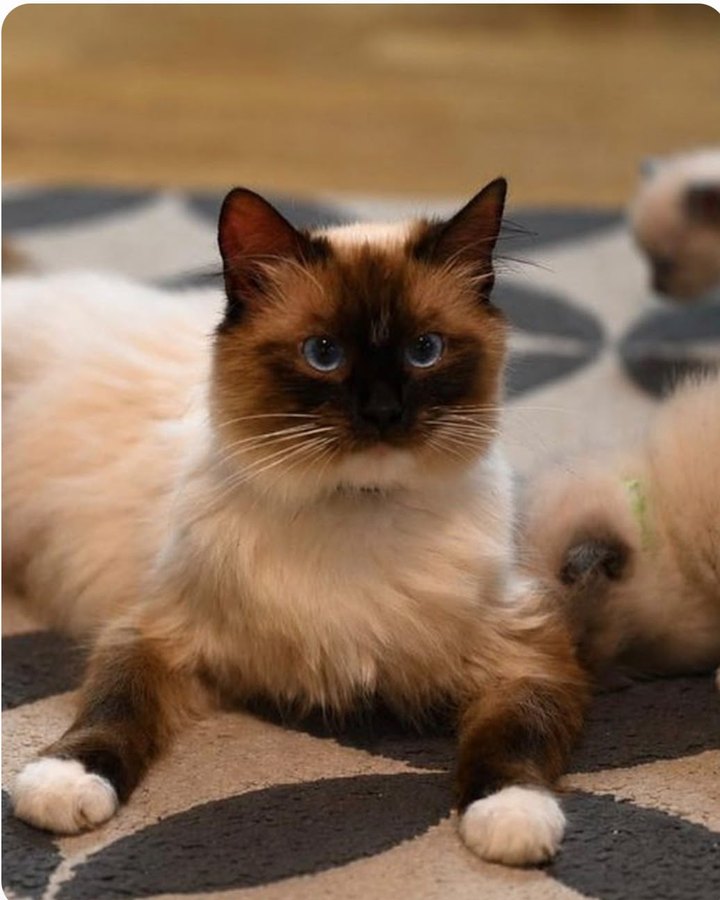
Tennessee, one of our queens. A relaxed cat breathes quietly through its nose with its mouth closed.
How fast should a cat breathe?
- At rest or asleep: about 20 to 30 breaths a minute. Some relaxed cats are a little lower.
- Through the nose, mouth closed. Cats nearly always breathe through the nose.
- Quiet. You should not be able to hear it across the room.
- Easy. The chest rises and falls gently. The belly does not heave and the cat is not working at it.
Over 40 breaths a minute in a cat that is resting or asleep, on more than one count, is a reason to ring the vet. So is any rate that is clearly higher than your own cat's normal and stays that way. The number matters less than the change, which is why it is worth knowing your cat's usual figure before you ever need it.
How to count your cat's breathing rate
- Wait until the cat is asleep or deeply relaxed, and not purring. Purring makes the chest flutter and the count unreliable.
- Do not touch or talk to the cat. Attention changes the rate.
- Watch the chest or the flank. One rise and one fall is one breath.
- Count the breaths in 30 seconds with a watch or a phone timer, and double it.
- Do it again a few minutes later. One odd count means little. Two or three the same mean something.
- Write it down, with the date. A short film on your phone is very useful to a vet.
Do this a few times while your cat is well, so that you know its normal. It takes a minute and costs nothing.
Harmless reasons for fast breathing
- Play and zoomies. A cat that has been charging about breathes fast, and a kitten may even pant for a few seconds. It should be back to normal within a few minutes of stopping. If it is not, ring the vet.
- Heat. A warm room, a sunny window or a hot day. Move the cat somewhere cool and the rate should fall.
- Stress or fear. A car journey, the vet's waiting room, fireworks. It settles when the cat does.
- Purring. It can look like rapid, shallow breathing.
- Dreaming. Twitching paws and whiskers and a burst of quick breaths in deep sleep, then back to slow and even.
- Kittens. They often breathe a little faster than adults, and they play harder.
The test is the same for all of these: there is an obvious reason, the cat is otherwise bright and comfortable, and the breathing slows down again once the reason has gone. If it does not, treat it as a problem.
Emergency signs
Ring your vet at once, day or night, if you see any of these:
- Open mouth breathing or panting that is not a few seconds after hard play.
- Noisy breathing: wheezing, rasping, gurgling or crackling.
- Effort: the belly and sides heaving, the nostrils flaring.
- Posture: crouched with the neck stretched out and the elbows held away from the chest, or lying stretched out taking short, fast breaths.
- Gum colour: blue, grey or white in place of pink.
- Collapse, or sudden weakness in the back legs.
- Fast breathing at rest that has not settled, especially with a cat that is hiding, quiet or off its food.
Cats hide breathing trouble well, and PDSA's vets point out that the signs often do not show until the problem is serious. Do not wait to see whether it improves by morning.
Why is my cat breathing fast?
Fast or laboured breathing is a sign, not a diagnosis. The causes vets look for include:
- Heart disease. When the heart fails, fluid gathers in or around the lungs. See HCM in Ragdolls.
- Asthma. Coughing, wheezing and crouched, effortful breathing. See asthma and coughing.
- Infections. Cat flu and pneumonia, usually with sneezing, a runny nose or eyes, or a temperature.
- Injury. A fall or a road accident can damage the chest without leaving a mark. See broken bones and falls.
- Heatstroke. See summer heat.
- Anaemia. Too few red blood cells to carry oxygen, so the cat breathes faster to make up. See anaemia.
- Pain, shock or severe stress. See recognising pain.
- Growths in the chest, mostly in older cats.
- Something stuck in the throat or airway. See swallowed objects and choking.
Sorting these out needs a vet, and usually a chest X ray or a scan. None of them can be told apart, or treated, at home.
Why Ragdoll owners should know the number
Hypertrophic cardiomyopathy, HCM, is the commonest heart disease in cats, and Ragdolls have a known inherited form of it. A cat with early HCM usually looks perfectly well. One of the first changes an owner can pick up at home is a rising breathing rate during sleep, as fluid starts to build up.
That is why vets ask the owners of cats with heart disease to count the sleeping breathing rate regularly and to report a rise. It is a good habit for any Ragdoll owner: a count now and then, written down, gives you a baseline. A rate that creeps up over days, or sits above 30 when the cat is asleep, is worth a phone call even if nothing else seems wrong.
Buying from parents tested for the Ragdoll HCM gene removes one known cause, not every cause. Health testing explained sets out what the test does and does not tell you.
First aid for a cat that is struggling to breathe
- Stay calm and keep the cat calm. Stress makes breathing worse. Speak quietly, dim the lights and keep children and other pets away.
- Keep the cat cool, with fresh air and no blankets.
- Let the cat choose its position. Do not lay it on its side or hold it tightly.
- Look in the mouth only if you can do it safely. Remove something you can plainly see and easily reach. Do not push fingers down the throat.
- Ring the vet and say you are coming, so that they are ready for you.
- Go straight in if the cat cannot breathe, has collapsed, has white, grey or blue gums, or is getting worse quickly.
- Travel quietly, with the cat in its carrier, the car cool and the radio off.
Do not give any medicine that was not prescribed for this cat, and do not offer food or water to a cat that is fighting for breath. If the breathing eases once the cat has calmed down, PDSA's advice is still to have it checked.
When to call the vet explains how out of hours care works, and the cat first aid kit lists what to keep ready.
Quick questions, answered
How many breaths a minute is normal for a cat?
About 20 to 30 at rest or asleep. Count the rises of the chest for 30 seconds and double it. Over 40 at rest, on more than one count, is a reason to ring the vet.
Why is my cat breathing fast while sleeping?
A short burst during a dream is normal. A sleeping rate that stays above 30, or is rising over several days, can be an early sign of heart or lung disease and should be reported to your vet.
Is it normal for a cat to pant?
Only briefly, straight after hard play or in real heat, and it should stop within a few minutes. Cats breathe through the nose, so open mouth breathing at any other time is an emergency.
Why is my kitten breathing fast?
Kittens often breathe a little faster than adults and play harder. If it settles with rest and the kitten is bright and eating, that is normal. Fast breathing at rest, with a kitten that is quiet or off its food, needs a vet the same day.
My cat is breathing fast but acting normal. Should I worry?
Count the rate at rest. If it is under 30 and there was an obvious reason, watch and count again later. If it is over 40 or stays raised, ring the vet, because cats hide breathing problems well.
Should I take my cat to the vet for fast breathing?
Yes, if it is fast at rest and does not settle, and at once if the mouth is open, the breathing is noisy or laboured, the gums are pale or blue, or the cat has collapsed.
Sources and further reading
- PDSA: Breathing problems in cats: The vet charity on the signs, the causes and why any breathing problem needs a vet straight away.
- PDSA: First aid for pets struggling to breathe: What to look for, what to do and when to go straight in.
- Hepper: Normal respiratory rate in cats (vet reviewed): The normal range at rest, how to count it and when a fast rate needs a vet.
Thinking about a Ragdoll kitten?
Our Ragdoll kittens grow up in our home in Ryde, Isle of Wight, with health tested parents and our support for life. See who is available now, or join the waiting list for the next litter.