
From our colony to your sofa
The Cat First Aid Kit
What goes in, what stays out, and stabilise and go basics.
Last reviewed
What goes in, what stays out, and stabilise and go basics.
Last reviewed
Feline first aid has one job: keep your cat safe and stable on the way to the vet. It is not home treatment, and the kit reflects that, small, boring and occasionally priceless. Here is what goes in the box, and the three habits that matter more than the box.
The most valuable item in any feline first aid kit is the phone call made early: ringing the vet while travelling turns your arrival from a queue into a prepared reception, and for suspected poisonings the practice can consult specialist toxicology while you drive. Save the daytime number, the out of hours number, and your nearest emergency hospital in the phone today, labelled so anyone in the house can find them.
For poisons, grab the packaging or a photo of the plant on the way out: the ingredients list answers the questions that matter most, and thirty seconds of evidence gathering can shortcut an hour of guesswork at the other end.
Home wound care has a short honest list: minor grazes and shallow scrapes, cleaned with saline or cooled boiled water and then watched. Everything else travels: punctures, always, because cat bites and thorn stabs seal over abscesses; anything that gapes, spurts or sits over a joint; and any bleeding that soaks through five minutes of firm, uninterrupted pressure with a clean cloth.
The pressure rule deserves its own line: press, hold, and resist peeking, because lifting the cloth to check restarts the clock. If five patient minutes have not stopped it, the wound has voted for professional hands, and pressure continues in the car.
An emergency is the worst possible moment to negotiate with a cat about carriers, so the drill happens on good days: the carrier lives out as furniture, treats appear inside it weekly, and once in a while the door closes for a calm minute. Cats rehearsed this way load in seconds when seconds matter.
Learn the towel wrap too, the firm gentle burrito that lets you move an injured, frightened cat without a wrestling match, and keep a dedicated towel with the kit. Warmth on the journey means a covered carrier and your own calm voice; a scared patient does not need conversation, it needs smooth, quiet, rehearsed motion.
A first aid kit’s value is measured in seconds to reach it, so it lives somewhere fixed, visible and announced: one shelf, known to every adult in the house, never borrowed from for household jobs. The emergency numbers are taped to its lid and saved in every phone besides.
Households that travel with cats keep a slim satellite kit in the car: saline, dressings, towel, the vet numbers again. Duplication is the point; the day you need a kit is the day you do not want to remember which room it wandered to.
Kits rot quietly: saline expires, dressings lose sterility once packets crease open, tape dries out, and the phone list goes stale when a practice changes its out of hours provider. A five minute audit at each season’s turn, checking dates, seals and numbers, keeps the box honest.
Tie the audit to something you already do quarterly and restock the same day you find a gap, not next week. A kit discovered empty mid emergency is worse than no kit, because it spent your calmest minutes on disappointment.
The most dangerous items near a cat emergency come from the human medicine cabinet: paracetamol is lethal to cats in tiny doses, ibuprofen and aspirin are poisons in their own right, and many household antiseptics, particularly phenol based products, are toxic on feline skin that will be licked.
So the kit’s rule is austere: nothing goes into or onto a cat unless your vet has said so, by name, for this animal. The kit exists to stabilise and transport; every treating decision beyond gentle pressure and plain saline belongs to the professionals.
Emergency skills decay unless the body has done them: practise the towel wrap on a calm day as a slow, treat ended game, keep the carrier out as furniture so it never signals crisis, and walk the route from kit shelf to car door once so it is choreography rather than improvisation.
Rehearsal also reveals gaps while they are cheap: the carrier whose clips stick, the towel too small for a full grown Ragdoll, the phone list missing the night number. Ten minutes of practice a year converts panic into procedure, which is the entire aim.
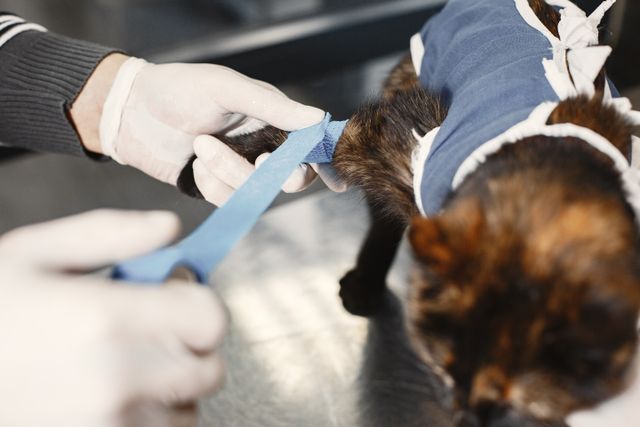
A Blue Cross vet demonstrates how to apply a bandage to a pet, the one hands on skill in this guide that can matter on the way to the clinic when a wound is bleeding. It is a general pet demonstration and a hold until the vet measure, never a substitute for the journey.
Watch on YouTube Blue Cross Pet Advice, presented by a Blue Cross vet
Feline first aid has one job: keep your cat safe and stable on the way to the vet, never home treatment. Phone first, always. The kit is modest: dressings, saline, a towel, the carrier ready as a drill, and the practice’s numbers where panic can find them. What never goes in matters more: no human painkillers, no antiseptics meant for people, no improvised medicine. Audit expiry dates yearly and rehearse the carrier routine, because rehearsal beats memory on the bad day.
No: every common human painkiller is dangerous or lethal to cats, and masking pain also hides information the vet needs. Warmth, quiet, and speed are the pain relief you can provide.
A torn claw tip usually yields to a few minutes of gentle pressure with a clean dressing and then a booked appointment; bleeding that will not slow, or a claw torn deep at the base, upgrades to same day.
A towel does both jobs better for most owners: safe restraint without a struggle over unfamiliar equipment. Frightened, hurt cats bite; wrapping beats wrestling every time.
Cool the area promptly with lukewarm to cool running water, never ice or creams, then travel; burns are deceptive and always vet checked. Kitchen scalds are a genuine cat hazard worth preventing at source.
Yes: keep the Animal PoisonLine number in the kit and your phone alongside your vet’s, and when in any doubt phone while travelling. Never induce vomiting at home; several poisons do double damage coming back up.
Sterile saline for flushing eyes and wounds, sterile dressings and a self adhesive bandage that sticks to itself rather than fur, blunt ended scissors and tweezers, a tick removal tool, disposable gloves, a digital thermometer, a foil blanket for warmth and shock, cotton pads, a small torch, and a soft towel, which doubles as the world’s best cat restraint when wrapped gently burrito style. Add your paperwork: vet details, insurance policy number, and your cat’s microchip number written where panic can find them.
Human medicines, all of them, per the iron rule in our health basics guide: no painkillers, no antiseptic creams meant for people, nothing dosed by guesswork, because the common human remedies are poisons in feline biochemistry. Antiseptics for the kit should be pet safe products chosen with your vet’s advice. When in doubt, plain saline and a clean dressing beat every clever idea.
Bleeding gets firm, direct pressure with a dressing and a calm voice. Suspected broken anything gets minimal handling, the towel wrap and a rigid carrier. Poisoning gets the packaging in your hand and the Animal PoisonLine, 01202 509000, or your vet on the phone before anything else, and never induce vomiting on your own initiative. Burns get cool running water, overheating gets the cooling steps from our summer guide, and everything above ends the same way: at the vet, promptly, with them warned you are coming.
First, numbers saved today: your vet, their out of hours line, and the PoisonLine, per health basics. Second, a carrier that lives accessible and familiar, not buried in the loft, as our travelling guide preaches. Third, hands on knowledge of your own cat, the weekly fuss that teaches you their normal, because first aid begins with noticing, and noticing is a skill you practise on the good days.
For further reading, the PDSA runs a free vet written first aid library, and Cats Protection publishes practical emergency guidance for cat owners.