
Do Ragdolls Like Water? Taps, Baths, Swimming and Panting
Why the breed hangs around taps and baths, whether it can swim, and the one water sign that needs a vet.
Last reviewed
Do Ragdolls like water? A surprising number do, for a cat. Many Ragdolls will sit on the edge of the sink to watch a dripping tap, paddle a paw in the water bowl and supervise the shower from the bathmat. It is curiosity and the breed's confident temperament at work rather than any love of swimming, and it varies cat by cat. This guide covers what that interest looks like, whether Ragdolls can swim, how to bath one when you have to, and why a Ragdoll that pants needs attention.
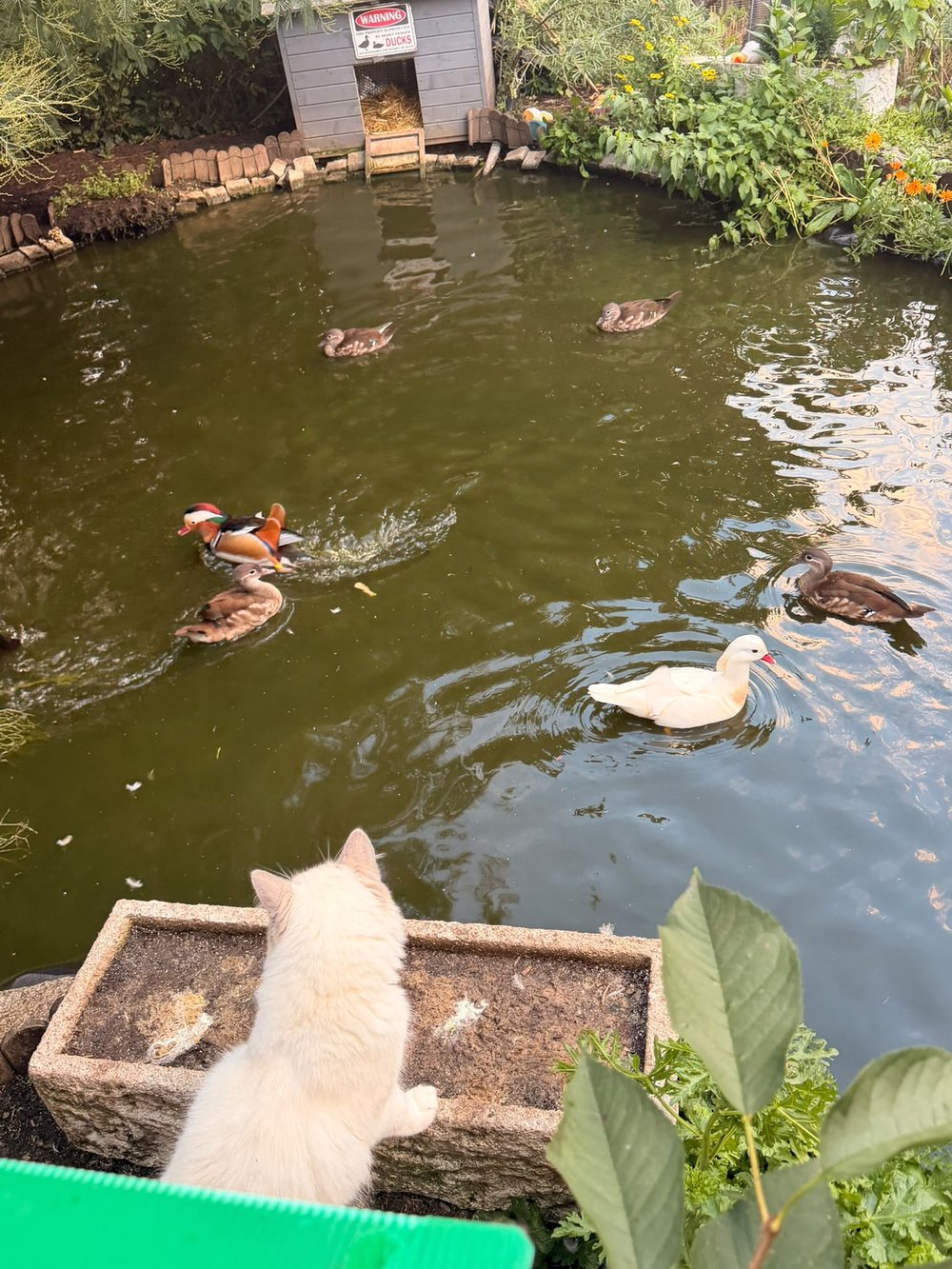
The colony watches the ducks from the dry side. Interest in water and a wish to be in it are different things.
Do Ragdolls like water?
Many do, in the sense that they find it interesting. Cats as a group are wary of getting wet, and most moggies treat a running tap as something to avoid. Ragdolls are different for two reasons. The first is curiosity: a Ragdoll wants to know what is going on, and water that moves, drips or sparkles is going on. The second is temperament. The breed was selected for a confident, unflappable nature, so a Ragdoll that gets a wet paw tends to inspect it with mild interest rather than bolting across the kitchen. Together they make a cat that will watch a tap for twenty minutes.
It is not universal. Water interest varies cat by cat, and in a house of sixteen we have the full range, from the ones who want to see what you are doing at the sink to the ones who leave the room when the shower starts. Liking to watch water is also not the same as liking to be in it, which matters below. If your Ragdoll shows no interest in water at all, nothing is wrong with it. It is simply being a cat.
What a water loving Ragdoll actually does
The classic behaviours:
- The dripping tap. A Ragdoll sits in the sink or on the edge of it and watches each drop form and fall, and some learn to pat the tap in the hope of starting it. Kittens discovering the drip of a tap for the first time is one of the quieter pleasures of a litter.
- The empty bath. The moment someone climbs out, a Ragdoll climbs in to inspect the puddles, lick the side and sit in the last warm centimetre of water.
- The water bowl. Paddling a paw in the bowl before drinking is common. Some are checking the depth, some are making the surface move so they can see it, and some are just tipping it over.
- The shower. Watching from the bathmat, or from inside the cubicle door, with an expression of deep concern for your welfare.
None of this needs managing beyond a towel by the bath and a mat under the water bowls; ours live on one for exactly that reason. The one thing to avoid is leaving a bath or sink full and unattended, which brings us to swimming.
Can Ragdolls swim?
A Ragdoll can swim a short distance, as almost any cat can when it has to, but Ragdolls are not a swimming breed. The problem is the coat. A heavy semi longhaired coat soaks up water fast and gets heavy, so a cat that falls into deep water is dragged down by its own fur within a minute or two. It tires, it panics, and if it cannot find a shallow edge or something to climb it can drown. A Ragdoll's calm nature is no help here, because a cat that is slow to panic is also slow to get out.
So the rule is simple: garden ponds, full baths, water butts, paddling pools and swimming pools are a drowning risk, and no cat should be left near open deep water unsupervised. Ponds should be made safe with a cover, a mesh or a fence, and a ramp or shallow shelf gives any animal that does fall in a way out. Water butts need lids. Baths get emptied. Walk round any garden or catio looking for anything a kitten could fall into; kitten proofing has the rest of the list. Our own colony watches the ducks from the dry side, and that is where we intend to keep them.
Do Ragdolls like baths? How to bath one
Most Ragdolls tolerate a bath rather than enjoy it, and the good news is that they rarely need one. The coat sheds dirt well and a healthy cat keeps itself clean, so bathing is for the real exceptions: something sticky or toxic on the coat, a medicated shampoo your vet has prescribed, or an old or ill cat that has stopped grooming. Routine coat care is combing, which Ragdoll grooming covers.
When a bath is needed:
- Use lukewarm water a few centimetres deep, with a non slip mat in the bottom so the cat has grip.
- Use a shampoo made for cats. Human and dog products are the wrong pH and some are toxic to cats.
- Wash from the neck back. Keep water out of the ears and eyes and wipe the face with a damp cloth instead.
- Rinse thoroughly, because leftover shampoo itches.
- Towel dry, then keep the cat somewhere warm and draught free until the coat is fully dry. A wet Ragdoll loses heat quickly.
Go slowly the first time: a damp cloth over the coat, a treat, a paw in a shallow tray, a treat, and build from there. A kitten that grows up with a calm bath or two tends to tolerate it later, so a quiet practice run early beats a crisis run at three years old.
Fountains, bowls and getting a Ragdoll to drink
The useful side of all this interest is that it can be turned into drinking. Cats are poor drinkers by design, having evolved to get most of their water from prey, and a cat on dry food often runs mildly short. Low intake is one of the things behind urinary problems, which are common in big, calm, indoor cats, and dehydration creeps up on older cats in particular.
A water fountain helps because moving water is more interesting and tastes fresher, and a Ragdoll that already stares at taps is the ideal customer. Ours is in constant use, alongside the plain bowls around the house. Other tricks: several bowls in different rooms, wide bowls that do not touch the whiskers, water well away from food and litter trays, and wet food, which carries far more water than kibble. Change the filter and wash the fountain weekly, because a slimy fountain puts cats off faster than a dry bowl.
One caution: a cat that suddenly drinks a great deal more needs a vet, not congratulations, since it can signal kidney, thyroid or diabetic trouble.
Why do Ragdolls pant?
Cats rarely pant, and that is the whole point of this section. Dogs pant to cool down as a matter of routine; a cat does it only when it is very hot, very stressed or struggling to breathe. A Ragdoll that pants for a minute after a wild play session on a warm day, then settles and breathes normally with its mouth closed, is probably just hot under a lot of fur. Summer heat explains how to keep the house cool enough that it does not happen again.
Panting at rest is different. Open mouth breathing in a cat that has not been exercising, panting after a car journey that does not stop, breathing with the belly heaving or the neck stretched out, or gums that look pale, grey or blue instead of pink, all need a vet the same day. The possible causes include asthma, heart disease, which matters in a breed with HCM in its history, fluid on the chest, heatstroke and severe pain. Ragdolls hide discomfort well, so recognising pain is worth reading too. The short version: a cat breathing through its mouth is telling you something, and it is never that it likes water.
Quick questions, answered
Do Ragdoll cats like water?
Many are more interested in water than the average cat: dripping taps, the empty bath, the water bowl and the shower all get an audience. It is curiosity and a confident temperament rather than a wish to swim, and it varies cat by cat. A Ragdoll with no interest in water at all is perfectly normal.
Can Ragdolls swim?
A Ragdoll can swim a short distance if it falls in, but the heavy semi longhaired coat waterlogs fast, so it tires and panics quickly. Ragdolls are not a swimming breed. Treat ponds, full baths, water butts and pools as a drowning risk, make them safe, and never leave a cat near open deep water unsupervised.
Do Ragdolls like baths, and how often should you bath one?
Most tolerate rather than enjoy a bath, and they rarely need one, because the coat sheds dirt and a healthy cat grooms itself. Bath only when something is on the coat or your vet advises it: lukewarm water, a cat shampoo, a non slip mat, water kept out of the ears and eyes, then towel dry and keep warm.
Why does my Ragdoll pant?
Cats rarely pant. A minute of panting after hard play on a hot day, followed by normal closed mouth breathing, is usually just heat under a thick coat. Panting at rest, open mouth breathing, heaving breaths or pale, grey or blue gums need a vet the same day, because the causes include asthma, heart disease and heatstroke.
Sources and further reading
- International Cat Care: Advice on encouraging cats to drink and on handling cats calmly for grooming.
- PDSA: UK charity guidance on heatstroke, breathing difficulties and when to call a vet.
Thinking about a Ragdoll kitten?
Our Ragdoll and Ragcoon kittens grow up in our home in Ryde, Isle of Wight, with health tested parents and our support for life. See who is available now, or join the waiting list for the next litter.