
Why Is My Ragdoll Not Cuddly? Cats That Dislike Being Held
The breed is famous for it. Your cat has not read the breed profile.
Last reviewed
Why is my Ragdoll not cuddly? Usually because it is young, because it is an individual, or because of how it is being asked. The breed's reputation for flopping into any pair of arms is earned, but it describes a tendency, not a guarantee, and it sets up a lot of new owners to feel they have been sold the wrong cat. They have not. Many cats of every breed dislike being lifted, and a Ragdoll that sits beside you with one paw on your leg is showing the same attachment as one draped over your shoulder. Here is why some hold back, and how to earn more without spoiling what you already have.
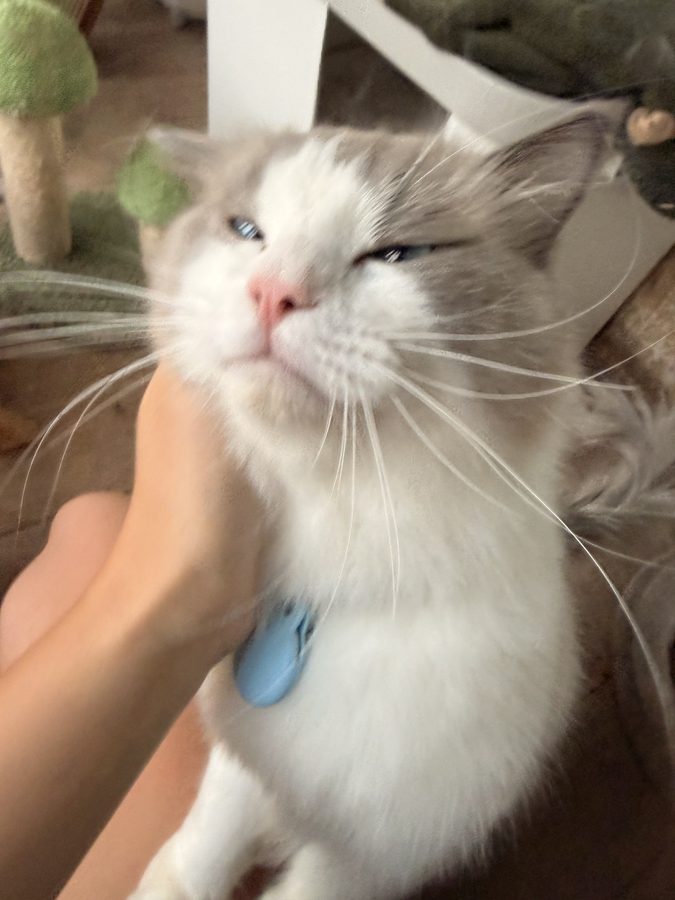
Aqua, our stud, on his own terms: chin, cheeks, and the choice to walk away.
Is it normal for a Ragdoll not to be cuddly?
Yes. Within one litter you will find a kitten that climbs into every lap and a kitten that prefers to sit near you and watch. Both are normal Ragdolls. Some are lap cats at eight weeks, some take two years, and a few will always prefer beside you to on you.
It also helps to separate three things that get lumped together as cuddly:
- Being near you. Following, settling in the same room, sleeping against your leg. Nearly every Ragdoll does this.
- Being stroked. Most enjoy it, in the right places and for as long as they choose.
- Being picked up and held. The one the breed is famous for, and the one cats in general like least. Cats Protection puts it plainly: many cats do not like being picked up, because they feel safest with all four paws on the ground.
A Ragdoll that scores two out of three is an affectionate cat. Why Ragdolls go limp explains where the famous flop comes from, and why it is not universal.
Why some Ragdolls do not like being held
- Age. A kitten has too much to do. Play comes first for most of the first year, and the sofa years arrive later. Many owners find the lap cat appears at two or three, when the breed finally slows down.
- Early handling. Kittens learn that hands are safe by being handled gently and often in their first weeks. A kitten that saw few hands, or rough ones, takes longer to trust them.
- How it is being held. A dangling back end is the commonest reason a cat stiffens and wriggles. So is being held too long, too tightly, or belly up when the cat did not choose it.
- How it is being asked. Being scooped up from behind, woken from sleep or pursued across the room teaches a cat to keep out of reach.
- The house. Noise, visitors, a boisterous dog or small children who grab all make a cat keep its options open.
- History. A rehomed or retired cat may never have been a lap cat, and may need months to settle.
- Pain. A cat that hurts does not want to be lifted. If the change is new, treat it as a symptom: see the section on the vet below.
- Personality. Some cats are simply more reserved, and nothing has gone wrong.
The affection you might be missing
Cats show attachment quietly, and a reserved Ragdoll is usually doing most of this already:
- Following you from room to room and settling where you can be seen.
- Greeting you at the door with the tail straight up.
- Slow blinking at you across the room.
- Bumping a head or cheek against your hand, leg or face.
- Sleeping near you, or on the bed, with its back to you.
- Kneading a blanket next to you, or you.
- Rolling over to show the belly, which is trust and not always an invitation to touch it.
Reading cat body language and why cats knead decode these properly. Once you can see them, a cat that will not sit on your lap stops looking like a cat that does not like you.
How to help a Ragdoll become more cuddly
The method that works is the opposite of picking the cat up more. Researchers at Nottingham Trent University, working with Battersea, tested a simple set of rules on 100 cats and found that people who followed them were hissed at and swiped at far less, and rubbed against and sought out far more. The rules spell CAT.
- C: choice and control. Offer a hand and let the cat decide. If it comes, carry on. If it does not, leave it.
- A: attention. Watch the cat while you stroke it. A turned head, flattened ears, a swishing tail, a ripple down the back or sudden grooming all mean stop.
- T: touch. Most cats prefer the cheeks, the chin and the base of the ears. The belly and the base of the tail are the places to avoid, and the back is somewhere in between.
Around those rules, build the habit:
- Sit down and be boring. On the floor or the sofa, with a book. Cats approach still people.
- Make the lap worth it. A soft blanket kept for the purpose, a warm room, and a treat or a chin rub when the cat arrives.
- Keep it short. End the stroking before the cat does. A cat that always leaves wanting more comes back sooner.
- Let it leave. Never hold on. A cat that knows it can go will stay longer.
- Play first. A cat that has just chased a wand toy and eaten is in the mood to settle.
- Be the same every day. Affection grows from routine, not from one long session at the weekend.
Expect weeks, not days, and measure progress in small things: a cat that sits closer, stays longer, or climbs up once unasked.
Picking up a Ragdoll that does not like it
Every cat has to be lifted sometimes, for the carrier, the vet or the claws, so it is worth teaching even a cat that will never enjoy it. Cats Protection's method is a good one to follow:
- Approach from the front, slowly, at the cat's level. Never corner it.
- Offer a still hand and wait for the cat to come to it.
- Stroke the cheeks or chin and check the cat stays relaxed.
- Slide one hand under the chest and the other behind the back legs, and lift in one smooth movement.
- Bring the cat against your chest with the back end supported. No dangling legs.
- Hold for a minute or two at most, then lower it until all four paws are on the floor before you let go.
Put the cat down the moment it wriggles, stiffens or growls, and never lift by the scruff. With a big Ragdoll, support matters more, not less: a 7 kg cat hanging from the armpits is uncomfortable and will tell you so. Pair every lift with something good and keep the early ones to a few seconds. Children should stroke rather than carry until they can do all of this reliably: preparing children for a kitten has the house rules.
When to see the vet
A cat that has never been cuddly is a character. A cat that used to be and has stopped is telling you something. Book a check if your Ragdoll:
- Suddenly dislikes being touched or lifted, or flinches, growls or bites when a particular place is handled.
- Has started hiding, sleeping more or keeping away from the family.
- Is jumping less, moving stiffly or grooming less, alongside the change in mood.
- Has become much more clingy than usual. That can be a sign of illness too.
Dental pain, arthritis, tummy trouble and urinary problems can all be behind it, and cats hide every one of them well. Recognising pain in cats lists the quiet signs.
Quick questions, answered
Are Ragdolls cuddly?
Most are, on their own terms. Nearly all want to be near their people, most enjoy being stroked, and a good many like being picked up. A few prefer to sit beside you. All of that is normal for the breed.
Why does my Ragdoll not like being picked up?
Many cats do not, because they feel safest with four paws on the ground. Common reasons are youth, being lifted without warning, a back end left dangling, or being held for too long. A sudden new dislike can mean pain and is worth a vet check.
Will my Ragdoll kitten get more affectionate with age?
Very often. Kittens put play first. As the breed slows down at two to three years old, many Ragdolls become far more interested in laps.
Are male or female Ragdolls more cuddly?
The individual matters much more than the sex. Averages are quoted both ways, and the kitten in front of you is a better guide than any of them.
Why does my Ragdoll only cuddle one person?
Cats often attach most closely to the person who feeds them, plays with them and handles them the way they like. Others in the house can build the same bond by taking over some of the feeding and play and by letting the cat choose when to approach.
My Ragdoll used to be cuddly and has stopped. Why?
A change in an adult cat is a reason to see the vet. Pain from teeth, joints or the bladder is a common cause. Upheaval at home, such as a move, a new pet or a new baby, can do it too.
Sources and further reading
- Cats Protection: How to pick up a cat: Why many cats dislike being lifted, how to tell if a cat wants it, and the safe way to do it.
- Nottingham Trent University and Battersea: letting cats decide when to be petted (2021): Report of the study behind the choice, attention and touch guidelines, published in Frontiers in Veterinary Science.
Thinking about a Ragdoll kitten?
Our Ragdoll kittens grow up in our home in Ryde, Isle of Wight, with health tested parents and our support for life. See who is available now, or join the waiting list for the next litter.