
Cats and Dementia: Company, Calm and What Is Known
For people living with dementia, their families and carers, and for care settings: what the evidence says, what the charities advise, how to keep a cat safely, and where the breed and our colony fit in.
Last reviewed
Around 982,000 people in the UK are living with dementia, and some of them live with a cat. The questions people ask us are whether the cat should stay, whether a new one would help, and whether a care home will take it. The research is clear about one thing: almost all of it is about dogs, and the best reviews find at most a small reduction in low mood from animal visits, with no proven effect on agitation or memory. What is better established is the practical side: Alzheimer's Society says animals can be a wonderful source of love and laughter for people with dementia, as long as the person understands the commitment and the animal's welfare is thought through, and there are schemes built to help: the Cinnamon Trust with day to day care, and Cats Protection's Cat Guardians with the cat's future. A calm, quiet, indoor cat that stays close and forgives a missed meal is the kind that suits, and a well raised Ragdoll is often that cat, though no breeder can promise an individual. This guide sets out what is known, what is not, how to keep a cat safely, and how we help.
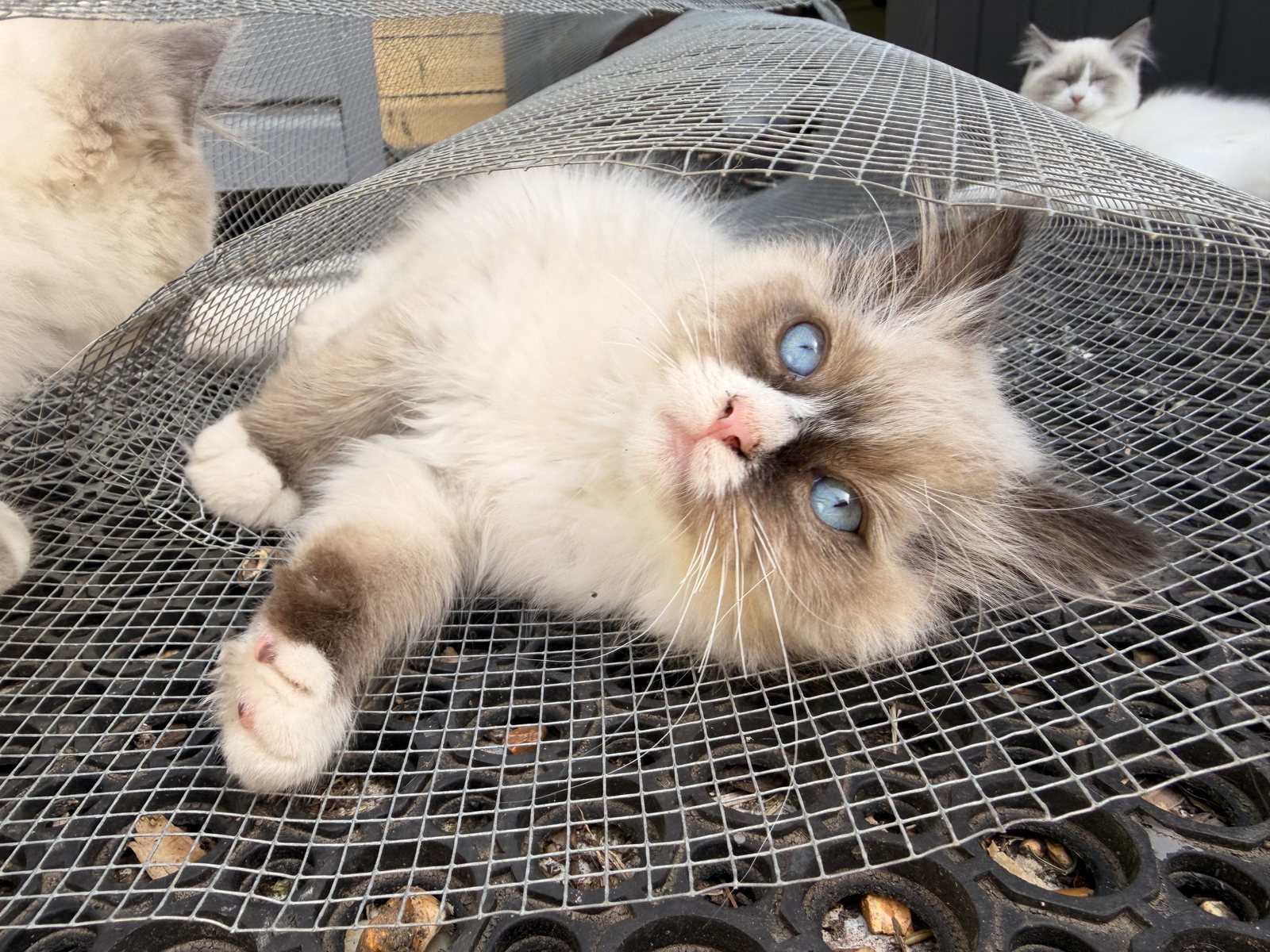
A colony kitten at ease: a Ragdoll is content to be close and quiet, which suits a quieter household.
The short version
- Nearly all the research is on dogs, and the honest reading is modest. The Cochrane review of nine trials found low certainty evidence that animal visits may slightly reduce depressive symptoms, and could not show an effect on agitation, quality of life or daily living. A broader review of 32 studies found social interaction rose in 11 of 12 and agitation fell in 9 of 15, but with weaker designs.
- There is no trial of live cats and dementia. The cat evidence is a toy cat used as a comparison, and robotic cats: a UK care home trial of robot pets found neuropsychiatric symptoms fell and 85% of residents who used them were rated by staff as benefiting.
- The charities are supportive and practical. Alzheimer's Society says animals can bring love and laughter, that many people with dementia keep a pet with support, that capacity and the animal's welfare must be considered, and that a robotic or soft toy pet suits some people better.
- Keeping an existing cat is often the right answer. Tie feeding to routines, use reminders, bring in help as the condition progresses, plan for the cat's future, keep claws trimmed, and watch for falls: cats account for about one pet related fall injury in eight, highest in people over 75.
- A new kitten is a bigger decision. A kitten is boisterous for a year or two and needs fifteen years of care. For a person in the early stages with a carer at home it can work well; for someone living alone with memory loss it usually should not be a kitten.
- Care homes: ask early for the written pet policy. The Cinnamon Trust keeps a register of homes that consider residents with pets, and Pets As Therapy assesses visiting cats.
Contents
- Dementia, and the words we use
- Why a cat can help, and what it cannot do
- Keeping the cat a person already has
- A new cat: when it suits and when it does not
- Why the Ragdoll suits
- Why colony raised: a kitten that is already settled
- Care homes and visiting cats
- What the research shows, and where it stops
- How we approach it
- Questions people ask and sources
Dementia, and the words we use
The NHS describes dementia as a group of related symptoms associated with an ongoing decline of brain functioning, affecting more than 944,000 people in the UK and one in eleven people over 65, with Alzheimer's disease and vascular dementia the main types (NHS: what is dementia). Alzheimer's Society's estimate is 982,000 people, more than a third without a diagnosis, rising to 1.4 million by 2040 (Alzheimer's Society).
On language we follow Dementia Words Matter, written by twenty people living with dementia: a person with dementia, or living with dementia, never a sufferer or a victim, and ask the person how they would like to be described (DEEP guidelines). We write about the cat the same way: as a companion and a member of the household, not an intervention.
Why a cat can help, and what it cannot do
Alzheimer's Society's position is the best starting point. Its advice is that animals can be a wonderful source of love and laughter for people with dementia, that pets give companionship, purpose and activity, and that many people with dementia continue to keep a pet, though they may begin to need support with feeding and other care as the condition progresses. It adds two conditions: the person needs to understand the commitment involved, and the welfare of the animal must be considered (Alzheimer's Society: can caring for a pet help; activity ideas).
What a cat offers
- Company without conversation. A cat does not mind a question asked twice or a word that will not come. It sits on the lap and purrs, and the relationship does not depend on memory.
- Routine and purpose. Feeding the cat at the same time each day is a task many people keep doing for a long time, with support as needed, and Alzheimer's Society suggests tying it to existing routines, with notes and phone reminders (planning your pet's care).
- Touch and calm. Ten minutes stroking a cat or dog lowered the stress hormone cortisol in a randomised trial of university students, not people with dementia (Pendry and Vandagriff, 2019), and in one of the Cochrane trials the live animal drew about three times as much physical contact as a robot.
- Something to talk about. Alzheimer's Society reports carers describing people opening up or having a conversation for the first time in weeks or months with a visiting animal (Alzheimer's Society and Pets As Therapy). Dogs, mostly; nobody has tested whether a cat draws the same response, though there is no obvious reason it would not.
What it cannot do
A cat does not treat dementia or slow it. The Cochrane review of nine randomised trials, 305 people, found low certainty evidence that animal assisted therapy may slightly reduce depressive symptoms and could not show any effect on agitation, quality of life, social functioning or daily living; eight of the nine trials used dogs (Lai and colleagues, 2019). A review of ten dog studies reached the same conclusion with very low certainty throughout (Zafra Tanaka and colleagues, 2019). A cat makes a day gentler; it does not change the course of the condition, and it is never a reason to delay a diagnosis, a care assessment or the support a person needs.
Keeping the cat a person already has
For most families the question is not a new cat but the old one. Alzheimer's Society says the idea of not being able to care for a pet can be scary, and that with planning and help a pet can stay safe and well (Alzheimer's Society). The things that make it work:
- Feeding that does not depend on memory. An automatic feeder set for breakfast and dinner means the cat is fed whether or not the person remembers, and reduces the double feeding that follows a forgotten meal. Food on subscription means it never runs out.
- Reminders and notes. A whiteboard by the kettle for the tray and the water, a phone alarm for flea and worm treatment, and the vet's dates in a family member's diary as well as the person's.
- Help that scales. A family member or neighbour checking the tray twice a week, then daily. The Cinnamon Trust's volunteers help older people with day to day pet care and can foster a pet during a hospital stay (Cinnamon Trust).
- Watch the cat. Alzheimer's Society says to watch for a change in the pet's behaviour or appearance. In a cat that means weight loss, a dirty or matted coat, or toileting outside the tray, and those tell you the care has slipped before anyone says so.
- Claws, scratches and tablets. Keep the cat's claws trimmed; a groomer or vet nurse can do it. If a scratch breaks the skin, wash it well and keep an eye on it. If a bite breaks the skin, wash it and see a GP or call 111 the same day, because cat bites often become infected, and go sooner if the person takes blood thinners, has diabetes or has a weakened immune system. Keep the cat's flea and worm treatments in a different place from the person's own tablets and give them yourself, and have someone else clean the tray if the person is unwell or their immune system is weakened.
- Doors and windows. An indoor Ragdoll is trusting and has no road sense, so a door or window left open is the risk to plan for: a microchip, a collar tag, a closed porch or a cat proof garden, and a neighbour who knows the cat.
- Falls. The main physical risk. American emergency data counted about 86,600 pet related fall injuries a year, about 11.7% involving cats, with the highest rates in people over 75 and two thirds of cat related falls from tripping over the cat (Stevens, Teh and Haileyesus, 2009). Feed the cat in one fixed place away from where the person walks, keep the floor clear, keep a light on at night, and prefer a calm cat to a kitten.
- Plan for the cat's future. Cats Protection's Cat Guardians will take and rehome a registered cat after its owner's death, free (Cat Guardians); the Cinnamon Trust offers lifelong care for pets whose owners can no longer look after them; and a named family member who already knows the cat is the simplest plan of all.
If a move into care happens, the cat going with the person is sometimes possible; see care homes below.
A new cat: when it suits and when it does not
We are asked this by families more often than by the person themselves, and we answer it carefully, because it has to be right for the person and for the cat.
When it can work
- The person is in the early stages, wants a cat, and understands what it involves.
- Someone else in the house, a partner or an adult child, owns the cat's care in the end and is there most days.
- The house is stable: no imminent move into care.
- A calm cat is chosen, not a boisterous kitten, or at least the quietest kitten in a litter with a carer to see it through the first year.
When it does not
- The person lives alone with significant memory loss. A kitten cannot be the one thing that keeps them company if nobody is there to keep the kitten safe.
- The cat would be chosen for the person rather than with them. Alzheimer's Society notes that fear of animals, allergies and cultural attitudes all matter, and that some people with dementia respond better to a lifelike robotic animal or a soft toy, which it suggests trying first (Alzheimer's Society).
- Nobody has planned who takes the cat when the person can no longer have it.
Alzheimer's Society also notes that some breeders and rescues hesitate to home an animal with a person with dementia. We do not refuse on diagnosis alone. We ask the questions above, we talk to the person first wherever that is possible, we welcome someone close to them joining the conversation if the person is happy with that, and we are frank if we think a kitten is the wrong answer. Whether a cat is right is the person's decision with their family and, where there is one, their care team. A retired adult from our colony, when one is available, is sometimes the right one.
Why the Ragdoll suits
If a cat is right, the kind of cat matters. The qualities that help a person with dementia are the ones that help any quieter household, and the Ragdoll has most of them.
What the breed bodies say
The GCCF describes the Ragdoll as having an easy, laid back temperament and in general loving interaction with people and other animals, and notes that how a kitten is raised, with frequent loving handling and play, contributes enormously to its socialisation (GCCF Ragdoll profile). TICA calls the Ragdoll a loving, quiet cat with a laid back disposition, and warns that if you want a very active or talkative cat the Ragdoll is probably not for you (TICA breed page).
What the studies say
Two veterinary scientists at UC Davis asked 80 feline practitioners to rank 15 pedigree breeds on 12 behaviours. The Ragdoll came out most affectionate, most socially outgoing and least aggressive to cats and people (Hart and Hart, 2013). A Finnish owner survey of 5,726 cats placed the Ragdoll among the least active breeds, in a group of breeds that were the least fearful and least aggressive, with aggression and shyness both moderately heritable, which is why choosing calm parents matters so much (Salonen and colleagues, 2019).
Why those traits suit
- Slow to startle, slow to bite. Anyone can sometimes handle a cat less carefully than it would like, and dementia can make that more likely. A tolerant cat is more forgiving of that; a nervous one is not, and a scratch matters more for someone whose skin tears easily or who takes blood thinners.
- Stays close. The breed settles on and beside its person, which is the comfort a cat is there to give.
- Quiet and low energy. Less night time noise, less racing round the furniture, and less chance of a cat underfoot.
- Suited to indoor life. A Ragdoll is content indoors and does not need to roam, which removes one daily task; the open door is the risk to plan for, as above (indoor cats guide).
- The trade off. A long coat needs combing a few times a week, which has to be someone's job, and a Ragdoll is a large cat to lift. Our older people guide covers lifting, feeding stations and grooming help.
Being honest about the limits
Breed averages describe populations, and every Ragdoll is an individual. Some are vocal, some are busy, some dislike being picked up. A Ragdoll kitten is still a kitten, with teeth, claws and zoomies, and the settled adult temperament takes two to three years to arrive. The coat needs combing a few times a week and the breed has an inherited heart condition to screen for; our pros and cons guide is the fair version. Nobody can promise you a calm cat. What a good breeder can offer is a kitten from calm parents, raised to be confident, whose individual personality you have met.
Why colony raised: a kitten that is already settled
Breed sets the ceiling; the first weeks of life decide how much of it a kitten reaches. A Ragdoll raised quietly by one queen in a spare room and a Ragdoll raised underfoot in a house of sixteen adult cats, chickens, a peacock, a hoover and a family will grow into different cats, and the science on why is consistent. Where someone is living with dementia, the kitten needs to be calm, confident and forgiving from the day it arrives, because the household may not have the time or energy to train one.
The sensitive period
Kittens have a window for learning what is safe, roughly two to seven weeks of age (International Cat Care; Cats Protection). What a kitten meets calmly in that window it tends to accept for life; what it never meets, it may fear. Handling by several different people, including men, women and children, produces more sociable adult cats than handling by one person.
Handling, parents and the mother's example
In a study that followed kittens to a year old, those handled regularly from two to twelve weeks were quicker to approach, touch and rub against people and were less distressed when approached and handled by strangers; boldness toward new things followed the father (McCune, 1995). Friendliness to people has been linked to the father in two separate colonies (Turner and colleagues, 1986), and how a cat reacts to being held by a stranger is a stable trait from four months onward (Lowe and Bradshaw, 2002). Kittens also learn by watching their mother, and International Cat Care notes that a poorly socialised mother holds back her kittens' socialisation.
Weaning and leaving
The large Finnish survey found that cats weaned before eight weeks showed more aggression and repetitive behaviour as adults, and the researchers suggested keeping kittens with their mother to at least fourteen weeks (Ahola, Vapalahti and Lohi, 2017). No kitten leaves us before nine weeks, weaned by its mother rather than by a timetable, and our reasoning on nine to ten weeks, and why it differs from that and from the usual guidance, is set out on our story page.
Why colony raised is different
A conventional set up is one queen and her litter, kept apart from other cats in a quiet room, with handling that depends on who has time. Ours is a domesticated colony of sixteen adult Ragdolls living in the house, and kittens are born into it. In practice that means:
- Many calm adults to learn from, not one. Kittens grow up inside a group with a settled social order, copying the unbothered way a dozen adults react to the doorbell, the hoover and visitors.
- Parents chosen for temperament. We breed from cats we live with every day, so we know which lines are bold, which are gentle and which are busy, and we keep only the calm, people loving ones in the programme. Because shyness and aggression are heritable, this matters.
- Daily handling by the whole household from birth: adults, children and visitors, with brushing, paw and ear checks and carrying built into the routine. Our kittens meet ducks, chickens, a peacock, guinea pigs, parrots, the washing machine and the general bustle of a working family home before the fear window closes.
- Underfoot, not in a spare room. They are raised in the kitchen and living room, which is where they will live with you.
No study has compared colony rearing with conventional rearing head to head, and we would rather say so than pretend. What the research does show is which ingredients make a confident, settled, people loving cat: several handlers, calm parents, adults to learn from and a long time with the mother. A colony delivers every one of them every day, as the way the house works rather than a programme someone has to remember to run. We think that is why our kittens tend to settle quickly and take handling in their stride, and why a colony raised kitten is the one we would choose for a quieter household.
Care homes and visiting cats
Taking a cat into care
Alzheimer's Society's advice is to check a care home's pet rules well in advance. The Society for Companion Animal Studies says care home pet policies vary widely from home to home and are not always applied consistently, and advises starting early, asking for the written policy, and asking whether staff will help with daily care; it provides risk assessment toolkits for care homes willing to try (SCAS: pets and housing). The Cinnamon Trust keeps a register of care homes and retirement housing in England, Scotland and Wales that will consider residents with pets, and visits each home every two years (pet friendly care home register).
Resident and visiting cats
Alzheimer's Society mentions a resident cat in a care home as one way people keep contact with animals (Alzheimer's Society). Pets As Therapy assesses cats as well as dogs for visiting: the cat must be at least a year old, settled with its owner for nine months, love attention from strangers in new places, be comfortable on a short lead, vaccinated and not raw fed, and is checked by an assessor (Pets As Therapy: volunteer with your cat). Some Ragdolls would pass; many cats of any breed would not, and should not be asked to.
A fair word on robotic cats
For people in the later stages, or in settings that cannot take a live animal, the robotic cats have encouraging evidence from one UK trial, rated by staff who knew which homes had the robots. Across eight Cornish care homes, residents given Joy for All robot cats and dogs showed a fall in neuropsychiatric symptoms where the control group's rose, the demands on staff fell, and 85% of residents who used them were rated as benefiting; those who took to them tended to be people with more advanced dementia (Bradwell and colleagues, 2022). A study of 1,327 consumer reviews of the robot cat found three quarters describing a positive effect, and about one reviewer in seven said they bought it because a live animal was no longer possible (Koh and colleagues, 2022). A small qualitative study of robot cats in people's own homes found benefits where the cat was accepted, and some people who did not accept it (Pike, Picking and Cunningham, 2020). We breed cats, so take this as it is meant: for some people a robot cat is the right answer, and Alzheimer's Society says so too.
What the research shows, and where it stops
Animals and dementia
- Cochrane, 9 randomised trials, 305 people: depressive symptoms may be slightly reduced (low certainty); no clear effect on quality of life (moderate certainty), agitation, behaviour, social functioning or daily living (low or very low); 8 trials used dogs, 1 horses; no adverse event or animal welfare data (Lai 2019; full text).
- Dog assisted therapy, 10 studies: no significant effect on daily living, depression, agitation, quality of life or cognition; a possible apathy benefit in one small study; very low certainty (Zafra Tanaka 2019).
- Animals and robots pooled, 9 trials, 507 people: a significant reduction in depression, no significant effect on agitation or quality of life (Park and colleagues, 2020).
- Broader review, 32 studies: agitation fell in 9 of 15, social interaction rose in 11 of 12, quality of life rose in 3 of 4; 27 of 32 used dogs; mixed designs (Yakimicki and colleagues, 2019).
Cats specifically
- No controlled study of live cats. In the one trial with a cat element, 100 Danish nursing home residents were visited by a dog, a robot seal or a soft toy cat; the dog group slept longer at three weeks, and nothing else differed (Thodberg and colleagues, 2016).
- Robot cats: the Cornish cluster trial and consumer review study above; a small qualitative study at home (Pike 2020).
- General cat evidence: stroking lowered cortisol in a trial of students (Pendry 2019); older pet owners less lonely, living alone without a pet loneliest (Stanley 2014).
Ragdolls specifically
- None. The case rests on the breed's temperament and how the kitten was raised.
In short: animals, mostly dogs, may slightly lift mood in dementia and reliably draw contact and conversation; nothing shows a change in the condition itself; nobody has studied live cats; and the practical case for keeping a person and their cat together rests on charity guidance and common sense rather than trials. We would rather tell you that than sell you a therapy cat.
How we approach it
If, after reading this, a Ragdoll seems right for you or for a person you care for, this is how it works with us.
- Tell us the situation. Who the cat is for, who will do the daily care, whether the person lives alone, and what stage things are at. Use the enquiry form or message us; we will be frank in return.
- Kitten or adult. We will tell you which kitten in a litter is the quiet one, and we will say plainly if we think a kitten is the wrong answer and a calmer adult, from us or a rescue, would suit better.
- Visit together. Alzheimer's Society suggests regular contact with an animal, or a robotic or soft toy pet, as something to try before committing to ownership. A visit to meet our cats, with no obligation, is one way for the person to find out whether they enjoy the company. We keep it short and quiet, one or two cats at a time in a calm room, and we can send video first if travel to the Island is hard.
- A gentle handover and support that continues. Collection at our home, a kitten pack with a blanket carrying the colony's scent, check ins at one week and one month, then support for life. If circumstances change and nobody can take the cat, we ask to be the first call.
Our current litters are on the kittens page, and the waiting list hears first about the next one. Alzheimer's Society's Dementia Support Line is 0333 150 3456 (Monday to Wednesday 9am to 8pm, Thursday and Friday 9am to 5pm, weekends 10am to 4pm) if you need advice about dementia itself.
Questions people ask
Can a person with dementia keep their cat?
Often yes, with planning. Alzheimer's Society says many people with dementia continue to keep a pet, with growing support for feeding and care as the condition progresses. An automatic feeder, reminders, a family member checking in, help from the Cinnamon Trust, attention to trip hazards and a plan for the cat's future, such as Cats Protection's free Cat Guardians scheme, are what make it work.
Do cats help people with dementia?
They can bring company, calm and purpose, and Alzheimer's Society describes animals as a wonderful source of love and laughter for people with dementia. The research is almost all on dogs and finds at most a small reduction in low mood from animal visits, with no proven effect on agitation or memory, and nobody has run a trial with live cats. A cat makes a day gentler; it does not treat or slow dementia.
Should I get a kitten for my parent with dementia?
Only if your parent wants one, is in the early stages, and someone else owns the cat's care and is there most days. A kitten is boisterous for a year or two and a commitment of fifteen years. For a person living alone with significant memory loss a kitten is usually the wrong answer; a calm adult cat with support, or for some people a robotic cat, suits better. We will say so if we think it.
Will a care home take a cat?
Some will. Ask early for the home's written pet policy and whether staff will help with daily care; the Society for Companion Animal Studies says policies vary widely. The Cinnamon Trust keeps a register of care homes and retirement housing in England, Scotland and Wales that consider residents with pets, and some homes have a resident cat or Pets As Therapy visits instead.
Are robotic cats any good?
Better than you might expect, for the right person. In a randomised trial across eight Cornish care homes, residents given robot cats and dogs showed a fall in neuropsychiatric symptoms, the demands on staff fell, and 85% of those who used them were rated by staff as benefiting; those who took to them tended to be people with more advanced dementia. Some people reject them outright. Alzheimer's Society suggests trying one, or a soft toy, before committing to a live animal.
Sources and further reading
- NHS: what is dementia: definition and the 944,000 figure
- Alzheimer's Society: how many people have dementia in the UK: 982,000 and the 2040 projection
- Alzheimer's Society: can caring for a pet help a person with dementia: love and laughter, capacity, welfare, robotic pets, care homes
- Alzheimer's Society: planning your pet's care after a diagnosis: routines, reminders and warning signs
- Alzheimer's Society: activity ideas, pets and other animals: many people with dementia continue to keep a pet
- Alzheimer's Society and Pets As Therapy partnership: people opening up to visiting animals
- DEEP: Dementia Words Matter: the language guidance this page follows
- Lai et al 2019, Cochrane review: animal assisted therapy for dementia: nine trials, 305 people; plain language summary
- Lai et al 2019, Cochrane review full text: the outcomes and certainty ratings
- Zafra Tanaka et al 2019, BMC Psychiatry: dog assisted therapy in dementia, ten studies
- Park et al 2020, Biomedicines: animals and pet robots pooled, nine trials
- Yakimicki et al 2019, Clinical Nursing Research: 32 studies, 27 with dogs
- Thodberg et al 2016, Psychogeriatrics: dog, robot seal and toy cat visits in Danish nursing homes
- Bradwell et al 2022, JMIR Aging: robot cats and dogs in eight Cornish care homes
- Koh et al 2022, JMIR Aging: 1,327 consumer reviews of the robot cat
- Pike, Picking and Cunningham 2020, Dementia: robot cats at home, five people
- The Cinnamon Trust: help with pet care and lifelong care for pets
- Cinnamon Trust: pet friendly care home register: homes that consider residents with pets
- Cats Protection: Cat Guardians: free rehoming after an owner's death
- Society for Companion Animal Studies: pets and housing: care home pet policies and toolkits
- Stevens, Teh and Haileyesus 2009, MMWR: pet related falls by age
- Pets As Therapy: volunteer with your cat: what a visiting cat must be
- Pendry and Vandagriff 2019, AERA Open: stroking and cortisol
- Stanley et al 2014, Aging and Mental Health: older pet owners and loneliness
- Salonen et al 2019, Scientific Reports: breed differences and heritability in 5,726 cats, including Ragdolls
- Hart and Hart 2013, Your Ideal Cat (UC Davis release): 80 feline vets rank 15 breeds; Ragdoll most affectionate, least aggressive
- GCCF and TICA Ragdoll breed profiles: the breed bodies on temperament; TICA at tica.org/breed/ragdoll
- McCune 1995, Applied Animal Behaviour Science: early handling and the father's influence on friendliness and boldness
- Ahola, Vapalahti and Lohi 2017 (University of Helsinki): weaning age and adult behaviour in the Finnish survey
- Cats Protection: kitten socialisation: the two to seven week window and what a kitten should meet
- Cats Protection: cat stress: reading stress signals in cats
- International Cat Care: stress in cats: causes, signs and prevention of stress
- PDSA: cat body language: posture, tail, ears and what purring does and does not mean
If and when the time is right
Our Ragdoll and Ragcoon kittens grow up in our home in Ryde, Isle of Wight, with health tested parents and our support for life. The waiting list is free to join and free to leave, and there is no rush.