
When Do Ragdoll Kittens Calm Down?
The famous calm is an adult trait, and it is earned.
Last reviewed
When do Ragdoll kittens calm down? Around two to three years old, give or take, and it follows the growth. Ragdolls are one of the slowest maturing breeds, so the kitten energy lasts longer than the breed's reputation for lying about might lead you to expect. A Ragdoll in its first two years is still a young cat: it climbs curtains, ambushes ankles and does laps of the landing at midnight. In our house the difference is plain. The adults spend the day in heaps on the sofa and the cat tree, and the rising girls, the youngest in the house, provide the evening entertainment. It does pass. Here is the timetable, and how to enjoy it while it lasts.
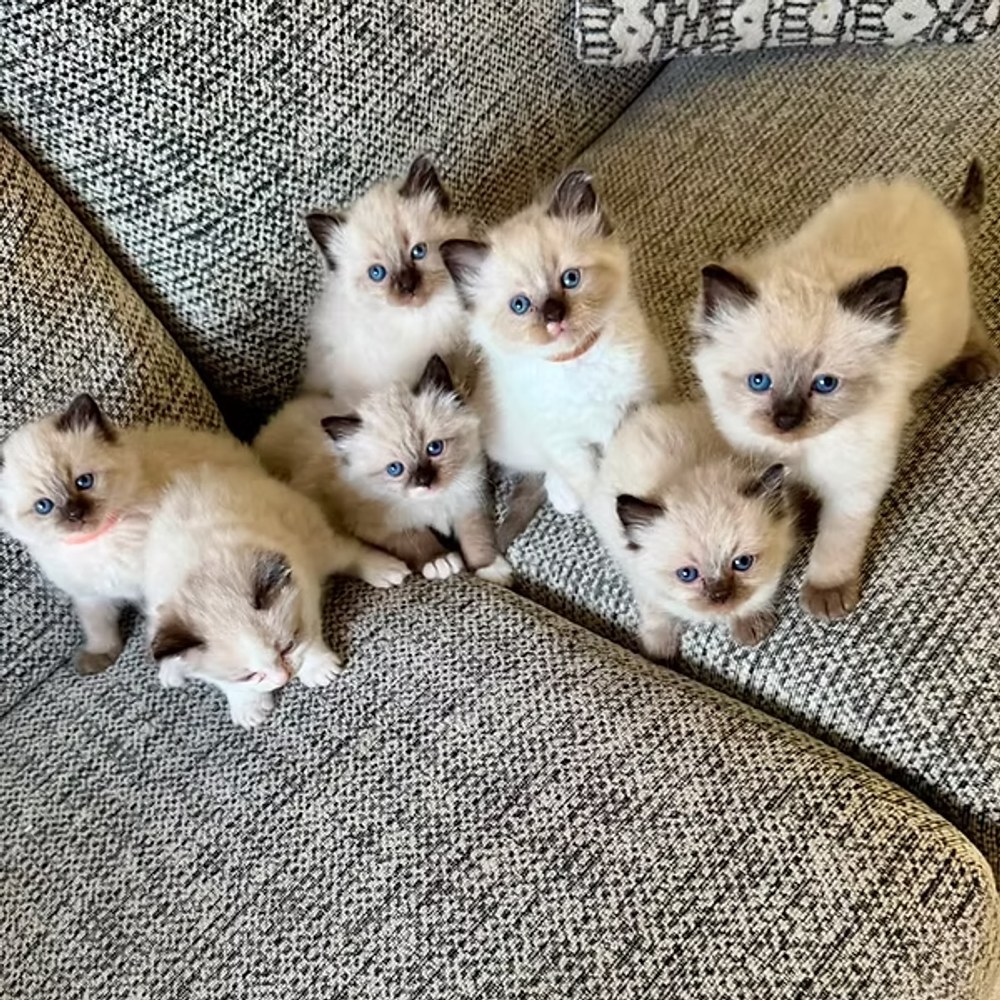
Six kittens, briefly still. It does not last, and it is not meant to.
At what age do Ragdolls calm down?
Up to six months: the kitten
Short, wild bursts of play with long sleeps in between. Everything is a toy and everything is climbed. This is the age for learning, and for gentle handling to become normal.
Six months to two years: the junior
Vets' life stage guides call the stage that starts at six months the junior stage, and describe it as the demanding one. The cat has most of its adult size and none of its adult judgement. Expect boundary testing, counter surfing, scratching in new places and the most energetic evenings of its life.
Two to three years: settling
The change is gradual. Play sessions get shorter, the naps get longer, and the cat that used to bounce off the sofa starts to choose it. For many Ragdolls this is also when the lap cat appears.
Three to four years: the finished Ragdoll
The body finishes filling out at three to four, and the temperament the breed is known for is fully in place. Calm does not mean inert. Most Ragdolls keep an appetite for a daily game for life.
Why Ragdolls stay kittenish for longer
Because they grow for longer. The breed standards give up to four years for a Ragdoll to reach full size, against about one year for an ordinary cat, and behaviour matures on the same slow clock as the body. The Ragdoll kitten weight chart shows how drawn out the growth is.
It is easy to be caught out by this. People choose a Ragdoll for its calm, meet the relaxed adults at the breeder's home, and then take home a twelve week old who behaves like any other kitten. Nothing has gone wrong. You have simply bought the film at the beginning.
The temperament still shows early. Many Ragdoll kittens will flop in your arms between games, which is the breed coming through, even at full speed.
Do Ragdolls calm down after neutering?
Partly, and not in the way people hope. Neutering removes the behaviours driven by hormones: calling, roaming, spraying and the restlessness that goes with them. It does not change personality and it does not switch off play. A playful six month old is a playful seven month old, with a shaved patch.
What owners often notice in the months afterwards is the natural slowing that comes with age, and a cat that puts on weight more easily, because energy needs fall after the operation. Adjust the food at the time. When to neuter a kitten covers the timing and the recovery week the aftercare.
What kitten energy looks like
All of these are ordinary in a young Ragdoll:
- The evening gallop. A mad half hour at dusk, and often another before dawn. Cats are built to be most active at those times.
- Ambushes. Ankles, feet under the duvet, the other cat.
- Climbing. Curtains, trouser legs, the back of the sofa.
- Play biting and grabbing. Worst between three and five months, while the adult teeth come through. Why does my kitten bite? explains how to teach gentle.
- Sudden stops. Flat out asleep, mid game.
None of it is naughtiness. It is practice for a hunting life the cat will never need, and it has to go somewhere.
How to live with a lively young Ragdoll
- Play twice a day, on purpose. A proper session with a wand toy, morning and evening, lets the cat stalk, chase, pounce and catch. Finish with a catch and then a meal. A kitten that has hunted and eaten will wash and sleep. Play and enrichment has the games.
- Move the evening madness earlier. Play before your bedtime, not during it. Night zoomies has the routine.
- Give it somewhere to climb. A tall, sturdy cat tree spares the curtains. Ragdolls are heavy, so buy one that does not wobble.
- Make food a job. Puzzle feeders and scattered kibble use up brain as well as legs.
- Never use hands or feet as toys. What is funny at ten weeks is painful at ten months.
- Keep the rules the same. If the worktop is out of bounds, it is out of bounds every day, for every member of the family.
- Consider a pair. Two kittens wear each other out in a way no person can. One kitten or two? sets out the case.
- Proof the house. Assume everything will be climbed, chewed or knocked off. Kitten proofing lists the hazards.
Do not punish a kitten for playing. It does not connect the telling off with the crime, and it learns only to be wary of you.
A daily routine for a young Ragdoll
Cats run on a simple loop: hunt, catch, eat, groom, sleep. A day built around that loop uses the energy up at the times that suit you.
- Morning. A short game before breakfast, then the meal. The cat washes and sleeps while you get on with the day.
- Daytime. Mostly sleep. Leave a window perch, a puzzle feeder with part of the day's food and a couple of toys for the waking spells. Change the toys every few days so they stay interesting.
- Early evening. The main event. A long game with the wand toy at the time the cat is naturally at its liveliest, with plenty of running, jumping and a proper catch at the end.
- Before bed. A second, calmer game, then the last meal. A cat that has hunted and eaten is ready to sleep when you are.
- Night. A warm bed, a firm rule about the bedroom, and no rewards for a 4am performance.
Kittens need more, shorter games than this and adults fewer, but the shape is the same at every age. Give it a couple of weeks. The ambushes ease off when the energy has already been spent on something better.
When a restless cat needs a vet
Youthful energy arrives young and fades slowly. Be more curious about energy that does not fit that pattern:
- An adult or older cat that becomes restless, especially at night, after years of sleeping soundly. In an older cat an overactive thyroid is a classic cause.
- Restlessness with other changes: a bigger appetite with weight loss, more drinking, more meowing.
- Frantic running with licking or biting at the skin, which can be fleas or other skin trouble.
- A kitten that is the opposite of lively. A young cat that does not play, sleeps all the time or tires quickly should be seen: that worries a vet far more than too much energy.
And an indoor cat of any age with nothing to do will invent something. Boredom looks a lot like bad behaviour, and the cure is the list above.
Quick questions, answered
At what age do Ragdolls calm down?
Around two to three years old for most, with the change coming gradually. The breed matures slowly, reaching full size at three to four years, and the kitten energy fades on the same timetable.
Do Ragdolls calm down after being neutered?
Neutering stops hormone driven behaviour such as calling, roaming and spraying, but it does not change personality or switch off play. The calming most owners notice afterwards is the cat growing up.
When do Ragdoll kittens stop biting?
Play biting is at its worst between three and five months, while the adult teeth come through, and the teeth are generally all in by six or seven months. It fades faster if hands and feet are never used as toys.
Are Ragdoll kittens hyper?
They are kittens, with a kitten's energy, and they keep it for longer than most breeds because they mature slowly. Many will still flop in your arms between games, but the calm adult takes two or three years to arrive.
Will getting a second kitten calm my Ragdoll down?
It gives the energy somewhere to go. Two kittens chase, wrestle and tire each other out, which usually means fewer ambushed ankles and quieter nights for the people.
Do adult Ragdolls still play?
Yes. Most keep an appetite for a daily game for life, in shorter bursts. An adult Ragdoll offered a wand toy in the evening will show you where the energy went.
Sources and further reading
- American Animal Hospital Association: Understanding your cat's life stages: Kitten, junior, adult, mature and senior stages, with the junior stage starting at six months.
- The International Cat Association: Ragdoll: Registry profile describing a relaxed, quiet, people loving breed that takes up to four years to mature.
Thinking about a Ragdoll kitten?
Our Ragdoll kittens grow up in our home in Ryde, Isle of Wight, with health tested parents and our support for life. See who is available now, or join the waiting list for the next litter.