
Ragdoll Kitten Weight Chart: Growth by Age
Typical ranges from birth to four years, and why your kitten's own curve matters more than any of them.
Last reviewed
A Ragdoll kitten weight chart is one of the things new owners ask us for most, usually with a kitten on the kitchen scales and a worried expression. The ranges below are typical, not targets. Ragdolls are one of the largest and slowest growing breeds, kittens from the same litter can be a few hundred grams apart and both be perfectly well, and the number on the scales matters much less than whether it keeps going up. Use the chart to see roughly where a Ragdoll should be, then use the rest of this page to track your own.
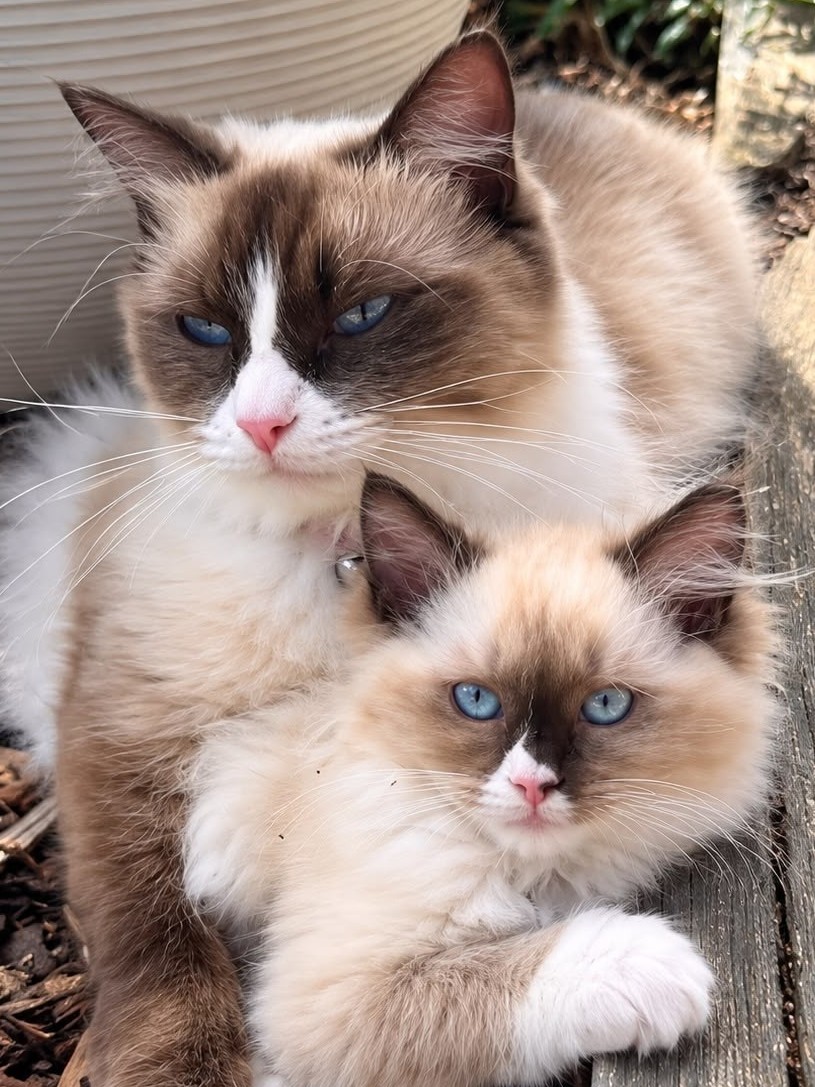
Pulaski with her daughter Daisy. A young Ragdoll has most of its height long before it has its weight.
Ragdoll weight by age
Typical ranges for a healthy Ragdoll. Males sit towards the top of each range and females towards the bottom.
| Age | Typical weight | What is happening |
|---|---|---|
| Birth | 90 to 120 g | Born white, eyes closed |
| 3 months (12 weeks) | 1.2 to 2 kg | Settled in the new home |
| 6 months | 2.5 to 4 kg | The leggy stage; neutering age |
| 12 months | 3.5 to 6 kg | Most of the height and length is in |
| 2 years | Females near adult weight; males still filling out | Chest and coat building |
| Adult, 3 to 4 years | Females 3.5 to 6.5 kg; males 5.5 to 9 kg | Full size |
For the months in between, expect a weight between the two nearest rows: a four month old sits between the three and six month figures, and so on. Growth is steady rather than explosive, and it is not perfectly even. Kittens grow in spurts, look thin for a fortnight and then catch up.
The adult figures match what the registries publish. The GCCF gives mature males as often upwards of 6 kg and females about 4 to 6 kg. The International Cat Association gives 15 to 20 pounds for males, roughly 7 to 9 kg, and 10 to 15 pounds for females. How big do Ragdolls get? has the full picture of adult size.
How a Ragdoll grows
Three things set a Ragdoll apart from an ordinary kitten.
- It takes years, not months. The breed standards give full size and weight at about four years old. Most cats are close to their adult size at around a year.
- Height first, weight later. Most of the height and length arrives in the first year. The chest, the bulk and the coat fill in afterwards, which is why a yearling Ragdoll can look rangy and a three year old looks like a different animal.
- Boys and girls part company. The gap between males and females opens during the first year and keeps widening until the males finish.
Kitten development week by week follows the early weeks in detail.
What to expect at each age
Up to three months
The fastest growth of all happens with the mother. Kittens are born at around 90 to 120 g and are weighed often in the first weeks, because steady gain is the best sign that a newborn is thriving. Ours leave at nine to ten weeks with big paws and a great deal of tail.
Three to six months
A settled kitten on a complete kitten food gains week after week. Appetite is large and should be. Feed a complete kitten food in measured meals, and do not cut it back to keep a kitten small; this is frame being built.
Six to twelve months
The leggy stage. Length and height run ahead of everything else, and many Ragdolls look lean and a little out of proportion. Neutering is done by about six months, and afterwards the same amount of food goes further, so this is the age to start measuring carefully.
One to four years
The gains slow down but do not stop. The chest broadens, the neck thickens, the coat fills, and a male can add a kilo or more after his second birthday without being fat.
What decides the adult size
Mostly the parents. A kitten from a large sire and dam will usually be large, and the sex of the kitten does the rest. Food decides whether a cat reaches the frame its genes allow; it cannot build a bigger frame. Feeding a kitten more than it needs produces a fat cat, not a big one, and the extra weight is carried by the same joints for life.
Why ordinary kitten growth charts do not fit a Ragdoll
Vets increasingly use printed growth charts for kittens, with curved centile lines like the ones in a baby's health record. They are useful, but it helps to know what they were built from. The best known set comes from the WALTHAM research institute, based on the weight records of just over 7,000 healthy domestic shorthair kittens. Pedigree cats and medium or long coated cats were not in that study, and any weight above 6.5 kg was treated as unlikely and left out. The guidance sent to vets with the charts adds that cats which will weigh more than 7 kg as adults grow in a different pattern, so no single chart exists for them.
In other words the charts describe an average moggy, and a Ragdoll is not one. A healthy Ragdoll kitten may run along the top lines of such a chart, or above them, and a male will often leave the page altogether before he is finished. That is not a sign of overfeeding on its own.
What the charts do teach is still worth having: a healthy kitten follows its own curve. Steady progress along one line is the sign of good growth. A line that flattens, or a kitten that drifts across more than two of the lines, is the sign to have checked, whatever the breed.
How to weigh and track your kitten
- Use the right scales. Kitchen scales that read in grams suit a small kitten: put a bowl on, zero the scales, add the kitten. Once the kitten will not stay in the bowl, weigh yourself holding the cat and then without, on bathroom scales, or use baby scales.
- Weigh on a schedule. The guidance that comes with the vets' charts suggests every two to four weeks until six months old, and every three months after that. Weigh monthly for three months after neutering, because energy needs drop and weight can creep.
- Keep the conditions the same. Same scales, same time of day, before a meal.
- Write it down. A note on the phone is enough. The trend is the information; a single reading tells you very little.
- Feel as well as weigh. You should be able to feel the ribs under a light covering. The hands on body condition check takes a minute and tells you more than the scales.
Take the notes to the vet at vaccinations and at neutering. A page of weights is the most useful thing an owner can bring.
Is my Ragdoll kitten too small, or too big?
Smaller than the chart
Usually this is nothing more than a female, a kitten from smaller parents, or a slow starter who will catch up. Ragdolls keep growing for so long that a small one year old tells you little about the adult. A Ragdoll cross will often finish smaller too. What matters is that the kitten is bright, eating well and gaining.
See the vet if a kitten stops gaining, loses weight, or is small and also has a pot belly, a dull coat, loose stools or low energy. Worms are a common cause in a young kitten and an easy one to fix: see worming and the poorly tummy.
Bigger than the chart
A big framed kitten from big parents is exactly what the breed is meant to be. The question is condition, not kilograms. If you cannot feel the ribs easily, or there is no waist seen from above, the kitten is carrying fat rather than frame, and the months after neutering are when it most often creeps on. Measure the food rather than topping up the bowl. Feeding a Ragdoll has the amounts.
Quick questions, answered
How much should a Ragdoll kitten weigh at 12 weeks?
About 1.2 to 2 kg at three months is typical, with males towards the top. Kittens from the same litter can be a few hundred grams apart and both be healthy.
How much should a Ragdoll weigh at 6 months?
Typically 2.5 to 4 kg. This is the leggy stage, when a Ragdoll has much of its length and little of its bulk.
How much should a Ragdoll weigh at 1 year?
Typically 3.5 to 6 kg. Most of the height and length is in by now, but a Ragdoll is not full grown at one: the body keeps filling out for another two or three years.
When is a Ragdoll fully grown?
At three to four years old. Adult females typically weigh 3.5 to 6.5 kg and adult males 5.5 to 9 kg.
Why is my Ragdoll so small?
Most often because she is female, has smaller parents, is a slow starter or is a Ragdoll cross. A bright kitten that eats well and gains steadily is fine. A kitten that stops gaining or loses weight should see a vet.
How often should I weigh my Ragdoll kitten?
Every two to four weeks until six months old, monthly for three months after neutering, and every three months after that. Use the same scales at the same time of day and keep a note of each weight.
Sources and further reading
- Governing Council of the Cat Fancy: Ragdoll: The UK registry's profile: recognised colours and patterns, coat care, size and maturity.
- The International Cat Association: Ragdoll: Registry profile: a semi long, silky coat, light seasonal shedding and up to four years to mature.
- Cat Fanciers' Association: Ragdoll breed profile and standard: The coat description, the seasonal shed and the slow road to full coat, colour and size.
- Salt and others, 2022: Growth standard charts for monitoring bodyweight in intact domestic shorthair kittens (PLoS ONE): The study behind the vets' kitten growth charts: 7,090 domestic shorthair cats, no pedigree breeds.
- Royal Canin and WALTHAM: Growth charts, questions and answers for the veterinary team: How often to weigh, what crossing centile lines means, and the note on cats over 7 kg.
Thinking about a Ragdoll kitten?
Our Ragdoll kittens grow up in our home in Ryde, Isle of Wight, with health tested parents and our support for life. See who is available now, or join the waiting list for the next litter.