
Are Ragdolls Good With Rabbits, Guinea Pigs and Birds?
Gentle is not the same as harmless, from a hamster's point of view.
Last reviewed
Are Ragdolls good with rabbits, guinea pigs and birds? Better than most cats, and still not to be trusted alone with them. A Ragdoll is a relaxed, tolerant animal with far less hunting drive than a farm cat, and one raised around other species usually treats them as part of the furniture. But it is a cat, and a small animal that runs, flutters or squeaks can switch on an instinct no amount of breeding has removed. Our own kittens grow up meeting ducks, chickens, a peacock, guinea pigs and parrots, and what that teaches is calm familiarity, not friendship. Here is what is realistic with each kind of small pet, and the house rules that keep all of them safe.
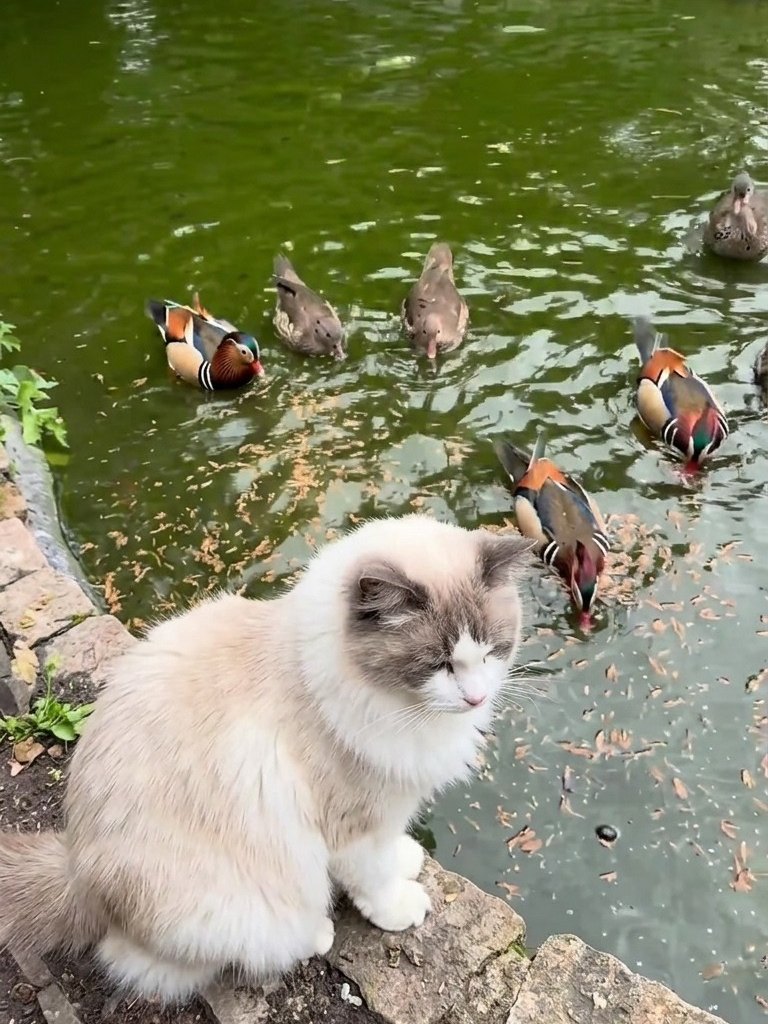
One of the colony at the edge of the pond with the Mandarin ducks.
Can a Ragdoll live with small pets?
Yes, with management, and never on trust alone. Three things are true at once.
- The breed helps. Ragdolls are placid and easy going. A mouse in the house is more likely to be followed about with polite interest than dispatched.
- The upbringing helps. A kitten that met other animals in its first weeks grows up treating them as ordinary. That is why ours are raised alongside the birds and the guinea pigs.
- The instinct stays. Every cat is born with the sequence: watch, stalk, pounce, grab. Movement triggers it. A calm cat can do in one second what it has never done in three years.
So the aim is not a cat that can be left with a rabbit. It is a house arranged so that the question never arises, and a cat relaxed enough that sharing a home is not stressful for anyone.
Are Ragdolls good with rabbits?
Rabbits are the small pet a cat is most likely to rub along with, and the Rabbit Welfare Association says cats and house rabbits can live together amicably. It also says plainly that cats are predators and great care is needed. Its advice:
- Size matters. A cat is much more likely to see a small rabbit as prey. Large breeds of rabbit are safer company, and a confident adult rabbit will often see a cat off.
- Pick a sleepy moment. Introduce them when the cat is calm and drowsy, not at dusk when it is ready to hunt.
- Use the rabbit's ground. Meetings usually go better on the rabbit's own territory.
- Let the rabbit lead. The best possible start is the rabbit approaching and the cat backing away.
- Do not rely on a cage. A rabbit shut in a hutch with a cat staring at it cannot get away and learns to be afraid. Give it a room, or a large pen with places to hide.
- Stay within reach, ready to step in, every time they are together.
- Kittens and young rabbits can grow up together, on neutral ground with hiding places, and always supervised.
Fleas and tapeworms pass between cats and rabbits, so keep both treated. And however well it goes, they should live apart when you are out or asleep.
Guinea pigs, hamsters, gerbils and mice
These are prey sized, and the answer is separation, not introduction.
- A room of their own with a door that shuts is the safest arrangement, and the kindest: a small animal that can see and smell a cat all day lives under stress even if the cat never touches it.
- A cage is not a safe. Paws go through bars. Choose a solid sided enclosure or narrow bar spacing, a lid that clips or locks, and a stand or shelf the cat cannot sit on.
- Floor time happens behind a closed door, with the cat elsewhere.
- Wheels at night. Hamsters are busiest when cats are. Keep the bedroom or utility room door shut.
- Guinea pigs outdoors need a run with a roof and a solid floor or buried mesh, whatever cats you own. The neighbours have cats too.
Some Ragdolls will lie beside a guinea pig run for an hour and do nothing. Enjoy it, and keep the lid on.
Parrots, budgies, hens and ducks
Cage and aviary birds
- Keep the cage in a room the cat is shut out of when you are not there, and on a stand that will not tip if jumped at.
- Free flying time is for when the cat is behind a closed door. A bird on the floor or on the wing is the strongest trigger there is.
- A large parrot can injure a cat badly with its beak. The risk runs both ways.
- Treat any contact as serious. See the section on accidents below.
Hens, ducks and other garden birds
Full grown hens and ducks are large, loud and well able to look after themselves, and many cats give them a wide berth. Chicks, ducklings and small bantams are another matter and need a secure, roofed run. Our own cats share the garden with ducks, chickens and a peacock, and the bantam hens have a covered run.
Fish and reptiles
Fit a lid to every tank. A Ragdoll that likes water will fish, and heat lamps and warm vivarium tops attract a cat looking for somewhere to sleep.
Keeping everyone safe
- Separate by default. Doors, lids and locks do the work, not the cat's good nature.
- Supervise every meeting, close enough to step between them.
- Never leave them together when you are out, asleep or in another room.
- Give the small pet the choice. It should always be able to get out of sight.
- Feed and play with the cat first. A cat that has just hunted a wand toy and eaten has much less interest in anything else. Play and enrichment has the games that use up the hunting urge.
- Teach children the rules, especially about shutting doors and lids.
- Treat every animal for parasites on the schedule your vet sets.
Signs to end a meeting at once
- In the cat: a fixed stare, a low crouch, the back end wiggling, the tail tip twitching, chattering teeth.
- In the small pet: freezing, thumping, frantic running, hiding and refusing to come out, or going off its food afterwards.
A small animal that is frightened every day is not living well, even if it is never harmed. If the cat cannot be relaxed about it, keep them in separate parts of the house for good. Reading cat body language explains the cat's signals.
If the cat catches or scratches a small pet
- Separate them calmly. Shut the cat in another room. Stay quiet: a chase makes things worse.
- Put the small animal somewhere warm, dark and quiet, in its carrier or a ventilated box, and handle it as little as possible. Shock is a danger to small animals in its own right.
- Ring a vet and go the same day, even if you can see no wound. Teeth and claws leave small punctures that close over and hide under fur or feathers, and a cat's mouth carries bacteria that turn those punctures into serious infections. Abscesses and bite wounds explains how that happens in cats themselves.
- Do not punish the cat. It did what cats do. Change the set up so that it cannot happen again.
- Work out how it happened: a door left open, a lid not clipped, a meeting that went on too long.
Check the cat over too. A cornered rabbit kicks hard, and a parrot's beak can do real damage.
Choosing a Ragdoll for a home with other animals
If you already keep small pets, ask the breeder what the kittens have met. A kitten's first weeks are when it learns what is normal, and one that has grown up with other species around it takes a new home full of them in its stride. Ours meet ducks, chickens, a peacock, guinea pigs and parrots, along with the washing machine and the general bustle of a family home, before they leave.
Then set the house up before the kitten arrives: the small pets' room chosen, the lids fitted, the rules agreed. A kitten is at its most curious and least sensible in its first year, and that is when habits are formed on both sides.
Dogs and other cats are a different and much easier question. See are Ragdolls good with dogs? and introducing a second cat.
Quick questions, answered
Are Ragdolls good with rabbits?
Often, with care. Cats and house rabbits can live together amicably, especially with a large, confident rabbit and a calm cat, but every meeting should be supervised and they should be kept apart when nobody is watching.
Can a Ragdoll live with guinea pigs or hamsters?
In the same house, yes. In the same space, no. Keep small rodents in a secure enclosure in a room the cat cannot get into, and give them floor time behind a closed door.
Will a Ragdoll hurt a pet bird?
It can. A fluttering bird is a strong trigger for any cat, however gentle. Keep cages in a room the cat is shut out of, and let birds fly only when the cat is behind a closed door.
Do Ragdolls have a prey drive?
Yes, though less than many cats. They will stalk and pounce in play and can catch small animals. The instinct is weaker than in a working farm cat but it has not gone.
Are Ragdolls good with chickens?
Usually. Full grown hens are big enough to look after themselves and most cats leave them alone. Chicks and bantams need a secure, roofed run.
Can a Ragdoll kitten be raised with a rabbit?
Yes, and growing up together gives the best chance of a relaxed relationship. Introduce them on neutral ground with hiding places for the rabbit, supervise every meeting, and house them separately when you are not there.
Sources and further reading
- Rabbit Welfare Association and Fund: Rabbits living with other pets: The UK rabbit charity on cats and rabbits: the risks, introductions and supervision.
Thinking about a Ragdoll kitten?
Our Ragdoll kittens grow up in our home in Ryde, Isle of Wight, with health tested parents and our support for life. See who is available now, or join the waiting list for the next litter.